China fears AI could blind its nuclear missiles, and is racing to use AI anyway


2 Sources
[1]
China Fears A.I. Could Give the U.S. an Edge in Nuclear Rivalry
Chinese military researchers are studying how to harness A.I., but they worry the technology makes their country's nuclear forces more vulnerable to attack. When Xi Jinping, the Chinese leader, set about expanding China's nuclear forces a decade ago, his goal was to ensure that enough missiles
[2]
China's military fears US AI could help find its nuclear missiles
Studies from Beijing's top military academy warn US AI could shrink nuclear decision time to 90 seconds. China is also testing AI to help its own missiles dodge defences. Chinese military researchers fear US advances in AI could make China's nuclear missiles easier to find and destroy. The New
Share
Copy Link
More than 100 recent studies by Chinese military and civilian researchers, reviewed alongside expert interviews, point to deep wariness in Beijing about American use of AI in nuclear systems
1
.The fear at the heart of the deterrent
China's nuclear strategy, which Xi Jinping set in motion about a decade ago, aims to keep enough missiles alive through a first strike to deliver a devastating reply
1
. US AI, Chinese researchers warn, could make those missiles easier to find, track and destroy1
. Two researchers at the Academy of Military Science in Beijing have argued the United States could shrink nuclear decision-making from a usual 15 to 30 minutes down to "90 seconds or less"2
.The researchers' own reason: AI could let US forces detect, track and strike Chinese missiles faster, undermining the assured-retaliation strategy
1
. The warnings describe what AI could do, not a capability the United States has demonstrated1
.China's smaller arsenal makes the survivability problem sharper. It has about 620 warheads, forecast to reach about 1,000 by 2030. The United States and Russia each deploy roughly 1,800, per Federation of American Scientists counts in the Times' report
2
. Beijing has already spread its forces out, test-firing a long-range missile from a submarine in July and building some 320 silos in northern desert regions2
. Named experts back the sense that the worry is genuine. Gerald C. Brown, once a State Department analyst focused on China's nuclear posture, said Beijing sees AI making its missiles much harder to keep alive2
. Sun Chenghao of Tsinghua University wrote that the risks weigh heavily in the capital2
. Experts in China also worry their country could lag the United States in applying AI to finding, tracking and striking nuclear weapons; today the three powers watch each other's arsenals with radars, satellites and sensors1
.China hedges, and races
The worry has not stopped China from pursuing the same technology. Rocket Force studies test how AI could help hypersonic and ballistic missiles dodge defences; that branch runs most of China's nuclear missiles, per the Times
2
. Xi convened senior officials in July to discuss AI's military uses2
.Not everyone inside the system is pushing forward. Some PLA researchers urge caution: a study published this year by two military institutes warned that false data amplified by AI poses enormous risks for nuclear command and control
2
. Jacob Stokes of the Center for a New American Security ties the worry to America's edge in advanced chips2
. A US commission reported last week that China's military is trying to obtain Nvidia's most powerful chips2
.Related Stories

Nowhere to talk about it
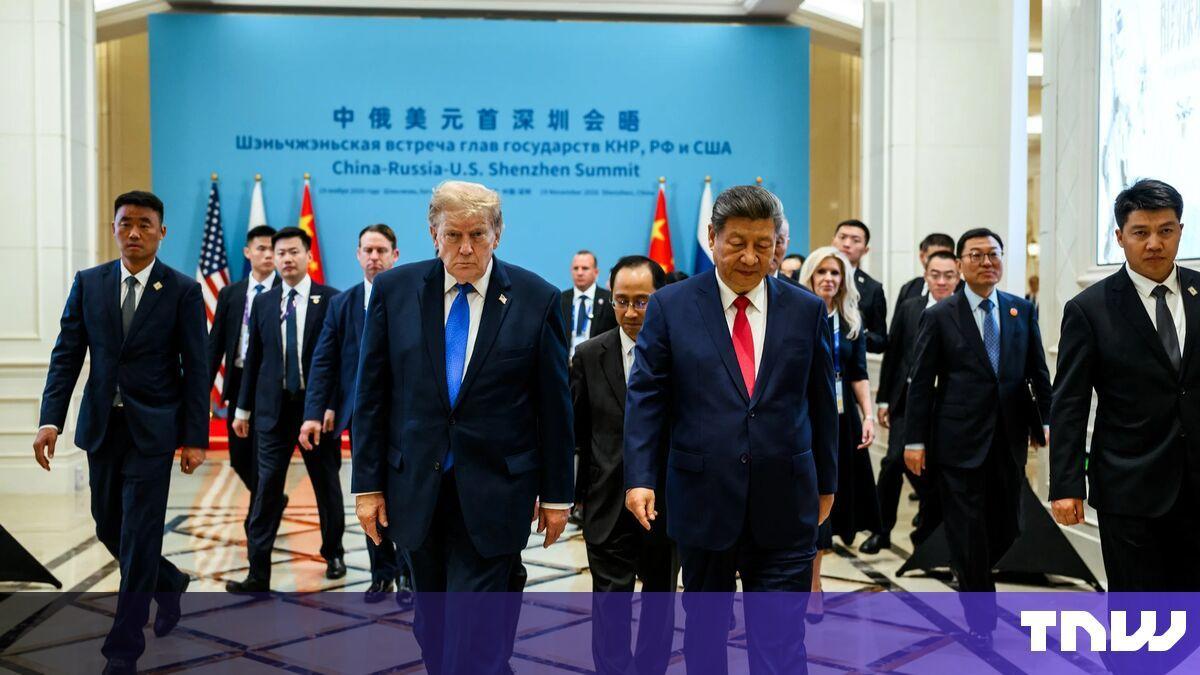
The diplomacy has not caught up. At a summit in Shenzhen last week, Xi, Donald Trump and Vladimir Putin spoke of reducing nuclear risks, but AI's role in nuclear weapons never came up
1
. Xi has shown no interest in Trump's calls for China to accept arms control limits, which would bind the smallest of the three arsenals1
.
Source: The Next Web
Philip Reiner, who runs the Institute for Security and Technology in California, told the Times: "Nobody's turning launch decisions over to A.I., but everything that tells you whether you should launch is now going to be shaped by A.I."
2
In 2024 Xi agreed with then-President Biden that humans would stay in charge of any nuclear-use decision; no formal talks on the subject have followed
2
.References
Summarized by

Navi
Related Stories
China Develops AI System to Detect Nuclear Warheads, Potentially Reshaping Arms Control
30 May 2025•Science and Research
AI Leaders Call for Global Standards as US-China Competition Intensifies Over Development Controls
16 Sept 2026•Policy and Regulation
US Calls for AI Slowdown While China Pushes to Accelerate: The Global Split on AI Risk
17 Sept 2026•Policy and Regulation

Recent Highlights



Recent Highlights
Today's Top Stories












Don’t drown in AI news. We cut through the noise - filtering, ranking and summarizing the most important AI news, breakthroughs and research daily. Follow topics that matter to you and stay ahead.


