Chinese Researchers Develop Ultra-Fast Laser-Based Artificial Neuron, Revolutionizing AI Processing


4 Sources
[1]
Chinese university unveils laser neuron processing data a billion times
This innovation could have a revolutionary impact on artificial intelligence and computing, enabling ultrafast data processing and significant energy savings. Chinese scientists have developed a laser-based artificial neuron that operates at unprecedented speeds, potentially revolutionizing
[2]
Laser-based artificial neuron mimics nerve cell functions at lightning speed
Researchers have developed a laser-based artificial neuron that fully emulates the functions, dynamics and information processing of a biological graded neuron. With a signal processing speed of 10 GBaud -- a billion times faster than its biological counterparts -- the new laser graded neuron could
[3]
Laser-based artificial neuron mimics nerve cell functions at lightning speed
Researchers have developed a laser-based artificial neuron that fully emulates the functions, dynamics and information processing of a biological graded neuron. With a signal processing speed of 10 GBaud -- a billion times faster than its biological counterparts -- the new laser graded neuron could
[4]
Chip-based laser neuron beats human neuron by a billion times in speed
Scientists at the Chinese University of Hong Kong state that this laser neuron operates at an astonishing speed of 10 GBaud, a billion times faster than its biological counterpart. Interestingly, the team leveraged this speed to process datasets of 100 million heartbeats or 34.7 million images in
Share
Copy Link
Scientists at the Chinese University of Hong Kong have created a laser-based artificial neuron that processes data a billion times faster than biological neurons, potentially transforming AI and computing with its speed and energy efficiency.

Breakthrough in Artificial Neuron Technology
Researchers at the Chinese University of Hong Kong, led by Chaoran Huang, have developed a groundbreaking laser-based artificial neuron that operates at unprecedented speeds. This innovation, detailed in the journal Optica, promises to revolutionize artificial intelligence and advanced computing
1
.Unparalleled Speed and Efficiency
The newly developed "laser graded" neuron processes data at an astonishing speed of 10 GBaud, approximately one billion times faster than natural neurons
2
. This remarkable speed allows the system to process 100 million heartbeats or 34.7 million handwritten digital images in just one second3
.Mimicking Biological Neurons
Unlike previous photonic spiking neurons, this laser graded neuron emulates the functions of biological graded neurons. These neurons encode information through continuous changes in membrane potential, allowing for subtle and precise signal processing
2
.Innovative Design
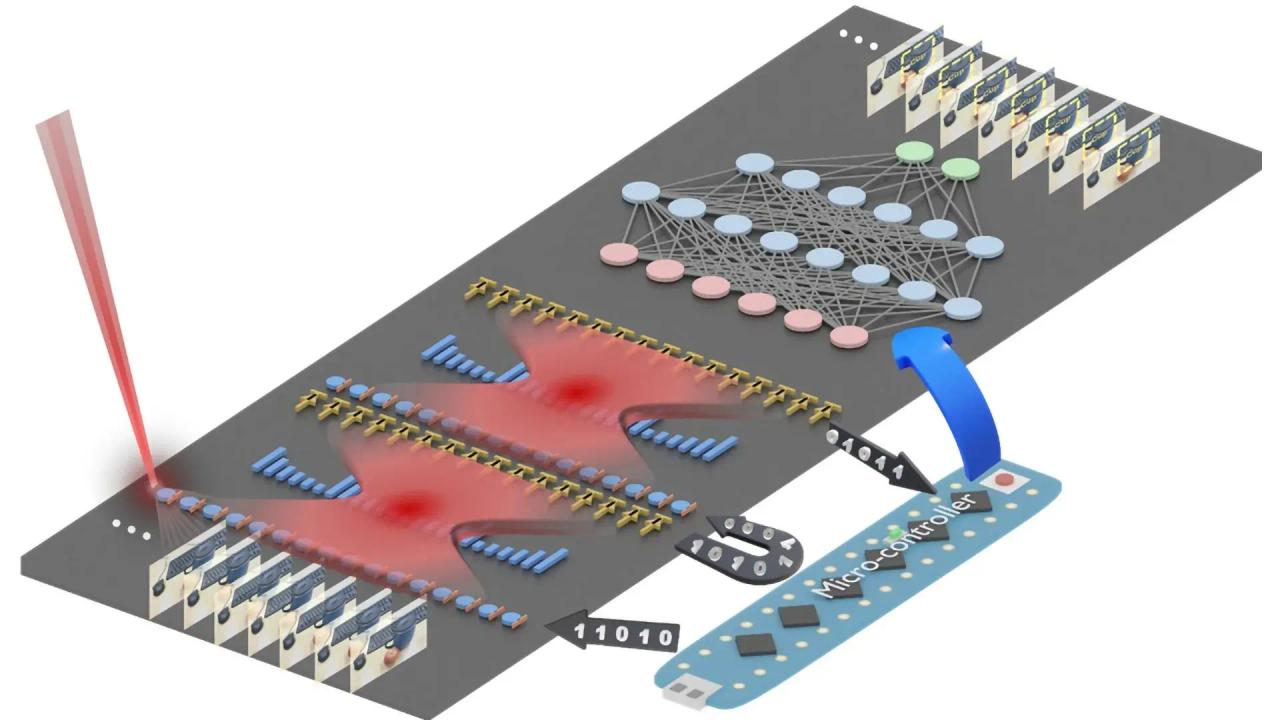
The researchers overcame speed limitations of previous designs by injecting radiofrequency signals into the saturable absorption section of a quantum dot laser. This approach, coupled with high-speed radiofrequency pads, results in a faster, simpler, and more energy-efficient system
1
.Reservoir Computing and AI Applications
The team demonstrated the neuron's capabilities by creating a reservoir computing system, which excelled in pattern recognition and sequence prediction tasks. In tests, it detected arrhythmic patterns with an average accuracy of 98.4%
3
.Related Stories
Implications for AI and Edge Computing
Huang suggests that this technology could significantly accelerate AI decision-making in time-critical applications while maintaining high accuracy. The integration of this technology into edge computing devices could facilitate faster and smarter AI systems with reduced energy consumption
4
.Future Developments
The research team is working on improving the processing speed of the laser graded neuron and developing a deep reservoir computing architecture incorporating cascaded laser graded neurons. They believe that combining multiple laser graded neurons could unlock even greater potential, mirroring the billions of neurons working together in biological brains
2
.This breakthrough in artificial neuron technology represents a significant step forward in the fields of AI and advanced computing, potentially leading to more efficient and powerful systems in the near future.
References
Summarized by

Navi
[1]
[4]
Related Stories
MIT Develops Ultrafast Photonic Chip for AI Computations with Extreme Energy Efficiency
03 Dec 2024•Technology

Revolutionary Light-Based AI Chip: Smaller Than a Speck of Dust, Faster Than Traditional Computing
08 Feb 2025•Technology

Photonic Chips: A Breakthrough in AI Processing and Energy Efficiency
10 Apr 2025•Technology

Recent Highlights



Recent Highlights
Today's Top Stories



Don’t drown in AI news. We cut through the noise - filtering, ranking and summarizing the most important AI news, breakthroughs and research daily. Follow topics that matter to you and stay ahead.


