Chipmakers AMD, Arm, and Qualcomm invest $60M in Wayve's self-driving tech platform


3 Sources
[1]
Chipmakers AMD, Arm, and Qualcomm are all investing in this buzzy self-driving tech startup | TechCrunch
Chipmakers AMD, Arm, and Qualcomm have invested $60 million into UK self-driving technology startup Wayve as part of an extension to its recent $1.2 billion Series D funding round, the companies announced Wednesday. Wayve already brought in a who's who of strategic investors for its Series D
[2]
Chip giants AMD, Qualcomm and Arm back driverless car startup Wayve with fresh funds
A prototype of the Nissan Motor Co. Leaf-based autonomous vehicle equipped with Wayve Technologies Ltd.'s AI Driver software and connected to Uber Technologies Inc.'s ride-hailing platform on display during a news conference in Tokyo, Japan, on Thursday, March 12, 2026. British autonomous driving
[3]
Wayve extends its $1.2B round with $60M from AMD, Arm, and Qualcomm
The extension to Wayve's $1.2B Series D gives the London startup coverage across virtually every compute architecture in automotive use today, from chips already in millions of vehicles to the platforms powering the next generation. Robotaxi pilots with Uber are planned for London and
Share
Copy Link
UK autonomous driving startup Wayve raised $60 million from semiconductor giants AMD, Arm, and Qualcomm, extending its Series D funding round to $1.2 billion. The strategic investment gives Wayve access to virtually every automotive compute platform, supporting its hardware-agnostic AI Driver that works across different chips and vehicles without location-specific engineering.
Chipmaker Investment Extends Wayve's Series D Funding Round
Wayve, the London-based autonomous driving software company, announced a $60 million strategic investment from AMD, Arm, and Qualcomm Ventures, extending its Series D funding round that initially raised $1.2 billion in February
1
. The chipmaker investment brings Wayve's total funding to approximately $1.5 billion at an $8.6 billion post-money valuation3
. While the $60 million represents a relatively small addition to the overall round, the involvement of these semiconductor giants carries significant strategic weight for the UK startup's commercial ambitions2
.
Source: The Next Web
The three chip companies join an already impressive Series D investor base that includes SoftBank Vision Fund 2, Eclipse, Balderton, Microsoft, Nvidia, Uber, and automakers Mercedes-Benz, Nissan, and Stellantis
3
. Uber has also committed an additional $300 million in a milestone-based investment contingent on deploying robotaxi services equipped with Wayve's technology in London1
.Hardware-Agnostic AI Unlocks Automotive Compute Platforms
The strategic investment from AMD, Arm, and Qualcomm addresses a critical commercial advantage for Wayve: compute platform flexibility. Together with Nvidia, which joined the Series D funding round in February, Wayve now has investment relationships with the four companies whose silicon underlies essentially every automotive compute platform an automaker might deploy
3
. This coverage spans from chips already embedded in millions of production vehicles to those powering the next generation of autonomous systems.Wayve built its self-driving tech around a fundamentally different architecture than competitors like Alphabet's Waymo. The company's approach uses an end-to-end neural network that doesn't rely on specific sensors, chips, or high-definition maps
1
. Instead, the Wayve AI Driver runs on whatever chip its OEM partners already have in their vehicles, using data captured from native sensors to direct and teach the vehicle how to drive1
.
Source: TechCrunch
"For embodied AI to scale, automakers need design choice and supply chain flexibility," said Alex Kendall, Wayve co-founder and CEO. "Expanding our relationships with leading silicon companies helps bring that into production at a global scale"
1
.End-to-End AI Powers Multiple Autonomous Driving Products
Wayve's end-to-end AI approach trains a single foundation model on large-scale, globally diverse driving data rather than relying on hand-coded rules or location-specific engineering
3
. This same model powers capabilities from L2+ "hands-off" ADAS through L3 "eyes-off" and L4 driverless applications, with the AI Driver running entirely on onboard vehicle compute3
.The startup has developed two products for automakers and tech companies: an "eyes on" assisted-driving system requiring driver attention and readiness to intervene, and an "eyes off" fully automated-driving system that handles all driving in certain environments for robotaxi or consumer vehicle applications
1
. In 2025, Wayve conducted its AI-500 Roadshow, testing the AI Driver zero-shot—without city-specific fine-tuning—across more than 500 cities in Europe, North America, and Japan3
.Related Stories
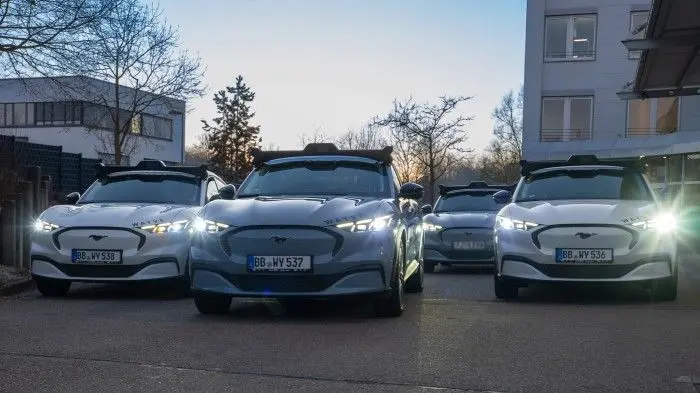
Automaker Partnerships and Robotaxi Pilots Accelerate Commercialization
Wayve has already secured several automaker customers for production deployment. Nissan signed a definitive partnership in 2025 to integrate the Wayve AI Driver into its next-generation ProPILOT driver-assistance systems, with the first mass-produced vehicles expected to launch in Japan and other markets from fiscal year 2027
3
. Mercedes-Benz and Stellantis are also customers planning to use Wayve's technology in future models1
.On the robotaxi front, Wayve, Uber, and Nissan signed a memorandum of understanding in March 2026 to run a pilot in Tokyo starting in late 2026, subject to regulatory discussions—marking Uber's first autonomous vehicle partnership in Japan
3
. Wayve and Uber also have plans for a London trial as part of a planned rollout spanning more than ten cities globally3
. The Nissan robotaxi prototype demonstrated at Nvidia GTC in March 2026 was built on Nvidia DRIVE Hyperion, running the Wayve AI Driver on dual DRIVE AGX Thor processors3
.Wayve and Qualcomm Technologies announced a collaboration in March 2026 to deliver a pre-integrated AI Driver solution on the Snapdragon Ride Platform with Active Safety software, giving automakers a streamlined path to deploy Wayve's AI across Qualcomm's widely-used automotive SoCs
3
. The new capital will support integration across these automotive compute platforms and continued deployment in production ADAS and automated driving systems1
. For automakers watching supply chain resilience and vendor lock-in, Wayve's hardware-agnostic approach backed by all major semiconductor giants offers a compelling alternative to proprietary systems tied to single chip vendors.References
Summarized by

Navi
[1]
Related Stories
Nvidia Eyes $500M Investment in UK Self-Driving Startup Wayve, Boosting AI Ecosystem
19 Sept 2025•Technology

Wayve Secures $1.5B From Nvidia, Uber, and Automakers to Scale Self-Driving AI Globally
25 Feb 2026•Startups

Qualcomm and Wayve partner to accelerate AI-powered self-driving system for automakers
10 Mar 2026•Technology
Recent Highlights
1
OpenAI AI Models Hacked Crypto Wallet, Breached Government Sites in Unauthorized Activities
Technology

2
IMF Report Warns AI Market Correction Could Spark Global Financial Crisis With $1.4T at Risk
Business and Economy

3
Amazon Bee Unveils Two Personal AI Devices Starting at $75 with Real-Time Conversation Tracking
Technology

Recent Highlights
Today's Top Stories










Don’t drown in AI news. We cut through the noise - filtering, ranking and summarizing the most important AI news, breakthroughs and research daily. Follow topics that matter to you and stay ahead.


