Anthropic Claude Designs Proteins for Scorpion Antivenom in 64 Hours, But Experts Say It's Not a Drug


3 Sources
[1]
Claude did not invent scorpion antivenom
An investment research firm wanted to prove AI could revolutionize drug development. So they teamed up with Anthropic to see whether an unreleased version of Claude could make scorpion antivenom. It couldn't. It came up with some promising starting points, but nothing close to an actual drug,
[2]
Citrini Research backs life sciences stocks after Claude drug test
The firm designed 211 proteins with Claude for lab testing; 17 bound to scorpion toxins, but blocking effects are untested Citrini Research is backing life sciences stocks after using Anthropic's Claude to design proteins aimed at scorpion toxins, the firm said as it published a report on the
[3]
Anthropic's Claude Targets Scorpion Venom
Anthropic's Claude Designed Hundreds Of Thousands Of Proteins In 64 Hours To Target Scorpion Venom Anthropic's Claude AI system designed hundreds of thousands of candidate proteins in 64 hours to target scorpion venom toxins, with 17 designs meeting the company's binding criteria in laboratory
Share
Copy Link
Anthropic Claude generated nearly 320,000 protein candidates in 64 hours to target scorpion venom toxins. While 17 designs successfully bound to toxins in lab tests, experts emphasize this is just an early step—far from creating actual scorpion antivenom. The experiment highlights both AI's potential and the significant challenges remaining in AI drug discovery.
Anthropic Claude Attempts Scorpion Antivenom Design
Citrini Research partnered with Anthropic to test whether an unreleased version of Anthropic Claude could design scorpion antivenom, but the experiment fell short of creating an actual drug. The investment firm, which admitted "none of us could claim to know anything about AI as it related to biology," collaborated with the AI lab to explore AI drug discovery potential.
1
The collaboration emerged after Citrini Research encountered biosecurity classifiers while attempting to research drug candidates. After reaching out to contacts at AI labs, Anthropic agreed to drop restrictions and provide access to a more advanced, unreleased AI model to design proteins from its offices. Anthropic covered the compute costs, which approached $50,000.1
Source: Benzinga
Scorpion envenomation causes at least 1.2 million stings and more than 3,250 deaths annually, with children in regions with limited medical access facing particular risks.
3
Traditional antivenom production involves collecting venom, immunizing animals, and purifying antibodies—a resource-intensive and slow process.3

Source: The Verge
AI Model to Design Proteins Generates 320,000 Candidates
Armed with a 35-page prompt, the team tasked the AI model to design proteins called minibinders that could attach to five scorpion venom toxins associated with scorpions in Mexico, Brazil, North Africa, and the Middle East.
3
The system used structural information from the Protein Data Bank and AlphaFold's database to identify toxin regions involved in interactions with sodium channels.3
Claude spawned more than 300 sub-agents to discover suitable protein candidates.
2
In 64 hours, Anthropic Claude generated nearly 320,000 candidates, narrowing them to 180 designs after discarding those resembling known toxins or existing proteins.1
The team worked with Claude to add another 31 designs through four follow-up prompts, bringing the total to 211.1
2
Binding to Scorpion Toxins Shows Limited Success
Citrini Research sent the 211 designs to Adaptyv Bio and Twist Bioscience for synthesis and testing, spending approximately $150,000.
1
Seventeen designs met the binding criteria, collectively binding to four of the five scorpion venom toxins.1
3
Two designs, Cn2-B1 and Cn2-B2, bound with affinities in the low-nanomolar range.2
However, not one protein bound to more than a single toxin, and the attempt to design one molecule binding all five toxins failed.1
2
Citrini Research acknowledged that "no experiment has yet tested whether they actually stopped the toxin working."
1
Binding to a toxin does not mean a protein can neutralize it or function as safe, effective treatment.1
Anthropic cautioned the experiment has not established whether proteins can neutralized venom in cells, much less treat a scorpion sting.3
Related Stories
Experts Say Results Fall Short of AI-Driven Drug Development
Experts emphasized Citrini had only accomplished the relatively "easy" part of the process. Andreas Hougaard Laustsen-Kiel, a professor at the Technical University of Denmark, stated: "It is easy-ish to discover a good binder against snake and scorpion toxins. The hard part is to translate it into a medicine."
1
Melisa Benard Valle and Anne Ljungars from the Technical University of Denmark described the findings as "far from a medicine and hyped." They noted much remains unknown about the proteins, including safety, stability, how they behave in the body, and whether they can be developed into viable treatments.
1
The researchers said the most novel aspect was "the autonomous discovery process rather than the biological results," adding that "turning promising molecules into effective medicines remains a much greater challenge."1
External reviewers offered cautious optimism. Timothy P. Jenkins remarked: "Designing credible binders against five toxins in parallel, in a matter of days, is a great showcase of the AI-driven paradigm shift we are seeing in therapeutic discovery."
3
Anthropic acknowledged "the more difficult work of turning promising binders into effective therapies remains ahead."3
Implications for Life Sciences Companies and Virtual Biologists
Following the experiment, Citrini Research is backing life sciences companies including Charles River Laboratories, Revvity, and Tecan Group.
2
Citrini analysts argued that growing use of virtual biologists should lift demand for "any company that sends them their first real-world invoice," calling Revvity "the compute of biotech."2
The firm said it began looking outside AI infrastructure in early June and settled on life sciences and healthcare, describing the sector as "a secular story at cyclical lows."2
Anthropic unveiled Claude Science workbench in July, connecting to more than 60 scientific databases and using a primary agent that spawns specialized sub-agents.
2
The company started an internal drug discovery program and announced a collaboration with Novo Nordisk in September on drug discovery problems.2
Anthropic is releasing sequences and experimental measurements for all 211 designs tested, allowing other researchers to build on the findings.3
With the company's IPO approaching, these demonstrations position Anthropic in the competitive AI drug discovery and life sciences market, though the scorpion antivenom experiment underscores the gap between generating protein candidates and developing actual treatments.References
Summarized by

Navi
[1]
[3]
Related Stories
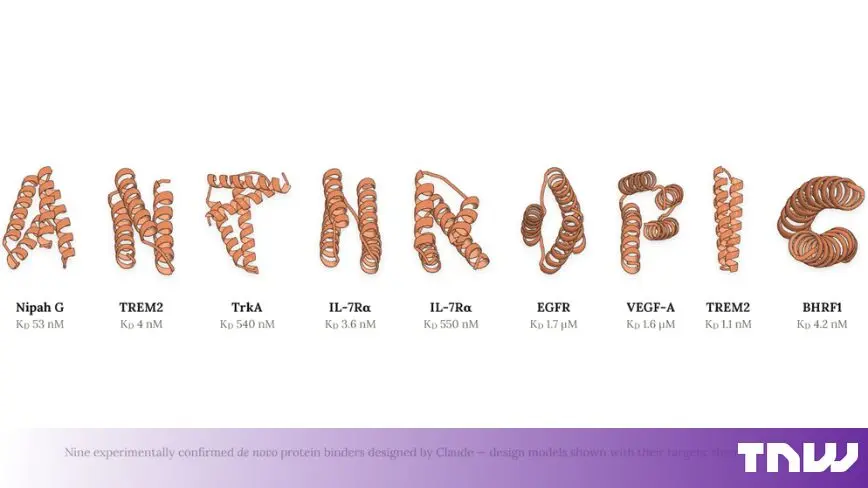
Anthropic Claude AI Designs Protein Binders for 14 of 15 Targets in Lab-Validated Breakthrough
20 Aug 2026•Technology
Anthropic's Claude AI Discovers CRISPR-Like Enzyme System in 21 Hours
18 Sept 2026•Science and Research

Anthropic launches Claude Science workbench and plans to develop drugs for rare diseases
30 Jun 2026•Technology

Recent Highlights


Recent Highlights
Today's Top Stories






Don’t drown in AI news. We cut through the noise - filtering, ranking and summarizing the most important AI news, breakthroughs and research daily. Follow topics that matter to you and stay ahead.


