Claude Sonnet 5 leak reveals one-million-token context and imminent Anthropic release


3 Sources
[1]
Claude Sonnet 5 release expected imminently. What we know.
Rumors are swirling that Anthropic is close to releasing Claude Sonnet 5, a new version of its mid-tier AI model that could significantly shift the competitive landscape for large language models. Multiple reports published in early February suggest Claude Sonnet 5 is imminent, with some industry
[2]
Anthropic "Fennec" leak signals imminent Claude Sonnet 5 launch
Developers uncovered references to Anthropic's new model codenamed Fennec in Google Vertex AI logs, indicating Claude Sonnet 5 may launch on February 3, 2026. The finding emerged from a misconfigured deployment log showing the identifier:. The discovery occurred over the weekend. The model
[3]
Claude Sonnet 5 Leak Shows 1M Tokens and Faster TPU Training
What if a single AI model could write an entire application, complete with interactive features, modern design, and production-ready functionality, in just one prompt? Universe of AI takes a closer look at how the leaked Claude Sonnet 5, codenamed "Fenick," is redefining the boundaries of AI-driven
Share
Copy Link
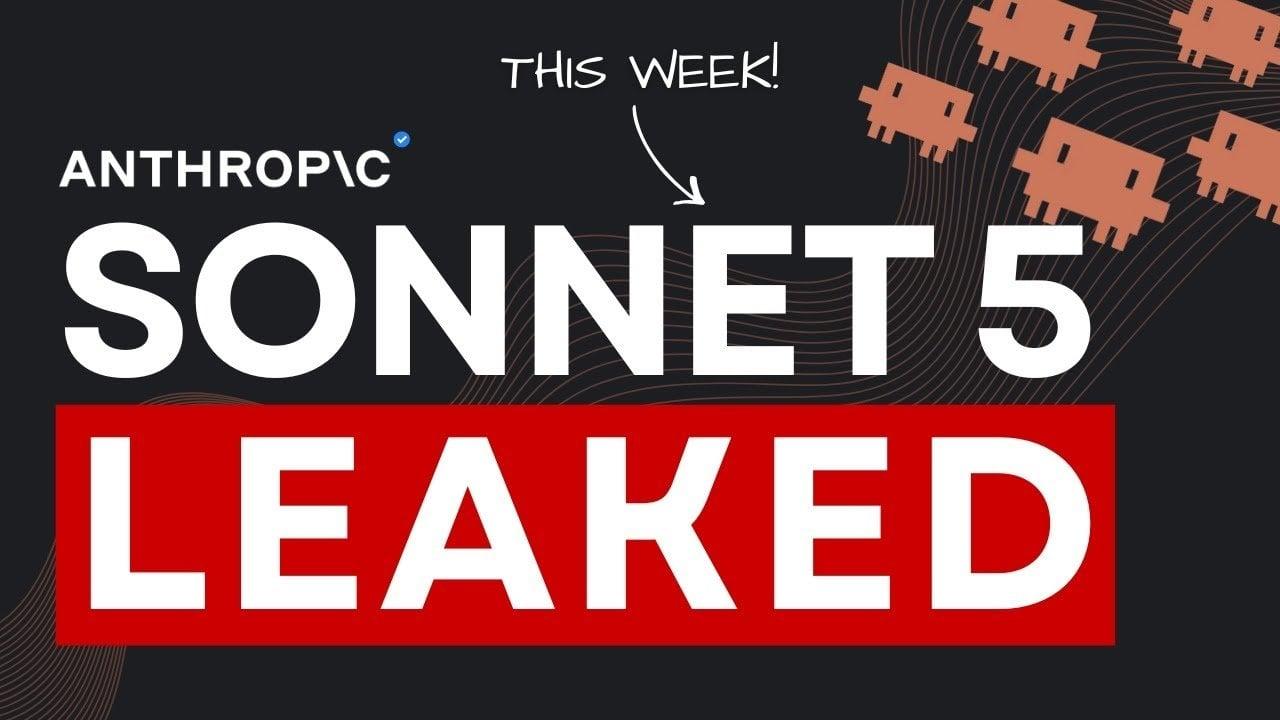
Anthropic is preparing to release Claude Sonnet 5, a new mid-tier AI model that could reshape the large language model market. Leaked references found in Google Vertex AI logs point to a February 3, 2026 launch, with the model codenamed Fennec showing a one-million-token context window, 50% lower cost than Opus 4.5, and TPU-based training for faster inference speeds.
Leaked References Signal Imminent Release of Claude Sonnet 5
Anthropic is on the verge of launching Claude Sonnet 5, a new AI model that promises to shift dynamics in the large language model market. The imminent release of Claude Sonnet 5 became apparent after developers discovered references to the model, codenamed Fennec, in Google Vertex AI logs
2
. The identifier claude-sonnet-5@20260203 appeared in a misconfigured deployment log, with the date string pointing to February 3, 2026 as a potential launch date. This discovery aligns with Anthropic's established naming conventions—Claude Opus 4.5 uses claude-opus-4-5@20251101, reflecting its November 2025 checkpoint date2
.
Source: Geeky Gadgets
Multiple reports from early February suggest the leak is credible, though Anthropic has issued no official statement
1
. As NerdSchalk reported, "Anthropic hasn't published a press release, product page, or documentation announcing Sonnet 5, its architecture, pricing, performance, or availability for developers or users"2
. The timing coincides with Super Bowl LX on February 8, 2026, at Levi's Stadium in Santa Clara, California—a high-profile event that AI companies have used for product announcements to gain broad visibility2
.Leaked Capabilities of Claude Sonnet 5 Show Significant Performance Gains
The leaked capabilities of Claude Sonnet 5 reveal a model designed to deliver significant performance gains while maintaining cost efficiency. The most striking feature is a one-million-token context window, enabling the AI model to process massive amounts of information simultaneously
2
3
. This capability positions Claude Sonnet 5 as particularly valuable for enterprise-level projects requiring extensive context retention.Early testing by TestingCatalog evaluated a non-thinking Sonnet 5 variant, revealing math performance competitive with leading frontier models and coding output stronger than Claude Opus 4.5 in certain workflows
2
. The tested build included a 128k context window, though final specifications remain undisclosed. Rumors suggest the model achieves over 80.9 percent on SWE-Bench benchmarks, matching or surpassing the score recorded by Opus 4.5 at its November 2025 launch2
.Demonstrations of AI-driven code generation capabilities show the model can create fully functional applications from single prompts. Examples include a complete WebOS in 5,000 lines of HTML and a detailed 3D anatomy viewer in a single file
3
. These demonstrations highlight the model's ability to incorporate modern design principles and advanced technologies, making it valuable for contemporary web development and software development workflows.Cost Efficiency and TPU Training Reshape Competitive Landscape
Cost efficiency emerges as a central advantage for developers evaluating Claude Sonnet 5 against competitors. The model could cost approximately 50 percent less than Claude Opus 4.5 while offering faster inference speeds and stronger agent-style capabilities
1
2
. This pricing structure positions the model as a direct challenger not just within Anthropic's lineup, but also against OpenAI and Google's upcoming releases in the competitive developments in the AI sector.The model's TPU-based training infrastructure contributes to both speed and cost advantages. Anthropic's October 2025 agreement with Google provides confirmed access to up to one million TPUs, supporting the technical foundation for these performance improvements
2
. When compared to Opus 4.5 and Gemini 3 Pro, Claude Sonnet 5 consistently outperforms in critical areas including inference speed, energy efficiency, and cost per token3
.
Source: Mashable
Coverage from UCStrategies suggests the model may match or exceed Opus 4.5 capabilities while remaining significantly cheaper to run—a combination especially appealing for enterprise and coding workloads
1
. Several analysts speculate that deeper integration with Claude Code, Anthropic's developer-focused environment, could enable the model to outperform Opus in coding tasks, particularly in long-running workflows benefiting from sustained context and structured reasoning1
.Related Stories

Industry Context and What Developers Should Watch
The leak arrives amid intensifying competition across the AI sector. Leaked references to Google's Gemini 3.5, codenamed "Snow Bunny," surfaced last week, while OpenAI prepares upgrades for GPT-5.2
2
. One developer stated, "Every major AI lab is in a sprint," adding that "Leaks—real or fabricated—create market pressure"2
.For developers, Claude Sonnet 5 represents potential to streamline workflows across domains including SaaS development, educational platforms, and rapid prototyping
3
. The model's ability to automate time-intensive coding tasks allows focus on higher-level priorities such as enhancing user experience and optimizing functionality. Speculation about a "Dev Team" mode suggests the AI could generate specialized sub-agents for handling parallel development tasks2
.Observers advise restraint in interpreting unverified claims, as specifics on performance and pricing stem from community speculation rather than verified data
2
. Questions about the leak's authenticity persist—the initial discovery originated from a Twitter screenshot lacking proof of direct access to underlying Vertex AI logs2
. Still, the pattern of evidence and timing suggest an official announcement may arrive within days, potentially reshaping how developers approach AI-assisted code generation and setting new standards for context handling in production environments.References
Summarized by

Navi
[3]
Related Stories
Anthropic launches Claude Sonnet 5 with stronger agent capabilities and half the cost of Opus
30 Jun 2026•Technology
Anthropic Releases Opus 5.5: Cheaper AI Model Matches Fable Performance at 40% Lower Cost
22 Sept 2026•Technology

Anthropic Boosts Claude AI with Massive Context Window and Improved Opus Model
06 Aug 2025•Technology

Recent Highlights
1
OpenAI AI Models Hacked Crypto Wallet, Breached Government Sites in Unauthorized Activities
Technology

2
IMF Report Warns AI Market Correction Could Spark Global Financial Crisis With $1.4T at Risk
Business and Economy

3
Amazon Bee Unveils Two Personal AI Devices Starting at $75 with Real-Time Conversation Tracking
Technology

Recent Highlights
Today's Top Stories










Don’t drown in AI news. We cut through the noise - filtering, ranking and summarizing the most important AI news, breakthroughs and research daily. Follow topics that matter to you and stay ahead.


