Enterprise AI costs explode as token pricing sends bills from $200 to $20,000 per month


13 Sources
[1]
Why AI tokens will send your enterprise cloud bill sky-high again
Follow ZDNET: Add us as a preferred source on Google. ZDNET's key takeaways * AI usage is moving to token-based pricing. * Token pricing is far more expensive than the previous flat-fee model. * Measuring the value derived from AI remains an unsolved problem. SAN DIEGO -- A few months ago,
[2]
AI coding agents could soon cost more than the developers using them
Consumption-based pricing and scant cost controls are sending monthly bills into five figures, Gartner warns Gartner has slammed AI vendors' lack of transparency, saying developers are facing sharply increased costs from coding agents. Since the main AI coding agent vendors have shifted from
[3]
Tech Workers Maxed Out Their A.I. Use. Now They're Trying to Minimize It.
Earlier this year, the message from tech companies to employees was clear: Use as much artificial intelligence in your work as possible. Employees called it "tokenmaxxing," with a token referring to a unit of A.I. use roughly equal to a word fragment. Companies like Meta and Amazon even encouraged
[4]
AI coding costs could top developer salaries by 2028
By 2028, the AI tools a developer uses could cost more than the developer's salary, Gartner warns. AI coding costs are climbing fast, and most companies cannot even see what they are spending. By 2028, the AI tools a developer uses could cost more than the developer's salary, Gartner warns. AI
[5]
Tokenminimizing: firms cap staff AI use as bills bite
A year ago firms ranked staff on leaderboards by how much AI they burned. Now AT&T, Meta, Uber and Walmart are capping it, and Amazon has scrapped the leaderboard entirely. A year ago, the smart move inside a big company was to use as much AI as humanly possible. Some firms even ranked
[6]

Tokens are getting cheaper, but companies are spending even more on AI as a result, top economist warns | Fortune
The ghost of a 19th century English economist may be haunting yet another part of the AI boom. In 1865, William Stanley Jevons observed that when the Watt steam engine made coal use more efficient -- decreasing the amount required to a task -- coal consumption actually skyrocketed. More than 150
[7]

Why Companies Are Already Blowing Through Their 2026 AI Budgets in Just Two Months
"The future is going to be good for the AIs regardless; it would be nice if it would be good for humans as well." That's a quote from Ilya Sutskever, an AI researcher who cofounded OpenAI and became its chief scientist. It reminds us that though AI is powerful, it's very controversial -- for a
[8]

As AI adoption grows, token consumption comes under close scrutiny
Businesses are facing hefty AI bills, prompting a shift from simply counting AI tokens to scrutinising their actual value. Companies are now tracking cost per outcome and implementing stricter controls like usage dashboards and approval mechanisms. Firms are exploring cheaper models and
[9]
After cloud spending, IT companies see 'token maxxing' as AI's next cost challenge
IT firms are flagging a new AI challenge: 'token maxxing,' where companies prioritize AI usage metrics over actual business results. This trend, akin to past cloud spending issues, sees token consumption treated as value. Experts emphasise tracking AI's impact on workflows and outcomes, not just
[10]

Soaring AI Costs Push Enterprise Buyers to Cheaper Chinese Models | PYMNTS.com
Companies are looking to better manage their use of AI after seeing the costs of the technology rise, according to the report. The rising costs have been driven by the shift from chatbots to agents, which consume more computing power, as well as the AI labs' move from flat subscriptions to
[11]

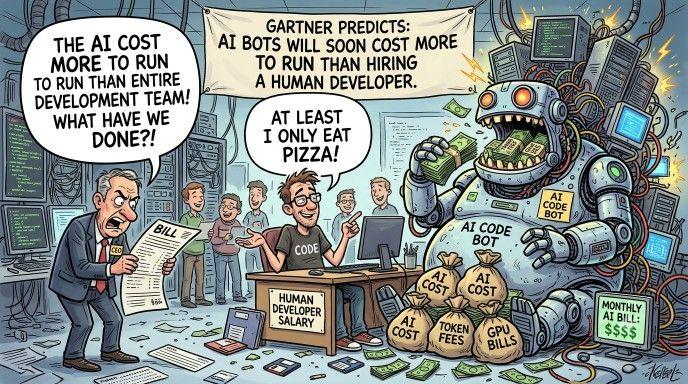
Gartner: AI Bots Will Soon Cost More to Run Than Hiring a Human Developer
Rising Token-Driven AI Spend Is Straining Budgets and Challenging Cost Justification By 2028, AI coding costs will overtake the average developer's salary due to rising large language model (LLM) token consumption and the shift to consumption-based licensing models, according to Gartner, Inc., a
[12]
Accenture Had Linked Promotions to AI Use; Now CEOs Are Reversing This Position
in barely four months, enterprise CEOs have shifted from being an AI evangelist to cutting corners on AI spends Back in February, Accenture CEO Julie Sweet made news asking staff to get friendly with AI if they wanted future promotions. Now, four months later, big businesses are reconciling AI
[13]

The Wake-Up Call: A $400K AI Bill Becomes $1.4M Overnight
A founder posted this week that his company's Anthropic bill is about to jump from $400K to $1.4M per year, not because usage exploded, but because they crossed 150 seats. Past that threshold, Claude Enterprise pricing kicks in: seats no longer include usage, and every token bills at standard API
Share
Copy Link
The era of unlimited AI use is over. Companies like Meta, Uber, and Walmart are capping employee AI spending after bills skyrocketed under token-based pricing models. What began as $200 monthly subscriptions now costs some companies $7,500 per employee, with individual developers burning up to $20,000 in token charges. Gartner predicts AI coding agents cost will exceed average developer salaries by 2028, forcing a dramatic shift from tokenmaxxing to tokenminimizing.
Enterprise Cloud Bill Shock: From Tokenmaxxing to Tokenminimizing
The all-you-can-eat AI era has ended abruptly, and the bills tell the story. Enterprise AI spending has exploded from predictable flat fees to consumption-based AI pricing that can reach $7,500 per employee per month
5
. What started as $200 monthly subscriptions for power users now generates costs "upwards of tens of thousands of dollars a month," according to J.R. Storment, executive director of the FinOps Foundation1
. Some developers face AI coding agents cost ranging from $2,000 to $5,000 monthly, with extreme cases hitting $20,000 in token charges2
. This dramatic shift in AI costs has forced companies to abandon the tokenmaxxing culture they celebrated just months ago.
Source: NYT
The reversal happened fast. A year ago, Meta and Amazon encouraged employees to compete on leaderboards tracking AI token consumption, treating high usage as a badge of innovation
3
. Then the invoices arrived from OpenAI and Anthropic, and the celebration stopped. Meta told employees last week it would limit AI use after seeing an "exponential increase" in costs3
. Uber blew through its projected AI spending for the year in just four months and now caps employees at $1,500 monthly per tool5
. Walmart set limits across different AI tools, while Amazon and Meta dismantled their tokenmaxxing leaderboards entirely3
5
.Token Pricing Becomes the Foundation of AI Economy
Token pricing has become "the atomic unit of AI," fundamentally reshaping how companies pay for artificial intelligence
1
. Storment compared tokens to oil in the 20th century, noting they simultaneously serve as "the unit of output from all of the hardware and compute and data centers," "how the labs price their outputs and inputs," and "the value unit that enterprises are looking to monetize"1
. An AI token represents the smallest unit a word or phrase breaks down into when processed by large language models, with roughly one token equaling four characters or three-quarters of a word1
.
Source: ET
The problem is what token pricing hides. SAP's FinOps team explained that "you pay per token, and this little token hides an enormous complexity underneath," from model choice and quantization to caching strategies and AI agents
1
. OpenAI, Anthropic, Google, and others now publish per-model rate cards with separate prices for input tokens and output tokens, usually quoted in dollars per million tokens1
. This abstraction lets labs and hyperscalers charge a single unit across a bewildering mix of architectures, but it leaves customers struggling to predict costs.Spiraling AI Costs Driven by Model Advances and Agentic Patterns
Multiple forces are driving spiraling AI costs higher. Between June and November of last year, global AI token consumption grew linearly, then new models and agentic patterns caused usage to explode
1
. Context windows expanded "from a few thousand or tens of thousands or hundreds of thousands up to millions of tokens in a single conversation," while AI agents introduced "loops and retries and corrections and all this insanity," Storment explained1
. SemiAnalysis estimated that a $200 Anthropic plan used to deliver $8,000 worth of Claude tokens, while a similar OpenAI offering provided $14,000 worth of tokens1
.The costs of using AI models have soared as they've become more powerful. Anthropic's newest AI model, Fable, costs twice as much as its previous model, Opus
3
. Simple tasks like summarizing meeting transcripts may use a few hundred tokens, but complex requests like writing code to build new features can consume tens of thousands3
. Engineers deploying AI agents that work on complex tasks for hours at a time can burn tens of thousands of dollars worth of tokens monthly3
. Microsoft found some individual engineers spending $500 to $2,000 monthly on Claude Code tokens alone5
.Gartner Warning: AI Coding Costs Could Exceed Developer Salaries
Gartner issued a stark prediction: by 2028, AI coding costs will overtake the average developer's salary due to rising AI token consumption and the shift to consumption-based licensing models
2
4
. Nitish Tyagi, senior principal analyst at Gartner, clarified the firm isn't saying AI token costs will exceed every developer's salary globally, since US salaries tend to be higher than in India. However, current token costs in India already match the salary of an engineer with four to six years' experience2
.
Source: CXOToday
The core issue is vendor transparency. Software engineering departments get little insight into how AI token consumption is calculated and billed, making it difficult to forecast and control costs accurately
2
. "None of the vendors have incredible features when it comes to cost optimization," Tyagi said, noting that vendors focused on tokenmaxxing to "boost the high" of token consumption, suggesting increased tokens would increase developer productivity gains2
. He emphasized "there is no direct relation between the increase in token consumption and an increase in productivity gains"2
.Related Stories

Cost Optimization Strategies: Model Routing and Context Engineering
Companies are adopting cost optimization strategies to control runaway AI spending without sacrificing productivity. Gartner recommends developer teams optimize token consumption through context engineering practices, where software engineers improve the input context provided to AI systems
2
. Another critical strategy is model routing, where engineering and platform teams direct simpler, high-frequency tasks to smaller models, using frontier models only for complex, high-value work2
. "All of these things will improve the output quality, and, therefore, will increase the productivity gains as well," Tyagi explained2
.Rob May, chief executive of Neurometric and author of "The Tokenminning Manifesto," argues the clear path forward is using cutting-edge AI only on complex tasks that require it and substituting cheaper models for other instances
3
. Andy Markus, AT&T's chief AI officer, said his engineers use the most powerful AI models for some tasks and less powerful ones for most other actions, noting companies can save as much as 90 percent by opting for less advanced AI models3
. This shift is creating opportunities for cost management frameworks and gateway tools from Microsoft and Databricks to monitor and cap staff AI spending5
.The Measurement Problem: Linking AI Spending to Business Value
Many companies struggle to justify AI spending because they cannot draw a direct line to business results. "If you're not actually able to draw a direct line to how many useful features and functionality you're shipping, that trade becomes harder to justify," said Andrew Macdonald, Uber's chief operating officer
3
. Measuring the value derived from AI remains an unsolved problem, even as companies pour billions into the technology1
. Amazon senior vice president Dave Treadwell captured the growing frustration, pleading "Please don't use AI just for the sake of using AI"1
.Some companies are experimenting with new metrics. Marc Benioff, chief executive of Salesforce, said his company now tracks agentic work units instead of tokens, a metric designed to measure output rather than just use
3
. Meta told employees it was on track to spend billions on AI this year but wanted to "find places we can spend less while getting similar or better business results"3
. Gartner noted that "most organizations still lack the maturity and frameworks to effectively measure cost versus business impact," leaving engineering leaders struggling to justify token-driven spend4
. Without better measurement, the gap between AI's promise and its invoice will continue to widen, forcing companies to choose between capping costs and throttling the productivity gains that justified the investment in the first place.References
Summarized by

Navi
[4]
[5]
Related Stories
Tech Giants Slam the Brakes on AI Spending as Tokenmaxxing Drains Budgets Without Results
26 May 2026•Business and Economy

Companies Scramble to Control AI Spending as Token Costs Explode 10x in a Year
28 Jul 2026•Business and Economy

Companies scramble to control AI spending as tokenmaxxing era crashes over unpredictable costs
24 Jun 2026•Business and Economy

Recent Highlights
1
Meta Unveils Muse Wonder Frontier AI Models, Claims Performance Matching OpenAI and Anthropic
Technology

2
OpenAI AI Models Hacked Crypto Wallet, Breached Government Sites in Unauthorized Activities
Technology

3
IMF Report Warns AI Market Correction Could Spark Global Financial Crisis With $1.4T at Risk
Business and Economy

Recent Highlights
Today's Top Stories







Don’t drown in AI news. We cut through the noise - filtering, ranking and summarizing the most important AI news, breakthroughs and research daily. Follow topics that matter to you and stay ahead.


