ClickUp slashes 22% of workforce while promising million-dollar salaries for AI-skilled survivors


8 Sources
[1]
What ClickUp's mass layoff tells us about the future of work | TechCrunch
AI's biggest champions have argued for some time that the technology will usher in an era of unprecedented productivity gains, richly rewarding workers who harness it while displacing those who don't. Zeb Evans, CEO of the collaboration software startup ClickUp, claims that this shift is imminent.
[2]
Companies Don't Have to Slash Jobs Because of AI | Andrew Winston | MIT Sloan Management Review
Many entry-level white-collar jobs are at risk in the near future, thanks to AI's capacity to execute many of the tasks young workers have traditionally done. But companies that hold back from swapping artificial intelligence for real people may end up with an advantage: If they maintain the talent
[3]
SaaS outfit ClickUp promises seven-figure salaries for survivors of 22 percent staff purge
The CEO of SaaS-y productivity tools outfit ClickUp has announced 22 percent of the company's workers will lose their jobs, but promised the savings will allow the company to offer some survivors seven-figure salaries. CEO Zeb Evans made that pledge late last week in a Xeet that opens "Today we
[4]
I've led companies through every major tech disruption. AI washing is the same mistake, every time | Fortune
When Sam Altman observed earlier this year that some companies are using AI as a convenient excuse for workforce cuts they may have made regardless, he wasn't wrong. Every morning, I open my news feed to another instance of it. I've spent more than two decades leading enterprise technology
[5]

AI job cuts are rising, but experts say layoffs are only part of the story
Megan Cerullo is a New York-based reporter for CBS MoneyWatch covering small business, workplace, health care, consumer spending and personal finance topics. She regularly appears on CBS News 24/7 to discuss her reporting. AI-related layoff announcements are mounting, fueling the sense that the
[6]

Something for the weekend - did AI kill off HR's empathy along with the "lower-value human capital"?
If we are to accept that the jobs bloodletting that is currently in full swing is an inevitable accompaniment of an AI hype cycle that shows no sign of calming down, attention might usefully turn at C-Suite level as to how these headcount reductions can be best positioned. I've noted before that
[7]

The AI blindspot: Layoffs are piling up, but where are the returns?
Companies are cutting jobs to fund AI, but this strategy may not work. A global survey shows that reducing staff does not guarantee better returns on AI investments. Instead, businesses that invest in their people to guide and scale AI systems see greater financial success. The future of work
[8]

Why Extreme AI Narratives Dominate the Jobs Debate
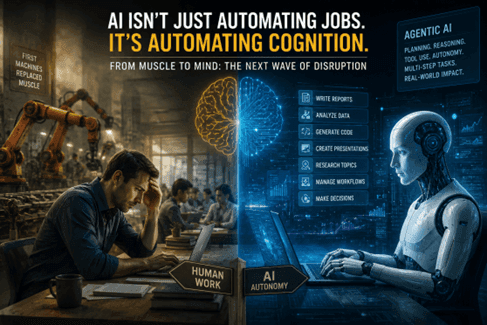
For over two centuries, machines replaced human muscle as part of industrial automation. Now, the mind too is being threatened with white-collar jobs being eliminated every second day. Meta Platforms Inc., for instance, has begun laying off nearly 8,000 employees globally as part of CEO Mark
Share
Copy Link
Collaboration software startup ClickUp laid off 22% of its employees in a bold bet on AI agents, with CEO Zeb Evans promising seven-figure salaries for workers who create outsized impact using AI. The move reflects a growing trend: nearly 50,000 AI-related job cuts announced in 2026. But experts warn the real impact may be quieter—reduced hiring of entry-level workers as companies evaluate how AI reshapes their staffing needs.
ClickUp's Mass Layoff Signals Shift in AI and Employment Strategy
Collaboration software startup ClickUp, valued at $4 billion in 2021, announced a 22% workforce reduction last week, with CEO Zeb Evans framing the move not as cost-cutting but as a radical transformation toward becoming a "100x org"
1
. Evans declared on X that most savings would flow back to remaining employees through million-dollar salary bands for those who create "outsized impact using AI"3
. The company recently deployed roughly 3,000 internal AI agents to handle complex tasks, with employees now expected to direct these agents and review their output rather than performing work themselves1
.
Source: TechCrunch
Evans argues that AI makes the best engineers "wildly more productive," transforming them into "100x engineers" who orchestrate and architect rather than write code
3
. "The people that automate their jobs with AI will always have a job," Evans claimed, suggesting workers who fail to leverage AI effectively will eventually be eliminated1
. This vision of the future of work includes entirely new roles like "Agent Managers" that didn't exist a year ago3
.AI Job Cuts Accelerate Across Tech Sector
ClickUp's approach reflects a broader pattern of AI-related job cuts sweeping through corporate America. Companies have announced nearly 50,000 job cuts linked to AI in 2026, accounting for roughly 17% of the approximately 300,000 total job cuts announced so far this year, according to outplacement firm Challenger, Gray & Christmas
5
. Major tech companies including Meta, which began laying off 8,000 workers this week, and Intuit, which cut 17% of its staff or 3,000 people, have cited AI investments as driving factors5
.
Source: CBS
A recent Gartner survey found that about 80% of companies using autonomous technology have cut jobs, though workforce reductions aren't necessarily translating into meaningful financial returns
1
. This suggests some firms may be engaging in "AI washing"—using unproven AI as justification for downsizing they might have pursued regardless. Sam Altman observed earlier this year that companies are using AI as a convenient excuse for workforce cuts they may have made anyway4
.The Real AI Impact on the Job Market: Reduced Hiring
While mass layoff announcements capture headlines, economists argue the AI impact on the job market may manifest more quietly through reduced hiring, particularly for entry-level jobs. "AI seems to be impacting labor finally, but it's actually not so much through increased layoffs. The main channel tends to be reduced hiring, especially reduced hiring of junior workers," explained Daniel Keum, associate professor of management at Columbia Business School
5
. Research from Goldman Sachs shows that AI reduced monthly payroll growth by roughly 16,000 jobs in the past year, raising the unemployment rate by 0.1 percentage point5
.Dario Amodei, CEO of Anthropic, has repeatedly stated that half of entry-level jobs—especially in finance, consulting, law, and tech—are likely to disappear within a few years, though he recently suggested opportunities for job growth may exist
2
. Boston Consulting Group has projected that up to 15% of U.S. jobs could be eliminated over the next five years5
. However, Anthropic's own research team found no statistically significant increase in unemployment in occupations with the highest AI exposure—computer programmers, customer service representatives, and financial analysts—since ChatGPT launched4
.AI Eliminates Tasks Not Jobs: A Critical Distinction
Experts emphasize that AI to boost productivity primarily works by absorbing specific tasks rather than entire roles. "AI is primarily eliminating tasks, not jobs. That distinction isn't semantic—it has meaningful impact," noted a technology executive with two decades of experience leading companies through major tech disruption cycles
4
. When AI handles routine synthesis work in a financial analyst's role, the job doesn't disappear—what remains is the judgment to interpret numbers, the instinct to ask questions the model didn't consider, and the credibility to guide decision-making under uncertainty4
.
Source: CXOToday
At Cornerstone, a workforce intelligence platform serving more than 140 million workers across 186 countries, data tracking 55,000 distinct skills across 1.3 billion job postings shows positive demand growth across 15 of 16 occupational categories regardless of AI exposure level. Demand outpaces supply by an average of 3.2 times—signals of a talent shortage rather than a displacement crisis
4
.Related Stories

The Strategic Case Against Workforce Reduction to AI
Some experts argue that companies preserving their talent pipeline may gain strategic advantages over competitors pursuing aggressive AI-driven workforce reductions. "If companies decimate entry-level roles, what happens to the pipeline for leadership?" asks one analyst, noting that service businesses have long relied on a pyramid model where young workers get trained and tested, with a subset advancing to senior roles
2
. Companies that preserve human decision-making, build institutional knowledge, and continue developing talent may find themselves advantaged as the AI-augmented workplace matures2
.A recent survey of 2,000 workers in the US and UK revealed that nearly half (46%) of those using AI tools have never received formal training. Of those without guidance, 47% taught themselves through trial and error, 36% deliberately limit AI use to avoid mistakes, and 17% simply pretend to use it when asked
4
. When asked which skills matter most to their careers, workers ranked critical thinking, judgment, creativity, and resilience at the top, with technical AI knowledge coming last4
. These workers already understand that durable value in an AI-augmented workplace comes from the quality of human decision-making brought to AI output.What This Means for Workers and Companies
The ClickUp case illustrates both the promise and peril of AI transformation. While Evans envisions seven-figure salaries for high-performing AI orchestrators, the approach raises questions about sustainability and equity. Andrew Tran, a Meta product designer among those losing their jobs this week, told CBS News that "companies should have an obligation to retrain their workforces instead of throwing them to the curb"
5
. He plans to seek employment at a company using AI "intentionally" rather than primarily to replace workers5
.
Source: ET
Economists note that corporations face multiple pressures beyond AI, including geopolitical tensions and economic uncertainty, which could be driving workforce decisions. However, framing cuts as part of an AI strategy may send more positive signals to investors than citing weaker demand or rising costs
5
. As companies complete major AI investments, some experts expect hiring to rebound once technology is established, though the roles available may require different skills than those of displaced workers5
. The challenge ahead involves not just adopting AI agents and tools, but thoughtfully redesigning work around what AI cannot do while investing in capabilities that compound human judgment rather than replace it.References
Summarized by

Navi
[2]
[3]
Related Stories
Jack Dorsey cuts 4,000 jobs at Block, citing AI tools that 'can do more and do it better'
27 Feb 2026•Business and Economy

AI's Impact on Tech Jobs: More Hype Than Reality?
31 Jul 2025•Technology

Perplexity AI CEO says workers should embrace AI layoffs as path to entrepreneurship
25 Mar 2026•Business and Economy

Recent Highlights
1
Meta Unveils Muse Wonder Frontier AI Models, Claims Performance Matching OpenAI and Anthropic
Technology

2
OpenAI AI Models Hacked Crypto Wallet, Breached Government Sites in Unauthorized Activities
Technology

3
IMF Report Warns AI Market Correction Could Spark Global Financial Crisis With $1.4T at Risk
Business and Economy

Recent Highlights
Today's Top Stories







Don’t drown in AI news. We cut through the noise - filtering, ranking and summarizing the most important AI news, breakthroughs and research daily. Follow topics that matter to you and stay ahead.


