CoreWeave Scales Nvidia Vera Rubin to Multi-Rack Cluster, Hundreds of GPUs Now Unified


4 Sources
[1]
Nvidia cloud partner crosses major compute threshold
In technology, the loudest applause usually comes at the demo, not the delivery. A flashy prototype draws headlines. The unglamorous rollout that actually generates revenue often gets a shrug. CoreWeave, Inc. (CRWV) just lived that gap. The AI cloud provider rents out Nvidia Corporation (NVDA)
[2]
CoreWeave stock rises on Nvidia Vera Rubin cluster deployment By Investing.com
Investing.com -- CoreWeave Inc (NASDAQ:CRWV) shares gained 2.9% in premarket trading Wednesday following the company's announcement that it deployed a multi-rack Nvidia Vera Rubin NVL72 cluster on CoreWeave Cloud. The deployment puts hundreds of Nvidia Rubin GPUs into a single scale-out cluster
[3]
CoreWeave deploys multi-rack Nvidia Vera Rubin clusters By Investing.com
LIVINGSTON, N.J. - CoreWeave, Inc. (NASDAQ:CRWV) announced the deployment of multi-rack Nvidia Vera Rubin NVL72 on its cloud platform, connecting hundreds of Nvidia Rubin GPUs into a single scale-out cluster, according to a press release statement. The configuration allows training and inference
[4]
CoreWeave Announces Bring Up of Multi-Rack Nvidia Vera Rubin Nvl72 Cluster And New Capabilities In Coreweave AI Object Storage
CoreWeave, Inc. announced the bring up of multi-rack NVIDIA Vera Rubin NVL72 on CoreWeave Cloud, putting hundreds of NVIDIA Rubin GPUs into a single scale-out cluster for agentic AI. The company also announced two new capabilities in CoreWeave AI Object Storage, cross-region write acceleration and
Share
Copy Link
CoreWeave deployed a multi-rack Nvidia Vera Rubin NVL72 cluster connecting hundreds of Rubin GPUs into a single system for agentic AI workloads. The AI cloud provider also introduced cross-region write acceleration and Archive tier storage, addressing data movement bottlenecks that have stalled GPU performance across its infrastructure.
CoreWeave Moves Beyond Single-Rack Milestone
CoreWeave, the AI cloud provider specializing in Nvidia GPU rentals, announced the deployment of a multi-rack Nvidia Vera Rubin NVL72 cluster on CoreWeave Cloud
1
2
. The system connects hundreds of Nvidia Rubin GPUs into a single scale-out cluster designed for agentic AI workloads, marking a shift from proof-of-concept to production-ready infrastructure3
. This deployment follows the company's June milestone when it first brought a single Vera Rubin rack online, a move that sent CoreWeave stock up nearly 14% in one day1
. Wednesday's announcement drove shares up approximately 2.9% in premarket trading, a more modest reaction that reflects the market's tendency to reward flashy prototypes over unglamorous but revenue-generating rollouts2
.Architecture Behind the Multi-Rack System
Each single Nvidia Vera Rubin NVL72 rack pairs 72 Rubin GPUs with 36 Vera CPUs, Nvidia NVLink 6, Nvidia ConnectX-9 SuperNICs, and Nvidia BlueField-4 DPUs on one liquid-cooled shelf
1
3
. CoreWeave unified multiple racks using Nvidia Spectrum-X Ethernet networking, creating infrastructure capable of supporting approximately 128,000 GPUs per rail in a non-blocking fabric1
4
. Each Rubin GPU includes two ConnectX-9 SuperNICs, providing 1.6 Tb/s of connectivity per GPU across multiplane, multirail paths3
. "CoreWeave was the first AI cloud provider to validate and bring up a Vera Rubin NVL72," said Chen Goldberg, executive vice president of product and engineering at CoreWeave3
. The multi-rack configuration enables training and inference jobs to run across hundreds of Rubin GPUs, delivering capacity to train larger models, serve demanding inference workloads, and execute reinforcement learning at scale4
.Storage Upgrades Target Data Movement Bottlenecks
Alongside the cluster deployment, CoreWeave introduced two capabilities in CoreWeave AI Object Storage: cross-region write acceleration and a new Archive tier
2
3
. Cross-region write acceleration allows data to be written at local latency while CoreWeave replicates it to a second remote region in the background, eliminating waits when working across multiple regions2
4
. The Archive tier offers lower-cost storage with no retrieval, early deletion, or reading fees2
4
. CoreWeave AI Object Storage LOTA (Local Object Transport Accelerator) delivers reads at local NVMe speeds and reduces latency by 8x compared to reading from a traditional storage cluster, providing up to 7 GB/s of throughput per GPU2
4
. "CoreWeave AI Object Storage gives us a unified dataset footprint across regions with reads cached locally, so nothing waits on the network," said Cécile Robert-Michon, director of internal infrastructure at Cohere3
. These storage upgrades address a critical weakness: idle GPUs waiting on data cost as much as GPUs that don't exist1
.Related Stories

Wall Street Divided on CoreWeave's Debt-Fueled Growth
Analysts covering CoreWeave carry a consensus "Buy" rating with an average price target of $144.46, implying more than 70% upside from current levels
1
. That consensus masks real disagreement. Bernstein reiterated a sell rating on September 14 with a $74 price target, while Truist Securities maintained a buy rating with a $165 target the same month1
. The debate centers on CoreWeave's heavy debt load: approximately $51.6 billion in total debt against $5.5 billion in cash1
. The company is betting that mega-cap clients including Microsoft, Meta, and OpenAI, who rent compute to run their own AI products, will generate revenue sufficient to justify the borrowing1
. CoreWeave completed its public listing on Nasdaq in March 20253
. CoreWeave CEO Michael Intrator has publicly pushed Nvidia to expand chip supply faster or risk losing customers to AMD, reflecting the tension inherent in the AI infrastructure provider's dependence on a single chipmaker1
.What This Means for AI Infrastructure Competition
The deployment signals a competitive shift in scalable AI infrastructure. CoreWeave's multi-rack Nvidia Vera Rubin system demonstrates that the AI buildout bottleneck is evolving from chip scarcity to data movement and financing challenges
1
. The company's approach, pairing compute milestones with storage innovations, positions it as one of the most direct public ways to bet on AI infrastructure demand without owning a chipmaker outright1
. CoreWeave consistently delivers industry-leading performance, demonstrated by record-breaking MLPerf benchmarks in inference and training, its Platinum ranking in both SemiAnalysis ClusterMAX 1.0 and 2.0, and its #1 ranking for inference speed and price-performance for Moonshot AI's Kimi K2.6 and Kimi K2.7 Code in independent benchmarking conducted by Artificial Analysis4
. Watch whether CoreWeave can sustain customer retention among its enterprise clients as competitors scale similar infrastructure, and whether its debt-fueled expansion model holds up if AI demand softens or chip supply diversifies beyond Nvidia's ecosystem.References
Summarized by

Navi
[1]
Related Stories
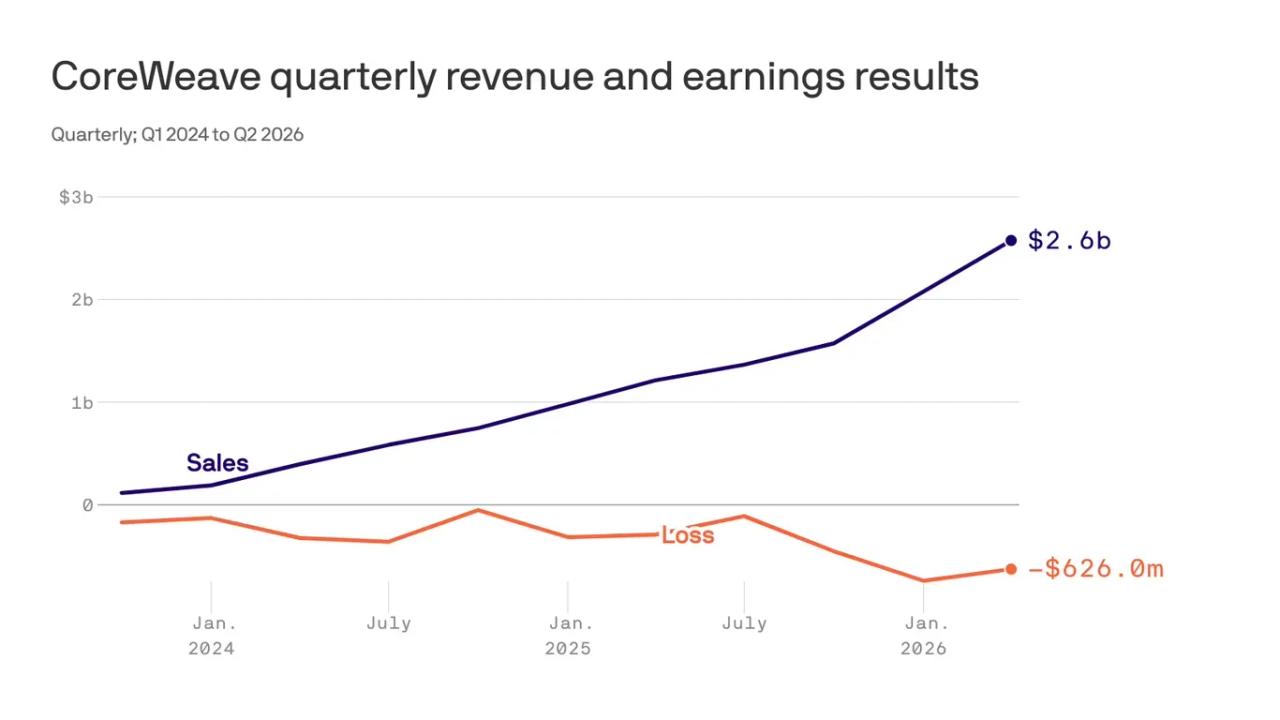
CoreWeave Revenue Doubles to $2.58 Billion as AI Infrastructure Demand Surges Despite Rising Debt
12 Aug 2026•Business and Economy
CoreWeave Draws Bullish Analyst Calls as AI Infrastructure Demand Surges Amid $35.6 Billion Debt
24 Sept 2026•Business and Economy
CoreWeave Eyes Explosive Growth with Federal Market Entry and $30B Backlog
23 Oct 2025•Business and Economy
Recent Highlights



Recent Highlights
Today's Top Stories






Don’t drown in AI news. We cut through the noise - filtering, ranking and summarizing the most important AI news, breakthroughs and research daily. Follow topics that matter to you and stay ahead.


