DeepSeek valuation doubles to $20 billion as Tencent and Alibaba join funding talks


7 Sources
[1]
DeepSeek in Talks to Raise at $20 Billion Value, Information Says
Chinese technology giants Tencent Holdings Ltd. and Alibaba Group Holding Ltd. are in discussions to invest funds into DeepSeek that would value the artificial intelligence startup above $20 billion, according to The Information. This is the first capital raise by the company, The Information
[2]
DeepSeek targets $20bn valuation to stop poaching of staff
Chinese AI start-up DeepSeek is raising funds for the first time in a bid to retain employees being paid with stock options and ensure they are not poached by rivals. The Hangzhou-based AI model developer is speaking to a small group of strategic investors about a fundraising that could value it
[3]
China's DeepSeek is raising funds at $10 billion valuation, The Information reports
April 17 (Reuters) - Chinese artificial intelligence startup DeepSeek is in talks with investors to raise at least $300 million at a valuation of $10 billion, The Information reported on Friday, citing two people familiar with the matter. The company, whose low-cost models took the AI industry by
[4]
DeepSeek seeks outside funding at $10 billion valuation
Chinese AI startup DeepSeek is in talks to raise at least $300 million at a valuation of $10 billion, according to The Information, which cited two people familiar with the matter. The fundraise would mark the first time DeepSeek has sought outside capital. Prior to this round, approaches from
[5]

Tencent, Alibaba in talks to invest in DeepSeek at over $20 billion valuation: Report
Chinese tech giants Tencent and Alibaba are reportedly in talks to invest in AI startup DeepSeek. The company is aiming for a valuation exceeding twenty billion dollars. This potential funding highlights the significant capital needed for advanced AI development. Discussions are ongoing, and terms
[6]

Tencent, Alibaba Eye DeepSeek As Valuation Hits $20B - Alibaba Gr Hldgs (NYSE:BABA), Alibaba Gr Hldgs (OT
Tencent, Alibaba Circle DeepSeek As AI Startup Eyes $20B Valuation That's a sharp jump from earlier discussions that pegged the raise at around $10 billion -- suggesting investor demand is accelerating quickly, the Information reported. A New AI Contender Emerges DeepSeek isn't a typical
[7]

DeepSeek Seeks $20 Billion Valuation as Tech Giants Weigh Investment | PYMNTS.com
By completing this form, you agree to receive marketing communications from PYMNTS and to the sharing of your information with our sponsor, if applicable, in accordance with our Privacy Policy and Terms and Conditions. Tencent and Alibaba are in talks to invest in the Chinese artificial
Share
Copy Link
DeepSeek is raising funds for the first time, with Chinese tech giants Tencent and Alibaba in discussions to invest at a valuation exceeding $20 billion. The funding aims to retain AI talent through stock options as the startup faces poaching from rivals. This marks a sharp increase from initial talks targeting a $10 billion valuation.
DeepSeek Seeks First Capital Raise at $20 Billion Valuation
Chinese AI startup DeepSeek is in talks with tech giants Tencent Holdings and Alibaba Group to raise funds at a valuation exceeding $20 billion, according to The Information
1
. This represents a dramatic shift for the Hangzhou-based company, which has previously turned down multiple funding offers from China's top venture capital firms and tech giants3
. The valuation target has doubled from initial discussions earlier in April, when DeepSeek was seeking to raise at least $300 million at a $10 billion valuation4
.
Source: Benzinga
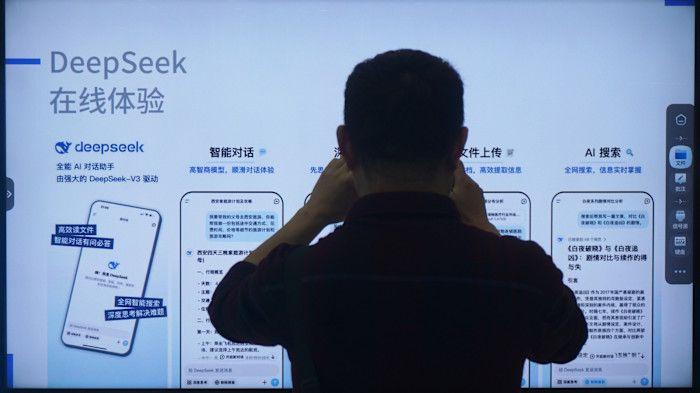
This marks the first capital raise by DeepSeek, owned by Chinese hedge fund Zhejiang High-Flyer Asset Management and founded by Liang Wenfeng in 2023
1
. The company stunned the AI world in January 2025 with its R1 model, achieving performance comparable to US rivals like ChatGPT despite China's limited access to cutting-edge semiconductor technology and international talent2
.
Source: FT
Retaining AI Talent Through Stock Options Drives Funding Push
The primary motivation for seeking outside funding is not cash flow urgency but employee retention. DeepSeek is raising funds to retain researchers being compensated with stock options and prevent them from being poached by rivals
2
. Stock options typically comprise a large part, if not the majority, of an AI researcher's salary, and the lack of a clear valuation has put DeepSeek at a disadvantage against both tech giants including Alibaba and Tencent and startup peers.The company has already lost key AI talent in recent months. Guo Daya, a leading author of the R1 paper, joined ByteDance, while Wang Bingxuan, a veteran of DeepSeek's model training team, departed for Tencent
2
. Competing Chinese AI startup Moonshot, operator of the Kimi AI models, was valued at $18 billion in its last fundraising round, while Hong Kong-listed developers MiniMax and Zhipu are valued at $34 billion and $58 billion respectively2
.Strategic Investors and Fundraising Challenges
The amount raised is expected to be a nominal figure in the low hundreds of millions of dollars, far less than the billions typically raised by peers
2
. Liang Wenfeng is also considering alternative options to establish a valuation, including a share buyback or a performance-based valuation method, in case fundraising terms cannot be reached2
.For financial institutions, DeepSeek's lack of a business model could inhibit fundraising. The company has differentiated itself from US companies including OpenAI and Anthropic by pushing out low-cost, open source models
1
, making it difficult to translate AI advances into profits. For strategic investors seeking synergies with their operations, Liang's unwillingness to share information beyond bare-minimum financial figures poses challenges2
.As a Chinese startup, some US venture capitalists might hesitate about investing in DeepSeek
3
. Reuters reported earlier this year that the company did not show US chipmakers its flagship model for performance optimization and had trained one of its newest models on Nvidia's most advanced chip despite export restrictions5
.Related Stories

Why This Investment Matters for China's AI Ecosystem
An investment in DeepSeek would likely serve as a hedge for Alibaba and Tencent. The popularity of free-to-download, open-source models in China has made it difficult for bigger players to translate their AI advances into profits
1
. Alibaba is already a major player in artificial intelligence, unveiling a new AI model earlier this month that can create 3D environments and interactive videos, while Tencent recently announced it would double investments in AI to more than 36 billion yuan ($5.2 billion) this year1
.
Source: ET
The potential fundraise underscores the intense capital requirements for developing and running top-of-the-line AI models amid the rise of advanced reasoning and agentic bots
3
. DeepSeek is expanding to take on OpenClaw, whose AI agent software can carry out tasks without human intervention and became wildly popular after launching in China. The company posted more than a dozen job listings for agent-related roles in March1
.The talks remain ongoing, and both the valuation and the amount of capital to be raised could still change
5
. US-traded shares of Alibaba Group rose 1.6% in premarket trading following the news1
.References
Summarized by

Navi
Related Stories
DeepSeek eyes $71 billion valuation and IPO after explosive $50 billion round just weeks ago
14 Jul 2026•Startups
DeepSeek seeks $45 billion valuation while prioritizing AGI over short-term profits
22 May 2026•Startups

DeepSeek valuation surges to $45 billion as China's Big Fund leads first investment round
06 May 2026•Startups

Recent Highlights



Recent Highlights
Today's Top Stories






Don’t drown in AI news. We cut through the noise - filtering, ranking and summarizing the most important AI news, breakthroughs and research daily. Follow topics that matter to you and stay ahead.


