4 Sources
[1]
Denmark presses pause on new data center grid connections as total requests hit 60 GW -- Nordic nation is the latest to put the brakes on AI buildouts
A sudden inrush of grid connection requests forced the country's power operator to temporarily cut the cord. It's a well-established fact that Europe's Nordic nations are home to some of the world's highest ratios of renewable energy production, ample grid connectivity, and cool climates. All those features make them a perfect home for massive data centers -- perhaps too perfect. After a sudden inrush of a total of 60 GW of grid connection requests, 14 GW of those for datacenters, Denmark's Energinet was forced to issue a moratorium on new large-scale installations, according to a CNBC report. For reference, Denmark's current power peak power consumption is estimated around 7 GW, so it's easy enough to understand why the action was necessary. The pause is meant to last three months, though there's speculation that that period might be extended given the need to reprioritize many of the requests. During this time, Energinet is reportedly meant to conduct an overview and decide on measures to implement to increase capacity. A part of that procedures should involve reprioritizing requests, and possibly even reviewing the regulatory framework, emulating the situations of the Netherlands and Ireland, both countries forced to rethink how to approach the situation. There are a few points worth noting, though. First off, the top-line 60 GW figure is not a steady-state power generation requirement, but a need for total grid connectivity. Second, said connection requests seem to be highly inflated and represent pie-in-the-sky scenarios, as the Danish Data Center Industry (DDCI) estimates the total installed power capacity for computing at 1.2 GW in 2030, or less than 10% of what is currently being asked for. Perhaps equally relevant, the remaining 44 GW worth of connection requests are for non-datacenter applications. Given the country's track record on big investments in renewable energy, it's not hard to imagine that a significant chunk of that capacity would be used by large-scale battery installations and power-to-X facilities. Altogether, it's quite the competition for scarce resources of a grid that was strained years ago already, very much a common story in any country with a high level of renewable energy production. Adding fuel to the fire, the rise of oil prices due to the Iran war have sparked a renewed interest in electrical vehicles across Europe, reigniting concerns about the grid operating at capacity. DDCI CEO Henrik Hansen told CNBC that the connection request queue reflects a "fantasy", and that "the gap between what's available and what's requested is growing", while seemingly asking for better criteria to determine the priority for connections. The same article quotes Sebastian Bøtcher from Schneider Electric describing the situation as "energy policy 'hunger games' between data centers and Danish businesses". It's not hard to imagine Denmark and many other countries following in the footsteps of Ireland, whose 2025 framework demands new datacenters over 10 MW to have their own power generation, be capable of feeding excess power back to the grid, and produce 80% of their annual demand from renewable sources. All told, Denmark joins the Netherlands, Ireland, Singapore, Germany's Frankfurt district, and the USA's Maine, New York, South Dakota, Oklahoma, Maryland, and Virginia in attempting to contain the consequences of unfettered AI datacenter buildouts. In the meantime, Digital Realty's Pernille Hoffmann puts it plainly, stating that whether for Denmark or the Nordic region, should the grid capacity requirements not be met, AI players will be forced to "move [their workloads] somewhere else." Follow Tom's Hardware on Google News, or add us as a preferred source, to get our latest news, analysis, & reviews in your feeds.
[2]
Denmark pauses grid connections as AI data centres overwhelm the cleanest power grid in Europe
Denmark generates more than 80 per cent of its electricity from renewable sources. Its wind farms, both onshore and offshore, have made the country a global model for clean energy transition. Its grid operator, Energinet, has spent decades building the infrastructure to support a decarbonised power system. In March, Energinet paused all new grid connection agreements. The reason was not a failure of renewable capacity. It was an explosion of demand from AI data centres that the grid was never designed to accommodate. Denmark, the country that solved clean energy, has become the first Nordic nation to confront a question that the rest of Europe will face within months: what happens when the AI industry's appetite for electricity exceeds the grid that was built for something else entirely. Energinet's temporary moratorium covers all new large-scale grid connection agreements, not only data centres, but data centres are the proximate cause. Approximately 60 gigawatts of projects are waiting for grid connections in Denmark. The country's peak electricity demand is roughly 7 gigawatts. The queue is nearly nine times the peak load, and a significant portion of it is data centre capacity. Denmark had around 398 megawatts of installed data centre capacity at the start of 2026, with an additional 208 megawatts under construction and projections to reach 1.2 gigawatts by 2030. Hyperscale facilities, the kind operated by Microsoft, Google, and Apple, account for 60 per cent of the country's current data centre footprint. Microsoft alone has committed $3 billion to data centre construction in Denmark between 2023 and 2027. Apple operates a data centre in Viborg. Google has expanded its Danish operations. The hyperscalers chose Denmark for the same reasons the country built its renewable grid: stable governance, reliable infrastructure, cool climate that reduces cooling costs, and abundant wind power. The irony is that the success of Denmark's green energy model is what attracted the data centres, and the data centres are now overwhelming the grid that made Denmark attractive in the first place. The scale of AI-driven electricity demand has outrun every forecast. The International Energy Agency reported that data centre electricity consumption surged 17 per cent in 2025, with AI-focused facilities growing even faster. Global data centre electricity use is projected to double by 2030, and power consumption from AI-specific data centres is expected to triple. Startups are racing to curb data centre energy consumption, but the efficiency gains from hardware innovation and cooling technology are being overwhelmed by the sheer volume of new capacity coming online. A single AI inference task can consume up to 1,000 times more electricity than a traditional web search. Training runs for frontier models require hundreds of megawatts sustained over weeks. The hyperscalers' combined capital expenditure is projected to exceed $690 billion in 2026, a 36 per cent increase over 2025, and the majority of that spending is directed at data centre construction and the power infrastructure to support it. Efforts to reduce AI's computational footprint through architectural innovation, including brain-inspired approaches that promise orders-of-magnitude efficiency gains, are years from deployment at scale. In the meantime, the industry is building as fast as grid operators will allow, and Denmark has just demonstrated that grid operators have limits. Denmark is not alone among the Nordics in facing this pressure, but it is the first to act. Sweden, Finland, and Norway have all attracted significant data centre investment for the same reasons: renewable energy, cool climates, and stable governance. Sweden's Lulea, home to a major Facebook data centre, and Finland's Hamina, where Google operates a facility cooled by Baltic Sea water, are established hyperscale locations. But none of these countries have implemented a grid connection pause. The Danish moratorium is designed to last three months, during which Energinet will assess how to manage the queue and develop new criteria for prioritising grid connection requests from large energy users. Soren Dupont Kristensen, Energinet's Chief Operating Officer, described the pause as a "window of opportunity" to rethink regulation. Data centre operators globally are accelerating capital deployment, with Australia's NEXTDC launching a A$2.2 billion plan anchored by a new campus in Western Sydney. The concern among data centre operators in Denmark is that a three-month pause becomes a longer-term regulatory framework that deprioritises their projects in favour of other industrial uses or residential demand growth. The structural tension is between two policy objectives that Denmark has pursued simultaneously: building the world's cleanest electricity grid and attracting the world's largest technology companies. Both objectives succeeded. The grid is among the cleanest in Europe. The technology companies arrived. But the grid was designed for a decarbonised industrial economy, not for an AI industry that treats electricity as a raw material consumed at petrochemical scale. Data centres are becoming a financial asset class, with Blackstone preparing the first AI-era data centre REIT. The financialisation of data centre capacity means that capital will flow toward the jurisdictions with the fastest grid connections and the most permissive regulatory environments, and away from jurisdictions that pause. Denmark's dilemma is that a pause protects the grid but signals to the hyperscalers that their next billion-dollar facility should be built somewhere else. Ireland faced a similar situation in 2021 when EirGrid imposed a moratorium on new data centre connections in the Dublin area, a pause that lasted more than two years and redirected investment toward other European markets. Denmark's grid operator has been explicit that the current pause is temporary, but the precedent it sets may be more important than its duration. If Denmark establishes that grid capacity for data centres is not guaranteed, the hyperscalers will diversify their Nordic footprint toward Sweden and Norway, where grid operators have not yet imposed similar restrictions. Europe has been trying to build a tech ecosystem that can compete with the United States and China. Data centres are the physical infrastructure of that competition: every AI model, every cloud service, and every enterprise deployment runs on hardware that sits in a data centre connected to a power grid. Europe's total data centre investment is projected to reach â'¬176 billion between 2026 and 2031, but the European Commission's own analysis warns that future capacity growth will be constrained primarily by grid readiness rather than access to capital. Denmark is the first demonstration of that constraint in practice. The question Denmark's pause raises is not whether it was necessary. Given a 60-gigawatt connection queue against 7 gigawatts of peak demand, some form of prioritisation was inevitable. The question is what comes after the pause. If Energinet develops a framework that allocates grid capacity based on economic value, energy efficiency, and contribution to the domestic economy, Denmark could emerge with a model that other European grid operators adopt. If the pause simply delays projects without resolving the underlying capacity mismatch, it will have achieved nothing except pushing investment toward competitors. Denmark built the grid the AI industry wanted. The AI industry showed up with an appetite the grid cannot satisfy. What happens next will determine whether Europe's cleanest energy market can also be its most competitive data centre market, or whether those two ambitions are, at the scale AI demands, incompatible.
[3]
Why powering the AI boom Is breaking Europe's grid
From decade-long grid queues to facilities running at half capacity, a new study exposes the energy crisis at the heart of Europe's push to boost its AI capabilities. Every time you ask an artificial intelligence chatbot with a question, somewhere, possibly a continent away, a warehouse full of computers is working hard to answer it and a mind-numbing amount of energy is churned to give you a quick reply. Data centres, the physical locations that house the supercomputers and associated components that underpin the dramatic increase in AI, are critical in our age of advanced data processing. But their appetite for electricity is becoming a problem in its own right. These facilities are growing bigger, more numerous and dramatically more power-hungry, and the energy required to run them is scaling just as fast. The United States currently dominates the global scene with roughly 5,400 facilities compared to around 3,400 across Europe, according to Cloudscene data, and Europe is desperate to close that gap. The problem is that closing it comes at an enormous energy cost -- and the continent's electricity grid is already struggling to cope with existing demand. A major new study by Interface, a European energy and digital policy think tank, highlights just how severe that tension has become. They warn that without urgent reform, Europe's AI ambitions could end up as costly stranded assets, hoovering up power and public money while being ignored for better options elsewhere. "Constructing multi-hundred-megawatt facilities that fail to use their contracted capacity effectively would be unsustainable not only economically but also from an energy- and climate-system perspective," the report said. A typical European household uses around 3,600 kilowatt-hours of electricity a year, or roughly 10 kilowatt-hours a day. The data centre behind your AI assistant can burn through the daily equivalent of tens of thousands of those homes before breakfast. "The power capacity of top AI clusters is increasing from around 13 MW in 2019 to an estimated 280-300 MW for xAI's Colossus in 2025 -- comparable to the demand of roughly 250,000 European households," the report explained. All this energy has to travel through something, and that something is already under serious strain. Europe's electricity grid, the vast network of power lines, substations and transmission infrastructure that moves electricity from where it is generated to where it is needed, was not built with AI in mind. When a single new facility demands hundreds of megawatts at once, it does not suffice to just plug it in. It strains and saps the entire system around it, potentially forcing costly upgrades and crowding out other users competing for the same capacity. "ChatGPT-4 training reportedly consumed around 46 GWh in total energy -- equivalent to a sustained 20 MW draw over three months, and enough to power the entire Brussels Capital Region for over four days," the report continued. The most advanced models being built now are estimated to consume far more. The International Energy Agency projects that global data centre electricity use will "more than double by 2030, largely due to AI workloads". Traditional server farms were built around modest, flexible power loads. AI clusters pack specialised chips running at near-maximum intensity for days or weeks at a stretch, behaving, as the report puts it, like "electro-intensive industrial plants connected to constrained grids". "Grid connection capacity, connection lead times, local congestion, and most recently energy prices, have already become binding constraints, delaying or redirecting large deployments despite initial investment interest," according to Interface. Nowhere is this more visible than in Europe's most sought-after data centre markets or what the industry calls the FLAP-D cities, or Frankfurt, London, Amsterdam, Paris and Dublin. The queues for grid connections have grown so long that they have effectively become a ban on development. "In the FLAP-D markets... new facilities wait on average 7 to 10 years for a grid connection, rising to 13 years in the most congested primary markets," the report explained. Ireland has imposed a de facto moratorium on new data centres in Dublin until 2028, while the Netherlands and Frankfurt have effectively banned new connections until at least 2030. The report noted that OpenAI has been "putting their UK and Norway investments on hold due to high electricity prices," a possible signal that even the world's best-capitalised AI companies are being stopped in their tracks by Europe's energy constraints. Europe's electricity grid is already contending with the demands of electrifying transport and heating, the uneven rollout of renewables, and what the report calls the risks of "tight gas and power markets," further strained by Russia's invasion of Ukraine and ongoing conflict in the Middle East. The report recommends that European facilities be integrated into national and EU grid planning from the outset, with siting decisions tied to renewable energy availability. Piling on hundreds of megawatts of AI infrastructure risks making all of that harder and more expensive. "The long-term value and acceptability of large AI compute clusters will depend on whether they are conceived, regulated and operated as critical energy infrastructure distinct from traditional data centres," the report concluded.
[4]
Data Center Boom Meets Energy Limits As Denmark Halts New Projects Amid AI-Driven Power Crisis - Alphabet
Denmark's temporary halt on new grid connections for data centers underscores how soaring AI and cloud infrastructure demand is forcing even renewable-rich nations to reconsider energy priorities. Denmark's Grid Strain Forces Data Center Pause Denmark has paused new grid connection agreements after requests surged far beyond available capacity, CNBC reported on Monday. State-owned grid operator Energinet said roughly 60 gigawatts of projects are awaiting access -- dramatically above the country's peak electricity demand of about 7 gigawatts. Data centers account for nearly a quarter of pending requests, intensifying concerns over whether critical infrastructure, local industries and public services could face tougher competition for electricity. Nordic Region Risks Losing AI Investment Edge Experts say Denmark's pause could become a model for Europe as governments weigh economic benefits against growing concerns over grid stability and energy security. Rising Backlash Against Data Centers Over Energy Consumption Data centers worldwide are facing mounting resistance over their heavy energy consumption. In the U.S., Maine nearly imposed a ban on new data center construction, while political backlash in Pennsylvania could impact incumbent leaders ahead of upcoming elections. Meanwhile, states such as Virginia and Oklahoma are also weighing potential moratoriums. In February, during his State of the Union address, President Donald Trump introduced a "Rate Payer Protection" initiative that would require major technology companies to produce their own power. Trump argued that the country's aging electrical grid is ill-equipped to handle rapidly growing demand. Disclaimer: This content was partially produced with the help of AI tools and was reviewed and published by Benzinga editors. Photo courtesy: Shutterstock Market News and Data brought to you by Benzinga APIs To add Benzinga News as your preferred source on Google, click here.
Share
Copy Link
Denmark's grid operator Energinet has paused all new large-scale grid connection agreements after requests hit 60 GW—nearly nine times the country's peak demand of 7 GW. With AI data centers accounting for 14 GW of pending requests, the moratorium highlights how even renewable energy leaders are struggling to meet the explosive electricity demands of AI infrastructure.
Denmark has become the first Nordic nation to press pause on new data center grid connections after its state-owned grid operator Energinet was overwhelmed by an unprecedented surge in power requests. The temporary moratorium on new grid connection agreements comes as total requests reached approximately 60 GW—nearly nine times Denmark's peak power consumption of about 7 GW
1
. Of these requests, AI data centers account for roughly 14 GW, representing a significant portion of the connection queue that is straining the country's infrastructure1
.

Source: Benzinga
The three-month pause, which began in March, is designed to give Energinet time to conduct an overview and develop new criteria for prioritizing grid connection requests from large energy users
2
. Soren Dupont Kristensen, Energinet's Chief Operating Officer, described the moratorium as a "window of opportunity" to rethink regulation2
. However, there is speculation that the period might be extended given the need to reprioritize many requests and possibly review the regulatory framework1
.The scale of AI-driven electricity consumption has outrun every forecast, creating an AI-driven power crisis that is forcing governments across Europe to reconsider their energy priorities. The International Energy Agency reported that data center energy consumption surged 17 per cent in 2025, with AI-focused facilities growing even faster
2
. A single AI inference task can consume up to 1,000 times more electricity than a traditional web search, while training runs for frontier models require hundreds of megawatts sustained over weeks2
.ChatGPT-4 training reportedly consumed around 46 GWh in total energy—equivalent to a sustained 20 MW draw over three months, and enough to power the entire Brussels Capital Region for over four days
3
. The power capacity of top AI clusters has increased from around 13 MW in 2019 to an estimated 280-300 MW for xAI's Colossus in 2025—comparable to the demand of roughly 250,000 European households3
.Denmark joins a growing list of regions implementing restrictions on data center development due to grid capacity challenges. Ireland imposed a de facto moratorium on new data centers in Dublin until 2028, while the Netherlands and Frankfurt have effectively banned new connections until at least 2030
3
. In Europe's most sought-after markets—Frankfurt, London, Amsterdam, Paris, and Dublin (FLAP-D cities)—new facilities wait on average 7 to 10 years for a grid connection, rising to 13 years in the most congested primary markets3
.
Source: Tom's Hardware
OpenAI has reportedly put UK and Norway investments on hold due to high electricity prices, signaling that even well-capitalized AI companies are being stopped by Europe's energy constraints
3
. In the United States, states including Maine, New York, South Dakota, Oklahoma, Maryland, and Virginia are attempting to contain the consequences of unfettered AI datacenter buildouts1
.Related Stories
Hyperscale data centers operated by Microsoft, Google, and Apple account for 60 per cent of Denmark's current data center footprint
2
. Microsoft alone has committed $3 billion to data center construction in Denmark between 2023 and 2027, while Apple operates a facility in Viborg and Google has expanded its Danish operations2
. These tech giants chose Denmark for its stable governance, reliable infrastructure, cool climate that reduces cooling costs, and abundant renewable energy from wind power2
.
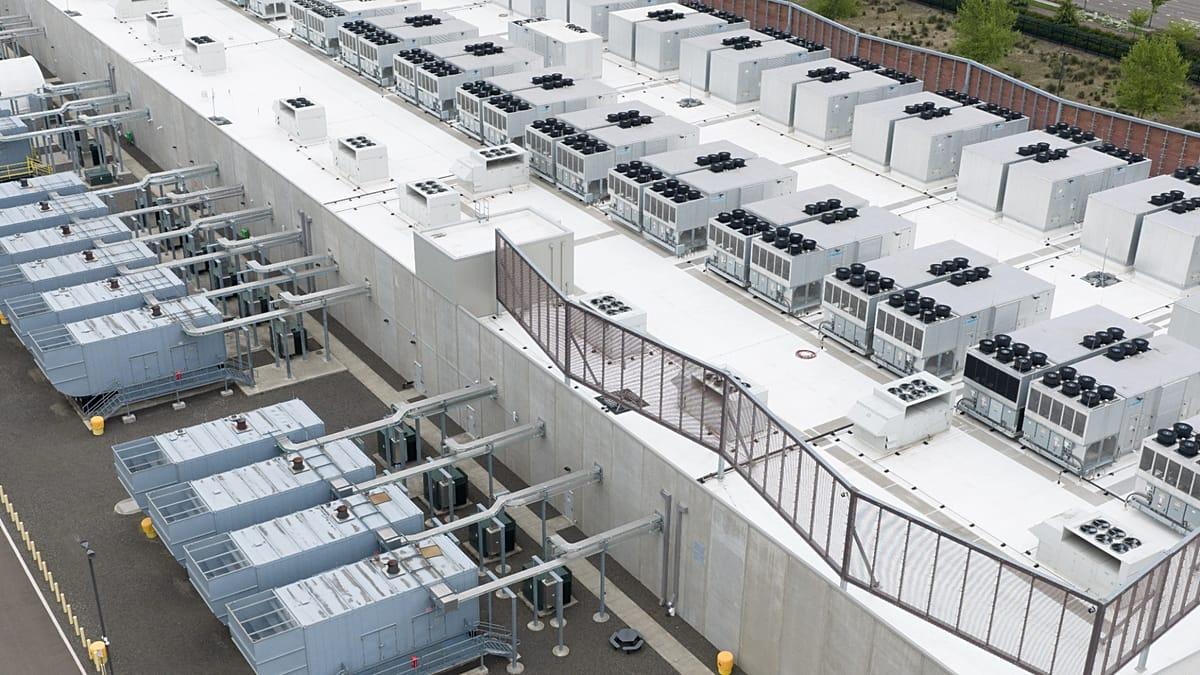
Source: Euronews
Denmark generates more than 80 per cent of its electricity from renewable sources, making it a global model for clean energy transition
2
. The irony is that the success of Denmark's green energy model attracted the data centers, and these facilities are now overwhelming the grid that made the country attractive in the first place2
.Henrik Hansen, CEO of the Danish Data Center Industry (DDCI), told CNBC that the connection request queue reflects a "fantasy," noting that "the gap between what's available and what's requested is growing"
1
. The DDCI estimates total installed power capacity for computing at 1.2 GW in 2030, less than 10% of what is currently being requested1
.Sebastian Bøtcher from Schneider Electric described the situation as energy policy "hunger games" between data centers and Danish businesses
1
. Digital Realty's Pernille Hoffmann warned that if grid capacity requirements are not met, AI players will be forced to "move [their workloads] somewhere else"1
.Denmark may follow Ireland's 2025 framework, which demands new datacenters over 10 MW to have their own power generation, be capable of feeding excess power back to the grid, and produce 80% of their annual demand from renewable sources
1
. This approach could become a model for powering the AI boom while maintaining grid stability and addressing the structural tension between building the world's cleanest electricity grid and attracting the world's largest technology companies2
.Summarized by
Navi
[1]
[2]
15 Aug 2025•Business and Economy

27 Jun 2025•Technology
31 Mar 2026•Technology

1
Health

2
Technology

3
Technology