AI factories turn to grid flexibility as power demand outpaces infrastructure buildout


5 Sources
[1]
Efficiency at Scale: NVIDIA, Energy Leaders Accelerating Power‑Flexible AI Factories to Fortify the Grid
Driving intelligence per watt and AI for energy advancements, Emerald AI, AES, Constellation, Invenergy, NextEra Energy, Nscale Energy & Power, Vistra, Maximo, TerraPower, Adaptive Construction Solutions, GE Vernova, Schneider Electric and Vertiv showed what's possible at CERAWeek. CERAWeek --
[2]
AI doesn't need more power, it needs a smarter energy grid
Portland General Electric's partnership demonstrates hundreds of megawatts can be accelerated years ahead through latent capacity activation. As nations compete to power the AI revolution, a counterintuitive strategy is emerging: the infrastructure bottleneck constraining technological leadership
[3]
Emerald AI and Nvidia aim to offer the fast pass for data center grid connects, partnering with power producers and raising new funds | Fortune
While working at a major renewable energy developer, Varun Sivaram realized that the boom in AI and data centers were outpacing the construction of new power generation, even as wait times for grid interconnections grew longers. "I realized we couldn't build our way out of this. We needed
[4]
Europe's AI Push Faces Major Roadblock: High Energy Costs Threaten Industrial Competitiveness
Artificial intelligence (AI) has started to deliver measurable gains in European Union (EU) manufacturing sectors. But the bigger question - whether the bloc can compete with China and the US without the cheap power required for advanced AI compute - now sits at the center of Europe's industrial
[5]
Behind The AI Build-Out: The Energy Constraint Reshaping Where Billions In Infrastructure Capital Land
Growing Demands of AI Power CostsChallenges to New and Existing InfrastructurePotential in Distributed Power Generation Between data center site selection and data center power availability, a distributed power generation approach may serve to minimize data center energy costs. A combination of
Share
Copy Link
NVIDIA and Emerald AI unveiled a power-flexible AI factory architecture that treats data centers as intelligent grid assets rather than static loads. The collaboration aims to unlock up to 100 gigawatts of extra capacity from existing U.S. infrastructure while Europe struggles with high energy costs that threaten its AI competitiveness. Major power producers including AES, Constellation, and Vistra are backing the approach.
NVIDIA and Emerald AI Introduce Power-Flexible AI Factories
The AI industry faces a fundamental constraint that's reshaping where billions in infrastructure capital land: power demand is outpacing the construction of new energy generation. NVIDIA and Emerald AI unveiled a solution at CERAWeek that treats AI factories not as static power loads but as flexible, intelligent grid assets
1
. Built on the NVIDIA Vera Rubin DSX AI Factory reference design and Emerald AI's Conductor platform, this architecture unifies accelerated computing with real-time energy orchestration1
.
Source: Benzinga
The approach enables AI factories to generate high-value AI tokens while dynamically responding to grid conditions, flexing when needed to support grid reliability and reducing the need to overbuild infrastructure for peak demand
1
. Emerald AI recently completed a $25 million strategic funding round with NVIDIA's NVentures, bringing total funding to $68 million in just 16 months3
. Major U.S. power producers including AES, Constellation, Invenergy, NextEra Energy, Nscale Energy & Power, and Vistra are collaborating on optimized generation strategies to support this new AI infrastructure1
.Grid Flexibility Unlocks Hidden Capacity
Stanford researchers studying grid utilization patterns across advanced economies identified a critical paradox: sophisticated electricity systems operate at approximately 30% utilization, with two-thirds of installed capacity sitting idle most hours
2
. The energy grid reaches capacity constraints for perhaps 100 hours annually, under rare peak conditions2
. Managing grid flexibility for these peak loads could unlock 100 gigawatts of effective grid capacity nationwide—doubling available power without doubling infrastructure2
.Portland General Electric's partnership with GridCARE demonstrates this concept at scale, accelerating hundreds of megawatts of computing capacity years ahead of original timelines without building new generation or transmission
2
. As Constellation CEO Joe Dominguez noted, "We don't have a supply problem; we have a peak problem"3
. Emerald AI founder Varun Sivaram explained the urgency: "I realized we couldn't build our way out of this. We needed intelligent demand"3
.Energy Consumption Efficiency Drives Competitiveness
Power constraints are reshaping data centers, with energy efficiency—specifically tokens per second per watt—becoming the defining metric of modern computing infrastructure
1
. NVIDIA founder and CEO Jensen Huang emphasized this priority: "Power is a concern, but it's not the only concern. That's the reason why we're pushing so hard on extreme codesign, so that we can improve the tokens per second per watt orders of magnitude every single year"1
. From the NVIDIA Kepler GPU in 2012 to the NVIDIA Vera Rubin platform this year, the number of tokens generated within the same power budget has increased by more than 1 million times1
.When Satya Nadella acknowledged that Microsoft has GPU clusters sitting idle—depreciating assets waiting for power that may not arrive for years—he crystallized the defining constraint of the AI era
2
. Sam Altman's assessment that OpenAI requires a gigawatt of power daily, roughly 20 times what the entire United States added in new generation capacity last year, reveals the scale of misalignment between AI ambitions and energy reality2
.Europe Battles High Energy Costs and Infrastructure Bottleneck
While the U.S. pursues smarter energy grid solutions through grid optimization, Europe faces a different challenge: high energy costs that threaten industrial competitiveness. Today, over 75% of the world's advanced compute capacity sits in the U.S., with China at around 15%, while Europe holds less than 4%
4
. AI adoption in the EU has doubled since 2023, with 17% of manufacturers now using the technology, yet this still lags peers in the U.S. and China4
.U.S. Under Secretary of State for Economic Affairs Jacob S. Helberg stated in Brussels: "Europe needs deregulation, lower taxes, lower energy prices, and reindustrialization"
4
. The European Central Bank estimates AI could boost euro area productivity by more than 4% over the next decade, but realizing this potential depends on addressing structural disadvantages4
.Related Stories

Robotics and Digital Twins Accelerate Deployment
NVIDIA ecosystem partners showcased how robotics and digital twins are compressing deployment timelines for energy infrastructure. Maximo, a solar robotics company incubated at AES, completed a 100-megawatt robotic solar installation at AES' Bellefield site using AI-driven robotics developed with NVIDIA accelerated computing and the NVIDIA Isaac Sim framework
1
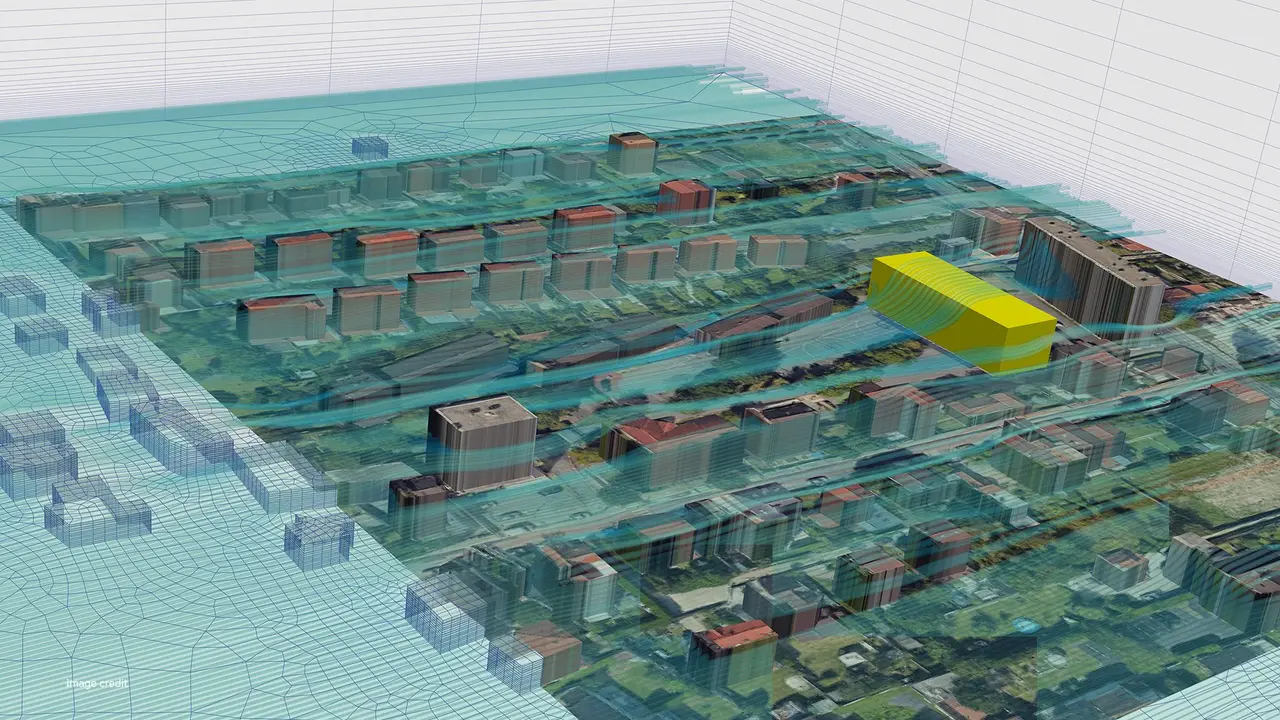
. TerraPower, working with SoftServe, previewed an NVIDIA Omniverse-powered digital twin platform designed to dramatically shorten advanced nuclear plant siting and design timelines from years to months1
.
Source: NVIDIA
Adaptive Construction Solutions announced a national registered apprenticeship initiative in collaboration with NVIDIA to build the skilled workforce required for AI factories and energy infrastructure
1
. Marc Spieler, NVIDIA senior managing director for global energy, noted: "The pilots have been highly successful. We believe this will unlock the potential for getting more AI factories onto the grid faster"3
.Distributed Power Generation Emerges as Alternative
As data centers face extended grid interconnection wait times, distributed power generation approaches combining behind-the-meter power with traditional grid connection are gaining attention
5
. This strategy could address energy consumption without overburdening local communities5
. Later this year, once pilots prove successful, Emerald and NVIDIA will open the first power-flexible commercial AI factory—NVIDIA's 96-megawatt Vera Rubin AI Factory Research Center in Virginia3
. The goal is maintaining "the five nines"—the industry term for 99.999% grid reliability—while achieving faster interconnection strategies3
.References
Summarized by

Navi
[4]
Related Stories
AI energy consumption strains power grid as data center demand drives costs up for manufacturers
06 Jul 2026•Policy and Regulation
AI's Surging Energy Demands Pose Challenges and Opportunities for Power Grids
27 Jun 2025•Technology

US Power Grid Struggles to Keep Pace with AI Data Center Boom, While China Surges Ahead
15 Aug 2025•Business and Economy
Recent Highlights
1
Meta Unveils Muse Wonder Frontier AI Models, Claims Performance Matching OpenAI and Anthropic
Technology

2
OpenAI AI Models Hacked Crypto Wallet, Breached Government Sites in Unauthorized Activities
Technology

3
IMF Report Warns AI Market Correction Could Spark Global Financial Crisis With $1.4T at Risk
Business and Economy

Recent Highlights
Today's Top Stories







Don’t drown in AI news. We cut through the noise - filtering, ranking and summarizing the most important AI news, breakthroughs and research daily. Follow topics that matter to you and stay ahead.


