DexForce Uses Virtual Data to Train Humanoid Robots, Raises $147M at $1.4B Valuation


3 Sources
[1]
Chinese startup DexForce trains humanoid robots using virtual data to slash costs
SHENZHEN, Oct 15 (Reuters) - At the offices of Chinese startup DexForce, a screen shows a virtual robot placing objects on a table. It repeats the task as the angle of its arms, the colour of the table and the objects themselves change. DexForce, based in the southern tech hub of Shenzhen, is
[2]
DexForce: Chinese startup DexForce trains humanoid robots using virtual data to slash costs
DexForce, based in the southern tech hub of Shenzhen, is betting that such simulated training can help solve one of the humanoid-robot industry's biggest challenges: teaching machines to perform a wide range of real-world tasks without human assistance. At the offices of Chinese startup DexForce,
[3]
Chinese startup DexForce trains humanoid robots using virtual data to slash costs
SHENZHEN, Oct 15 (Reuters) - At the offices of Chinese startup DexForce, a screen shows a virtual robot placing objects on a table. It repeats the task as the angle of its arms, the colour of the table and the objects themselves change. DexForce, based in the southern tech hub of Shenzhen, is
Share
Copy Link
Shenzhen-based DexForce is transforming humanoid robot training by using synthetic data generated in virtual environments instead of costly real-world data collection. The startup raised 1 billion yuan ($147 million) in Series B funding at a valuation exceeding 10 billion yuan, with backing from Lenovo Capital and major manufacturers.

DexForce Tackles Humanoid Robot Training Challenge
Chinese startup DexForce is addressing one of the humanoid robot industry's most pressing obstacles by training humanoid robots using virtual data instead of relying on expensive real-world data collection
1
. The Shenzhen-based company employs synthetic data generated in virtual environments to teach machines how to perform real-world tasks without human assistance, offering a cost-effective method to train humanoid robots2
. At DexForce's offices, screens display virtual robots repeatedly placing objects on tables while variables like arm angles, table colors, and object types continuously change3
.Why Traditional Training Methods Fall Short
Chief Executive Jia Kui, a machine-learning professor at the Chinese University of Hong Kong, Shenzhen, explained that achieving physical artificial general intelligence through purely real-world data collection would require 10 trillion samples
1
. He told Reuters that manual data collection for infinite human tasks is fundamentally inefficient, especially when human trainers may need to repeat a movement more than 100 times to generate precise examples2
. While China has developed humanoids capable of outperforming humans in running and jumping, the harder commercial test lies in whether they can reliably carry out useful work in factories, offices, and homes1
.The AI-Driven Training Methodology Behind DexForce
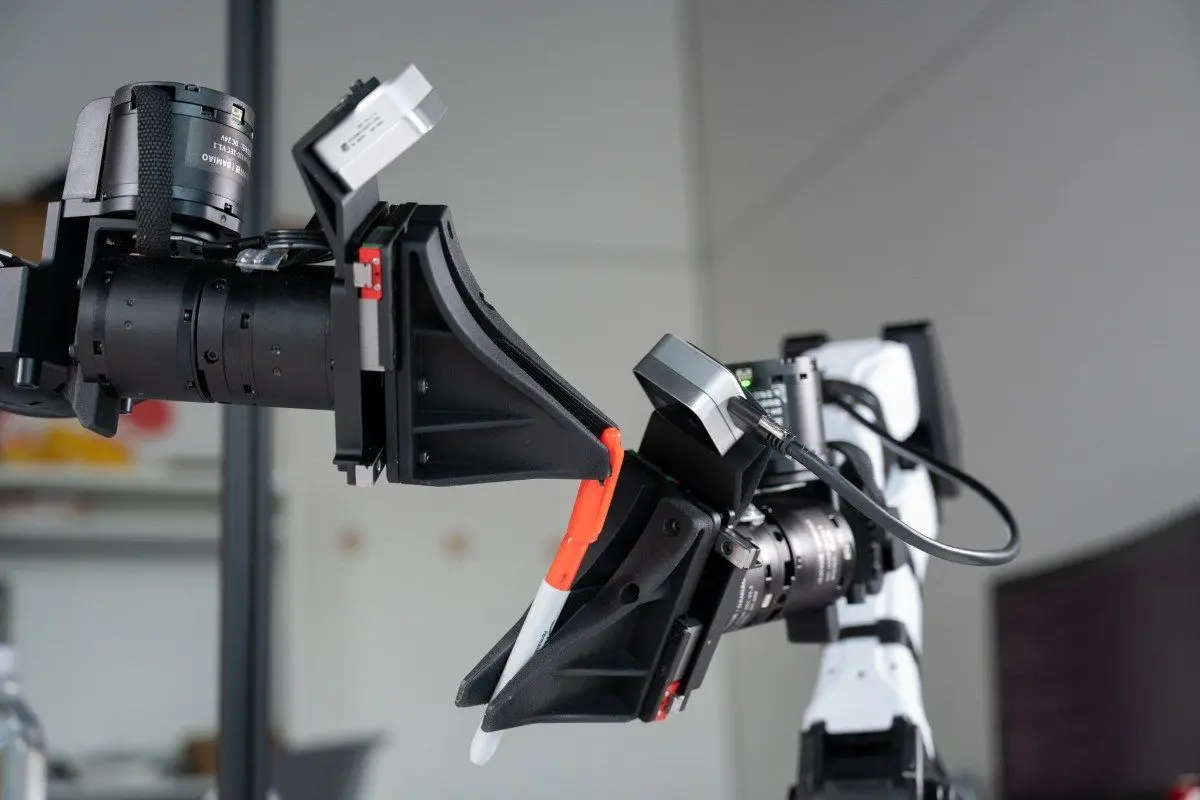
DexForce develops AI software designed to simulate physical environments and models intended to predict how objects move and interact
3
. The company creates a digital version of a workplace or task, trains a robot in the simulation, and then transfers that learning to physical machines1
. This AI-driven training methodology represents a stark contrast to the dozens of humanoid robot data training centers currently being built nationwide at great expense, which are often heavily reliant on government subsidies2
. Most Chinese robot makers use a combination of simulated and real-world data, with many citing access to high-quality training data as a key bottleneck1
.Related Stories
Strong Backing and Commercial Deployment
Founded in 2021 by Jia Kui, the roughly 500-employee startup is backed by Lenovo Capital, the investment arm of Lenovo, and Lens Technology, as well as several state-owned funds
2
. DexForce raised 1 billion yuan ($147 million) in a recent Series B funding round at a valuation of more than 10 billion yuan3
. Bloomberg reported the company was considering a Hong Kong IPO, though Jia declined to comment1
. The firm's software is already deployed in industrial settings by major manufacturers including Toyota, Samsung, Panasonic, Foxconn, Haier, and Hisense2
. Beyond factories, DexForce's humanoid robots make coffee and serve customers at malls and tourist sites in more than 15 cities nationwide3
.Implications for the Robotics Industry
Jia Kui believes this approach could more quickly power a breakthrough in robot capability, akin to the one ChatGPT triggered after its 2022 release helped propel generative AI into the mainstream
1
. Reaching physical artificial general intelligence will require AI systems that can perceive and navigate their surroundings and adapt to variation—a technological milestone where a humanoid can complete new tasks in an unfamiliar environment on command2
. Watch for how DexForce's synthetic data approach influences the broader robotics industry's training methodologies and whether it can deliver on the promise of achieving true task versatility at scale.References
Summarized by

Navi
Related Stories
China dominates humanoid robots market with 85% of global output, but finding buyers proves harder
03 Jun 2026•Business and Economy
China's AI-Powered Humanoid Robots: Transforming Manufacturing and Driving Economic Growth
13 May 2025•Technology
China Ships 97% of Global Humanoid Robots as US Struggles to Compete in Physical AI Race
11 Aug 2026•Technology

Recent Highlights



Recent Highlights
Today's Top Stories




Don’t drown in AI news. We cut through the noise - filtering, ranking and summarizing the most important AI news, breakthroughs and research daily. Follow topics that matter to you and stay ahead.


