2 Sources
[1]
Asian shares rally after Dow hits a record, as some AI shares bounce back
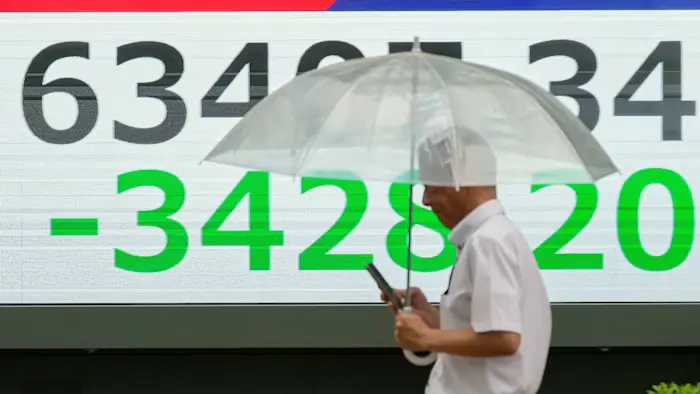
BANGKOK (AP) -- Shares rallied in Asia on Friday after the Dow Jones Industrial Average set another record, as some key AI related stocks rose while others extended losses. U.S. futures were moderately higher and oil prices also rose. South Korea's Kospi, which sank nearly 8% on Thursday, recovered some of those losses, gaining 2.8% to 7,863.22. Samsung Electronics, the country's biggest company and a major maker of computer chips, gained 7%. Smaller rival SK Hynix was up 4.9%. In Tokyo, the Nikkei 225 advanced 0.9% to 69,368.30. Chipmaker Tokyo Electron slipped 2.5%, while memory maker Kioxia jumped 6.6%. Hong Kong's Hang Seng climbed 1.7% to 23,444.45 and the Shanghai Composite index added 0.7% to 4,056.81. Taiwan's Taiex fell 0.6%. In Australia, the S&P/ASX 200 picked up 1.3% to 8,834.90. U.S. markets will be closed Friday for the Independence Day holiday. On Thursday, most U.S. stocks rose as the Dow snagged another record, gaining 1.1% to 52,900.07. But more drops for computer chip companies and other winners of the artificial-intelligence boom kept indexes mixed. The S&P 500 finished the day virtually unchanged and edged up by less than 0.1%, even though seven out of every 10 stocks within the index rose. It closed at 7,483.24. The Nasdaq composite dropped 0.8% to 25,382.67. Stocks broadly got some help from a report showing U.S. employers added 57,000 jobs to their payrolls last month. That's good for the economy, but it was also short of the 100,000 jobs that economists expected and a slowdown from May's hiring pace. The bright side of the weaker-than-expected result is that it could keep pressure off inflation, which has been accelerating worldwide because of jumps in oil prices caused by the war with Iran. And now that oil prices are back below where they were before the war, if inflation slows in upcoming months, the Federal Reserve may feel less need to raise interest rates several times this year. That would be a relief for investors, who tend to love lower interest rates because they can give the economy a boost by making it less expensive for U.S. households and businesses to borrow money and spend. Lower rates also tend to push upward on prices for stocks and other investments. Stocks of companies in the crypto industry were also strong after the price of bitcoin rose roughly 2%, a day after dropping near its lowest level since 2024. Robinhood Markets rose 3.8%, and Coinbase Global gained 3.9%. But more drops for computer chip companies weighed on indexes. They've come under pressure because of worries that their stock prices shot too high in the frenzy around AI and that all the spending on chips and data centers may not yield as much profit and productivity growth as hoped. Memory maker Micron Technology erased an early gain to drop 5.5%, a day after plunging 10.6%. Nvidia fell 1.4%, and Lam Research sank 10.2%. They were some of the heaviest weights on the S&P 500 because they've grown so huge in size amid AI mania. Nvidia has a total value of nearly $4.7 trillion, for example, which means that its stock's movements have more weight on the S&P 500 than any other. In other trading early Friday, Brent crude, the international standard, gained 0.6% to $72.26 a barrel. U.S. benchmark crude was up 0.5% to $69.05 a barrel. The dollar fell to 161.17 Japanese yen from 161.97 yen. The euro rose to $1.1439 from $1.1431. ___ AP Business Writers Matt Ott and Stan Choe contributed.
[2]
World shares rally after Dow hits a record, as some AI shares bounce back
BANGKOK -- Shares advanced Friday in Europe and Asia after the Dow Jones Industrial Average set another record, as some key AI related stocks rose while others extended losses. The future for the S&P 500 gained 0.4 per cent while that for the Dow was up 0.2 per cent. U.S. markets will be closed Friday for the Independence Day holiday. In early European trading, Germany's DAX rose 0.7 per cent to 52,643.30 and the CAC 40 in Paris gained 0.3 per cent to 8,497.30. Britain's FTSE 100 picked up 0.4 per cent to 10,689.77. During Asian trading, South Korea's Kospi, which sank nearly 8 per cent on Thursday, gained 5.8 per cent to 8,088.34. Samsung Electronics, the country's biggest company and a major maker of computer chips, gained 8.2 per cent, while its smaller rival SK Hynix jumped 10.9 per cent. In Tokyo, the Nikkei 225 advanced 1.5 per cent to 69,744.07. Chipmaker Tokyo Electron rose 0.4 per cent, while memory maker Kioxia jumped 9.2 per cent. Hong Kong's Hang Seng climbed 1.3 per cent to 23,345.28 and the Shanghai Composite index added 0.4 per cent to 4,043.64. Taiwan's Taiex edged 0.1 per cent higher, while the Sensex in India jumped 0.7 per cent. In Australia, the S&P/ASX 200 picked up 1.4 per cent to 8,844.40. "Asian stocks found some footing after two bruising tech-led sessions, with the Korean market once again showing how quickly a stretched rubber band can snap back when everyone leans the same way," Stephen Innes of SPI Asset Management said in a commentary. On Thursday, most U.S. stocks rose as the Dow snagged another record, gaining 1.1 per cent to 52,900.07. Drops for computer chip companies and other winners of the artificial-intelligence boom kept indexes mixed. The S&P 500 finished the day virtually unchanged and edged up by less than 0.1 per cent, even though seven out of every 10 stocks within the index rose. It closed at 7,483.24. The Nasdaq composite dropped 0.8 per cent to 25,382.67. Stocks broadly got some help from a report showing U.S. employers added 57,000 jobs to their payrolls last month. That's good for the economy, but it was also short of the 100,000 jobs that economists expected and a slowdown from May's hiring pace. The bright side of the weaker-than-expected result is that it could keep pressure off inflation, which has been accelerating worldwide because of jumps in oil prices caused by the war with Iran. And now that oil prices are back below where they were before the war, if inflation slows in upcoming months, the Federal Reserve may feel less need to raise interest rates several times this year. That would be a relief for investors, who tend to love lower interest rates because they can give the economy a boost by making it less expensive for U.S. households and businesses to borrow money and spend. Lower rates also tend to push upward on prices for stocks and other investments. Stocks of companies in the crypto industry were also strong after the price of bitcoin rose roughly 2 per cent, a day after dropping near its lowest level since 2024. Robinhood Markets rose 3.8 per cent, and Coinbase Global gained 3.9 per cent. Bitcoin rose 0.5 per cent early Friday. Selling of computer chip companies' shares has weighed on indexes. They've come under pressure because of worries that their stock prices shot too high in the frenzy around AI and that all the spending on chips and data centers may not yield as much profit and productivity growth as hoped. Memory maker Micron Technology erased an early gain to drop 5.5 per cent, a day after plunging 10.6 per cent. Nvidia fell 1.4 per cent, and Lam Research sank 10.2 per cent. They were some of the heaviest weights on the S&P 500 because they've grown so huge in size amid AI mania. Nvidia has a total value of nearly US$4.7 trillion, so its stock's movements have more weight on the S&P 500 than any other. In other trading early Friday, Brent crude, the international standard, gained 0.6 per cent to $72.26 a barrel. U.S. benchmark crude was up 0.5 per cent to $69.05 a barrel. The dollar fell to 160.97 Japanese yen from 161.11 yen. The euro rose to $1.1450 from $1.1431.
Share
Copy Link
Global stock markets experienced a mixed session as the Dow Jones Industrial Average reached a new record high of 52,900.07, while AI shares demonstrated sharp volatility. South Korea's Kospi rebounded 5.8% after an 8% plunge, with Samsung Electronics and SK Hynix leading gains. However, concerns persist about whether AI spending on chips and data centers will deliver expected returns.
The Dow Jones Industrial Average climbed to a fresh record high of 52,900.07 on Thursday, gaining 1.1%, even as stock markets displayed divergent signals across AI-related stocks
1
. The S&P 500 finished virtually unchanged, edging up less than 0.1% to 7,483.24, while the Nasdaq composite dropped 0.8% to 25,382.67, weighed down by continued selling pressure in semiconductor companies2
.
Source: AP
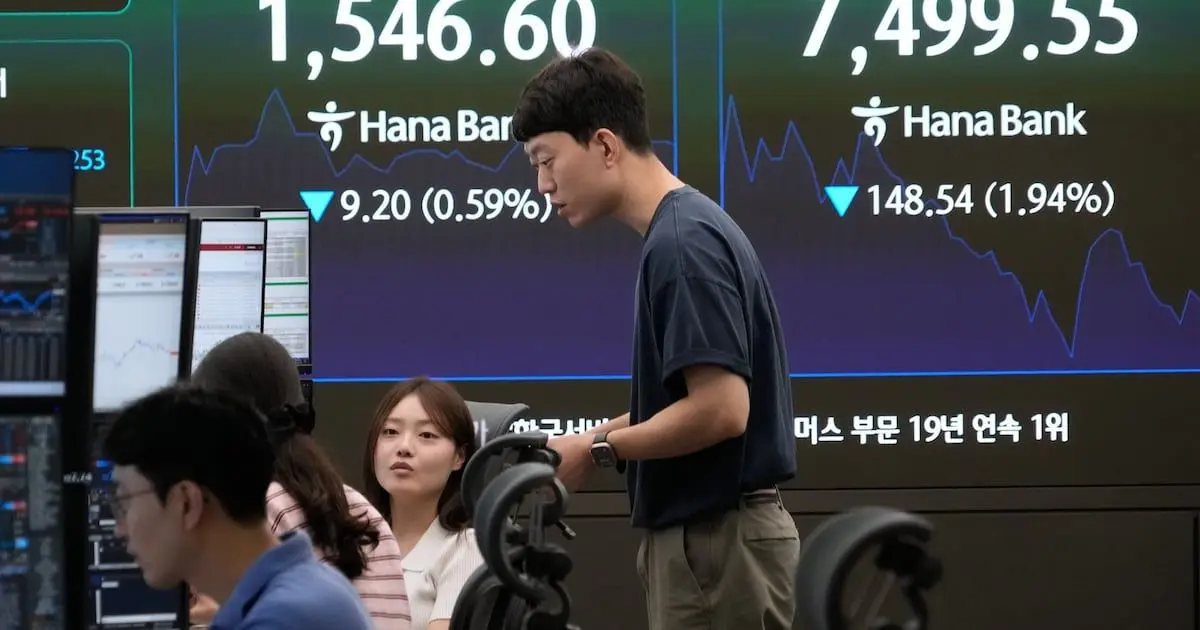
Asian markets mounted a strong recovery Friday following Thursday's brutal selloff. South Korea's Kospi, which had plunged nearly 8% the previous session, surged 5.8% to 8,088.34 as investors rushed back into beaten-down AI shares
2
. Samsung Electronics, the country's largest company and a major chipmaker, jumped 8.2%, while SK Hynix soared 10.9%. In Tokyo, the Nikkei 225 advanced 1.5% to 69,744.07, with memory maker Kioxia surging 9.2%2
. Stephen Innes of SPI Asset Management noted that "Asian stocks found some footing after two bruising tech-led sessions, with the Korean market once again showing how quickly a stretched rubber band can snap back when everyone leans the same way"2
.
Source: BNN
The sharp swings in AI shares underscore growing market sentiment around whether the AI boom justifies current stock valuations. Nvidia, with a total value of nearly $4.7 trillion, fell 1.4%, while Micron Technology dropped 5.5% after plunging 10.6% the previous day
1
. Lam Research sank 10.2%, contributing to the heaviest weights on the S&P 5002
. Investors worry that stock prices shot too high in the frenzy around AI and that spending on chips and data centers may not yield as much profit and productivity growth as hoped .Related Stories
A weaker-than-expected U.S. jobs report showed employers added just 57,000 jobs in June, short of the 100,000 economists predicted and a slowdown from May's pace
1
. While this signals economic softening, it could ease inflation concerns that have been accelerating worldwide due to oil price jumps caused by the war with Iran. With oil prices now back below pre-war levels, the Federal Fed may feel less pressure to raise interest rates multiple times this year2
. Lower interest rates typically boost stock markets by making borrowing cheaper for households and businesses, while pushing prices upward for stocks and other investments1
.Investors should monitor upcoming inflation data closely, as it will determine whether the Fed maintains its current stance or pivots toward rate cuts. The near-term outlook for AI-related stocks remains uncertain as the market tests whether current valuations reflect genuine productivity gains or speculative excess. European markets also showed strength Friday, with Germany's DAX rising 0.7% and Britain's FTSE 100 gaining 0.4%
2
.Summarized by
Navi
21 Aug 2025•Business and Economy

27 Feb 2025•Business and Economy

29 Aug 2024

1
Policy and Regulation

2
Policy and Regulation

3
Policy and Regulation