4 Sources
[1]
This World Cup could be the most high-tech yet -- the innovations to watch for
The FIFA World Cup 2026 kicks off at a stadium in Mexico City today in what could be the most high-tech edition of the tournament yet. Every team will have access to an artificial-intelligence tool that can analyse its players' movements, and digital avatars of the players, created from scans of their bodies, will help referees to model match action and spot illegal moves. To understand the role science will have in football's biggest tournament and where the field is heading, Nature spoke to the editor-in-chief of the journal Science and Medicine in Football, which publishes research on various forms of football, including association football -- also known as soccer -- American football and rugby. Franco Impellizzeri, also a sports scientist at the University of Technology Sydney in Australia, once competed for Italy's national taekwondo team. But he admires football -- "I'm Italian, so football is part of our culture" -- and has since collaborated on studies with football organizations including FIFA (the International Federation of Association Football) and elite clubs. He says that AI has led to a surge in football research, which he can see in journal submissions, but that until scientists work out how best to handle the data deluge, "an increase in quantity doesn't always come with a similar increase in quality". How will science play a part at this World Cup? FIFA has regularly introduced various technologies to improve the fan experience. For this edition, they have announced the use of AI-generated 3D avatars. There are also new systems to help referees make decisions, including detecting offsides and handball touches. The latter is made possible by using smart balls with sensors inside them. There is also a real-time system to provide staff with match analytics: information on how players move on the pitch, tactical behaviour and individual behaviours of the players. Since these systems are provided by FIFA, it is a great way to democratize access to technology. Whether the teams will have people on their staff who can actually use this information is another question. To what extent are teams now relying on science to improve play? Nowadays, most clubs and national teams have sport scientists, who are usually the ones taking care of data collection and analysis. Even if there isn't an official research position in the team, it's normal to have some staff members with a scientific background. Some clubs even have data-science departments. It's also very common now to have PhD students embedded in the team [carrying out studies]. Experiencing the everyday challenges faced by the team can help these scientists to develop research with more practical applications. What is most exciting in football research at the moment? I can tell you what the hot topics are right now, but 'hot' doesn't always mean exciting or promising in absolute terms. I would say that AI integration in decision-making, using wearables to collect information from players and sports analytics are major emerging areas. But there is always ongoing work in training-load management, which is the effect of the demands posed by training and competing on players' health.
[2]
A 2026 World Cup tech makeover is turning every player into a digital twin, with 16 cameras, a 13-gram smart ball, and millimeter-level scans that could settle the sport's tightest calls
The World Cup introduces a revolutionary AI offside system. Players are now 3D scanned, and a smart ball tracks every touch. This technology will deliver quicker, more precise decisions, reducing game delays. Fans will see lifelike 3D replays explaining complex calls. This innovation marks a significant advancement in football officiating. If you're watching the World Cup this summer, you might see something new during instant replays: a video-game-like 3D model of a player, frozen mid-stride, showing exactly where his foot was when the ball was kicked. That's not fun graphics. According to FIFA and Lenovo's announcement ahead of the tournament, every player has been digitally scanned to create an accurate 3D model that will be used in the new AI-enabled offside system. For American fans watching a World Cup on home soil for the first time in decades, here's a breakdown of the tech that's about to change how the beautiful game is officiated. Meet your digital twin Every player sat through a quick body scan before the tournament started. Each scan takes about a second and, according to FIFA and Lenovo, it makes highly accurate measurements of body parts, allowing the system to track players reliably even when they are moving fast or are partially blocked from view. Why is this important? The old system was based on generic one-size-fits-all player outlines to judge close offside calls. Now the outline is what the actual human being on the pitch looks like, right down to their exact build and proportions. Lenovo's global CIO, Art Hu, put it simply: no two footballers have the same physique, so each player's exact dimensions are now factored into the call. FIFA and Lenovo unveiled the AI-powered avatars that will officiate this summer's matches. Image Credits: Lenovo More eyes on the field than ever The optical tracking side has also leveled up, according to a Wired report. Hawk-Eye, the company behind the camera-based system, now uses 16 high-resolution cameras per stadium, up from 12 in 2022, capturing more than 2 dozen skeletal tracking points on each player during the match. That extra coverage means fewer blind spots in assessing where a foot, hand or shoulder was at the exact moment the ball was played. A smarter ball with a brain inside it The official match ball is no longer just a ball. The Adidas Trionda, named after the three host nations of Canada, Mexico and the US, is a 13-gram smart ball that replaces the old multi-panel design with only four thermally bonded panels. Sensors inside the ball track its exact location and spin 500 times a second, according to Wired, noting the precise moment of every touch. Then the data is paired with the player avatars. The system can additionally use the exact kick point from the ball's sensor and the limb positions of the 3D avatars to resolve offside calls in seconds rather than minutes. Meet the Trionda, the World Cup ball with a sensor-packed brain hidden inside. Image Credits: Adidas Tighter margins, faster flags One of the biggest frustrations with VAR in the past has been the waiting. This year's upgrade is designed to do just that. The new system, which will alert the linesman using an AI-powered system, will detect when an attacking player is more than 10 centimeters offside, a huge jump in precision compared to the 50-centimeter threshold used back in 2022. But the tighter calls, such as whether a player was actively interfering with play, still need a human referee to make the final call. It's worth noting this is not a robot-ref take-over. The system is officially 'semi-automated,' meaning AI and sensors determine where a player was and when the ball was hit, but human referees make the final call. According to Wired, the improved VAR system is also being used to check red-card decisions and instances where the referee may have wrongly identified the wrong player. Now, referees can also spot corner-kick mistakes, with alerts going straight to on-field officials via their headsets so play doesn't get held up any longer than necessary. A goalkeeper's eye view One notable new feature is a 3D goalkeeper view within the review system, according to Wired. It allows officials to "stand" in the goalkeeper's shoes and decide whether an offside attacker was obstructing their view or otherwise interfering with the play, which is traditionally one of the most difficult calls to make with standard camera angles. What this means for fans watching at home Here's where it gets fun for American viewers, who are steeped in the instant-replay culture of the NFL and NBA: the 3D avatars are rendered into life-like graphics that recreate offside calls on stadium screens and across the broadcast, translating a complicated decision into something you can understand in one short clip. The VAR review screen will become as familiar as the scoreboard itself. Image Credits: Lenovo The system has already undergone road tests. These digital avatars were successfully trialed as part of the offside technology at the FIFA Intercontinental Cup in Qatar last December, and earlier trials during the FIFA Club World Cup resulted in faster, more accurate offside calls, reducing game delays. The bigger picture This tech push isn't just about offside calls. Lenovo is also running digital twins of all 16 host stadiums for crowd and security management, and all 48 teams now have access to an analytics tool trained on 2,000-plus football-specific metrics. This is viewed as a pivotal moment in how the sport is officiated and watched by FIFA's own leadership. FIFA Secretary General Mattias Grafström said the AI-enabled 3D avatars are a major step forward in the way officiating technology supports accuracy and transparency. So the next time you see a slow-motion replay with a glowing 3D figure stretched across the field, you'll know exactly what's happening behind the scenes: a body scan, a smart ball and a whole lot of computing power, all working together to settle an argument that's been going on for as long as soccer has existed.
[3]
FIFA World Cup 2026 goes full AI: 3D player models, smart match balls and robot dogs set to transform football
The FIFA World Cup 2026 in the United States, Canada, and Mexico will showcase advanced technology. AI will create 3D player models for VAR reviews. Smart match balls will track every touch and referee cameras will offer new perspectives, enhacing the overall experience. Robot dogs will assist security. The FIFA World Cup 2026 will not just be remembered for its football. It could also go down as the tournament where artificial intelligence became a central part of the fan experience. From AI-generated 3D player avatars and sensor-equipped match balls to virtual reality-style replays and robot dogs guarding broadcast facilities, the upcoming World Cup in the United States, Canada and Mexico is set to showcase some of the most advanced technology ever seen in global sport. ALSO READ: FIFA World Cup 2026 Games Schedule in Indian Time (IST) PDF AI-Powered 3D Player Models Could Change VAR ForeverOne of the most talked-about innovations is FIFA's plan to create lifelike 3D digital models of every player participating in the tournament. Each player will undergo a rapid digital scan, allowing FIFA to generate highly detailed AI-powered avatars. These virtual replicas will be used during Video Assistant Referee (VAR) reviews, particularly for offside decisions. The technology is designed to improve tracking accuracy and help fans better understand controversial calls through realistic visual explanations. ALSO READ: FIFA World Cup Opening Ceremony Time in India: When and where to watch US, Canada, Mexico live streamings, performers list Instead of viewing simple lines on a screen, viewers could see detailed three-dimensional recreations that show exactly why a player was ruled onside or offside. Smart Match Balls Will Track Every TouchThe Adidas Trionda match ball contains an advanced motion sensor capable of transmitting data hundreds of times per second. The embedded technology can detect the precise moment the ball is kicked, touched or deflected and send that information directly to match officials and VAR systems. This data will help officials make faster and more accurate decisions involving offsides, handballs and disputed touches. AI and Sensors Working TogetherThe real breakthrough comes from combining player tracking with ball-tracking technology. Multiple cameras positioned around stadiums will monitor players in real time, while the sensor inside the ball records movement data. Artificial intelligence then processes both streams of information to create an automated offside analysis system. The final decision still rests with human officials, but the technology is expected to reduce errors and shorten review times. The result could be quicker VAR checks and fewer controversial calls during crucial matches. Virtual Reality-Like Replays for FansFans watching from home can expect a more immersive experience than ever before. The new technology will allow broadcasters to generate highly detailed virtual recreations of key moments. Using AI-generated player models and tracking data, viewers may be able to see incidents from multiple angles with greater clarity than traditional camera footage can provide. The aim is to make complex decisions easier to understand while bringing fans closer to the action. Referee Cameras Enter the SpotlightFor the first time at a FIFA World Cup, live broadcasts will also feature footage captured directly from cameras worn by referees. The cameras use AI-powered image stabilization technology to reduce shakiness and deliver a smoother viewing experience. Fans will be able to see parts of the game from the referee's perspective, offering a unique look at the speed and intensity of elite football. The footage may also assist VAR reviews and referee training. Meet the Robot Dogs of World Cup 2026Artificial intelligence will not be limited to the pitch. Robot dogs equipped with surveillance technology are being deployed at FIFA's International Broadcast Centre in Dallas. The four-legged machines will help monitor facilities, protect equipment and support security operations throughout the tournament. Videos of the robotic units patrolling and performing movements have already attracted attention online, giving fans a glimpse of the futuristic side of the World Cup.
[4]
The 2026 World Cup Is Running on AI From Kickoff to Final Whistle | PYMNTS.com
Behind the spectacle, a separate competition is playing out. Technology companies have turned the World Cup into the biggest live test of artificial intelligence in sports. Argentina, the defending champion, is using Google's Gemini to prepare for matches. Techweez reported that players and coaching staff will use Gemini to break down plays and analyze data on both their own and opponents' performance across the tournament. Google announced deals with several national teams including France, Morocco and the United States, with the AI working inside team preparation alongside kit sponsorship. Lenovo is going further. As FIFA's official technology partner, Lenovo deployed Football AI Pro, a tactical analysis tool built on FIFA's own football data model. Computer Weekly reported the tool analyzes more than 2,000 metrics and millions of data points per match. All 48 competing teams have access to it. Coaches can simulate tactical changes against opponents before a match. Players can pull personalized performance breakdowns after one. Lenovo said the tool is designed to give smaller nations, including tournament debutants Curaçao and Cabo Verde, access to the same analytical resources as major football powers. Real-Time AR Overlays, Facial Recognition The AI layer extends well beyond the pitch. Fans inside stadiums can point their phones at the field and see a live overlay showing player names, speeds and physical intensity data in real time, WION News reported. Outside venues, Google pushed tournament features across Search, Maps and Waze, including live score tracking and AI-generated tactical diagrams available to anyone following the matches. At stadium gates, fans are using their faces as tickets. The Next Web reported that a biometric identity layer runs alongside the consumer AI layer across all 16 host cities, letting fans move through entry checkpoints without physical documentation. The same report noted that more than 120 civil society groups, including the ACLU and Amnesty International, issued a travel advisory before the tournament, warning of facial recognition risks and advising some travelers to disable face unlock on their devices before arriving. FIFA Hides Abusive Posts On social media, FIFA expanded its Social Media Protection Service for the 2026 tournament. The Guardian reported that FIFA is offering the moderation tool free to all 48 football associations. The system scans 30,000 keywords across Facebook, Instagram, YouTube and TikTok. Abusive posts are hidden within two seconds. The person who sent the abuse can still see their own post, but it is not visible to the player or their followers. People of Color in Tech noted that users posting abusive content can also be banned from buying tickets to FIFA matches. The service does not run on X, which does not participate in the program. CBS News reported that during the 2022 World Cup in Qatar, the same system scanned more than 20 million posts and flagged nearly 20,000 as abusive, discriminatory or threatening. The 2026 tournament runs larger, spans three countries and carries greater commercial scale. Lenovo also built an intelligent command center that monitors tournament operations in real time and generates daily summaries for FIFA officials. Digital twins of all venues let FIFA track conditions and respond to issues across the tournament's footprint. The broadcast layer includes AI-generated 3D player avatars used in offside replays to give officials and viewers clearer visual context for decisions. FIFA President Gianni Infantino said 6 billion people are expected to watch from home. For all PYMNTS AI coverage, subscribe to the daily AI Newsletter.
Share
Copy Link
The FIFA World Cup 2026 introduces AI-generated 3D player models, sensor-equipped smart match balls, and real-time tactical analysis tools for all 48 teams. The technologically advanced tournament features semi-automated offside detection using 16 cameras per stadium, millimeter-level player tracking, and Google's Gemini AI for match preparation, marking a significant shift in how football is played and officiated.
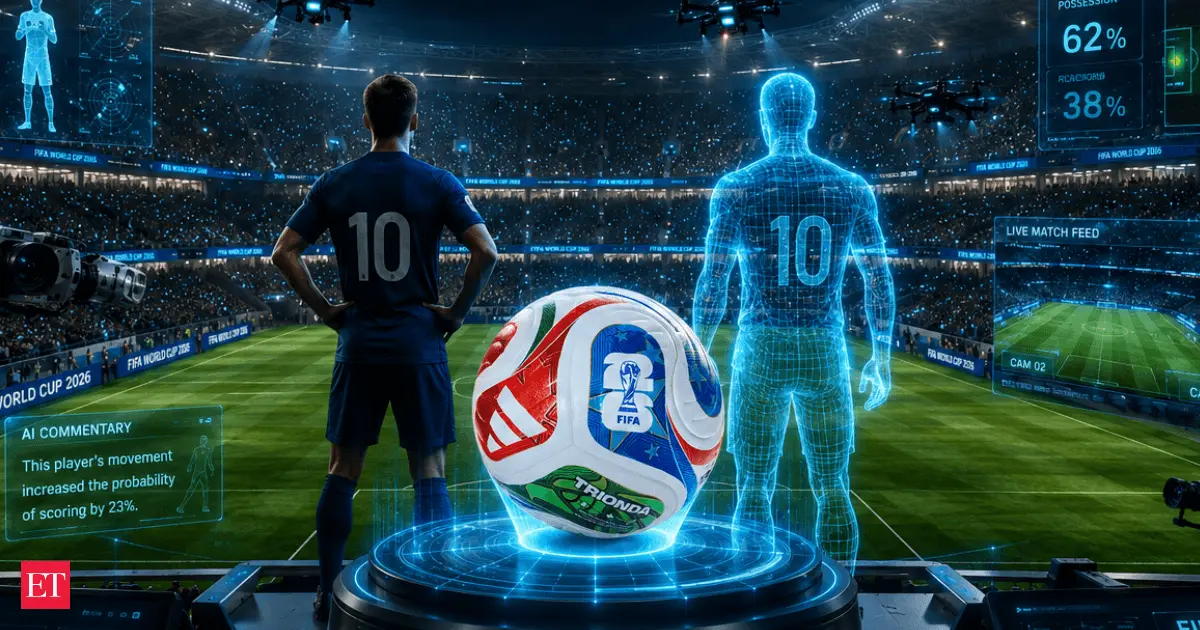
The FIFA World Cup 2026 kicks off as the most technologically advanced tournament in football history, with AI in sports transforming everything from officiating decisions to team preparation
1
. Every player competing across the United States, Canada, and Mexico has undergone digital scanning to create AI-generated 3D player models that will be used during Video Assistant Referee reviews, particularly for offside detection2
. The innovation represents a fundamental shift in sports officiating, moving from generic player outlines to precise digital twin technology that accounts for each athlete's exact build and proportions.
Source: ET
Football technology reaches new precision levels with the Adidas Trionda, a 13-gram smart ball equipped with sensors that track its exact location and spin 500 times per second
2
. The ball's embedded technology detects the precise moment of every touch, transmitting data directly to match officials and VAR systems3
. Combined with 16 high-resolution cameras per stadium—up from 12 in 2022—the system captures more than two dozen skeletal tracking points on each player during matches2
.
Source: ET
The semi-automated offside technology now detects when an attacking player is more than 10 centimeters offside, a massive improvement from the 50-centimeter threshold used in 2022
2
. While AI-powered innovations determine player positions and ball contact moments, human referees retain final decision-making authority, making this a semi-automated rather than fully robotic system.As FIFA's official technology partner, Lenovo deployed Football AI Pro, a tactical analysis tool that processes more than 2,000 metrics and millions of data points per match
4
. All 48 competing teams have access to this real-time match analytics platform, which FIFA provides to democratize access to technology1
. Coaches can simulate tactical changes against opponents before matches, while players receive personalized performance breakdowns afterward4
.The system gives tournament debutants like Curaçao and Cabo Verde access to the same analytical resources as established football powers
4
. Meanwhile, defending champion Argentina is using Google's Gemini to break down plays and analyze data on both their own and opponents' performance, with similar deals struck with France, Morocco, and the United States4
.Related Stories
The fan experience transforms with lifelike virtual replays that recreate offside calls using AI-generated 3D player models frozen mid-stride, showing exactly where a foot was when the ball was kicked
2
. Fans inside stadiums can point their phones at the field to see live overlays displaying player names, speeds, and physical intensity data in real time4
. For the first time at a FIFA World Cup, broadcasts will feature footage from cameras worn by referees, using AI-powered image stabilization technology to deliver smoother viewing experiences3
.
Source: PYMNTS
A notable innovation includes a 3D goalkeeper view within the review system, allowing officials to virtually stand in the goalkeeper's position and determine whether an offside attacker was obstructing their view
2
. With FIFA President Gianni Infantino expecting 6 billion viewers worldwide, these enhancements aim to make complex decisions more understandable4
.Franco Impellizzeri, editor-in-chief of Science and Medicine in Football and sports scientist at the University of Technology Sydney, notes that AI has led to a surge in AI-driven football research visible in journal submissions
1
. Current hot topics include AI integration in decision-making, using wearables to collect player information, and sports analytics, though Impellizzeri cautions that "an increase in quantity doesn't always come with a similar increase in quality"1
.Most clubs and national teams now employ sport scientists for data analysis, with some maintaining entire data-science departments
1
. PhD students are increasingly embedded in teams to develop research with practical applications1
. Beyond the pitch, robot dogs equipped with surveillance technology patrol FIFA's International Broadcast Centre in Dallas for security operations3
, while facial recognition systems allow fans to use their faces as tickets across all 16 host cities4
.Summarized by
Navi
07 Jan 2026•Technology

07 Jun 2026•Technology

16 Oct 2024•Technology

1
Technology

2
Business and Economy

3
Health