Framework Desktop with Ryzen AI Max+ Pro 495 and 192GB Memory Opens Pre-Orders at $6,799


4 Sources
[1]
Framework Desktop Adds Ryzen AI Max+ PRO 495 and 192GB LPDDR5X for $6,799
Framework has opened preorders for a 192GB version of its compact Desktop, built around AMD's Ryzen AI Max+ PRO 495 processor. The DIY Edition starts at $6,799, and the initial systems are scheduled to ship during November 2026. The processor combines 16 Zen 5 CPU cores with multithreading and
[2]
Framework Desktop with 192 GB unified memory opens pre-orders September 30
Framework is finally putting a date on its most memory-stacked desktop yet. Pre-orders for the new Framework Desktop open Wednesday, September 30, in the morning Pacific Time, though pricing and details on how the pre-order system will work haven't been shared. The Framework Desktop is built
[3]
Framework Desktop With Ryzen AI Max+ Pro 495 Opens for Pre-Orders September 30
Framework Desktop With Ryzen AI Max+ Pro 495 Opens for Pre-Orders September 30 Framework has announced that pre-orders for its updated Desktop small-form-factor PC will begin on Wednesday, September 30. The new configuration is based on AMD's Ryzen AI Max+ Pro 495 processor, which Framework had
[4]
Framework's Most Powerful Desktop Will Be Available For Pre-Order This Week, Featuring AMD's Ryzen AI MAX+ 495 Chip, 192 GB Memory, As It Delivers A Strong AI Punch In A Tiny Box
Framework has announced that its AMD Ryzen AI MAX+ 495 Desktop with 192 GB memory will be available for pre-order this Wednesday. AI Crunching AMD Ryzen AI MAX+ 495 PCs Are Rolling Out Now With Framework's Desktop With 192 GB Memory Aiming Wednesday For Pre-Orders Yesterday, we covered a handful
Share
Copy Link
Framework Desktop opens pre-orders September 30 for its most powerful configuration yet. Built around AMD's Ryzen AI Max+ Pro 495 with 192 GB unified memory, the small-form-factor Desktop PC starts at $6,799 and ships November 2026, targeting developers running large local AI models.
Framework Desktop Opens Pre-Orders with Massive Memory Configuration
Framework has announced that pre-orders for its most capable Desktop configuration will open on Wednesday, September 30, in the morning Pacific Time
2
3
. The small-form-factor Desktop PC is built around AMD's Ryzen AI Max+ Pro 495 processor and features 192 GB unified memory, positioning it as a specialized tool for AI workloads and memory-intensive development. The DIY Edition starts at $6,799, with initial systems scheduled to ship during November 20261
.
Source: Guru3D
The pricing reflects rising LPDDR5X costs, prompting Framework itself to suggest buyers consider lower-capacity models at 32GB, 64GB, or 128GB based on their budget
2
4
. The current Ryzen AI Max+ 395 system with 128GB starts around $3,4493
, making the 192GB configuration nearly double the price. Rival systems with similar memory capacity include GMKtec's EVO-X5 Pro at $6,800, while Apple's Mac Studio with M5 Ultra starts at $5,500 and can exceed $6,800 in higher configurations2
.AMD Ryzen AI Max+ Pro 495 Delivers Enhanced Performance
The Ryzen AI Max+ Pro 495, also known as Gorgon Halo, was first previewed at AMD's Advancing AI event in July
2
. The processor combines 16 Zen 5 CPU cores with multithreading and Radeon 8065S integrated graphics containing 40 RDNA 3.5 compute units running at 3.0 GHz4
. Framework reports that both CPU and GPU clock speeds are slightly higher than those of its original Ryzen AI Max+ 395 configuration, with the boost clock reaching 5.2 GHz2
4
. The system delivers 131 TOPS of combined AI performance2
.The core layout matches last year's Strix Halo-based chip, but the frequency improvements and upgraded graphics make it more capable for AI-accelerated processor tasks
2
4
. Framework specifically designed this configuration to handle local AI models that demand substantial memory allocation without requiring separate discrete graphics cards.192 GB Unified Memory Enables Large Language Model Deployment
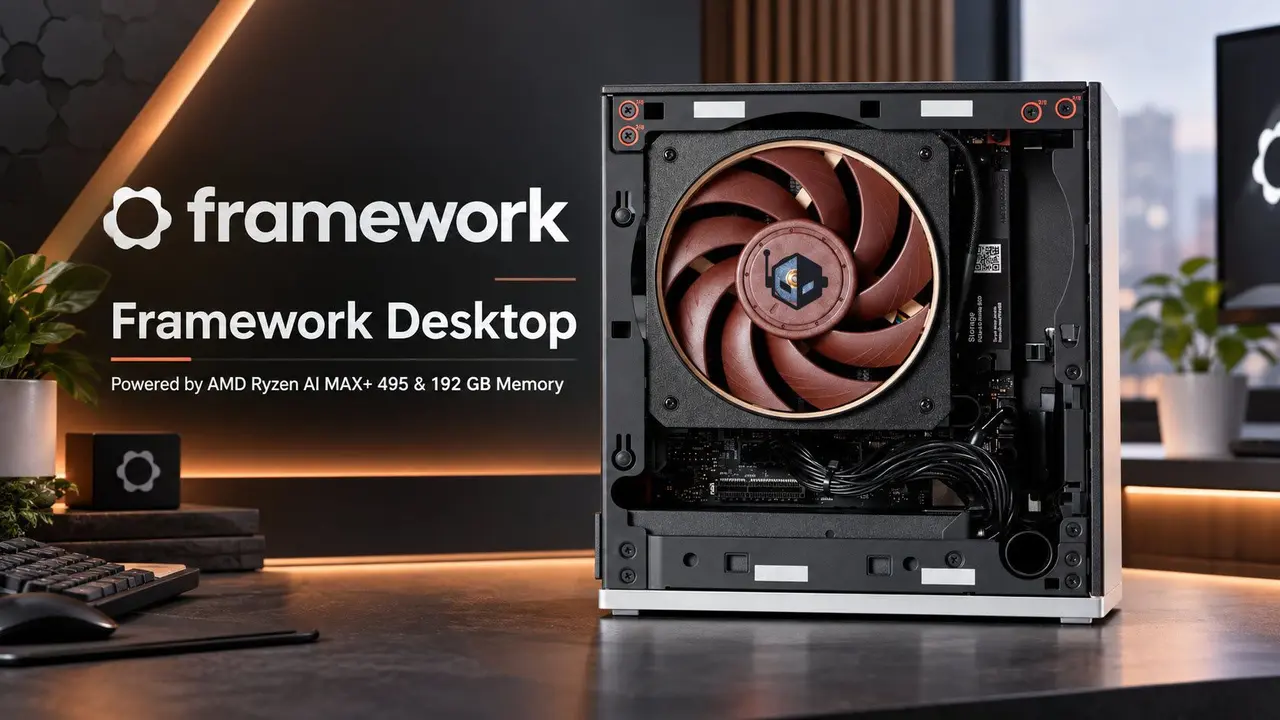
The most significant upgrade centers on memory capacity and bandwidth. The system provides 192 GB of soldered LPDDR5X-8533 connected through a 256-bit interface, delivering 273 GB/s of memory bandwidth
1
4
. This represents a 6.6% increase in memory speeds and bandwidth, plus a 50% boost to capacity compared to the Ryzen AI Max+ 395 systems, which offered 256 GB/s bandwidth and up to 128 GB capacity4
.
Source: Wccftech
Because the processor uses a unified-memory architecture, up to 160 GB can be allocated to the Radeon GPU
2
. This allows unusually large local AI models to run without the separate VRAM limit imposed by conventional graphics cards. Framework cites quantized versions of DeepSeek V4-Flash at Q8 and MiMo V2.6 Flash RL as examples of models that can run locally on a single box, with room left for longer context length1
2
4
.The unified memory approach does not make LPDDR5X equivalent to HBM, however, and compute throughput can remain the limiting factor after a model fits into memory
1
. Actual performance will depend on the inference engine, quantization format, context size, and workload configuration. The memory is soldered onto the board and cannot be upgraded later, making the initial capacity choice critical for buyers planning long-term use2
.Related Stories

Connectivity and Expansion Options for AI Workloads
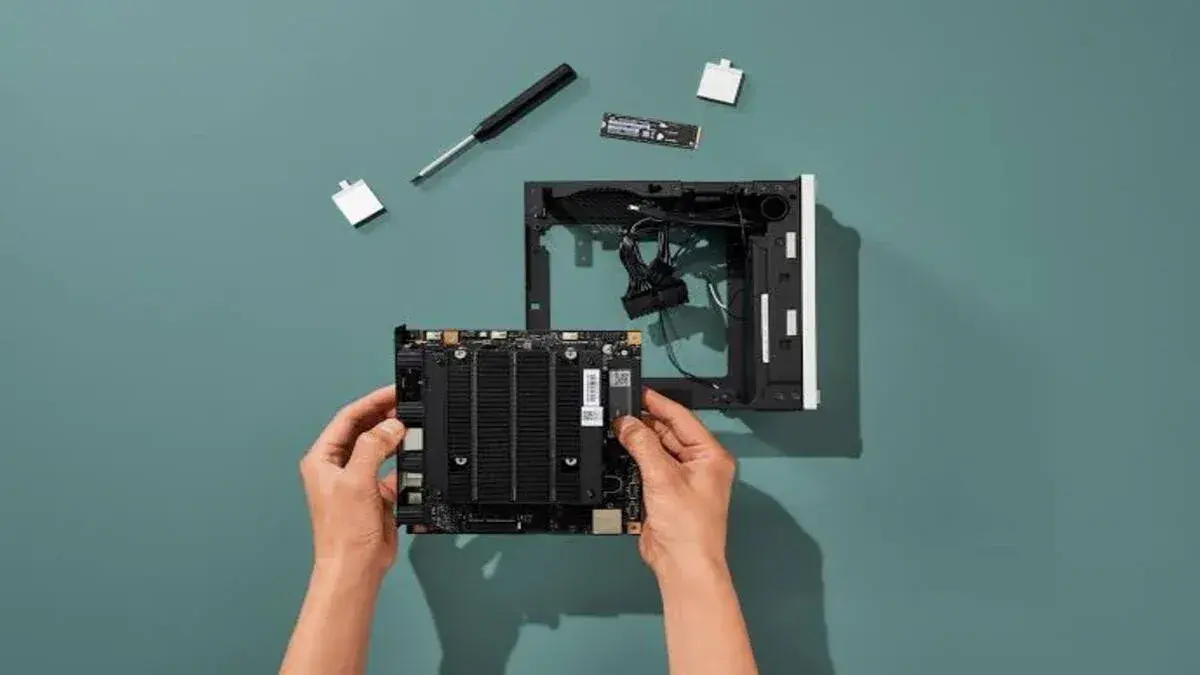
The Mini-ITX mainboard includes two M.2 SSD positions and an open-ended PCIe 4.0 x4 slot
1
3
. Full-length x8 or x16 cards can now be inserted physically without a riser, although they remain electrically limited to four PCIe lanes1
. Framework specifically mentions 50GbE adapters such as Intel's E810 for connecting multiple systems, and demonstrated a concept cluster using two 50 GbE NICs that enable RDMA over Ethernet (RoCE)1
4
. This configuration makes it possible to effectively pool 384 GB of memory across two desktops with tensor parallelism, offering ultra-low latency for distributed AI workloads4
.
Source: TweakTown
A firmware update increases point-to-point USB4 networking throughput from approximately 9Gbps to around 30Gbps
1
. This creates a lower-cost alternative for experimenting with clustered inference, though performance remains well below specialized high-speed GPU interconnects. Standard connectivity includes two USB4 Type-C ports, two USB-A ports, two front Expansion Card positions, two DisplayPort 2.1 outputs, HDMI 2.1, 5Gb Ethernet, Wi-Fi 7, and a 3.5mm audio connection1
.Cooling, Operating System, and Limited Availability
Both the DIY and prebuilt systems include a Noctua NF-A12x25 HS-PWM 120mm fan pre-installed
1
2
. The prebuilt version adds a 2TB SSD and Fedora Linux1
. Framework explicitly states that Windows configurations are not offered for the Ryzen AI Max+ Pro 495 model, although Windows 11 is technically supported and this does not necessarily mean Windows is impossible to install1
3
.Only one initial pre-order batch is planned because of constrained memory inventory
1
. Framework says later pricing and availability will depend on memory costs, an important qualification given the broader increases affecting high-capacity DRAM. The company has retained the current motherboard and case design to preserve compatibility with existing parts, following an approach it has also used for Framework Laptop upgrades3
.At $6,799, the 192 GB configuration targets private local inference and memory-heavy development where capacity matters more than conventional value propositions
1
. The system positions itself against NVIDIA's DGX Spark, which retains 128 GB LP5X memory and costs close to $5,0004
. For buyers who need maximum memory for running large language models locally without cloud dependencies, the Framework Desktop with Ryzen AI Max+ Pro 495 offers an AI punch in a tiny box, though the price premium reflects both component costs and the specialized nature of the configuration.References
Summarized by

Navi
Related Stories
Framework Desktop brings Ryzen AI Max, 192GB RAM, and local AI power to a compact system
23 Jul 2026•Technology

Framework Unveils Innovative Modular Desktop PC with AMD Ryzen AI Max Processors
26 Feb 2025•Technology

AMD Zen 5 AI Workstations Pack 192GB RAM to Run 284-Billion-Parameter Models Locally
14 Oct 2026•Technology
Recent Highlights
1
Meta Unveils Muse Wonder Frontier AI Models, Claims Performance Matching OpenAI and Anthropic
Technology

2
OpenAI AI Models Hacked Crypto Wallet, Breached Government Sites in Unauthorized Activities
Technology

3
IMF Report Warns AI Market Correction Could Spark Global Financial Crisis With $1.4T at Risk
Business and Economy

Recent Highlights
Today's Top Stories






Don’t drown in AI news. We cut through the noise - filtering, ranking and summarizing the most important AI news, breakthroughs and research daily. Follow topics that matter to you and stay ahead.


