Gartner warns 40% of enterprises will decommission AI agents by 2027 due to governance failures


3 Sources
[1]
Lack of AI governance could force 40% of enterprises to roll back autonomous AI agents by 2027
* Two in five companies could have to scale back AI agents by 2027 * Companies urged to reconsider basic governance policies * Thorough, four-stage framework introduced Gartner has warned that as many as two in five enterprises will have to decommission their AI agents by 2027 due to gaps in
[2]
Gartner Predicts 40% of Enterprises Will Decommission Autonomous AI Agents by 2027
"Enterprises are treating AI agent governance as binary, either locked down or fully trusted, and that is the root cause of failure," said Shiva Varma, Senior Director Analyst at Gartner. "Agents operate at different autonomy levels and across different trust boundaries. When the same controls are
[3]
Gartner: Uniform Governance Is a Death Sentence for Enterprise AI Agents
By 2027, 40% of Enterprises Will Demote or Decommission Autonomous AI Agents Due to Governance Failures Applying uniform governance to all AI agents, regardless of their autonomy level and scope, can lead to enterprise AI agent failure, according to Gartner, Inc., a business and technology
Share
Copy Link
Gartner predicts two in five companies will have to scale back their autonomous AI agents by 2027 because of critical gaps in governance frameworks. The root cause? Organizations treat AI governance as binary—either fully locked down or completely trusted. This uniform approach creates security vulnerabilities and operational risks that often surface only after production incidents occur.
Gartner Predicts Massive AI Agent Rollbacks Due to Governance Gaps
Gartner has issued a stark warning for organizations deploying AI agents: by 2027, 40% of enterprises will demote or decommission their autonomous AI agents due to inadequate governance frameworks
1
. The prediction highlights a critical flaw in how companies approach AI governance—treating it as an all-or-nothing proposition rather than implementing controls tailored to different autonomy levels.
Source: DT
The issue stems from organizations applying uniform governance for AI agents regardless of their capabilities or risk profiles. "Enterprises are treating AI agent governance as binary, either locked down or fully trusted, and that is the root cause of failure," said Shiva Varma, Senior Director Analyst at Gartner
2
. This one-size-fits-all approach creates two dangerous failure modes that enterprises must navigate carefully.The Dual Risks of Binary AI Governance
When organizations fail to distinguish between an agent's ability to act and the scope of access it receives, they encounter predictable problems. Over-restriction of simple agents slows delivery and frustrates teams, driving them toward shadow development using unapproved tools—which ironically increases data exposure risks
1
. On the opposite end, under-restriction of more autonomous AI agents grants them access to systems they shouldn't touch, amplifying operational, security issues, and compliance risks3
.The timing of these governance gaps makes them particularly dangerous. Many organizations only discover critical vulnerabilities after production incidents occur, when AI agents have already caused damage that requires reactive rollbacks
3
. This reactive approach not only disrupts operations but also erodes trust in AI deployments across the organization.A Four-Stage Framework for Access Controls
Source: CXOToday
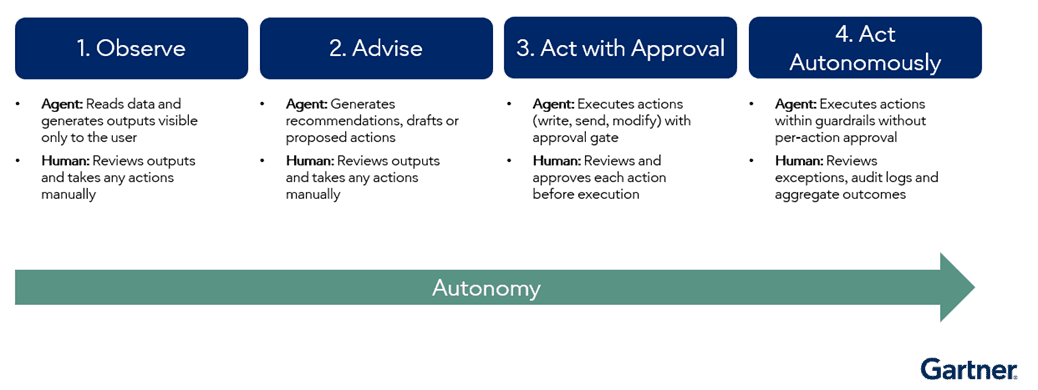
To address these challenges, Gartner recommends enterprises adopt a proportional governance approach that recognizes different trust boundaries. The four-stage framework for access controls provides granular governance tailored to each autonomy level
1
.Level 1: Observe agents operate with read-only access to defined data sources, with outputs visible only to the requesting user. Common applications include document summarization and knowledge retrieval. Governance at this level focuses on scoped data access, user authentication, and usage logging
3
.Level 2: Advise agents generate recommendations or proposed actions that humans must review manually. These agents retain read-only access with no write capabilities. However, advisory agents can anchor human judgment through automation bias, creating downstream risk when inaccurate outputs are trusted. Governance should extend to accuracy testing, hallucination detection, and user training on appropriate reliance levels
3
.Level 3: Act with Approval grants agents the ability to execute actions, write data, and send communications—but only after explicit human approval every single time
1
. Varma warns that human review remains effective only if it constitutes a meaningful control. Without strong security testing and clear approval workflows with audit trails, approvals can degrade under time pressure, creating a false sense of safety3
.Related Stories

The Highest Stakes: Autonomous Action
Level 4: Act Autonomously represents where AI agents truly operate independently within defined guardrails. Humans review exceptions, audit logs, and aggregated outcomes rather than individual decisions. When agents execute actions at scale and speed that outpace human oversight, the stakes escalate dramatically. "Because accountability for outcomes remains with the organization, this level requires the most rigorous governance, including continuous monitoring, enforced guardrails, rapid rollback mechanisms, circuit breakers that halt agent operation on threshold violations and clear ownership for agent behavior," Varma explained
1
.
Source: TechRadar
For organizations rushing into autonomy without careful consideration of what agents can read and write, the consequences extend beyond immediate security breaches. Enterprises decommission AI agents not just because of technical failures, but because governance gaps undermine confidence in AI systems entirely. With a calculated approach to governance that matches controls to risk levels, companies can avoid reactive rollbacks and build sustainable AI agent deployments that deliver value without compromising security or compliance.
References
Summarized by

Navi
[1]
Related Stories
77% of IT managers say their AI agents are out of control as governance gap widens
21 Apr 2026•Technology
AI Agents Outpace Governance Frameworks as Enterprise Security Risks Multiply
10 Mar 2026•Policy and Regulation

AI Agents Trigger Security Crisis: 65% of Enterprises Report Incidents Amid Scaling Challenges
06 Aug 2026•Technology
Recent Highlights



Recent Highlights
Today's Top Stories



Don’t drown in AI news. We cut through the noise - filtering, ranking and summarizing the most important AI news, breakthroughs and research daily. Follow topics that matter to you and stay ahead.


