Genesis AI unveils Eno robot with wheels, challenging the $39 billion humanoid robot industry


4 Sources
[1]
Genesis AI bets wheels beat legs in the robot race
Genesis AI unveiled Eno, a wheeled robot with dexterous hands and a foundation model called GENE, positioning it as a cheaper, more practical alternative to humanoids. The French-American startup has raised $105 million in seed funding and plans customer deployments by the end of 2026. On Tuesday,
[2]
Eno humanoid robot debuts as general-purpose worker for industries
Genesis AI has unveiled Eno, its first general-purpose robot, as the company pushes toward building machines that can work across factories, laboratories, hospitals, hotels and eventually homes. The robot combines Genesis AI's custom hardware with GENE, the company's robotics foundation model,
[3]
French startup unveils non-humanoid robot as AI race moves to physical machines
French robotics startup Genesis AI on Tuesday unveiled Eno, its first general-purpose robot, marking a step toward bringing advanced AI into physical machines. Backed by former Google CEO Eric Schmidt, the company says the wheeled robot is designed to extend human capabilities rather than mimic
[4]
French startup bets on non-humanoid design in crowded AI robot race
PARIS, June 16 (Reuters) - Genesis AI, the French robotics startup backed by former Google CEO Eric Schmidt, unveiled its first general-purpose robot on Tuesday, as AI capabilities expand beyond chatbots and into physical machines. The robot, named Eno, breaks from the humanoid design usually
Share
Copy Link
French-American startup Genesis AI has introduced Eno, a wheeled robot with human-like hands and a foundation model called GENE, positioning it as a cheaper alternative to humanoid robots. The company raised $105 million in seed funding and plans customer deployments by the end of 2026, targeting logistics, manufacturing, and healthcare sectors.
Genesis AI Challenges the Humanoid Robot Consensus
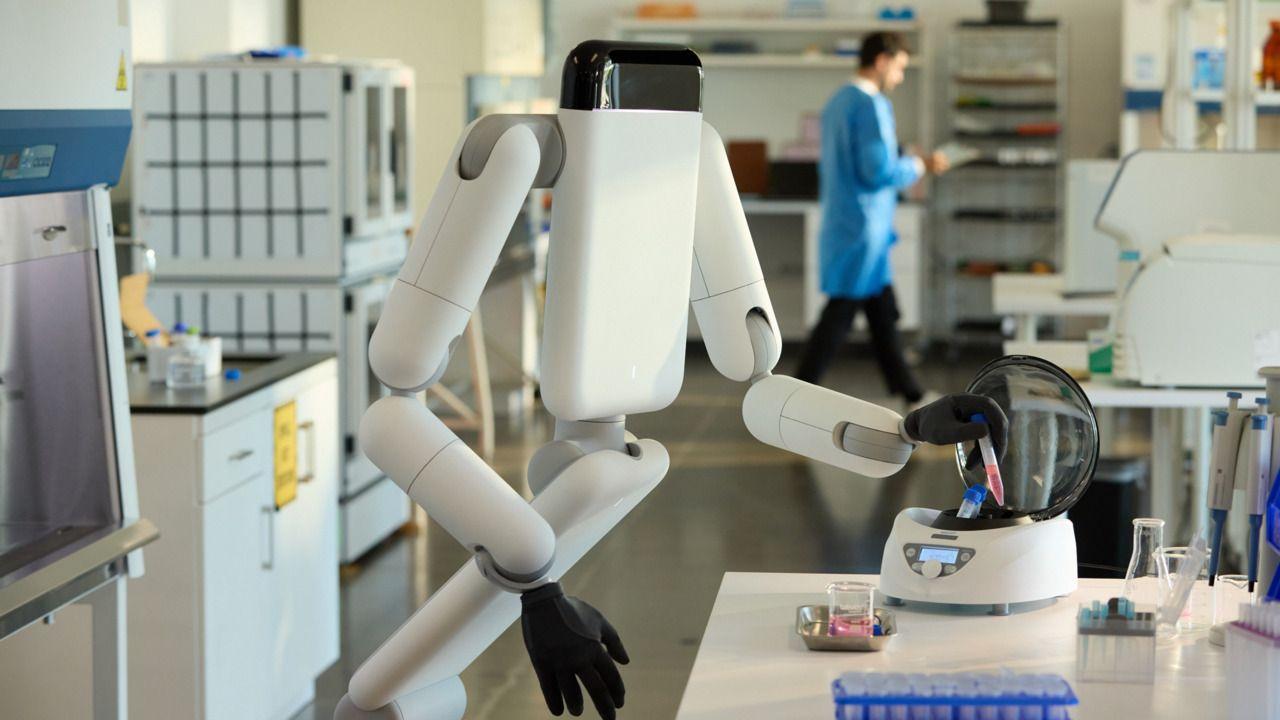
While the AI robotics industry pours billions into machines designed to walk like humans, Genesis AI took a different path on Tuesday by unveiling Eno, a wheeled robot that deliberately rejects the prevailing assumption that useful robots must mimic human form
1
. The French-American startup's non-humanoid robot features a foldable tower, dexterous hands, and runs on GENE, a robotics foundation model that its creators say delivers human-level manipulation capabilities2
.The bet against Genesis AI appears enormous at first glance. Figure AI holds a $39 billion private valuation and has begun deploying its Figure 03 humanoid in a Catalyst Brands warehouse
1
. Boston Dynamics and Hyundai plan to produce 30,000 Atlas humanoid robots annually by 2028 for deployment at car factories in Georgia, while Norway's 1X Technologies sold out its first production run of 10,000 home robots within five days of opening preorders1
. Yet Genesis AI believes the gap between supply-side ambition and demand-side reality vindicates its approach, particularly given that only 23% of buyers in China's market of 14,000 units reported satisfaction in 20251
.Why Wheels Beat Legs for Industrial Applications
"The hardest problem in robotics is not locomotion," Zhou Xian, Genesis AI's co-founder and CEO, explained
1
. Instead, it's manipulation—the ability to handle objects with the dexterity and adaptability of a human hand. The Eno robot's wheeled base represents the direct consequence of that diagnosis. Wheels are cheaper to build, simpler to stabilize, and safer to deploy around humans than bipedal legs, which remain an unsolved engineering challenge at commercial scale1
.Vivian Sun, Vice President of Commercial and Strategy at Genesis AI, told Reuters that the wheeled base was chosen because most industrial customers operate on flat floors, adding that legs would only make sense for use cases like climbing stairs
4
. "We are mimicking humans in capabilities, not in form. Humans can go up and down, and so does the robot, but through this foldable design," Sun said3
. The general-purpose robot can change its height and reach in real time and fold into a more compact form when not in use2
.Human-Like Hands and the $300 Training Solution
The Eno robot's most human-like features are its robotic hands, which Genesis AI says match the form and function of human hands, allowing the machine to use existing tools and interact with environments already designed for people
2
. Most robotics companies teach their machines through teleoperation, in which a human operator remotely controls the robot while its sensors record every movement—a process that reportedly costs up to $6,000 per hour1
.Genesis AI developed a sensor glove instead, one that maps directly between a human hand, the glove, and the robot's hand. The company says the gloves cost roughly $300 a pair, approximately 100 times less than conventional teleoperation setups, and collect up to five times more usable training data per session
1
. That data feeds GENE-26.5, the foundation model Genesis AI demonstrated in May. In a public demo, a single model running on the same hardware performed cooking tasks, solved a Rubik's cube, played piano, and assembled wire harnesses1
.Related Stories

AI-Driven Robotics as Physical Agents
Genesis AI said the Eno robot differs from traditional industrial robots because it is built to operate as a physical agent rather than execute a fixed set of commands
2
. The company claims the system can understand goals, reason through changing conditions, retain memory, and carry out multi-step tasks over extended periods. According to Genesis AI, Eno could eventually manage entire workflows rather than perform isolated actions, including keeping production lines supplied, coordinating tasks across facilities, and preparing workspaces for the next shift2
.One of the robot's distinguishing features is an optional built-in screen that displays its reasoning process, operational status, and intended actions in real time. Genesis AI said the feature is designed to improve transparency and help people understand what the robot is doing as it works alongside human operators
2
. "From day one we've approached our design and engineering through a production mindset built around bringing our hardware, software and intelligence together as a whole," said Zhou Xian2
.$105 Million in Seed Funding and Customer Deployments Ahead
Founded in early 2025, Genesis AI has raised $105 million in seed funding co-led by Eclipse Ventures and Khosla Ventures, with participation from Eric Schmidt, Xavier Niel, MIT robotics professor Daniela Rus, and former Intel Labs head Vladlen Koltun
1
3
. The funding round matches the record seed round of Mistral AI, Europe's leading AI company3
.The company has offices in Paris and San Francisco and employs roughly 60 people
1
. Genesis AI plans to begin production and targeted customer deployments by the end of 2026, starting with logistics and manufacturing customers, followed by hospitality and healthcare settings2
3
. Consumer-focused applications are expected at a later stage2
. The company has built dozens of units so far and plans to scale up production in the second half of 20263
.Former Google CEO Eric Schmidt said in a statement that the robot's breakthrough will not replace human expertise, but rather "amplify it" to unlock what he called "one of the largest economic opportunities of the AI era"
3
. "Even in the most automated industries, the robot-to-human ratio rarely exceeds 1:30," Eclipse partner Charly Mwangi noted1
, suggesting substantial room for expansion in AI-driven robotics deployment across industrial settings.References
Summarized by

Navi
[1]
[2]
[4]
Related Stories
Genesis AI Launches with $105M Seed Funding to Develop Universal Robot Foundation Model
02 Jul 2025•Technology

Genesis AI in talks to raise $500M at $3B valuation for robot foundation models
24 Jul 2026•Startups
Generalist's GEN-1 robotics model achieves 99% reliability, masters complex physical tasks
07 Apr 2026•Technology

Recent Highlights



Recent Highlights
Today's Top Stories










Don’t drown in AI news. We cut through the noise - filtering, ranking and summarizing the most important AI news, breakthroughs and research daily. Follow topics that matter to you and stay ahead.


