Ghost AI Raises $11 Million as Teen Founder Zain Javaid Unveils $3,499 Personal AI Computer Core


5 Sources
[1]
At 19, Ghost founder raises $11 million to build a $3,499 computer for your personal AI
For much of his life, Zain Javaid, 19, wanted to be a quant. And for a while, he was one. But he got bored. Then, in 2022, ChatGPT was released and "I felt fundamentally excited in a way that I never had been before," he told TechCrunch. Those feelings only grew as AI technology advanced. He
[2]
Teen founder reveals 'personal AI computer' for running local agents -- $3,499 Mac mini rival runs on Nvidia RTX Pro 4000 GPU and promises to be a subscription-free 'brain in a box'
* A new startup has built an AI PC which has sold out of its first batch * Ghost's Core is a 'personal AI computer that runs models entirely on device' * It connects to your apps, services and devices, so it 'builds context on your life over time, and works continuously to help you' Ghost is a
[3]
Buy this 24GB Nvidia RTX 5080-class GPU and get a 'free' AI PC: Generous 19-year old US startup CEO 'happy to pass on our savings to the customer' as he raises $11M from Andreessen Horowitz and others
Ghost AI workstations are selling like hot cakes and there's a very good reason why Ghost, a new US startup, has launched Core, a personal AI computer to run LLMs locally and will compete directly with Nvidia and AMD. What makes it noteworthy is the fact that they are selling it for $3,499. This
[4]
AI agent hardware startup Ghost, led by its 19-year-old-founder, raises $11M
AI agent hardware startup Ghost, led by its 19-year-old-founder, raises $11M Artificial intelligence hardware startup Ghost AI said today it has raised $11 million in funding to build what it believes is the first personal computer that's dedicated to running personal AI agents. The round was led
[5]
19-year-old Zain Javaid's startup called Ghost builds an AI computer without screen; the 'brain in a box' can be the next big PC idea
Ghost is pioneering a revolutionary startup with its innovative screenless AI computer known as Core, co-founded by Zain Javaid. This cutting-edge device is crafted to operate AI agents that function independently, engaging users via a mobile application. With an emphasis on security, Core protects
Share
Copy Link
Zain Javaid, 19, launched Ghost AI with $11 million in Andreessen Horowitz funding to build Core, a screenless personal AI computer priced at $3,499. The device runs local AI agents on an Nvidia RTX Pro 4000 GPU, keeping user data private and encrypted on-device. The first batch sold out within hours of pre-orders opening.
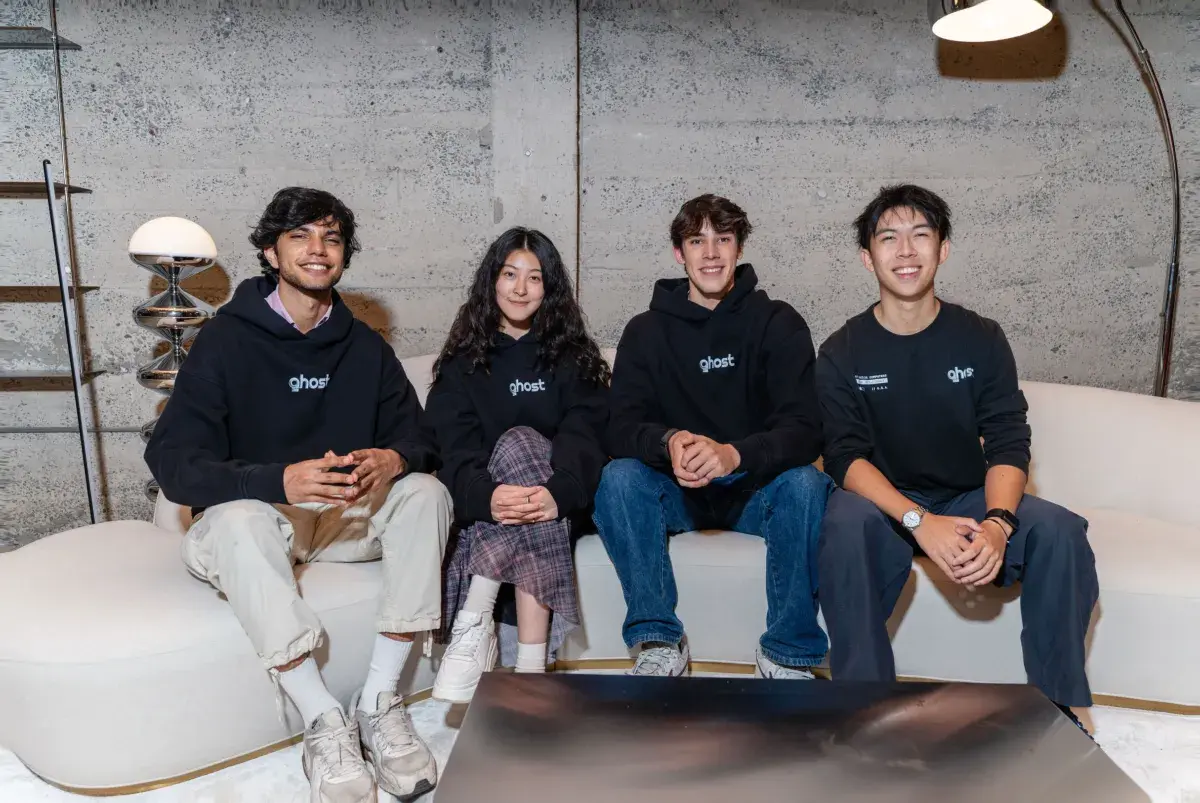
Ghost AI Secures $11 Million to Build Personal AI Computer
Ghost AI, an AI agent hardware startup led by 19-year-old founder Zain Javaid, has raised $11 million in seed round funding led by Andreessen Horowitz
1
. The round saw participation from Abstract, Audacious Ventures, Nova, and SV Angel4
. After a year of building in stealth, the company emerged Monday with Core, a screenless AI computer designed specifically to run local AI agents continuously without cloud dependency1
.Javaid, who previously worked as a quantitative analyst, found his calling after ChatGPT's 2022 release. He told TechCrunch he "felt fundamentally excited in a way that I never had been before"
1
. His vision centers on personal AI agents that understand individual habits, values, and goals to become extensions of users themselves. The founding team includes Nicholas Chua, 19, handling growth strategies; Yifei Chen, 24, as design lead; and Gautam Sharda, 23, serving as technical lead with prior software engineering experience at Google5
.Core: A Brain in a Box for Running Local AI Agents
Core is priced at $3,499 and functions as what Javaid calls a "brain in a box" without a screen
2
. The personal AI computer centralizes data from desktops, apps, and smart home devices into one piece of hardware designed to continuously run AI agents that operate as agentic assistants1
. Users interact with the device through a smartphone or web app, with voice mode available through the Core application rather than direct speech to the hardware1
.The device is powered by an Nvidia RTX Pro 4000 SFF Blackwell GPU with 24GB of video RAM, delivering 770 TOPS of AI performance
2
. Core also includes 64GB of DDR5 system RAM and a 1TB NVMe SSD3
. Three AI models come pre-installed: Qwen-3.8-Next, Qwen-3.8-27B, and Gemma-4-31B1
. Users can install additional models from Hugging Face or load their own model weights4
.Javaid emphasized that Core's hardware and software were built specifically around AI agent usage, with models already installed, differentiating it from general-purpose devices like the Mac Mini that require configuration
1
. The device performs local processing exclusively on-device, with its own software layer, browser, and filing system1
.Data Privacy and Subscription-Free AI Operation
Data privacy stands as Core's central selling point. All personal information is encrypted, with users holding the encryption keys, meaning no third-party including Ghost AI can access the memory in any meaningful way
4
. Javaid stated, "All of the source code, logic, and model weights live on the device, not the services. We build this device to not be dependent on having an outside entity maintaining the service"1
.The team built a firewall that monitors every outgoing network request on the computer. If it detects the agent performing a sanctioned action or exfiltrating data it shouldn't, the firewall rejects the request and flags it for user review
1
. Users control how much autonomy they give their Core agents, with the ability to heavily restrict AI capabilities if preferred2
.Core operates as subscription-free AI without cloud dependency. The device is programmed to continue functioning even if Ghost shuts down, as all source code, logic, and model weights run on the computer itself
4
. Updates are delivered over-the-air similar to how Tesla works, with users able to enable auto-updates to always run the latest generation of a given model1
.Related Stories

First Batch Sells Out as Viral Marketing Succeeds
Pre-orders for Core's first batch opened Monday with shipping scheduled for the last week of October
1
. The first batch sold out within hours on the first day of availability2
. Ghost now invites users to register interest for the second batch with a fully refundable $499 deposit3
.The pricing strategy contributed to the viral marketing success. Javaid explained on X.com that Ghost "were able to lock down supply of this GPU when it was widely available and $1700 a couple months back. since then prices have doubled so for our next batch will probably need to raise prices. until then we're happy to pass on our savings to the customer"
3
. The $3,200 Nvidia RTX Pro 4000 Blackwell SFF GPU combined with other components valued the complete system around $5,000, making the $3,499 price point a significant discount3
.Javaid and his team of four currently manufacture the units at their San Francisco facility
1
. The AI workstation competes directly with Nvidia's DGX Spark, which will go on sale from October 23rd for $4,999 for the 64GB version3
.Contextual Awareness and Autonomous AI Agents
Core's capability extends to forming connections among diverse data sources for contextual awareness. The device could alert a user if it notices a rising heart rate, late-night project work, and the onset of flu season, thereby suggesting potential health issues
5
. The system continuously processes information and tasks without constant prompting, building context on user life over time2
.Javaid envisions a future where "every person on earth would eventually have a single agent that would know everything about and be able to do anything for them"
1
. This agent would function as an extension of ourselves, where the more it understands habits, values, and goals, the more useful it becomes in daily lives1
. Ghost's initiative reflects a shift in personal computing where AI functionalities seamlessly integrate into daily life, operating in the background rather than requiring explicit user engagement5
.Javaid dismissed competition concerns, stating "People sometimes give incumbents credit for having already built the product because they have the ingredients"
3
. He credited Apple with good hardware and disruption, but emphasized that much of what Core tackles is software: how the model reasons over your life, how it remembers, how it takes action, and how it knows when to act1
.References
Summarized by

Navi
[1]
Related Stories
Nvidia RTX Spark AI Laptops Launch With Powerful Local AI But Sky-High Prices Starting at $2,600
15 Oct 2026•Technology
AMD's Gorgon Halo AI Workstations Hit Market With 192GB Memory at $6,399-$7,399
28 Sept 2026•Technology
AMD Ryzen AI Max+ PRO 495 Mini PCs With 192GB RAM Target Local AI Workloads at IFA 2026
03 Sept 2026•Technology
Recent Highlights



Recent Highlights
Today's Top Stories



Don’t drown in AI news. We cut through the noise - filtering, ranking and summarizing the most important AI news, breakthroughs and research daily. Follow topics that matter to you and stay ahead.


