Google AI Data Centers Trigger Finland Deforestation Crisis as 400,000 Trees Fall


4 Sources
[1]
Wolves roam into Finnish villages after Google destroys 1,300 acres of forest for AI data centers -- forest where wolf packs used to live is now an expanse of mud
This is thankfully a less common but still very serious side effect of an AI data center being built nearby. Google's Finland country manager has apologized for unauthorized forest clearings near Muhos, which have turned 816 acres of forest into an expanse of mud. The American search and AI giant
[2]
740 acres forest cleared: Finland orders Google to halt work on two AI data center sites
Finnish authorities have ordered Google to stop preparatory work at two data center sites after it cleared large areas of forest without completing required environmental impact assessments. The order, issued Oct. 6 by Finland's Licensing and Supervision Agency (LVV), covers sites in Muhos and in
[3]
Google just cut down 250,000 trees for AI data centers -- and now it's facing a major backlash
Google's massive AI expansion in Finland has come at a startling environmental cost. Approximately 250,000 trees have been cut down at one planned data center site, and Finnish authorities have ordered the company to halt work while environmental reviews are completed. According to a new
[4]
Wolves Invade Village After Illegal Deforestation For Data Centers
Wildlife have slowly relocated into towns and cities due to environmental collapse, but a controversial data center in Finland suggests this phenomenon can now occur overnight with help from AI AI, and the immense amount of computer cooling it demands, is already infamous for its water
Share
Copy Link
Google faces a major backlash after clearing approximately 400,000 trees across two Finnish sites for AI data centers without completing required environmental impact assessments. Finnish authorities ordered construction to halt at Muhos and Otanmäki locations, while displaced wolves now roam into neighboring villages, raising serious safety concerns for residents.
Google Halts AI Data Center Construction After Massive Finland Deforestation
Finnish authorities have ordered Google to immediately halt construction work at two Google AI data centers after the tech giant cleared approximately 400,000 trees without completing mandatory environmental impact assessments
1
2
3
. The Finnish Licensing and Supervision Agency (LVV) issued the stop-work order on October 6, targeting sites in Muhos and Otanmäki near Kajaani, with compliance required by October 232
. The order specifically addresses Google's project subsidiary, Tuike Finland Oy, and remains in force until environmental impact assessments are completed for both locations.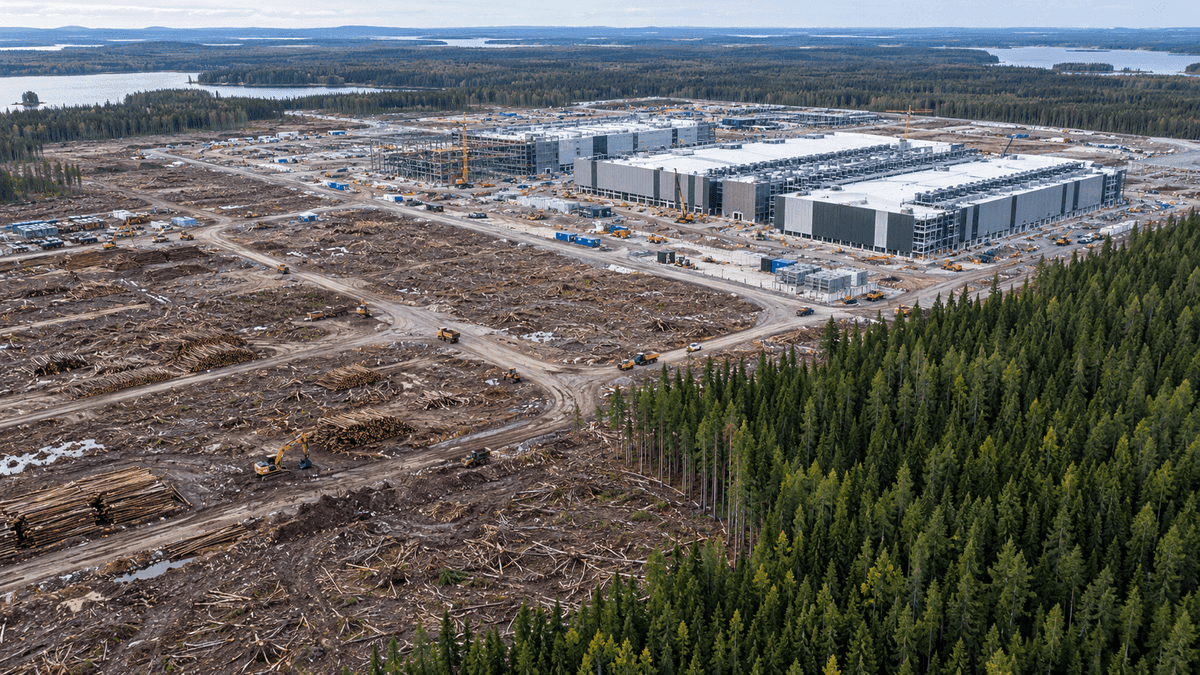
Source: Tom's Guide
The scale of Finland deforestation is staggering. Environmental experts estimate that roughly 250,000 trees were removed at the Muhos site alone, covering approximately 330 hectares—an area larger than 450 American football fields
3
. An additional 150,000 trees were cleared at the Otanmäki site, bringing the total environmental damage to around 740 acres across both locations2
. Google's Finland country manager, Antti Järvinen, apologized for the unauthorized forest clearings that transformed 816 acres of forest into expanses of mud, stating the company acted "on the best understanding we had of the legislation at the time"1
2
.Wildlife Displacement Creates Safety Crisis as Wolves Invade Village
The environmental impact has triggered an unexpected wildlife displacement crisis. Anni Ranta, a 53-year-old resident whose family has lived in Otanmäki for generations, reported that wolves invade village areas after being forced from their natural habitat
1
4
. "We had wolves coming into the village because all the wild animals moved out of the forest," Ranta explained to The Guardian4
. While the wolves were eventually scared off, the incident highlights how AI infrastructure development can rapidly destabilize local ecosystems and create immediate human safety concerns.
Source: Tom's Hardware
The illegal deforestation for data centers extended beyond tree removal. Workers removed topsoil, constructed site roads and storage areas, dug excavations, and altered drainage systems including ditches and culverts
2
. Residents near the Muhos site reported brown water flowing from the construction area into streams that feed the Oulujoki River, raising concerns about water contamination2
. The Finnish Association for Nature Conservation described Google's flouting of environmental policy as "unprecedented and clear," with campaigners noting that timber from the unauthorized clearing cannot be sold to wood-processing plants1
2
.€13 Billion AI Investment Faces Environmental Reckoning
The halt construction order comes just weeks after Google announced plans to invest at least €13 billion (approximately $15 billion) in AI infrastructure across Finland through 2027 and 2028
2
3
. The company promoted this as its largest single investment in Europe, targeting sites in Hamina, Kajaani, Muhos, and Vaala2
. Google separately secured a 20-year deal covering up to 50% of the Loviisa nuclear plant's capacity to power its expanding Finnish data center footprint2
. However, the environmental damage has fueled intense national debate, with more than 93,000 people signing a petition calling for stricter data center regulation and fees to compensate local communities for habitat destruction2
.Google spokesperson Sondre Ronander acknowledged the company had "fallen short of our own high standards in this instance"
2
. The company maintains it acted in good faith under Finland's Forestry Act and conducted nature surveys with protective measures for high-value areas2
. Google has outlined plans to plant trees across 130 hectares in Muhos as part of its biodiversity efforts3
, though experts note that replacing hundreds of thousands of mature trees is far more complex than simple replanting.Related Stories

Broader Implications for AI's Environmental Footprint
The Finland controversy exposes the cascading environmental consequences of the global AI boom. Behind services like Gemini and ChatGPT are enormous data centers filled with powerful processors requiring land, electricity, cooling systems, and supporting infrastructure
3
. Finland has attracted technology companies due to its cool climate, available land, and energy resources, with cooler temperatures reducing electricity needed to prevent server overheating3
. However, the Muhos and Otanmäki incidents demonstrate that the environmental impact extends far beyond electricity consumption.Forests absorb carbon dioxide, support wildlife, and regulate local ecosystems—functions that cannot be quickly restored
3
. The rapid timeline from construction approval to environmental collapse illustrates how AI infrastructure development can accelerate habitat destruction from a process spanning decades to mere weeks4
. Critics argue these projects create limited jobs and direct few tax benefits to Finland, while residents face environmental disruption and concerns about future electricity costs2
. Finnish police are currently investigating the suspected illegal logging at both sites2
, and both locations now await completed environmental impact assessments before any significant work can resume. The incident serves as a stark warning about balancing AI development ambitions with sustainability commitments as companies race to build the infrastructure needed for increasingly sophisticated AI models.References
Summarized by

Navi
[1]
[2]
Interesting Engineering
|740 acres forest cleared: Finland orders Google to halt work on two AI data center sites
[3]
Related Stories
Finland Orders Google to Halt AI Data Center Construction After 300 Hectares of Forest Cleared
06 Oct 2026•Policy and Regulation

Amazon Engineers Publicly Challenge AI Data Centers as Opposition Hits 71% Nationwide
04 Jun 2026•Policy and Regulation

Google's $15 Billion Finland Investment Triggers Debate Over Power Supply and Energy Security
09 Sept 2026•Business and Economy
Recent Highlights



Recent Highlights
Today's Top Stories








Don’t drown in AI news. We cut through the noise - filtering, ranking and summarizing the most important AI news, breakthroughs and research daily. Follow topics that matter to you and stay ahead.


