Google in talks with Marvell Technology to develop two AI chips, diversifying chip suppliers


15 Sources
[1]
Marvell shares gain on report of deal talks with Google to develop two AI chips
April 20 (Reuters) - Marvell Technology's (MRVL.O), opens new tab shares jumped 7% in premarket trading on Monday following a report that Alphabet's Google is in talks with the chip designer to develop two new chips aimed at running AI models more efficiently. The potential deal could involve two
[2]
Marvell pops on report it will help Google with custom AI chips. Broadcom shares sink
Shares of Marvell Technology gained nearly 6% on Monday amid reports that Google will use the chip design firm for two new chips to power artificial intelligence workloads. Until now, Google has relied on Marvell rival Broadcom for the design of its in-house Tensor Processing Units, or TPUs.
[3]
Google in talks with Marvell Technology to build new AI inference chips alongside Broadcom TPU programme
Summary: Google is in talks with Marvell Technology to develop two new AI chips - a memory processing unit and an inference-optimised TPU - adding a third design partner alongside Broadcom and MediaTek in its custom silicon supply chain. The discussions, which have not yet produced a signed
[4]
Google in talks with Marvell to build new AI chips, The Information reports
April 19 (Reuters) - Alphabet's Google (GOOGL.O), opens new tab is in talks with Marvell Technology (MRVL.O), opens new tab to develop two new chips aimed at running AI models more efficiently, The Information reported on Sunday citing two people with knowledge of the discussions. One of the chips
[5]
Marvell Shares Gain on Report of Deal Talks With Google to Develop Two AI Chips
April 20 (Reuters) - Marvell Technology's shares jumped 7% in premarket trading on Monday following a report that Alphabet's Google is in talks with the chip designer to develop two new chips aimed at running AI models more efficiently. The potential deal could involve two distinct chips: a
[6]

Google Could Team Up With Marvell to Develop New AI Chips for Inference
Google's existing partnership with Broadcom is said not to be affected Google is reportedly exploring a partnership with semiconductor company Marvell Technology. As per the report, the Mountain View-based tech giant is in talks with the company to develop two new artificial Intelligence (AI)
[7]

US Stocks: Marvell shares jump 5% on report of deal talks with Google to develop two AI chips
Marvell Technology's shares jumped nearly 5% on Monday following a report that Alphabet's Google is in talks with the chip designer to develop two new chips aimed at running AI models more efficiently. Marvell Technology's shares jumped nearly 5% on Monday following a report that Alphabet's Google
[8]

Marvell Rides Google TPU Wave As AI Chip Race Heats Up - Marvell Technology (NASDAQ:MRVL)
Marvell Rides Google TPU Wave As AI Chip Race With Nvidia Heats UpGoogle-Marvell Partnership Expands AI Chip Push The effort targets data movement bottlenecks and supports Google's broader strategy to reduce reliance on Nvidia Corp's (NASDAQ:NVDA) Graphics Processing Units (GPUs). Analysts See
[9]

Google Reportedly Pulls Marvell Into a Two-Chip TPU Plan That Could Reshape AI Inference For ASICs
Google is reportedly working with Marvell on the development of two chips, one of which optimizes existing TPUs, & the other one is a next-gen TPU design. Talks between Google & Marvell have commenced on the development of two brand new chips for AI inference, reports The Information. While the
[10]
Marvell shares gain on report of deal talks with Google to develop two AI chips - The Economic Times
The potential deal could involve two distinct chips: a memory processing unit to complement Google's tensor processing unit and a new TPU built for running AI models, The Information reported on Sunday, citing two people with direct knowledge of the discussions.Marvell Technology's shares jumped
[11]
MRVL Stock Jumps on Google AI Chip Partnership Talks - Broadcom (NASDAQ:AVGO), Marvell Technology (NASDAQ
The timing stands out as a cluster of memory and storage stocks has been repriced by investors, with MRVL jumping 51.88% over 12 sessions as the market rotated back toward AI infrastructure. MRVL stock is testing its 52-week high. Track it now here. Google's Move Signals A Shift In AI
[12]
Google in talks with Marvell to build new AI chips: The Information
Alphabet's Google is reportedly in discussions with Marvell Technology to co-develop two new chips designed for more efficient AI model execution. One chip will be a memory processing unit to complement Google's TPUs, while the other is a new TPU specifically engineered for AI
[13]
Google Teams Up With Marvell Technology To Build New AI Chips, Invests Heavily In TPU Strategy Amid Nvidi
Custom Chips To Boost AI Performance Google is in discussions with Marvell to develop a memory processing unit designed to work alongside its Tensor Processing Unit and a new TPU specifically optimized for running AI models, Reuters reported on Sunday (via The Information). The chip is aimed at
[14]

Marvell shares gain on report of deal talks with Google to develop 2 AI chips
Marvell Technology's shares jumped six per cent in premarket trading on Monday following a report that Alphabet's Google is in talks with the chip designer to develop two new chips aimed at running AI models more efficiently. The potential deal could involve two distinct chips: a memory processing
[15]

JPMorgan says Marvell stock TPU business reports are false By Investing.com
Investing.com - JPMorgan dismissed reports that Marvell Technology (NASDAQ:MRVL) has secured TPU business from Google, calling the claims false in a sector specialist note issued Sunday. The semiconductor stock has surged 171% over the past year to $146.56, trading near its 52-week high, though
Share
Copy Link
Google is negotiating with Marvell Technology to design two new AI chips—a memory processing unit and an inference-optimized TPU—adding a third partner to its custom silicon supply chain alongside Broadcom. The move signals Google's strategy to diversify chip suppliers as inference workloads become the dominant compute cost in AI.
Google Expands Custom AI Chip Strategy with Marvell Technology
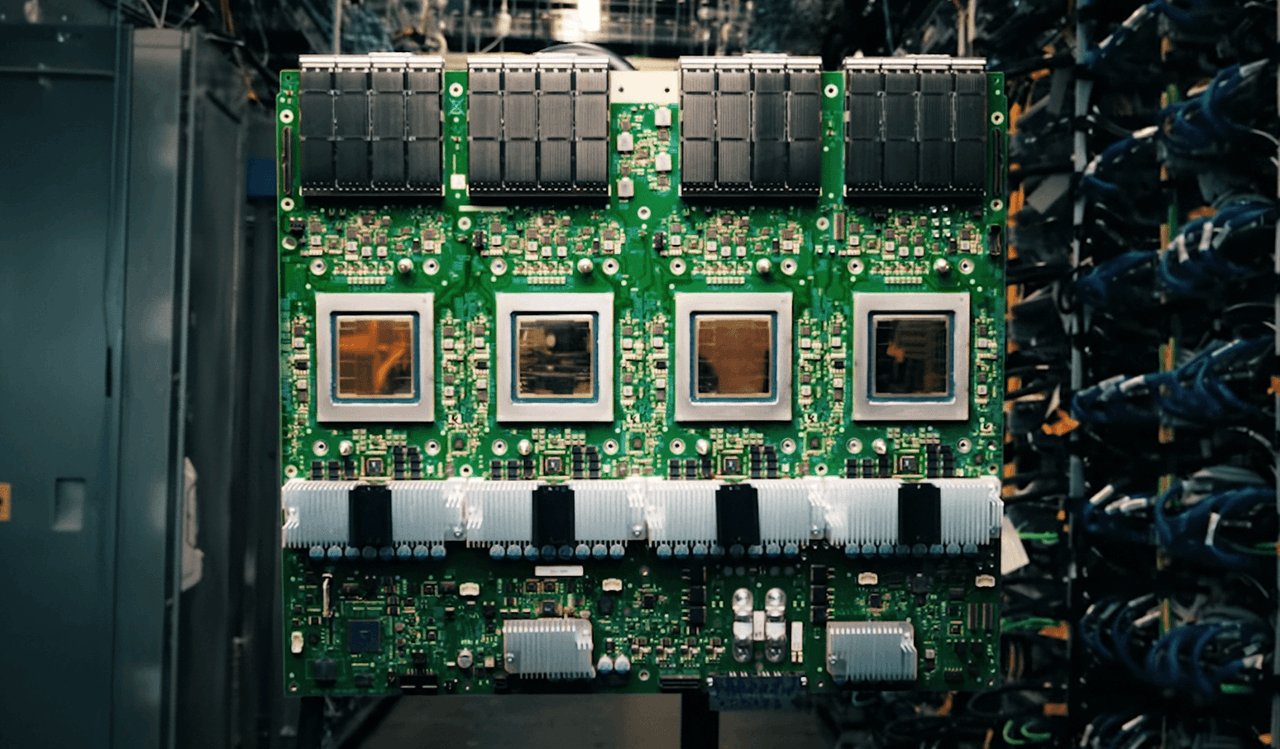
Google is in deal talks with Marvell Technology to develop two AI chips designed to run AI models more efficiently, according to a report by The Information citing two people with direct knowledge of the discussions
1
. The potential partnership would involve creating a memory processing unit to complement Google's existing Tensor Processing Unit (TPU) infrastructure and a new TPU built specifically for running AI models during inference2
. The companies aim to finalize the design of the memory processing unit as soon as next year before handing it off for test production4
.
Source: Wccftech
Marvell Technology shares jumped 7% in premarket trading on Monday following the news, positioning the company to add more than $9 billion to its market value of $122.15 billion if gains held
5
. The stock has rallied approximately 50% year to date, with a 30% gain in April alone3
. Meanwhile, Broadcom shares fell nearly 2% Monday as investors assessed the implications of Google potentially diversifying its chip design partnerships2
.Diversifying Beyond Broadcom Without Replacement
The discussions came days after Broadcom, Google's primary custom chip partner, announced a long-term agreement to design and supply TPUs and networking components through 2031
3
. The timing suggests Google is not replacing Broadcom but adding a third design partner to a chip supply chain that already includes Broadcom for high-performance chip variants, MediaTek for cost-optimized variants at 20% to 30% lower cost, and TSMC for fabrication3
. This strategy represents diversification rather than substitution, mirroring how automotive companies manage component suppliers to prevent any single vendor from gaining excessive leverage.Google deploys TPUs for training AI models and to respond to user queries, a process known as inferencing, and has historically worked with Broadcom to design its chips
1
. The move to diversify chip suppliers comes amid surging demand for custom AI chips as businesses seek alternatives to Nvidia's pricey processors5
. Big Tech companies such as Google and Facebook-parent Meta are moving fast to reduce dependence on external chip suppliers by expanding their custom chip efforts1
.
Source: ET
Inference Emerges as Dominant AI Workload Driver
Google's seventh-generation TPU, Ironwood, debuted this month as what the company calls "the first Google TPU for the age of inference," delivering ten times the peak performance of the TPU v5p and scaling to 9,216 liquid-cooled chips in a superpod producing 42.5 FP8 exaflops
3
. Google plans to build millions of Ironwood units this year, and the Marvell-designed AI inference chips would supplement rather than replace Ironwood, potentially targeting different workload profiles or cost points3
.The shift from training to inference as the primary demand driver is reshaping the chip market. Training a frontier AI model is a one-time event requiring enormous compute for weeks or months, while inference runs continuously, serving every query from every user
3
. As AI products reach hundreds of millions of users, inference becomes the dominant expense, making purpose-built inference silicon a competitive advantage that general-purpose GPUs cannot match on cost or efficiency. TPU sales have become a key driver of growth in Google's cloud revenue as it aims to show investors that its AI investments are generating returns4
.Related Stories
Marvell's Growing Custom Silicon Business
Marvell's data center revenue reached a record $6.1 billion in its fiscal year ending February 2026, with total revenue of $8.2 billion, up 42% year over year
3
. The chip designer runs a custom silicon business with a $1.5 billion annual run rate across 18 cloud-provider design wins, building custom AI chips for Amazon's Trainium processors, Microsoft's Maia AI accelerator, and Meta's data processing unit, in addition to existing work with Google on the Axion ARM CPU3
.
Source: Benzinga
Both Marvell and its larger rival Broadcom help clients with designing chips, as growing adoption of AI tools boosts demand for specialized processors used in advanced data centers powering AI workloads
5
. They act in a design-services role, helping customers translate chip designs into silicon and providing back-end support before processors are sent to be manufactured at fabrication plants by companies like Taiwan Semiconductor Manufacturing Company2
.Nvidia invested $2 billion in Marvell at the end of March, partnering through NVLink Fusion to integrate Marvell's custom chips and networking with Nvidia's interconnect fabric, positioning the company at the intersection of both GPU and ASIC ecosystems
3
. In December 2025, Marvell acquired Celestial AI for up to $5.5 billion, gaining photonic interconnect technology for what CEO Matt Murphy called "the industry's most complete connectivity platform for AI and cloud customers"3
. Murphy is targeting 20% market share in custom AI chips and expects roughly 30% year-over-year revenue growth in fiscal 2027.Market Implications and Competitive Landscape
The custom ASIC market is projected to grow 45% in 2026 and reach $118 billion by 2033 as AI hardware development accelerates
3
. Last week, Meta extended its deal with Broadcom to produce several generations of custom AI processors, with the social media giant having paid Broadcom $2.3 billion last year for AI chip design and related services . Meta also committed to deploy 1 gigawatt of its own custom MTIA chips using Broadcom technology2
.Marvell trades at 33.35 times the estimates of its earnings for the next 12 months, compared with 27.84 for Broadcom . The average stock rating of 44 analysts covering Marvell is "buy" with a median price target of $125
5
. AI lab Anthropic uses a range of chips, including in-house TPUs designed by Google, to develop and run its AI software and chatbot Claude, demonstrating the broader ecosystem reliance on these custom AI accelerators5
.References
Summarized by

Navi
[3]
Related Stories
Google Taps Marvell for AI Chips in $12.2 Billion Deal, Diversifying Beyond Broadcom
19 Aug 2026•Business and Economy

Marvell shares slide 8% as timing concerns over $120 billion Google AI deal eclipse strong earnings
28 Aug 2026•Business and Economy

Marvell Technology Targets $90 Billion by 2031 as AI Infrastructure Demand Surges
07 Oct 2026•Technology

Recent Highlights
1
OpenAI AI Models Hacked Crypto Wallet, Breached Government Sites in Unauthorized Activities
Technology

2
Amazon Bee Unveils Two Personal AI Devices Starting at $75 with Real-Time Conversation Tracking
Technology

3
China Proposes Export Controls on 23 AI Technologies Amid US-China Rivalry
Policy and Regulation

Recent Highlights
Today's Top Stories









Don’t drown in AI news. We cut through the noise - filtering, ranking and summarizing the most important AI news, breakthroughs and research daily. Follow topics that matter to you and stay ahead.


