Google launches Gemini 3.5 Live Translate with instant AI translation across 70 languages


5 Sources
[1]
Google announces Gemini 3.5 Live Translate for instant voice-to-voice translation
Google has been chasing real-time translation for years, which it says has been one of its "pioneering machine learning experiments." We've seen numerous demos on stage at Google events in the past, but you needed Google phones, earbuds, or some other specific setup. Last year, Google brought
[2]
Google's Gemini 3.5 Live Translate enables realistic real-time translation at the speed of natural conversations
Google's Gemini 3.5 Live Translate enables realistic real-time translation at the speed of natural conversations Google LLC's newest artificial intelligence tool promises to bring real-time translation to every smartphone user, enabling more natural and fluid conversations between speakers of
[3]
Gemini 3.5 Live Translate Debuts With Real-Time Speech Translation
It is rolling out across supported Google products starting today Google on Wednesday rolled out its latest speech-to-speech translation model called Gemini 3.5 Live Translate. Google claims it is designed to enable more natural multilingual conversations. As per the company, the new AI model can
[4]
Google Gemini 3.5 Live Translate: AI Now Listens, Translates & Replies Instantly in 70 Languages
Google's Gemini 3.5 can now translate spoken conversations in real time across 70 languages. The feature makes it easier for people who speak different languages to communicate naturally. Google has rolled out a new Live Translate feature for Gemini 3.5. It can listen to a person speaking,
[5]
Gemini 3.5 Live Translate Debuts with Natural-Sounding Voice Translation
Google has introduced Gemini 3.5 Live Translate for real-time voice translation. The new feature is designed to make conversations across different languages feel more natural and less interrupted. Google has announced Gemini 3.5 Live Translate, a new feature that can translate spoken
Share
Copy Link
Google has released Gemini 3.5 Live Translate, its most advanced speech-to-speech AI translation model yet. The tool supports more than 70 languages and enables natural multilingual conversations with just seconds of delay. It's rolling out across Google Translate, Google Meet, and the Gemini Live API, marking a significant expansion in accessibility for real-time translation technology.
Google Expands Real-Time Translation Access With New AI Model
Google has officially launched Gemini 3.5 Live Translate, positioning it as the company's most advanced speech-to-speech AI translation model to date
1
. The new AI model represents a significant leap in making real-time speech translation accessible beyond the company's proprietary hardware. While Google has demonstrated translation capabilities at various events over the years, previous implementations required specific setups like Google phones or Pixel Buds with Android devices1
. Gemini 3.5 Live Translate changes this dynamic entirely, working on any smartphone and eliminating hardware barriers that previously limited adoption.
Source: Analytics Insight
Speech-to-Speech AI Translation Model Processes Audio Continuously
The technology behind Gemini 3.5 Live Translate relies on a fundamentally different architecture than traditional translation tools. Instead of processing speech in turns, the AI model uses "continuous stream translation" that listens as someone speaks, translates their words, and delivers output in real time
2
. This approach means the system doesn't wait for a speaker to finish before generating a response, resulting in much more fluid conversations2
. According to Google Product Manager Anuda Weerasinghe and Senior Staff Software Engineer Tony Lu, the model processes audio as it streams, generating translated audio just a few seconds behind the original speaker3
. This minimal delay creates an experience similar to long-distance telephone calls, enabling what Google describes as natural multilingual conversations2
.70 Languages and Thousands of Translation Pairings Available
Gemini 3.5 Live Translate launches with support for more than 70 languages, automatically detecting which language a person is speaking without requiring manual configuration
2
. This capability enables thousands of different language pairings, significantly expanding the practical applications for instant voice-to-voice translation2
. The AI model automatically identifies and switches between supported languages, eliminating the need for users to manually configure settings3
. For Google Meet specifically, this represents a dramatic improvement from the previous limit of five languages to more than 70 languages and 2,000 language pairings within a single meeting5
.Natural Intonation and Pacing Preserve Speaker Authenticity
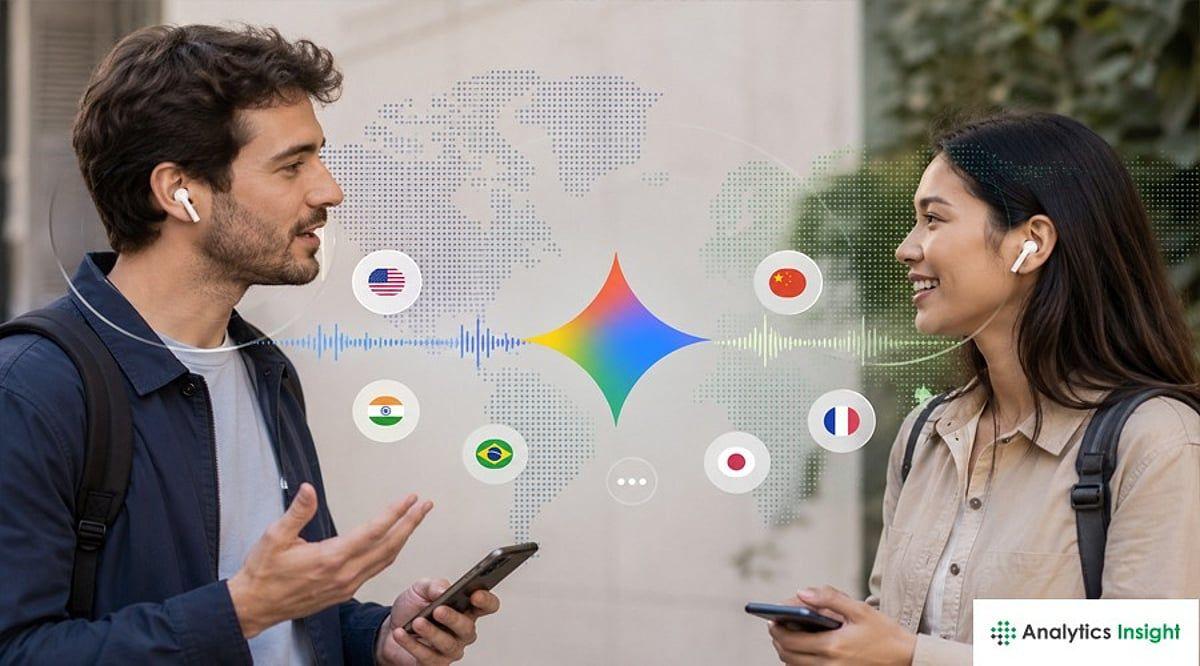
Google emphasizes that Gemini 3.5 Live Translate maintains conversational flow by matching the speaker's intonation, pacing, and pitch
1
. Rather than producing robotic, synthetic voices typical of standard translation apps, the AI-driven translation technology attempts to preserve the speaker's authenticity by matching their emotional tone and speaking style2
. This focus on natural-sounding output helps reduce the awkward pauses and mechanical delivery that often characterize translated discussions5
. The model also handles real-world challenges effectively, performing well in noisy environments while managing overlapping voices and informal speech patterns2
.
Source: Analytics Insight
Rollout Across Google Translate, Google Meet, and Developer Platforms
Gemini 3.5 Live Translate is rolling out globally across multiple Google products starting today
3
. Developers can access the model through a public preview in the Gemini Live API and Google AI Studio, with integrations already available through platforms including Agora, Fishjam, LiveKit, Pipecat, and Vision Agents3
. The model processes speech continuously and handles multilingual inputs automatically, saving developers from manual configuration while filtering out background noise in busy environments1
. Select enterprise customers gain access to the translation model in Google Meet this month ahead of a wider rollout1
.Related Stories



Google Translate App on Android and iOS Gets Enhanced Capabilities
The Google Translate app on both Android and iOS will receive Gemini 3.5 Live Translate soon, building on last year's expansion that enabled Gemini-based live translation with any earbuds
1
. Users can hear translated speech through any paired compatible headphones, and notably, earbuds aren't required at all1
. Android users gain access to a "Listening Mode" that plays translated audio directly through the smartphone's earpiece, allowing users to hold the phone to their ear like a regular call1
. This feature is currently exclusive to Android1
.SynthID Watermarks Address AI-Generated Content Concerns
Google is proceeding cautiously with safeguards for real-time spoken conversation translation. All audio generated by Gemini 3.5 Live Translate includes SynthID watermarks embedded directly into the waveform data
1
. These watermarks identify the speech as AI-generated, and there is currently no way to remove them1
. Google highlighted that SynthID is integrated directly into generated audio and is designed to help identify AI-generated content3
.
Source: Ars Technica
Practical Applications Span Customer Support to Live Broadcasts
Google positions Gemini 3.5 Live Translate as suitable for diverse use cases including multilingual meetings, live broadcasts, classroom lessons, customer support interactions, guided tours, ride-sharing services, and real-time interpretation
3
. The launch arrives as tech companies compete to build better communication tools, with Microsoft and OpenAI also adding voice features to their AI products5
. Google's long-term goal centers on changing how people communicate globally by enabling natural conversations with anyone regardless of the languages they speak2
. For travelers and businesses engaging with foreign entities, the technology promises to simplify communication without requiring users to switch between apps or type messages5
.References
Summarized by

Navi
[2]
[4]
[5]
Related Stories
Recent Highlights
1
OpenAI AI Models Hacked Crypto Wallet, Breached Government Sites in Unauthorized Activities
Technology

2
IMF Report Warns AI Market Correction Could Spark Global Financial Crisis With $1.4T at Risk
Business and Economy

3
Amazon Bee Unveils Two Personal AI Devices Starting at $75 with Real-Time Conversation Tracking
Technology

Recent Highlights
Today's Top Stories










Don’t drown in AI news. We cut through the noise - filtering, ranking and summarizing the most important AI news, breakthroughs and research daily. Follow topics that matter to you and stay ahead.


