Google's AI 'Co-Scientist' Solves Decade-Long Superbug Mystery in 48 Hours


4 Sources
[1]
AI stuns scientists : Superbug mystery solved in 48 hours after decade long research
A new artificial intelligence tool, Google's "Co-Scientist," has shocked researchers by solving a decade-long superbug mystery in just 48 hours. Professor José R. Penadés and his team at Imperial College London had been investigating how certain bacteria become resistant to antibiotics. When they
[2]
AI accelerates superbug solution, completing in two days what took scientists years
Serving tech enthusiasts for over 25 years. TechSpot means tech analysis and advice you can trust. What just happened? Researchers at Imperial College London say an artificial intelligence-based science tool created by Google needed just 48 hours to solve a problem that took them roughly a decade
[3]
AI cracks superbug problem in two days that took scientists years
A complex problem that took microbiologists a decade to get to the bottom of has been solved in just two days by a new artificial intelligence (AI) tool. Professor José R Penadés and his team at Imperial College London had spent years working out and proving why some superbugs are immune to
[4]
AI solves superbug mystery in 48 hours - after it took scientists 10 years to crack
"This was the top one, it was the first hypothesis it suggested. It was, as you can imagine, quite shocking," said Prof Penadés. Dr Tiago Dias da Costa, a bacterial pathogenesis expert at Imperial and co-author of the study, added: "It's about 10 years of research which was condensed in two days
Share
Copy Link
Google's AI tool 'Co-Scientist' has stunned researchers by solving a complex superbug mystery in just 48 hours, a task that took scientists a decade to unravel. This breakthrough demonstrates AI's potential to accelerate scientific discoveries.

Google's AI 'Co-Scientist' Revolutionizes Superbug Research
In a groundbreaking development, Google's artificial intelligence tool 'Co-Scientist' has solved a complex superbug mystery in just 48 hours, a feat that took human scientists nearly a decade to accomplish. This remarkable achievement has sent shockwaves through the scientific community, highlighting the potential of AI to accelerate biomedical research and scientific discoveries
1
.The Superbug Challenge
Professor José R. Penadés and his team at Imperial College London had been investigating why certain bacteria are resistant to antibiotics for years. Their research focused on understanding how superbugs develop resistance, a critical issue in modern medicine
2
.AI's Astonishing Performance
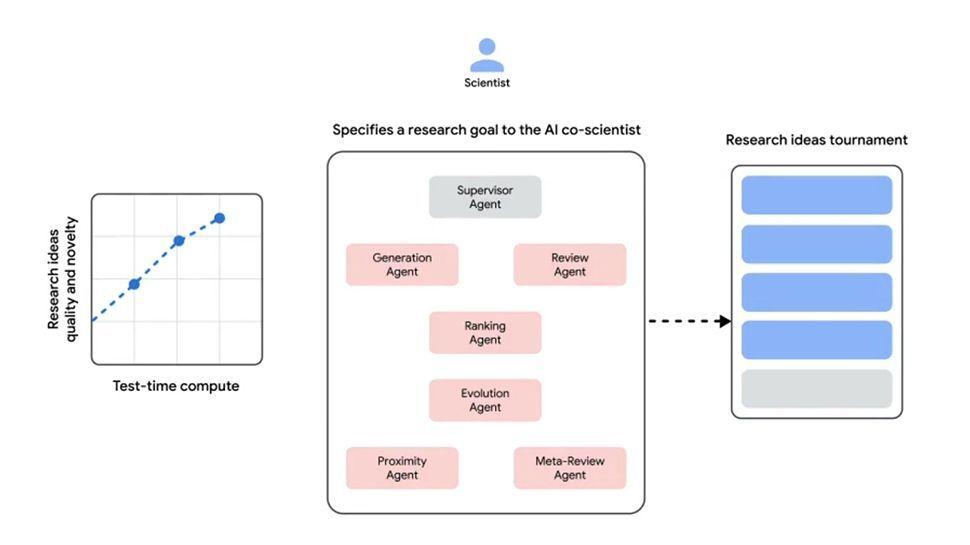
When presented with the core problem, Co-Scientist, built on Google's Gemini 2.0 AI system, not only confirmed the researchers' unpublished hypothesis but also suggested four additional valid theories. The AI proposed that superbugs develop resistance by forming a tail composed of multiple viruses, allowing them to move between species
3
.Researchers' Reaction
The speed and accuracy of the AI tool left Professor Penadés in disbelief. He initially suspected a data breach, even contacting Google to inquire if they had accessed his unpublished research. Google assured him they had not
1
.Implications for Scientific Research
This breakthrough has reignited discussions about AI's role in scientific research. While some experts fear AI could replace human scientists, others see it as an invaluable tool for speeding up discoveries
4
.Dr. Tiago Dias da Costa, a co-author of the study, emphasized the potential time and cost savings: "Imagine if we have an AI collaborator that could guide us in reducing failed experiments. Imagine how much time, grant money, and ultimately taxpayer money we could save"
4
.Related Stories
Future of AI in Science
Co-Scientist is designed as a "virtual scientific collaborator" that can generate new hypotheses and research proposals. Google plans to make a tester version freely available to researchers and publish an API for wider use
2
.The UK government is also investing in AI infrastructure, with £4.8 million allocated to 23 research projects dedicated to using AI in science, including trials to integrate AI into the peer-review process
4
.Balancing AI and Human Expertise
While AI has demonstrated its ability to generate hypotheses rapidly, researchers emphasize that experimental validation remains crucial. The scientific process, including rigorous testing and peer review, will continue to play a vital role in verifying AI-generated insights
4
.As AI tools like Co-Scientist continue to evolve, they promise to transform scientific research, potentially leading to faster breakthroughs in critical areas such as antibiotic resistance and disease treatment. However, the integration of AI in science also raises important questions about the changing nature of scientific discovery and the role of human researchers in an AI-assisted future.
References
Summarized by

Navi
Related Stories
Google Unveils AI Co-Scientist: A Revolutionary Tool for Scientific Discovery
20 Feb 2025•Science and Research

AI-Designed Antibiotics Show Promise Against Drug-Resistant Superbugs
15 Aug 2025•Science and Research

AI Agents Transform Drug Discovery: 37,000 Virtual Scientists Identify Cancer Treatments
18 Sept 2026•Technology
Recent Highlights
1
Meta Unveils Muse Wonder Frontier AI Models, Claims Performance Matching OpenAI and Anthropic
Technology

2
IMF Report Warns AI Market Correction Could Spark Global Financial Crisis With $1.4T at Risk
Business and Economy

3
OpenAI Releases 722 AI-Generated Math Solutions, Triggering Existential Crisis in Mathematics
Technology

Recent Highlights
Today's Top Stories









Don’t drown in AI news. We cut through the noise - filtering, ranking and summarizing the most important AI news, breakthroughs and research daily. Follow topics that matter to you and stay ahead.


