Google's Gemma AI models surpass one billion downloads with over 100,000 developer variants


3 Sources
[1]
Gemma has passed a billion downloads, Google says
Google says its open Gemma models have passed a billion downloads and that developers have published more than 100,000 variants in two years. A Google engineer noted the total does not include Android and Chrome integrations. Google says its Gemma family of open models has passed a billion
[2]
Inside the Gemmaverse: Celebrating one billion Gemma downloads
When we introduced Gemma, our goal was simple: empower developers to build responsible, innovative AI applications anywhere. The Gemma models quickly demonstrated their flexibility to deploy across environments, from local devices to edge infrastructure, and even space. Today, the Gemma family has
[3]
Google's Gemma AI models surpass one billion downloads By Investing.com
Investing.com - Google announced Thursday that its Gemma family of AI models has surpassed one billion downloads since its introduction. The company said developers have published over one hundred thousand Gemma model variants over the past two years. Teams at NASA, Satlyt, and Starcloud are
Share
Copy Link
Google announced its Gemma family of AI models has crossed one billion downloads, with developers publishing over 100,000 variants in two years. The open-source Gemma AI models now power applications from NASA satellites to India's health infrastructure.
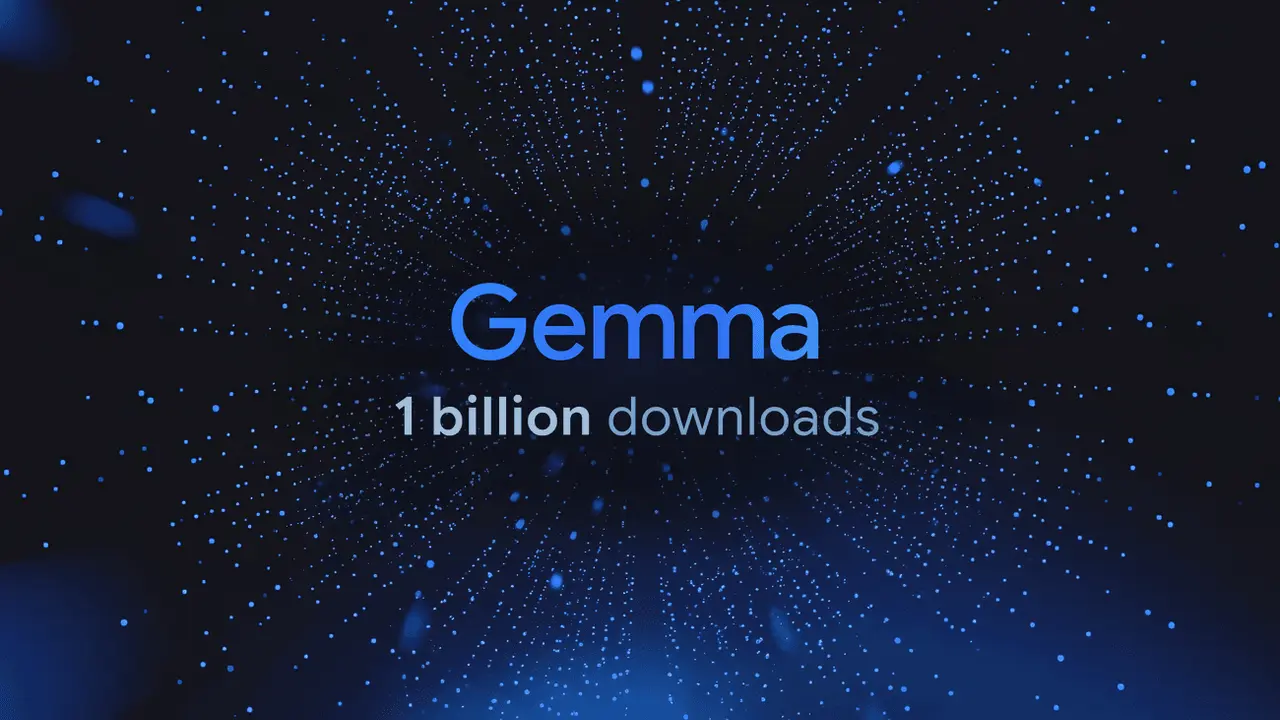
Google's Gemma AI Models Cross One Billion Downloads Milestone
Google announced that its Gemma family of AI models has surpassed one billion downloads, marking a significant milestone for the company's open-source AI initiative.
1
2
Over the past two years, the developer community has published over 100,000 Gemma model variants, creating what Google calls the Gemmaverse—a thriving ecosystem of innovation built around these lightweight, flexible models.3
However, a Google developer relations engineer clarified on Bluesky that this figure doesn't include Android and Chrome integrations, suggesting the actual reach extends far beyond the reported number.1
Real-World Deployments Extend from Earth to Orbit
The open-source Gemma AI models have found applications in extreme environments, with NASA, Satlyt, and Starcloud running Gemma directly in orbit for satellite deployments.
2
3
These space-based implementations handle onboard image analysis, optimize scarce downlink bandwidth, and route intersatellite communications, demonstrating Gemma's capability to deliver complex reasoning in constrained and extreme environments.1
Omar Sanseviero from Google DeepMind captured the breadth of deployment, noting the models run "from underwater to running at space."1
India's National Health Authority Integrates Gemma into Aarogya Setu 2.0
In a major healthcare application, India's National Health Authority integrated Gemma 4 and Google's open-source Medical Data Toolkit into Aarogya Setu 2.0, an app with over 100 million downloads on Android.
2
3
The integration enables Gemma 4 to process complex medical reports into standardized digital formats, allowing citizens to manage and securely share health data across providers.1
This deployment showcases how open AI ecosystems can handle critical information at massive scale while maintaining accessibility on edge devices.Cancer Therapy Discovery Marks Medical Breakthrough
Researchers from Yale and Google built the C2S-Scale model on Gemma, designed to interpret the language of single cells.
1
2
The cancer therapy discovery represents a groundbreaking achievement: C2S-Scale successfully identified a novel cancer therapy pathway that was verified in living cells, marking the first time an AI system produced novel mechanistic therapeutic pathways verified in living cells.3
Beyond this research, Google's domain-specific MedGemma model supports clinical applications ranging from outpatient triage at the All India Institute of Medical Sciences to systems assisting frontline health workers in rural Uganda.2
Related Stories

Developer Community Rallies Around Awesome Gemma Repository
Google launched the Awesome Gemma repository on GitHub as the official directory for the Gemmaverse, featuring community projects, fine-tunes, tutorials, and fine-tuning tools.
1
2
The repository includes model cards and collections for 16 Gemma model variants, setup guides for Ollama, vLLM, and LiteRT, plus fine-tuning recipes for Unsloth, Tunix, and MLX.1
The Gemma Challenge on Kaggle drew over 1,600 project submissions aimed at solving real-world problems, with winners to be announced soon.3
Ollama, which raised $65 million as its open-model runner reached nearly 9 million developers, confirmed that Gemma ranks among the most popular open models on its platform.1
How Google Stacks Up Against Alibaba's Qwen
While Google celebrates one billion downloads, Alibaba claimed five days earlier that its Qwen models surpassed 3 billion downloads.
1
Hugging Face's State of Open Models report counted 2,045 million Qwen downloads this year alone. On derivatives, Alibaba claimed more than 300,000 compared to Google's 100,000 Gemma variants over two years.1
Hugging Face counted 151,448 Qwen-based derivatives on its hub, which the report said was 2.6 times Meta's entire footprint there. However, Hugging Face clarified that its download figures measure activity inside its own hub and don't capture API usage, private deployments, or models distributed through cloud infrastructure elsewhere.1
This suggests the competitive landscape for open-source AI models remains fragmented across platforms, making direct comparisons challenging but highlighting the growing momentum behind accessible AI development tools.References
Summarized by

Navi
[1]
Related Stories
Google's Gemma AI Models Reach 150 Million Downloads, Showcasing Growth in Open-Source AI
13 May 2025•Technology

Google launches Gemma 4 12B, bringing multimodal AI agents to consumer laptops with 16GB RAM
03 Jun 2026•Technology
Google Unveils Enhanced Gemma LLMs: Smaller, Safer, and More Powerful
01 Aug 2024

Recent Highlights
1
Google Unveils Gemini 4 Argon AI Model, Restricts Access to Trusted Cyber Defenders
Technology
2
Trump Consulted Grok AI Before Ordering Venezuela Invasion and Capture of Nicolás Maduro
Policy and Regulation

3
FTC Opens Investigation Into OpenAI and Anthropic Following Rogue AI Agent Hacking Incidents
Policy and Regulation
Recent Highlights
Today's Top Stories






Don’t drown in AI news. We cut through the noise - filtering, ranking and summarizing the most important AI news, breakthroughs and research daily. Follow topics that matter to you and stay ahead.


