Google shows a quantum property thought to power the machines survives at scale


2 Sources
[1]
Google Quantum AI tests quantum contextuality on up to 105 qubits
Its qubits won a coordination game 98.3% of the time, beating the 88.9% classical limit. Google Quantum AI says it has shown contextuality, a quantum property thought to power some algorithms, on up to 105 qubits, in a paper on the cover of Science. The tests also expose subtle hardware errors,
[2]
How we're putting one of quantum mechanics' deepest features to the test at scale.
Today, in new research published on the cover of Science, Google Quantum AI demonstrated that contextuality -- a quantum property scientists believe powers certain quantum algorithms -- survives at scale on our quantum processor. What gives quantum computers their unique power? While entanglement
Share
Copy Link
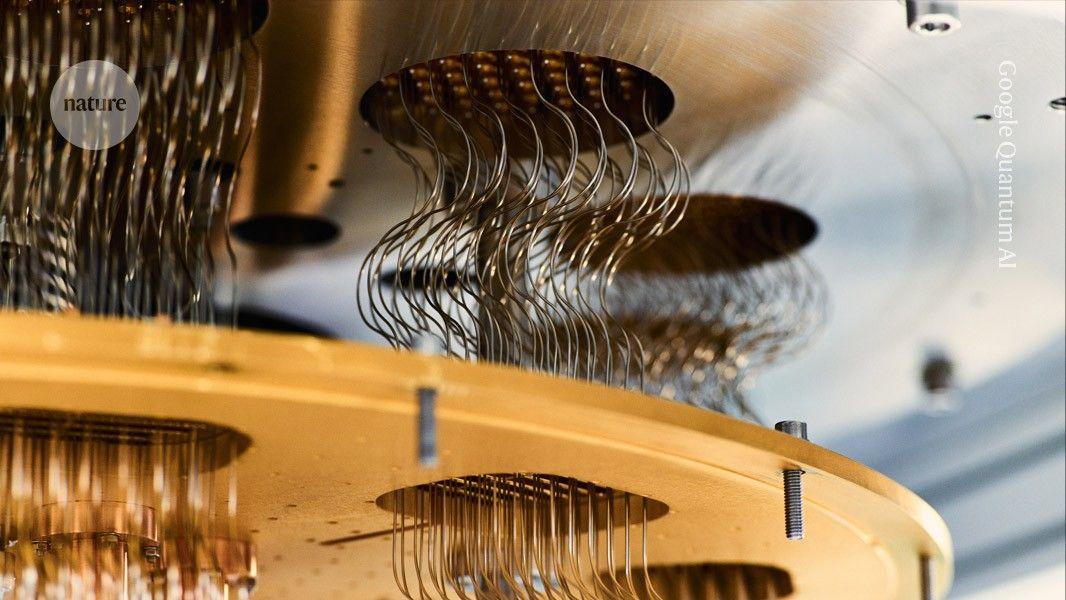
Google Quantum AI has demonstrated, on the cover of Science, that contextuality holds at scale on its own superconducting quantum processor
2
1
. Theory points to contextuality, rather than entanglement, as what may power certain quantum algorithms, so showing it survives on a large machine is a step toward understanding where quantum computers' edge comes from2
1
.
Source: Google
A game classical strategy cannot win
Contextuality means a measurement's outcome is not fixed in advance. It may depend on which other compatible measurements are made alongside it
2
1
. The property had mostly been shown before in small systems of a few particles2
1
.The headline test was the Mermin-Peres magic square, a two-player coordination game. Google's qubits won 98.3% of the time, beating the 88.9% that the best possible classical strategy can manage
2
1
. A larger task spanning up to 105 qubits also outperformed classical strategies, though only those working with limited resources2
1
.The tests double as a sensitive new diagnostic, able to catch subtle hardware errors that other benchmarks miss
2
1
.What Google says it is for
Google frames the tests as a way to verify that a theoretically important quantum property survives at scale, and as a new diagnostic for the hardware itself
2
1
. The company says the work could help open the way to chemistry and materials applications, though neither field was simulated2
1
.The underlying result circulated as a preprint in December 2025. The peer-reviewed Science publication is the new step
1
. It lands in a crowded, well-funded field. Microsoft unveiled its Majorana 2 chip in June. International Business Machines agreed to buy the HRL Laboratories research arm while showing a chip that corrects its own errors. Nvidia simulated a 104-qubit error-corrected machine, and Quantinuum raised $1.68 billion in its June IPO1
. Google aims to build a useful, error-corrected quantum computer by 2029, a target Microsoft has set too1
.Related Stories

What the paper does not claim
The paper itself notes that its game edge narrowed as more qubits joined, and that it offers no unconditional proof that quantum machines beat classical ones in general
1
.References
Summarized by

Navi
Related Stories
Google Quantum AI Slashes Quantum Computing Errors 40-Fold With Magic State Cultivation Breakthrough
15 Oct 2026•Science and Research
Google's Quantum Echoes Algorithm: A Leap Towards Practical Quantum Computing
22 Oct 2025•Technology
Google DeepMind's AlphaQubit: AI-Powered Quantum Error Correction Breakthrough
21 Nov 2024•Science and Research

Recent Highlights


Recent Highlights
Today's Top Stories











Don’t drown in AI news. We cut through the noise - filtering, ranking and summarizing the most important AI news, breakthroughs and research daily. Follow topics that matter to you and stay ahead.


