4 Sources
[1]
Google to build AI campus in South Korea, presidential office says
SEOUL, April 27 (Reuters) - South Korea and Google (GOOGL.O), opens new tab have agreed to build an artificial-intelligence campus in Seoul to develop cooperation between the tech firm and local engineers and startups, Kim Yong-beom, a presidential policy adviser, said on Monday. South Korean President Lee Jae Myung met with Google DeepMind Chief Executive Officer Demis Hassabis in Seoul on Monday, with the Science Ministry and the company signing a memorandum of understanding on the campus, Kim said. The following are some details on the meetings and planned campus. Reporting by Heejin Kim and Hyunjoo Jin Editing by Ed Davies Our Standards: The Thomson Reuters Trust Principles., opens new tab
[2]
Google DeepMind to open its first AI campus in the world in Seoul
Demis Hassabis met South Korean President Lee Jae Myung at Cheong Wa Dae on Monday and signed an MOU with the Ministry of Science and ICT. The campus will be operational this year. Hassabis accepted a request to send at least 10 Google engineers from US headquarters. He presented Lee with a Go board signed by himself and Lee Se-dol. Google DeepMind will open an artificial intelligence campus in Seoul, South Korea, the first facility of its kind in the world for the company, after Demis Hassabis met South Korean President Lee Jae Myung at Cheong Wa Dae on Monday. Kim Yong-beom, the presidential chief of staff for policy, confirmed the agreement. The Science Ministry and Google signed a memorandum of understanding on the campus at the Four Seasons Hotel in Seoul later the same day, with Minister of Science and ICT Bae Kyung-hoon and Hassabis in attendance. The campus is expected to open within 2026. The MOU covers joint AI research in science and technology, AI skills development, and the responsible use of AI. Hassabis confirmed he would actively consider dispatching Google researchers to Korea. Kim quoted him directly: "The CEO instantly accepted our request to send at least 10." The campus is intended to serve as a hub connecting Google engineers with South Korean startups, researchers, and industrial companies. The Ministry of Science and ICT framed it as a key element of Korea's "K-Moonshot" project, which brings together AI and science capabilities to address major national challenges. South Korea has stated its intention to become one of the world's top three AI powerhouses alongside the United States and China. The choice of venue and timing carries specific symbolic weight. The 2016 match between Google DeepMind's AlphaGo and Korean Go grandmaster Lee Se-dol took place at the Four Seasons Hotel in Seoul, the same venue where Monday's MOU was signed. AlphaGo's 4-1 victory over Lee Se-dol in March 2016 is widely credited with catalysing the modern wave of investment in artificial intelligence by demonstrating that deep learning could surpass human expert performance in a domain of extreme complexity. Hassabis cited it explicitly during the meeting, noting that the AlphaGo match had "inspired many advances in AI, including its work in science like the AlphaFold system for protein folding." AlphaFold subsequently solved one of biology's most important open problems: predicting the three-dimensional structure of proteins from their amino acid sequence. The achievement led to Hassabis being jointly awarded the Nobel Prize in Chemistry in 2024. As a symbolic gesture, Hassabis presented President Lee with a Go board signed by himself and Lee Se-dol, marking the 10th anniversary of the match. Hassabis also expressed interest in strengthening cooperation with major Korean companies including Samsung, SK Hynix, Hyundai's Boston Dynamics, and LG, to start new joint projects. Those four names span the full breadth of Korea's technology industrial base: Samsung and SK Hynix in semiconductors and memory (both critical to AI infrastructure), Hyundai's Boston Dynamics in physical AI and robotics, and LG in consumer and enterprise electronics. The campus, combined with these industrial partnerships, suggests Google is positioning Korea not just as a market for its AI products but as a node in its global AI development and hardware supply chain. The announcement is consistent with a broader pattern of major technology companies seeking government-endorsed AI campus arrangements in Asia-Pacific democracies. Microsoft's A$25 billion investment in Australia, includes similar elements: an MOU with the national government, infrastructure expansion tied to a national AI strategy, and skills training commitments. The Seoul AI campus adds South Korea to a list of countries, alongside Australia, Japan, Singapore, and the United Kingdom, where Google DeepMind and its peers are embedding their AI development presence at the government-partnership level, rather than purely through commercial market entry. Hassabis also noted that countries like Korea, the UK, and Singapore urgently need to cooperate to build a broader framework for AI safety, pointing to the campus as part of a responsible AI agenda alongside the commercial and research dimensions.
[3]
Google to open AI campus in Korea - The Korea Times
Google will open an artificial intelligence (AI) campus in Korea within this year, which will be the first of its kind in the world, in line with the Korean government's expanded cooperation with global AI companies, a senior Cheong Wa Dae offcial said, Monday. Kim Yong-beom, presidential chief of staff for policy, said the envisioned campus is anticipated to facilitate Google's cooperation with startups and researchers in Korea. Kim said Demis Hassabis, co-founder and CEO of Google DeepMind, disclosed the plan during his meeting with President Lee Jae Myung at Cheong Wa Dae. Google DeepMind is Google's AI research lab. "Hassabis agreed to actively consider dispatching Google researchers to Korea," Kim said. "The CEO instantly accepted our request to send at least 10." During the meeting, Lee and Hassabis discussed a range of cooperative measures, such as advancing the country's AI ecosystem and promoting the responsible use of related technologies. The cooperation will help bolster Korea's "K-Moonshot" project, which brings together AI and science capabilities to tackle major national challenges, according to the Ministry of Science and ICT. Hassabis met the president at Cheong Wa Dae, before meeting Science Minister Bae Kyung-hoon at the Four Seasons Hotel in downtown Seoul later in the day to sign a memorandum of understanding (MOU). The meetings came as Korea strives to become one of the world's top three AI powerhouses, alongside the United States and China. "The meeting is an extension of the government's global AI cooperation efforts and will serve as an opportunity to further accelerate policy through collaboration with a world-leading AI company," the presidential office said. Google DeepMind heralded the start of what is now recognized as the modern era of AI in 2016, when AlphaGo, a Go-playing AI, captured a 4-1 victory against world-class Korean master Lee Se-dol in a five-game match in Seoul. The game of Go is known locally as "baduk," and the signing ceremony took place in the same venue where the games between Lee and AlphaGo were held in 2016. The company subsequently demonstrated the potential of AI applications in science and technology through AlphaFold. AlphaFold's achievement in solving the long-standing challenge of protein structure prediction led to Hassabis being jointly awarded the Nobel Prize in chemistry in 2024. DeepMind's work corresponds with the goals of the K-Moonshot project, which aims to use AI technology for the betterment of the country. The government seeks to use the project to raise research productivity to the world's fifth-highest level by 2030 and use AI to address 12 national missions by 2035, in areas including advanced biotechnology, energy, space and semiconductors. The MOU outlined key areas of cooperation, including joint AI research in science and technology, AI skill development and the responsible use of AI. "If AlphaGo opened the era of AI a decade ago, we are now entering a stage where AI is solving complex challenges in science and technology and having a tangible impact on people's lives," Bae remarked. He said the MOU will "serve as a key opportunity for the two organizations to cooperate in accelerating AI-driven innovation in science and technology centered on Korea's K-Moonshot." The minister also expressed hope that the agreement will "promote safe and responsible AI research and the spread of best practices." Hassabis was quoted by the ministry as saying, "Korea has become a very special place for Google since the historic AlphaGo match." He explained that Google is beginning a new journey to expand the frontiers of bio innovation and weather forecasting, while also working as a partner to help build safeguards that ensure AI develops responsibly. Hassabis was the latest among high-profile AI business leaders whom the president has met, including OpenAI's Sam Altman, Nvidia's Jensen Huang, SoftBank Group's Masayoshi Son and BlackRock's Larry Fink, as part of efforts to bolster cooperation and attract investment.
[4]
Google to build AI campus in South Korea, presidential office says
SEOUL, April 27 (Reuters) - South Korea and Google have agreed to build an artificial-intelligence campus in Seoul to develop cooperation between the tech firm and local engineers and startups, Kim Yong-beom, a presidential policy adviser, said on Monday. South Korean President Lee Jae Myung met with Google DeepMind Chief Executive Officer Demis Hassabis in Seoul on Monday, with the Science Ministry and the company signing a memorandum of understanding on the campus, Kim said. The following are some details on the meetings and planned campus. o South Korea requested Google send at least 10 engineers to the AI campus from Google's headquarters in the United States and Hassabis said he would consider that, Kim said. o The Google AI campus will be the first of its kind in the world for the U.S. company, the presidential adviser said. o President Lee and Hassabis shared their thoughts about the outlook for AI and its impact on people, Kim said. o Lee raised the need for the introduction of a base wage in case of job losses caused by AI at the meeting. o Hassabis said he hoped with this partnership "to help with training up the next generation in these amazing technologies through internships at our AI hub and other training programmes." o DeepMind would like to deepen partnerships with Korean companies from Samsung and SK Hynix to Hyundai's Boston Dynamics and LG and "instigate new joint projects" with them, Hassabis said. o He described South Korea as a "great industrial base" in all of the key AI areas, from chips to robotics. o The historic match between DeepMind's AlphaGo program and Go player Lee Sedol in Korea a decade ago signaled the beginning of the modern AI era and inspired many advances in AI, including its work in science like the Alphafold system for protein folding, Hassabis said. (Reporting by Heejin Kim and Hyunjoo Jin Editing by Ed Davies)
Share
Copy Link
Google DeepMind will establish its first-ever AI campus in Seoul by 2026, following a meeting between CEO Demis Hassabis and South Korean President Lee Jae Myung. The facility will serve as a hub connecting Google engineers with local startups and researchers, with at least 10 engineers dispatched from US headquarters. The agreement marks South Korea's push to become a top-three AI powerhouse alongside the US and China.
Google will establish an AI campus in South Korea, marking the first facility of its kind globally for the tech firm. The announcement came after Google DeepMind CEO Demis Hassabis met with South Korean President Lee Jae Myung at Cheong Wa Dae on Monday, where both parties signed a memorandum of understanding with the Ministry of Science and ICT
1
2
. Kim Yong-beom, presidential chief of staff for policy, confirmed that the campus is expected to open within 2026 and will facilitate collaboration with engineers and startups across the country3
.
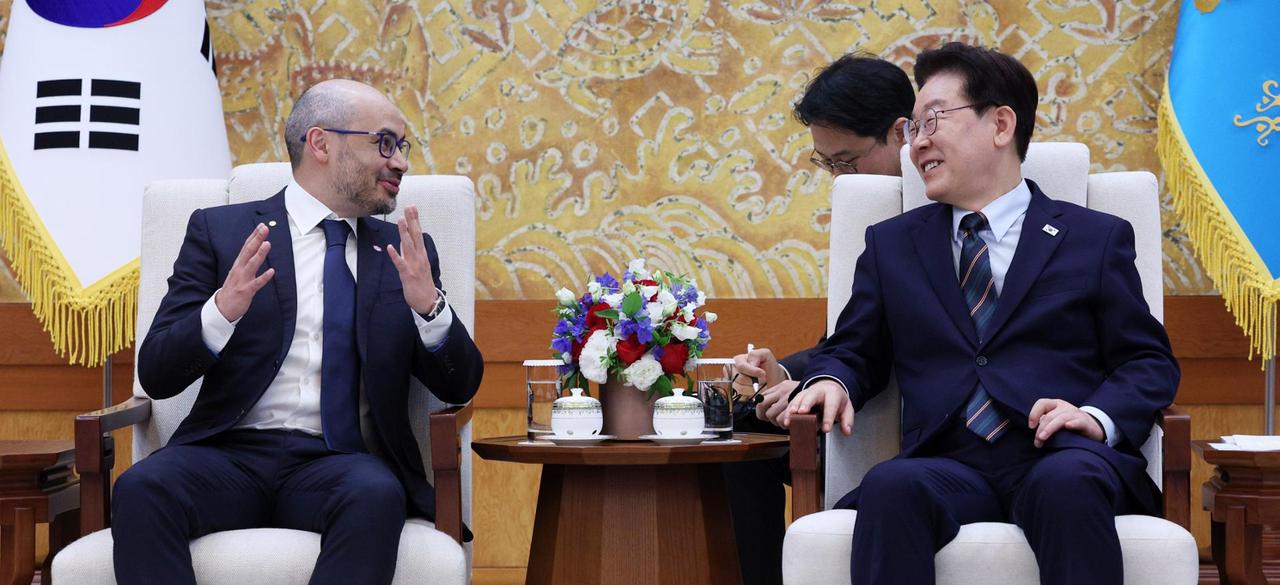
Source: Korea Times
The Seoul signing ceremony took place at the Four Seasons Hotel, the same venue where Google DeepMind's AlphaGo defeated Korean Go grandmaster Lee Se-dol 4-1 in March 2016, an event widely credited with catalyzing modern investment in artificial intelligence
2
. As a symbolic gesture marking the 10th anniversary of that historic match, Hassabis presented President Lee with a Go board signed by himself and Lee Se-dol2
.South Korea requested that Google send at least 10 engineers to the AI campus from its headquarters in the United States, and Hassabis instantly accepted the request, according to Kim
4
. The campus will serve as a hub connecting Google engineers with South Korean startups, researchers, and industrial companies, positioning the country as a critical node in Google's global AI development and hardware supply chain2
.Hassabis expressed interest in strengthening cooperation with major Korean companies including Samsung, SK Hynix, Hyundai's Boston Dynamics, and LG to instigate new joint projects
4
. He described South Korea as a "great industrial base" spanning the full breadth of key AI areas from semiconductors and memory chips to robotics2
4
.The Ministry of Science and ICT framed the campus as a key element of Korea's "K-Moonshot" project, which brings together artificial intelligence and science capabilities to address major national challenges
2
3
. The government seeks to use the project to raise research productivity to the world's fifth-highest level by 2030 and deploy AI to address 12 national missions by 2035 in areas including advanced biotechnology, energy, space, and semiconductors3
.The memorandum of understanding outlined key areas of cooperation including joint AI research in science and technology, AI skills development, and the responsible use of AI
2
3
. Science Minister Bae Kyung-hoon remarked that the agreement will "serve as a key opportunity for the two organizations to cooperate in accelerating AI-driven innovation in science and technology centered on Korea's K-Moonshot"3
.Related Stories
The announcement positions South Korea within a broader pattern of major technology companies seeking government-endorsed AI campus arrangements in Asia-Pacific democracies, similar to Microsoft's A$25 billion investment in Australia
2
. South Korea has stated its intention to become one of the world's top three AI powerhouses alongside the United States and China2
3
.Hassabis noted that countries like Korea, the UK, and Singapore urgently need to cooperate to build a broader framework for AI safety, pointing to the campus as part of a responsible AI agenda alongside commercial and research dimensions
2
. President Lee raised the need for the introduction of a base wage in case of job losses caused by AI during the meeting4
. The meeting represents an extension of the government's global AI cooperation efforts, following similar engagements with OpenAI's Sam Altman, Nvidia's Jensen Huang, SoftBank Group's Masayoshi Son, and BlackRock's Larry Fink3
.Summarized by
Navi
[3]
[4]
26 May 2025•Business and Economy

01 Oct 2025•Business and Economy

04 Feb 2025•Business and Economy

1
Technology

2
Policy and Regulation

3
Science and Research