9 Sources
[1]
Google's new Universal Cart wants to follow you across the entire internet | TechCrunch
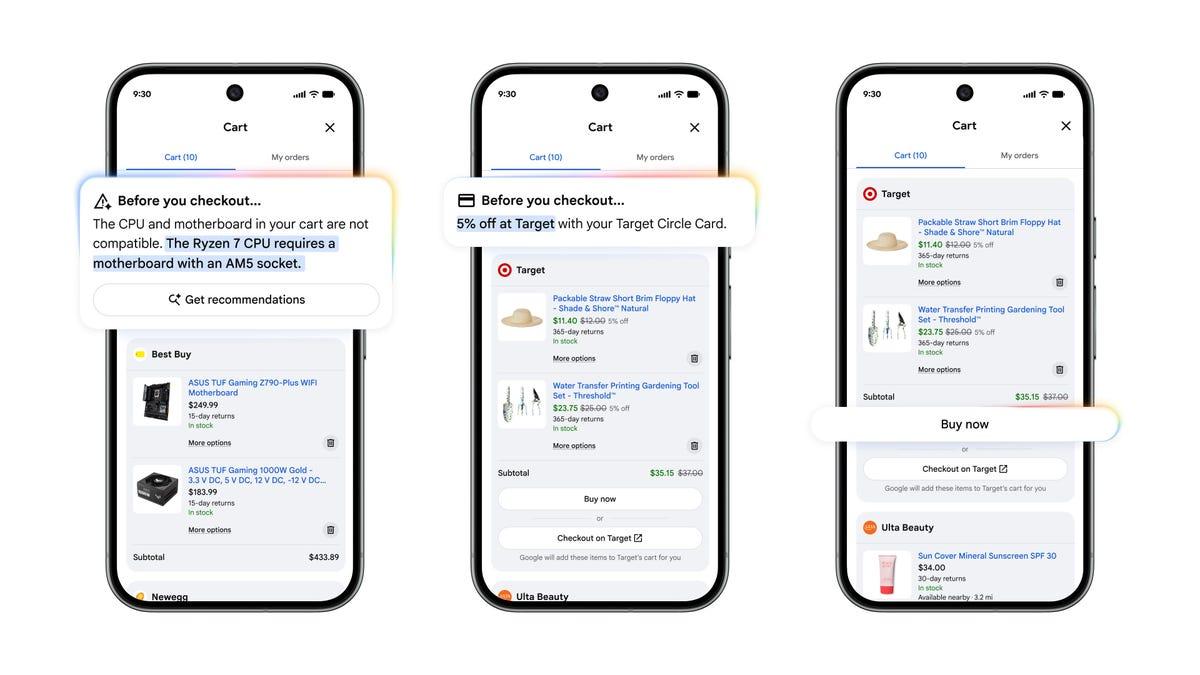
At I/O on Tuesday, Google introduced Universal Cart, its so-called agentic hub for managing shopping in one place. The tech giant also announced updates to its Agent Payments Protocol (AP2) and teased that it would bring the technology to Google products in the coming months, enabling users to authorize agents to make payments on their behalf. The announcements signal Google's push to turn AI assistants from passive recommendation tools into active participants in online commerce. By launching a centralized shopping system and building infrastructure that lets software agents complete purchases autonomously, the company is positioning itself to control more of the entire shopping journey, and potentially the relationship between consumers and the merchants competing for their attention. With Universal Cart, users can add products they're considering from anywhere on Google -- while browsing Search, chatting with Gemini, watching YouTube, or reading Gmail. Once items are added, Universal Cart tracks deals, monitors price drops, surfaces price history insights, and alerts users when items are back in stock. The feature is built around something Google knows well, which is that most people shop across multiple devices, multiple retailers, and over the course of many days. The cart also uses AI to help shoppers make better decisions. For example, if you're building your first custom PC, you can add parts from multiple merchants into a single cart, and Google may flag compatibility issues, such as a processor that doesn't work with the motherboard you selected -- and suggest an alternative. For frequent travelers or rewards maximizers, the feature can also surface hidden savings and help stretch your points further because it's built on Google Wallet. Thanks to Google's open-standard Universal Commerce Protocol (UCP), users can check out directly through Google with participating merchants, or transfer their items to the merchant site and complete the purchase there. Universal Cart is rolling out in the U.S. today and coming to the Gemini app this summer, with YouTube and Gmail to follow, Google says. Google also announced that UCP is expanding to more categories, like hotels and local food delivery services. UCP-powered experiences will also expand beyond the U.S. to Canada and Australia in the coming months, and later to the U.K. The more consequential announcement for the commerce industry may be AP2, Google's protocol designed to let AI agents securely make payments on users' behalf within defined limits. At I/O, Google detailed the guardrails users can set, including specifying the brands and products they want, and a spending limit. When those conditions are met, the agent makes the purchase automatically. Google says it's bringing AP2 to its own products in the coming months. That integration would give Google direct visibility into what consumers discover, consider, and ultimately buy, and it's a degree of commercial influence that retailers and payment processors will be watching closely. Under the hood, AP2 creates a transparent, verifiable link between the user, the merchant, and the payment processor, with encryption protecting user data throughout. The protocol also includes tamper-proof digital records that ensure the agent is always acting on the user's behalf, and a permanent audit trail that both buyers and sellers can reference for returns or disputes.
[2]
Google Wants Its AI to Be Your 'Fun' Personal Shopper
Macy has been working for CNET for coming on 2 years. Prior to CNET, Macy received a North Carolina College Media Association award in sports writing. Google has a massive, constantly refreshed "shopping graph" that tracks more than 60 billion product listings, and it wants to turn its AI on that giant catalog to help you find the right product for the right price. At its Google I/O annual developers conference Tuesday, the company revealed a handful of new features that aim to turn a typical Google search into a personal shopper experience driven by agentic AI. Suresh Ganapathy, Google's senior director of consumer shopping, told reporters ahead of I/O that he hopes the AI tools create shopping experiences that feel "fun and powerful and intelligent." The announcements at I/O focus on making agent-driven commerce seamless across discovery, purchase and post-purchase tasks. "On the shopping side, I'm really looking forward to a world where shopping feels really fun," Ganapathy said. "We keep hearing from shoppers that they really enjoy the fun aspects of shopping, but would love to delegate the more tedious parts to AI." To handle the hard parts, Google is using UCP, a shared language co-developed with major retailers and platforms (Shopify, Wayfair, Target, Walmart, etc.). UCP is described as letting agents and systems operate together across a shopper's journey. Another AI shopping tool, Agentic Payments Protocol -- or AP2 -- allows agents to buy things under user-defined constraints. "Imagine you could go tell your agent to buy something within certain budget constraints from a certain set of merchants and your agent is able to go do that, and it only buys it if it meets all of those criteria, and it keeps your data safe and secure," Ganapathy said. The protocol protects payment data through digitally signed contracts that only disclose information to necessary parties. Google plans to bring AP2-based products to its platform this fall. In addition to payment controls, Google announced the Universal Cart, described as an "agentic hub" that lets you add items you're considering purchasing across several different merchants and platforms, like Search, the Gemini app, YouTube or Gmail, into one major digital shopping cart. The Universal Cart can also help you maximize awards, proactively identify price insights (such as when something is hitting its lowest price yet) and can flag compatibility issues (like if you added a device and an incompatible charger at the same time). "The cart also uses the advanced reasoning in our Gemini models to help you anticipate and solve problems that you might not even know," Ganapathy said.
[3]
Would you let robots spend your money? Google is betting on it
Google is going all in on AI-driven shopping even as some competitors back off. At Google I/O, the company unveiled the latest iteration of its AI commerce tools: a "Universal Cart" that works across different retailers and Google products like Gemini -- and eventually YouTube and Gmail, too. Users can add products to Google's universal cart as they browse Search and chat with Gemini and then check out through Google. The cart will also track prices, provide in-stock notifications, suggest potential discounts, and alert shoppers to potential issues with their selections. Despite the transformative changes AI has brought to the workplace, business, and culture, tech companies are still trying to make the case to the average person that AI can improve their lives or make tedious, unpleasant tasks easier. One place Google thinks that could be is shopping. In November, the company introduced a way for shoppers to dispatch an AI voice to call brick-and-mortar stores to ask about inventory; it also began rolling out a semi-automatic way for shoppers to have AI agents purchase items online on their behalf. The Universal Cart attempts to corral people's shopping habits into one place. People shop over the course of days, across different devices and accounts, says Vidhya Srinivasan, vice president and general manager of ads and commerce at Google. "A lot of the ways I capture this is by having many, many, many tabs open and by syncing profiles and things like that. And it kind of works," Srinivasan said in an exclusive briefing. "What the shopping cart does from a current problem perspective is it brings all of this together ... It is a cart that's going to be available wherever I am across Google properties." A cart icon will be displayed next to a user's profile picture. Srinivasan envisions the cart almost like a personal shopper working in the background. The Universal Cart works across different retailers, including Sephora, Target, Wayfair, and Walmart, and eventually users will be able to add items to their cart from YouTube or when they see products in Gmail. Once a product is in the cart, users can get price-drop alerts, view price history, and be notified when an out-of-stock item is available again. Srinivasan says the cart -- which runs on Gemini -- can also alert a user to potential issues with their planned purchases. She gives the example of someone building their first PC choosing a motherboard and processor with incompatible sockets without realizing it; the cart would flag the discrepancy and warn the shopper of potential problems. Shoppers can also connect retailer loyalty programs and credit cards through Google Pay, and the Universal Cart will suggest payment methods and potential ways to save money. If a shopper wants to build a cart but doesn't want to check out through Google, they can also transfer the contents of their cart to a retailer's website and finish checkout there. "The retailer might have other things they want to show the person when they land over there, and they can go deeper in other ways potentially," Srinivasan says. Agentic shopping is only possible -- and helpful -- with the buy-in from a variety of actors: search engines, retailers, payment processors, and so on. Participation from retailers is especially important, considering widespread adoption of agentic shopping could mean customers have little reason to actually visit a store's website at all (we've been calling this "the Doordash problem" at The Verge). Amazon sued AI company Perplexity in November for allowing users to buy products through its Comet AI browser. OpenAI's efforts at checkout features within ChatGPT were disappointing. As more shoppers use AI chatbots to research products to buy or get recommendations, getting surfaced in AI search platforms is becoming more and more urgent for retailers and brands, which are already tweaking their online presence to try to get chatbots to mention them. Google seems to know it is getting between merchants and their customers; Srinivasan says the company is "very focused" on the value exchange between all parties. "[Consumers] benefit, but also merchants benefit, because [in the] long run, that's the only way it works," she says. Having billions of products available for purchase within Gemini is great for Google, but retailers need something in return. Srinivasan says Google does not currently take a cut of sales or a commission for products purchased. I asked Srinivasan whether she's heard concerns from retailers about the idea that Google could become the portal through which shoppers buy things online. She describes Google's place in the interaction as a "matchmaker." "We really want to facilitate lots of consumers talking to lots of merchants," Srinivasan says. "We don't want to be the merchant of record." On the infrastructure level, there are signs that the retail industry is coalescing around Google. In January, the company announced the Universal Commerce Protocol (UCP), a new open standard it developed with major retailers like Walmart, Shopify, and Target that makes the entire AI shopping journey possible: researching items, putting them in a cart, buying them, paying for them, and getting post-purchase customer service. (OpenAI has its own competing version.) In April, Amazon, Meta, Microsoft, Salesforce, and Stripe joined the committee that governs UCP. Google previously introduced a way for shoppers to purchase products directly within AI Mode in Search and in the Gemini app, and it's now expanding into hotel and local food delivery categories. Using Gemini Spark, a new "24/7 personal AI agent" announced by Google, users will also be able to give AI agents more specific guidelines for purchases, like the brands they like, items they're looking for, and budget. The shopping agent can then make purchases on the shopper's behalf, provided all criteria are met. A shopper could specify the exact model of a pair of boots they want, for example, set a price limit, and have the AI agent purchase the item when it finds it. The purchases use a technology called Agent Payments Protocol (AP2), essentially a digital paper trail and approval process for having an AI agent carry out a task like buying something. Shopping is complicated -- what happens, for example, when the robot buys something under the price a user specifies, but with tax and shipping it ends up being much more expensive than another option? Would most shoppers trust AI enough to spend their money on their behalf? (Srinivasan tells me Google is currently working through all of this, but that in general, a shopper would go to the actual retailer, not Google, to resolve problems after purchase. Which raises another question: Will retailers introduce policies around purchases made with AI?) Buying things is also emotional: If a rare item on my wishlist pops up for $4 more than I told the chatbot was my limit, I might pull the trigger even if the robot couldn't. It is hard to imagine a world where shoppers immediately outsource their shopping to a machine: It would be a radical reshaping of what it means to buy things. Most of all, adoption would require an enormous amount of consumer trust -- and that is still an uphill battle.
[4]
Google's Universal Cart will keep an eye on your shopping - Engadget
Google is today announcing a raft of updates to Shopping, the most notable of which is likely its new Universal Cart. Universal Cart is a tool which aggregates all of your purchases under one roof and lets you shop from more places. In essence, you'll be able to add products to this cart from every corner of Google's mansion, including search, YouTube and Gmail. Once you've added a product to the cart, the system's agentic AI will get to work looking for the cheapest price, comparing price trends and letting you know where said desirable objects are in stock. One key benefit of Universal Cart is that it's been designed to anticipate problems you might not have thought about. In the company's example, someone buying components for a custom PC might be pulling parts from a wide variety of retailers. If the Cart spots an issue, like two of the parts aren't compatible with one another, then it'll flag it before you hand over your payment information. If you use Google Wallet, the system will also know which merchants you like, have loyalty schemes with, and will try to flag any options for additional savings or points maximization. And, when you are ready to hand over the cash, the system is designed to make the interface between Google Shopping and the retailer seamless. Naturally, it'll be even faster and more effortless if said retailer takes Google Wallet, such as Nike, Sephora, Target, Fenty and Steve Madden. Universal Cart is rolling out across the Google family this summer, you'll find it first in Shopping, Search and Gemini, with YouTube and Gmail arriving later in the year. Other features announced today include the rollout of Google's Universal Commerce Protocol, which uses AI to smooth the gaps between online payment platforms and retailers. That's going to be coming to Canada and Australia in the coming months, with the UK due to follow afterward. In addition, UCP will be plugging in to YouTube in the US soon, as part of that platform's near-constant evolution into an online shopping channel.
[5]
Gemini-powered Universal Cart helps you shop the web with deal tracking, proactive help
Google is launching a new Universal Cart tool that leverages Gemini and the Universal Commerce Protocol to allow buyers to gather together products from across the web through Gemini, Gmail, YouTube, and more, with added benefits such as deal tracking and smart recommendations. The Universal Cart essentially boils all of your shopping, at least on Google, into one central hub. Whether you're finding products on Search, Gemini, YouTube, or Gmail, you can add everything to a single cart. When you do add something to the cart, Gemini works in the background to find deals, track price changes, and even makes useful recommendations based on what it sees. One of the clever use cases Google lays out here is shopping for PC parts - ironic, given the AI-fueled pricing crisis hitting the gaming market. Gemini will be able to identify PC parts in your cart, even if they're from multiple retailers, and be able to identify product incompatibilities without you asking. Another way the Universal Cart can proactively help is by knowing perks and loyalty programs for the retailers you're shopping with, even leveraging info from Google Wallet, to help you use points or find additional savings. For compatible retailers - which will include some big names such as Walmart, Shopify, Wayfair, Nike, Target, and more - the Universal Cart will be a one-step checkout too, with buyers able to make a purchase across multiple retailers with a single Google Pay process. You can even transfer items from one merchant to another within the Universal Cart. Google says that Universal Cart is rolling out first in Search and Gemini in the US "this summer" with YouTube and Gmail to follow. Meanwhile, the Universal Commerce Protocol (UCP) is expanding from the US to Canada and Australia, with the UK next in line. UCP checkout is coming to YouTube, too, while also expanding to hotel bookings and food delivery. Google's Agents Payment Protocol (AP2) is launching as a way to help AI agents "make secure payments on your behalf" and will start rolling out to Google products soon, starting with Gemini Spark.
[6]
Google's new 'Universal Cart' uses AI to track deals and shop across apps
Google announced a major upgrade to its AI-powered shopping feature at today's Google I/O 2026 event. Dubbed "Universal Cart," the intelligent shopping cart was designed to turn online shopping into a more seamless and personalized experience. According to Google, the shopping feature is part of a broader plan for "agentic commerce," meaning that AI systems would help users online shop in real-time rather than simply display search results -- almost as if you have your own personal shopper assisting you. Instead of creating separate carts on every website, Google's Universal Cart follows you across its apps like Search, Gemini, YouTube and Gmail. This allows you to add items to the smart cart while you're doing other tasks like browsing, streaming and responding to emails. The cart does more than just store items. The moment you add a product to your cart, it gets to work in the background. The Universal Cart can monitor prices, track discounts, notify users when products return to stock and find better deals. It also uses Google's Gemini AI models to analyze shopping behavior and provide suggestions. One example that Google provided was based on a user building their first custom PC. They would likely add a few parts from several different retailers to their cart. The cart would then flag any product incompatibilities and suggest alternatives before the user made their purchases. Additionally, Google is expanding their Universal Commerce Protocol (UCP), a system that makes checking out super simple. You'll be able to check out with Google Pay or transfer your items to the merchant's site to complete your purchase. This checkout feature will be available soon at brands like Nike, Sephora, Target, Ulta Beauty, Walmart, Wayfair and Shopify merchants such as Fenty and Steve Madden. Lastly, Google is also introducing a new payment feature called the Agent Payments Protocol (AP2). The system allows users to authorize AI agents to make purchases for them. For peace of mind, it will include strict boundaries like spending caps and approved products. The Universal Cart is expected to launch across Search and the Gemini app in the U.S. this summer, with platforms like Gmail and YouTube to follow. Follow Tom's Guide on Google News and add us as a preferred source to get our up-to-date news, analysis, and reviews in your feeds. Subscribe to Tom's Guide on YouTube and follow us on TikTok. Finally, you can visit our dedicated Tom's Guide Savings Squad hub for expert help on getting the best products for less.
[7]
Google IO 2026: 3 new AI features are coming to Google Shopping
At Google I/O, three new features for Google Shopping were announced. The updates, all ready to improve the AI shopping experience, not only bridge the gap across retailers but also put parameters in so AI agents don't go rogue. Perhaps the most exciting feature launching on Google Shopping is Universal Cart coming across Google platforms, including Gemini, YouTube, and Gmail. The universal shopping cart collects all of the products you add to a cart, whether that be on Target or Amazon, and adds them to your universal Google cart, so you can see everything you're vying for in one spot. "The moment you add a product, the cart goes to work for you in the background. It can do things like find deals, price drops, give you insights on price history, and can even alert when something comes back in stock. Now, these are all things that we've gotten used to doing ourselves, but the cart can just do it in the background," said Vidhya Srinivasan, VP/CM, Google Ads and Commerce. Universal Cart is going to Google and Gemini in the US this summer. Gmail and YouTube support will follow. Also announced at Google I/O is Universal Commerce Protocol (UCP), allowing AI agents to purchase products, order goods, and reserve hotels for users. Current partners for Google's UCP include eShopify, Amazon, Walmart, Stripe, Salesforce, and Meta. This makes it possible for AI agents to engage with retailers on these platforms to make bookings rather than just planning a trip or suggesting products. UCP will be available soon in Canada, Australia, and the United Kingdom. But with the power being given to AI agents to book and purchase on behalf of users, Google has updated its parameters, launching too. Agent Payments Protocol 2 (AP2) lets users place limits on how much and what an AI agent can purchase. Even with the new protocol in place, mistakes may happen, which is why AP2 also creates a permanent paper trail in the case of returns or order issues. The new Google Shopping features follow the announcements made at last year's I/O, which included Google's 'Try it on' feature.
[8]
Introducing the Universal Cart and more ways to help you shop
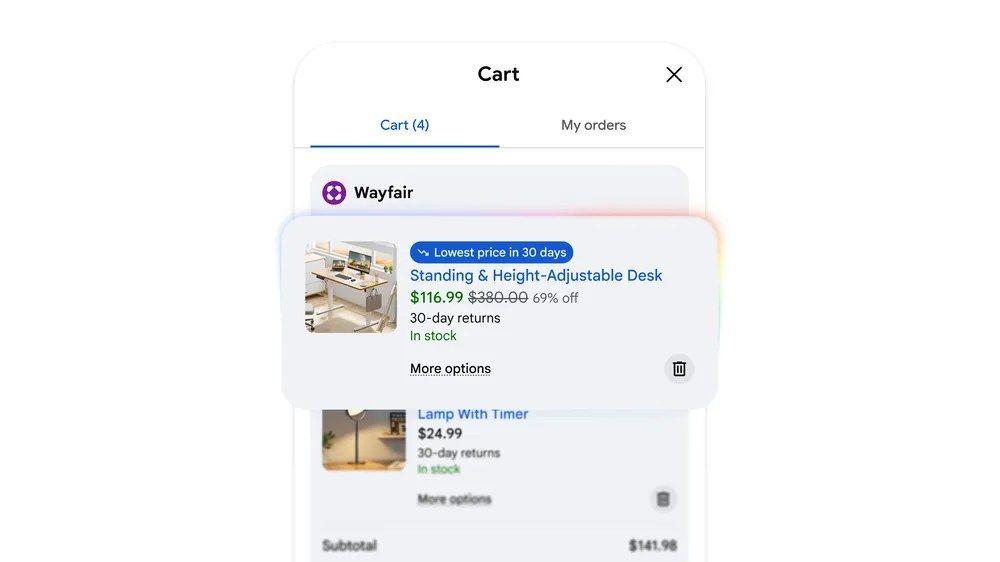
People shop across Google more than a billion times a day, powered by advanced AI and the Shopping Graph -- the world's most comprehensive catalog of over 60 billion product listings. As agentic technology advances, shopping has the opportunity to become even more powerful, intelligent and fun. We've been building the foundation for agentic commerce -- from a common language for agents with Universal Commerce Protocol (UCP) to the payments infrastructure to make agentic checkout seamless. Today at Google I/O 2026, we introduced the next step that brings this all together: the new Universal Cart. Universal Cart is an intelligent shopping cart and your new hub for shopping on Google. It works across merchants and across services, so you can add things to your cart while you're browsing Search, chatting with Gemini, watching YouTube or even reading your Gmail. The moment you add a product to your cart, it gets to work in the background -- finding deals and price drops, giving you insights on price history and alerting you when an item is back in stock. It all runs on our Gemini models, so your cart gets even smarter as the models improve.
[9]
Google's 'Universal Cart' Is Your New AI Shopping Assistant
AI will search for deals, suggest items, integrate rewards, and help you complete checkout. Among the many AI-powered features announced today at Google I/O 2026 is a new "intelligent shopping cart" designed to help you find items faster and make purchasing more seamless. Universal Cart is an agentic hub that works across Google, so you can add products from multiple merchants while using Search, Gemini, YouTube, and Gmail to a single shopping cart. Once you add an item to your Universal Cart, Gemini will search for deals, show pricing history, and alert you to price drops and restocks. It can suggest other products relevant to your purchase, identify potential problems (such as items that are incompatible), and provide alternatives. For example, if you're buying parts to build a PC, Universal Cart may warn you if one component isn't compatible with another. Universal Cart integrates with Google Wallet, so it will also consider loyalty points, merchant offers, and rewards programs to look for additional savings. Finally, you can complete your purchase from your cart with Google Pay or transfer saved items to the retailer's website. These checkout features will be integrated for merchants like Nike, Sephora, Target, Ulta, Walmart, Wayfair, and Shopify merchants. Universal Cart builds on existing AI shopping features from Google, like price tracking and agentic checkout, powered by the Universal Commerce Protocol (UCP). Google says the feature runs on its Gemini models, so Universal Cart should continue to improve as the company upgrades its AI over time. Universal Cart is rolling out to Search and the Gemini app this summer (in the U.S.) and will eventually integrate with YouTube and Gmail. Google is also expanding agentic checkout features to users in Canada, Australia, and the U.K. as well as to YouTube in the U.S. and services like hotel booking and food delivery.
Share
Copy Link
Google unveiled Universal Cart at I/O, a centralized shopping hub that aggregates all online purchases across Search, Gemini, YouTube, and Gmail. The Gemini-powered Universal Cart tracks deals, monitors price drops, and flags product compatibility issues. Google also introduced its Agent Payments Protocol (AP2), allowing AI agents to make payments autonomously within user-defined limits, signaling a shift toward agentic AI controlling the entire online shopping experience.
At Google I/O on Tuesday, Google introduced Universal Cart, a centralized shopping hub designed to transform how consumers navigate the online shopping experience
1
. The announcement signals Google's push to turn AI assistants from passive recommendation tools into active participants in online commerce, positioning itself to control more of the entire shopping journey and potentially reshape the relationship between consumers and merchants competing for their attention1
.
Source: Google
With Universal Cart, users can aggregate all online purchases from anywhere on Googleโwhile browsing Search, chatting with Gemini, watching YouTube, or reading Gmail
1
. The feature addresses a fundamental reality that Google knows well: most people shop across multiple devices, multiple retailers, and over the course of many days1
. Vidhya Srinivasan, vice president and general manager of ads and commerce at Google, describes the cart almost like a personal shopper working in the background, with a cart icon displayed next to a user's profile picture3
.Once items are added, the Gemini-powered Universal Cart tracks deals, monitors price drops, surfaces price history insights, and alerts users when items are back in stock
1
. The AI-driven shopping tool uses advanced reasoning in Gemini models to anticipate and solve problems shoppers might not even know about2
. For example, if someone is building their first custom PC and adds parts from multiple merchants into a single cart, Google may flag product compatibility issues, such as a processor that doesn't work with the motherboard selected, and suggest an alternative1
.
Source: CNET
For frequent travelers or rewards maximizers, the feature surfaces hidden savings and helps stretch points further because it's built on Google Wallet
1
. The system knows which merchants users like, which loyalty programs they participate in, and will flag options for additional savings or points maximization4
. Google shopping now leverages a massive, constantly refreshed "shopping graph" that tracks more than 60 billion product listings2
.Thanks to Google's open-standard Universal Commerce Protocol (UCP), users can experience one-step checkout across multiple retailers directly through Google with participating merchants, or transfer their items to the merchant site and complete the purchase there
1
. UCP is a shared language co-developed with major retailers and platforms including Shopify, Wayfair, Target, and Walmart, designed to let agents and systems operate together across a shopper's journey2
. Compatible retailers include big names such as Nike, Sephora, Target, Fenty, and Steve Madden4
.Universal Cart is rolling out in the U.S. today and coming to the Gemini app this summer, with YouTube and Gmail to follow
1
. UCP is expanding to more categories, like hotels and local food delivery services, and will expand beyond the U.S. to Canada and Australia in the coming months, with the U.K. to follow1
.Related Stories
The more consequential announcement for the commerce industry may be Agent Payments Protocol (AP2), Google's protocol designed to let AI agents to make payments securely on users' behalf within defined limits
1
. Suresh Ganapathy, Google's senior director of consumer shopping, envisions a world where users can tell their agent to buy something within certain budget constraints from a certain set of merchants, and the agent only buys if it meets all criteria while keeping data safe and secure2
.
Source: Lifehacker
At Google I/O, Google detailed the guardrails users can set, including specifying the brands and products they want and a spending limit
1
. When those conditions are met, the agent makes the purchase automatically. Under the hood, AP2 creates a transparent, verifiable link between the user, the merchant, and the payment processor, with encryption protecting user data throughout1
. The protocol includes tamper-proof digital records that ensure the agent is always acting on the user's behalf, and a permanent audit trail that both buyers and sellers can reference for returns or disputes1
. Google plans to bring AP2 to its own products in the coming months, starting with Gemini Spark5
.Google's integration of agentic AI into shopping would give the company direct visibility into what consumers discover, consider, and ultimately buyโa degree of commercial influence that retailers and payment processors will be watching closely . Widespread adoption of AI shopping could mean customers have little reason to actually visit a store's website at all, what The Verge calls "the Doordash problem"
3
. As more shoppers use AI chatbots to research products or get recommendations, getting surfaced in AI search platforms is becoming increasingly urgent for retailers and brands3
.Srinivasan says Google is "very focused" on the value exchange between all parties, emphasizing that consumers benefit, but merchants must benefit too, because in the long run, that's the only way it works
3
. Google does not currently take a cut of sales or a commission for products purchased3
. Srinivasan describes Google's place in the interaction as a "matchmaker" that wants to facilitate lots of consumers talking to lots of merchants rather than becoming the merchant of record3
. Despite the transformative changes AI has brought to the workplace, business, and culture, tech companies are still trying to make the case to the average person that AI can improve their lives or make tedious, unpleasant tasks easier3
.Summarized by
Navi
[1]
13 Nov 2025โขTechnology

20 Mar 2026โขTechnology

11 Jan 2026โขTechnology

1
Technology

2
Technology

3
Technology