HII Signs $900M Deal to Automate Navy Shipbuilding with AI-Powered Robotics


3 Sources
[1]
HII partners with robotics firms to automate U.S. Navy ship production
America's largest military shipbuilder is making one of its biggest automation investments yet, announcing a performance-based agreement worth up to $900 million aimed at bringing advanced AI-powered robotics into U.S. Navy ship production. HII has signed long-term agreements with Path Robotics
[2]
HII signs $900M robotics deal for Navy shipbuilding automation By Investing.com
ARLINGTON, Va. - HII (NYSE:HII) announced today multi-year production agreements with robotics companies Path Robotics and GrayMatter Robotics worth up to $900 million over seven years, according to a press release statement. The agreements aim to deploy AI-powered automation across U.S. Navy
[3]
Huntington Ingalls Industries Inc Signs Performance-Based Production Agreements with Path Robotics Inc and Graymatter Robotics Inc
Huntington Ingalls Industries Inc. announced long-term performance-based production agreements with High-Yield Production Robotics (HYPR) team members GrayMatter Robotics Inc. and Path Robotics Inc. The signed agreements are designed to accelerate the development and deployment of advanced physical
Share
Copy Link
Huntington Ingalls Industries announced performance-based production agreements worth up to $900 million with Path Robotics and GrayMatter Robotics to deploy AI-powered automation across U.S. Navy shipbuilding. The seven-year deal aims to address labor shortages and boost production capacity by 30% through autonomous welding, grinding, and inspection systems.
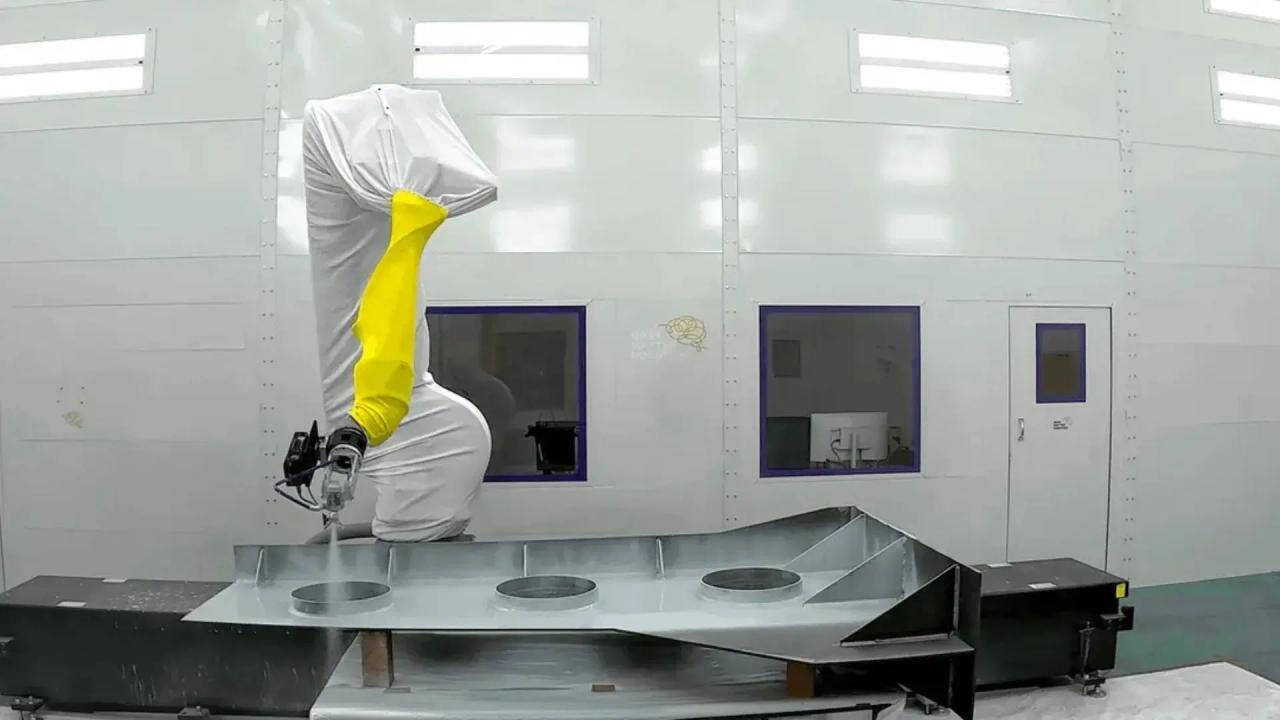
HII Commits $900 Million to Transform Navy Shipbuilding with AI-Powered Robotics
Huntington Ingalls Industries (HII), America's largest military shipbuilder, has signed performance-based production agreements with Path Robotics and GrayMatter Robotics worth up to $900 million over seven years
1
2
. The agreements mark one of the industry's most significant automation investments, designed to deploy AI-powered robotics across U.S. Navy shipbuilding programs including aircraft carriers, submarines, destroyers, amphibious ships, future frigates, and unmanned surface vessels. This partnership addresses a critical challenge facing the maritime industrial base: production capacity and skilled labor shortages in an industry where demand continues to outpace supply.Unlike conventional defense contracts, this deal structures payment around achievement. The $900 million in shipbuilding work becomes available only if Path Robotics and GrayMatter Robotics meet clearly defined technology, manufacturing readiness, and performance milestones
3
. This approach shifts risk and incentivizes the robotics companies to deliver systems that genuinely meet Navy-grade standards rather than simply deploying experimental technology.Two-Stage Development Tackles Shipbuilding's Unique Complexity
The agreements establish a rigorous two-stage process beginning with a Navy-grade development stage
2
. During this phase, both companies will partner with HII to develop and validate autonomous manufacturing systems for welding, grinding, blasting, painting, assembly, and inspection processes. These systems must then integrate into an autonomous production line that meets the stringent quality requirements unique to naval construction. Shipbuilding presents engineering challenges far beyond automotive manufacturing, where robots perform identical tasks on standardized lines. Naval vessels vary dramatically in size, shape, and assembly sequence, with no two projects exactly alike1
.The technology relies on physical AI, combining robotics, sensors, machine vision, and autonomous decision-making to enable machines to adapt to changing production conditions
1
. Once these autonomous systems demonstrate acceptable cost, schedule, and quality performance, HII will enter the delivery stage and begin outsourcing production work through the new manufacturing network. This phased approach ensures that automation genuinely improves efficiency rather than introducing new quality or scheduling risks into an already complex process.Scaling Production Capacity Through Distributed Manufacturing
HII plans to outsource more than 2.5 million hours of shipbuilding work during 2026, representing a 30% increase compared with 2025
1
2
. This expansion addresses labor shortages while enabling the company to meet growing Navy demand without overwhelming its primary shipyards. The robotics initiative supports HII's broader distributed shipbuilding strategy, allowing more structural sections to be fabricated outside major facilities before final assembly. Initially, robotic production will focus on smaller steel structures before gradually expanding to larger units and complete modules used across multiple naval platforms1
.Because the autonomous systems are designed to work within this distributed manufacturing framework, production could eventually spread among multiple facilities rather than concentrating entirely at traditional shipyards. This approach creates resilience in the supply chain while providing flexibility to scale capacity based on Navy requirements. For Path Robotics, founded in 2018 and backed by more than $370 million in funding, and GrayMatter Robotics, founded in 2020 and headquartered in Carson, California, the sustained demand signal enables significant long-term investments in facilities, workforce, and technology development required to deliver Navy-grade production at scale
2
.Related Stories

High-Yield Production Robotics Program Aims to Reshape Industrial Base
The collaboration forms part of HII's High-Yield Production Robotics (HYPR) program, which seeks to combine robotics, autonomous manufacturing, and industrial AI to strengthen America's naval industrial base
1
2
. Modern naval shipbuilding remains one of the world's most labor-intensive manufacturing sectors, with skilled welding and fabrication workers in particularly high demand. While automation has transformed automotive manufacturing and electronics, shipbuilding has been slower to adopt robotics because of the size, complexity, and variability of its products.Eric Chewning, executive vice president of maritime systems and corporate strategy at HII, described the collaboration as "a strategic investment in the future of American shipbuilding"
2
. If successful, this approach could demonstrate that advances in physical AI are mature enough to automate tasks once considered too complex for machines. The implications extend beyond HII's operations. Proving that autonomous systems can meet Navy-grade standards while improving cost and schedule performance could accelerate automation adoption across the entire defense industrial base, addressing capacity constraints that currently limit how quickly the U.S. can expand its naval fleet. With HII employing 45,000 workers and serving as the largest U.S. shipbuilder, the outcome of this initiative will signal whether AI-powered robotics can genuinely transform one of manufacturing's most demanding environments.References
Summarized by

Navi
[1]
Related Stories
America's Largest Military Shipbuilder HII Targets 15% Throughput Boost Using Physical AI
05 Sept 2026•Business and Economy
Gecko Robotics lands $71M US Navy contract to deploy AI ship inspection robots across Pacific Fleet
17 Mar 2026•Technology

US Navy bets $448 million on Palantir's ShipOS to modernize American shipbuilding operations
10 Dec 2025•Technology
Recent Highlights
1
Microsoft and Nvidia Launch Surface Laptop Ultra: A $2,599 AI-Ready PC With RTX Spark Chip
Technology

2
Trump Consulted Grok AI Before Ordering Venezuela Invasion and Capture of Nicolás Maduro
Policy and Regulation

3
Scientists Build AI Model That Reconstructs Images From Brain Scans in Record Time
Science and Research

Recent Highlights
Today's Top Stories







Don’t drown in AI news. We cut through the noise - filtering, ranking and summarizing the most important AI news, breakthroughs and research daily. Follow topics that matter to you and stay ahead.


