Users Are Ditching Claude and ChatGPT for Local AI Models That Run on Personal Computers


4 Sources
[1]
I ran local AI models on my PC without knowing what the acronyms mean, and they save me hundreds on cloud subscriptions
Abhinav pivoted from a career in banking to pursue his first love in writing. Even while working full-time, he continued contributing as an editor-at-large, a role he has held for more than 7 years. A lifelong tech enthusiast who has built three gaming and productivity powerhouse PCs since 2018,
[2]
I ditched Claude for a local AI that writes Excel formulas and automations for me
Nick Lewis is an editor at How-To Geek. He has been using computers for 20 years --- tinkering with everything from the UI to the Windows registry to device firmware. Before How-To Geek, he used Python and C++ as a freelance programmer. In college, Nick made extensive use of Fortran while pursuing
[3]
I stopped using Claude to process sensitive files and switched to a local model instead
Nick Lewis is an editor at How-To Geek. He has been using computers for 20 years --- tinkering with everything from the UI to the Windows registry to device firmware. Before How-To Geek, he used Python and C++ as a freelance programmer. In college, Nick made extensive use of Fortran while pursuing
[4]
4 more excellent local LLM projects you can run for free on a slow laptop
Nick Lewis is an editor at How-To Geek. He has been using computers for 20 years --- tinkering with everything from the UI to the Windows registry to device firmware. Before How-To Geek, he used Python and C++ as a freelance programmer. In college, Nick made extensive use of Fortran while pursuing
Share
Copy Link
Tech users are increasingly turning to local AI models that run directly on personal computers, bypassing cloud-based services like Claude and ChatGPT. The shift is driven by data privacy concerns, cost savings from eliminating cloud subscriptions, and the ability to process sensitive files without uploading them to third-party servers.
Local AI Models Gain Traction as Privacy-Conscious Alternative to Cloud Services
A growing number of users are abandoning cloud-based AI services in favor of local AI models that run entirely on personal computers. This shift addresses mounting concerns about data privacy, cloud subscription costs, and the security risks associated with uploading sensitive information to third-party servers
1
3
. Local LLM deployment offers users unlimited access to AI capabilities without recurring fees, while ensuring that confidential data—from medical records to financial statements—never leaves their hardware.The appeal of run local AI models on PC extends beyond privacy. Users report saving hundreds of dollars annually by eliminating cloud subscriptions, while maintaining control over their computing environment
1
. Even users who trust major AI companies recognize that these platforms represent attractive targets for cyberattacks due to their concentration of sensitive data from millions of users3
. Local AI for sensitive files eliminates this attack surface entirely, with the only vulnerability being the user's own computer.Hardware Requirements for Local AI Are More Accessible Than Expected
Contrary to common assumptions, hardware requirements for local AI don't demand cutting-edge equipment. The critical component is VRAM—the memory residing on your GPU that holds the model and working memory during inference
1
. An RTX 4070 Ti Super with 16GB of VRAM can comfortably run 13B-class models, while an RTX 3070 with 8GB handles 4B-7B tier models effectively1
.When model size exceeds available VRAM, GPUs offload overflow to system RAM, causing inference speed—measured in tokens per second—to drop significantly
1
. A common gaming build with 32GB of RAM and a 12GB or 16GB GPU can run 27B parameter models at 4-bit quantization, with generation speeds roughly matching human reading pace3
. For budget-conscious users, a used RTX 3090 with 24GB represents the most cost-effective way to run larger local AI models today3
.Free local LLM projects can even run on older laptops with 8GB of RAM minimum, though 16GB is preferable. Models in the 1.5B to 4B parameter range operate acceptably on CPUs, making offline AI functionality accessible to users with five-year-old hardware
4
.Beginner-Friendly Tools Lower Entry Barriers
Two platforms have emerged as cloud-based AI alternatives for newcomers: Ollama and LM Studio. Ollama provides a balanced mix of command-line control and GUI accessibility, handling most setup complexity automatically
1
. LM Studio offers an even more navigable interface with a built-in model browser that lets users find, download, load, and interact with models without technical knowledge1
.While these tools make conservative decisions about inference settings that may not be universally optimal for every model or PC configuration, they provide an essential on-ramp for beginners
1
. Advanced users can graduate to llama.cpp or vLLM for granular control over model performance.Additional open-source platforms expand local AI capabilities. Cherry Studio combines model downloading, inference engines, and chat interfaces with built-in retrieval-augmented generation (RAG) for analyzing PDFs, documents, and spreadsheets locally
4
. Jan offers a polished, ChatGPT-like experience without requiring command-line interaction4
. Whisper.cpp provides CPU-optimized speech-to-text transcription, while Continue adds AI-powered coding autocomplete to VS Code4
.Related Stories



Practical Applications Demonstrate Real-World Value
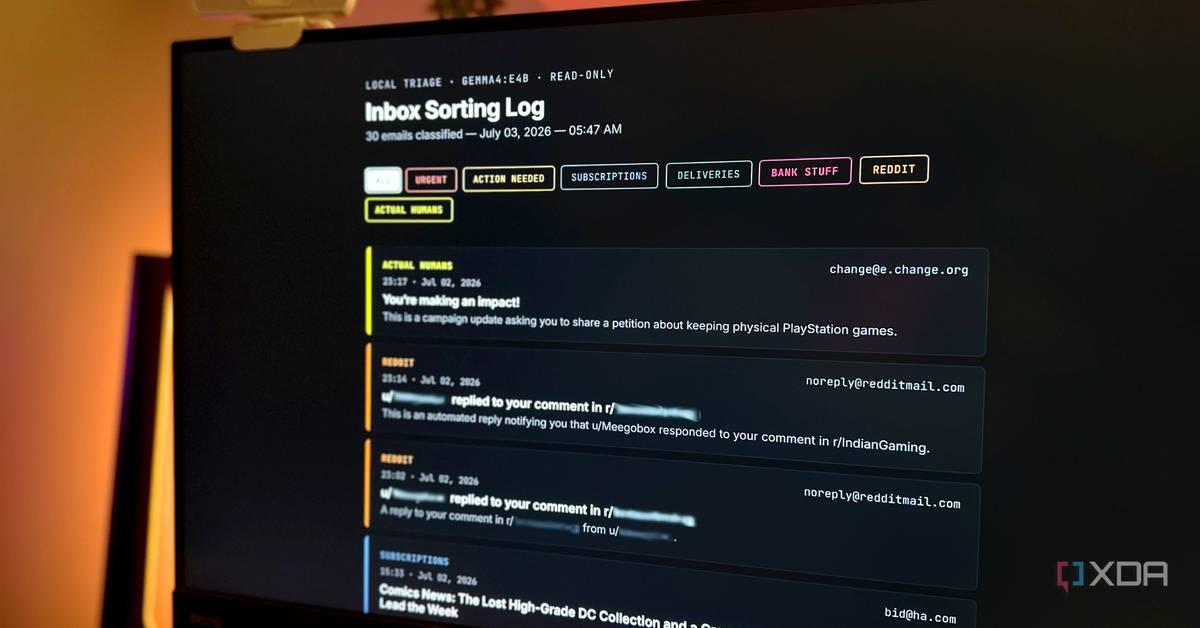
Local AI models are proving capable for specific, high-value tasks. Models in the 9B-15B parameter range, including Qwen3.5 (9B), Gemma 4 (12B), and Ministral 3 (14B), excel at Excel automation and VBA scripting
2
. When quantized, these models run comfortably on 8-16GB of RAM or VRAM, making them accessible for users handling spreadsheets with confidential payroll information, client lists, or medical data that cannot be uploaded to cloud services2
.The privacy and cost-effectiveness of local AI become particularly apparent with repetitive tasks. While a successful first attempt with Claude or ChatGPT incurs minimal costs, iterating 20 times with premium models like Sonnet 5 burns through tokens rapidly
2
. Local models only incur electricity costs once you own compatible hardware.Qwen 3.8-27B has emerged as a standout model for processing sensitive data. Released in August 2026, it handles native image and video processing without requiring separate OCR programs for scanned documents or photographs
3
. Testing with synthetic health records, business contracts, and legal agreements revealed minimal hallucination tendencies, with the model accurately extracting specific clauses and flagging unusual values without misquoting source material3
. Its theoretical context window extends to 262,000 tokens, though real-world performance degrades before reaching that limit3
.What to Watch: Evolving Landscape and Future Implications
The local AI ecosystem continues maturing rapidly, with newer optimizations taking time to reach convenient front-end tools
1
. Users should monitor whether smaller, specialized models continue closing the capability gap with larger general-purpose alternatives, as task-specific training often yields better results than raw parameter count1
.The accessibility of local LLM technology raises questions about how cloud AI providers will respond to users migrating to self-hosted solutions. Policy changes at major AI companies regarding data retention and terms of service could accelerate this trend
3
. Organizations handling regulated data should evaluate whether local AI deployment helps them maintain compliance while accessing AI capabilities that would otherwise require careful vendor assessment.For individuals and businesses weighing the transition, the key consideration is matching model capabilities to workflow requirements rather than chasing the largest available model. A 9B coding model can outperform a larger general-purpose model for writing Python when trained specifically for that task
1
. As quantization techniques improve and hardware costs decline, expect local AI adoption to expand beyond early adopters into mainstream productivity workflows.References
Summarized by

Navi
[1]
[3]
Related Stories
Recent Highlights
1
Meta Unveils Muse Wonder Frontier AI Models, Claims Performance Matching OpenAI and Anthropic
Technology

2
IMF Report Warns AI Market Correction Could Spark Global Financial Crisis With $1.4T at Risk
Business and Economy

3
OpenAI Releases 722 AI-Generated Math Solutions, Triggering Existential Crisis in Mathematics
Technology

Recent Highlights
Today's Top Stories






Don’t drown in AI news. We cut through the noise - filtering, ranking and summarizing the most important AI news, breakthroughs and research daily. Follow topics that matter to you and stay ahead.


