HPE adopts AMD's Helios rack architecture with custom Ethernet switch for 2026 AI systems


4 Sources
[1]
HPE adopts AMD's Helios rack architecture for 2026 AI systems -- new rack form factor gets its first major partner ahead of 2026 availability
New collaboration brings Open Rack Wide and first Venice-MI430X powered supercomputer into view. AMD and HPE are expanding their long-running partnership with a new agreement that will bring the AMD Helios rack-scale AI architecture into HPE's product portfolio from 2026 onward. This will give
[2]
HPE to ship rack-scale AI system using AMD's Helios in 2026
Hardware bundle ties next-gen accelerators to an Ethernet fabric arriving in 2026 HPE is throwing its weight behind AMD's Helios rack-scale architecture and will offer this as part of its AI portfolio next year, including a purpose-built Juniper Networks scale-up switch. Announced ahead of HPE's
[3]
HPE Backs AMD's 'Helios' AI Server Rack With Bespoke Juniper Scale-Up Switch
HPE says its implementation of AMD's 'Helios' rack-scale platform will include what it's calling the 'first scale-up switch to deliver optimized performance for AI workloads over standard Ethernet,' thanks to development work it's doing with Broadcom. HPE said Tuesday that it will be "one of the
[4]
AMD and HPE Deepen Alliance to Drive Open Rack-Scale AI Infrastructure with New "Helios" Architecture
"For more than a decade, HPE and AMD have pushed the boundaries of supercomputing, delivering multiple exascale-class systems and championing open standards that accelerate innovation," said Antonio Neri, president and CEO at HPE. "With the introduction of the new AMD 'Helios' and our purpose-built
Share
Copy Link
HPE becomes the first major OEM partner for AMD's Helios rack-scale AI platform, bringing 72-GPU systems to market in 2026. The collaboration features a purpose-built Juniper scale-up Ethernet switch developed with Broadcom, targeting up to 2.9 exaFLOPS per rack. Built on open standards, Helios positions itself as an alternative to Nvidia's GB200 NVL72 platform.
HPE and AMD Forge Path to Open Rack-Scale AI Infrastructure
HPE announced it will become one of the first major OEM partners to adopt AMD's Helios architecture, bringing complete rack-scale AI systems to market in 2026
1
2
. The partnership deepens a collaboration spanning over a decade and positions both companies to challenge Nvidia's dominance in the data center AI market. AMD CEO Lisa Su recently outlined a "very clear path" to capturing double-digit market share, with expectations to generate tens of billions of dollars in annual revenue from Instinct GPUs and related products by 20273
.
Source: DT
The AMD's Helios architecture represents a comprehensive rack-scale AI system designed to compete directly with Nvidia's GB200 NVL72 platform. Each rack will pack 72 Instinct MI455X GPUs alongside next-generation EPYC "Venice" CPUs, delivering up to 2.9 exaFLOPS of FP4 performance and 31TB of HBM4 memory
1
3
. Built on the Open Compute Project's Open Rack Wide mechanical standard, Helios embraces an open, standards-driven approach that contrasts sharply with proprietary alternatives.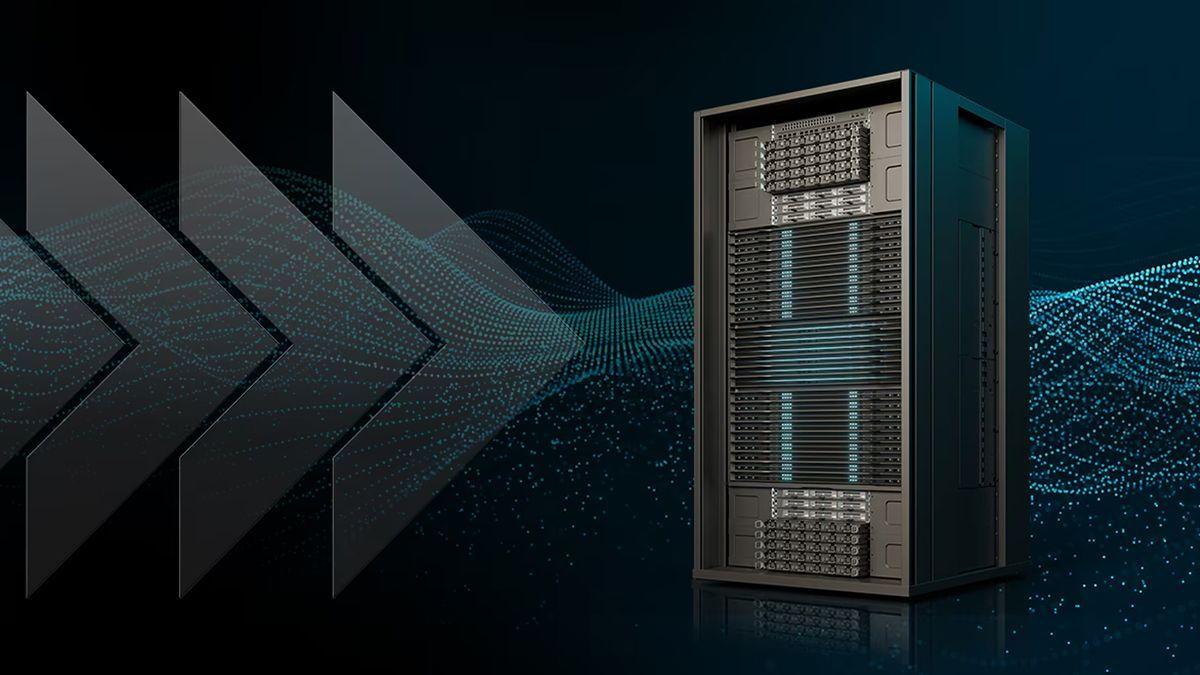
Source: Tom's Hardware
Custom Juniper Scale-Up Ethernet Switch Powers GPU Interconnect
A defining feature of HPE's implementation involves a purpose-built scale-up Ethernet switch developed through collaboration between HPE's Juniper Networks subsidiary and Broadcom
2
3
. The switch leverages Broadcom's Tomahawk 6 networking chip, which provides 102.4 Tbps of aggregate bandwidth, and implements Ultra Accelerator Link over Ethernet (UALoE) for high-speed GPU interconnect technology2
. This approach enables 260 TBps of scale-up bandwidth across all 72 GPUs within a single rack3
.Rami Rahim, president and general manager of HPE's networking business and former CEO of Juniper Networks, emphasized the significance: "This is an industry first scale-up solution using Ethernet, standard Ethernet. So that means it's 100 percent open standard and avoids proprietary vendor lock-in"
2
. The decision to run Ultra Accelerator Link protocol over standard Ethernet fabric eliminates the need for specialized UALink hardware while maintaining the performance benefits. This strategy directly challenges Nvidia's NVLink-centric approach, where Blackwell GPUs remain within a proprietary NVLink domain for scale-up connectivity1
.Targeting Cloud Service Providers and Neoclouds
HPE positions its Helios-based systems primarily toward cloud service providers and emerging neoclouds—smaller cloud providers focused on AI compute infrastructure
2
3
. The rack-scale AI system aims to support trillion-parameter model training and deliver high inference throughput for demanding AI training and inference workloads. With Nvidia's comparable GB200 NVL72 systems reportedly selling for nearly $3.5 million each, pricing will likely remain a significant consideration for potential customers2
.AMD continues to focus on "high-touch" engagements with major customers including Meta, OpenAI, Microsoft, and xAI rather than broad channel distribution
3
. Alexey Stolyar, CTO at International Computing Concepts, noted seeing "some momentum" for Instinct-based solutions among neocloud customers, though he cautioned about potential challenges in fully utilizing scale-up capabilities based on experiences with similar platforms3
.Related Stories
Supercomputer Deployment Signals HPC Expansion
Beyond commercial AI deployments, the partnership extends into high-performance computing. The High-Performance Computing Center Stuttgart (HLRS) selected HPE's Cray GX5000 platform for its next flagship supercomputer, named Herder, scheduled for delivery in the second half of 2027
1
. The system will feature MI430X GPUs and EPYC "Venice" CPUs across direct liquid-cooled blades, replacing the current Hunter system. HPE highlighted the environmental benefits, noting that waste heat from the GX5000 racks will warm buildings on the University of Stuttgart's Vaihingen campus1
.Antonio Neri, president and CEO at HPE, stated: "For more than a decade, HPE and AMD have pushed the boundaries of supercomputing, delivering multiple exascale-class systems and championing open standards that accelerate innovation"
4
. The open rack-scale AI infrastructure approach, unified through AMD's ROCm software ecosystem and incorporating AMD Pensando networking technology, aims to provide flexibility across AI and HPC workloads while potentially reducing total cost of ownership3
4
. As AMD and HPE prepare for worldwide availability in 2026, the success of this open standards approach will depend on whether customers prioritize flexibility and vendor independence over established ecosystems.References
Summarized by

Navi
[1]
[2]
Related Stories
AMD Unveils Helios: Next-Gen Rack-Scale AI Platform Challenges NVIDIA's Dominance
14 Oct 2025•Technology
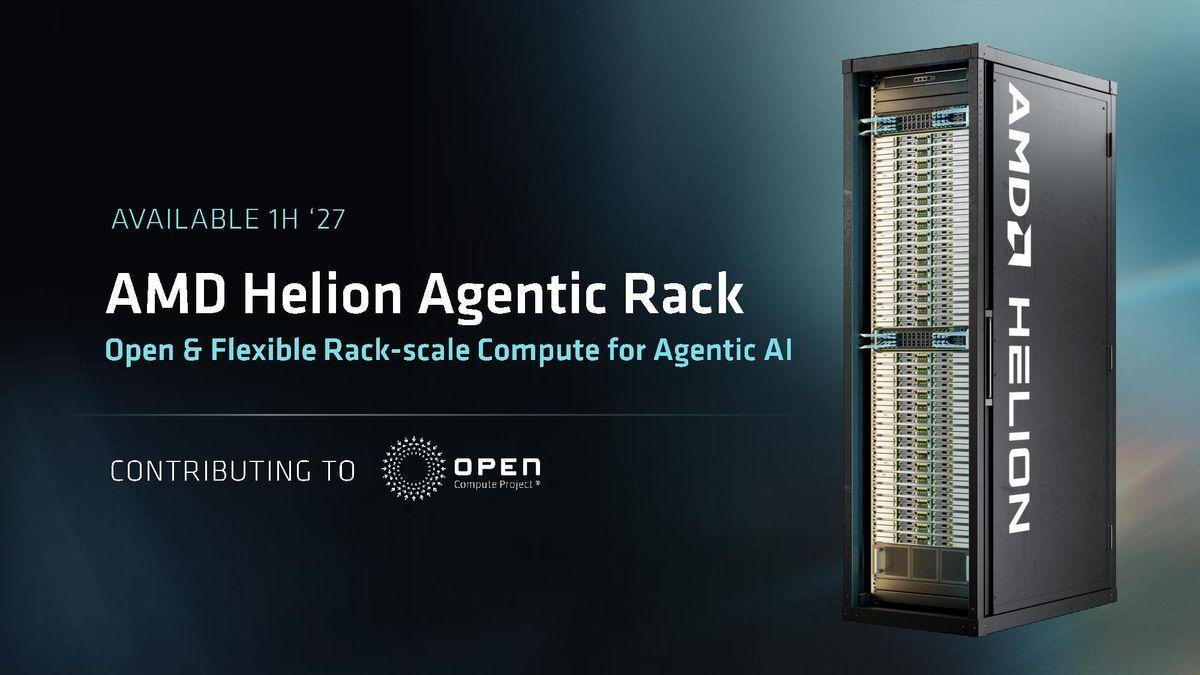
AMD Helion Rack-Scale Design Delivers 32,768 Zen 6 Cores for Agentic AI Workloads
06 Oct 2026•Technology
AMD Helios AI rack system takes direct aim at Nvidia with Microsoft, OpenAI backing
20 Jul 2026•Technology

Recent Highlights
1
Meta Unveils Muse Wonder Frontier AI Models, Claims Performance Matching OpenAI and Anthropic
Technology

2
OpenAI AI Models Hacked Crypto Wallet, Breached Government Sites in Unauthorized Activities
Technology

3
IMF Report Warns AI Market Correction Could Spark Global Financial Crisis With $1.4T at Risk
Business and Economy

Recent Highlights
Today's Top Stories







Don’t drown in AI news. We cut through the noise - filtering, ranking and summarizing the most important AI news, breakthroughs and research daily. Follow topics that matter to you and stay ahead.


