Humanoid Robots Shatter Usain Bolt's 100-Meter Record, Clocking 8.64 Seconds at Beijing Games


17 Sources
[1]
'Robot Olympics' reveal humanoids' rapid progress -- but hurdles remain
A human-sized robot sprinted faster than any human has before. Another jumped more than 3 metres in the air to break a record. And a third faced off against a human Olympian during a table-tennis showcase match. These were scenes from the second annual World Humanoid Robot Games in Beijing, at
[2]
Humanoid robots shatter Usain Bolt's 100m record, hits 23.8 mph before crashing into foam pads -- video shows Tiangong Ultra logging 9.39-second sprint before colliding with padded wall
Two Chinese humanoid robots just beat the record of the world's fastest human in the 100-meter dash. According to Reuters, Tiangong Ultra achieved a record time of 9.39 seconds in the race, while Honor's Lightning came in at a close second, with a time of 9.47 seconds. These are 0.19 and 0.11
[3]
China's record robotic strides show the limits of human speed
BEIJING, Aug 28 (Reuters) - A made-in-China humanoid shattered Usain Bolt's world record time in the 100-metre sprint this week, a milestone in the development of robots that can match, and even surpass, human achievements. But the robot did not beat Bolt by running like him, or like any human,
[4]
Humanoid 'Olympics' reveal why the US can't compete with China's robots
Shanghai-based MirrorMe has its Bolt humanoid at the games CCTV As the second World Humanoid Robot Games got under way on August 21 at Beijing's National Speed Skating Oval, most of the interest has been on the machine sprinters and boxers. But away from the sporting arena, the five-day games
[5]
Robot Olympics ends with humanoid's 8.64-second 100m, nearly a second faster than Bolt
BEIJING, Aug 26 (Reuters) - A Chinese humanoid robot on Wednesday ran the 100 metres in 8.64 seconds, almost a second faster than Jamaican Usain Bolt's human world-record time, at the close of a five-day competition featuring robotic athletes, viral stumbles and industrial tests. Tiangong Ultra,
[6]

Usain Bolt's 100m sprint record shattered by Honor's humanoid robot
A Chinese humanoid robot named Lightning has reportedly completed the 100-meter sprint in 9.32 seconds, beating Usain Bolt's long-standing world record. Developed by smartphone maker Honor, the robot reached a peak speed of 14.5 meters per second during a test event in Beijing. The performance
[7]

Robots have smashed human world records for the 100m sprint and high jump at China's 'robot Olympics' -- but the biggest hurdle is stopping safely
* The 2026 World Humanoid Robot Games are happening this week * Robots are performing better than ever across 51 events * Stopping a sprinting robot remains a major engineering challenge The World Humanoid Robot Games are underway in Beijing, China, and records set by flesh and blood humans are
[8]
Robots can outrun humans, but can they plug in a cable?
BEIJING, Aug 23 (Reuters) - China's humanoid robots have shown they can run quicker than the fastest humans. Now comes the real test: can they also handle packaging and warehouse operations while reliably performing precision tasks like connecting cables designed to evaluate their ability to work
[9]

At Olympics-like event, Chinese robots smash athletic records set by humans -- including Usain Bolt's 100-meter sprint time | Fortune
Chinese humanoid robots broke records set by humans, including beating Usain Bolt's 100-meter sprint world record, on the opening day of the Olympics-like World Humanoid Robot Games in Beijing on Saturday. More than 2,000 humanoid robots were participating in the event, the organizer said. The
[10]

Chinese humanoid robot 'Lightning' beats human 100m world record in test run
A humanoid robot developed by Chinese smartphone maker Honor ran 100 meters in 9.32 seconds, China's state broadcaster reported on Saturday, beating the human world record held by Jamaican sprinting great Usain Bolt. The robot, dubbed Lightning, reached a peak speed of 14.5 meters per second
[11]

Chinese humanoid robots smash human records at Beijing competition
BEIJING (AP) -- Chinese humanoid robots broke records set by humans, including beating Usain Bolt's 100-meter sprint world record, on the opening day of the Olympics-like World Humanoid Robot Games in Beijing on Saturday. More than 2,000 humanoid robots were participating in the event, the
[12]

Chinese humanoid robot beats Usain Bolt's 100m record at Beijing games
A Chinese humanoid robot named Tiangong Ultra ran 100 meters in 9.39 seconds. This impressive speed surpassed Usain Bolt's previous world record of 9.58 seconds. Another robot, Honor's Lightning, also finished faster than Bolt's record time. These results show significant improvement from last
[13]

Chinese Humanoid Robot Beats Usain Bolt's 100m Record
Chinese Humanoid Robot Beats Usain Bolt's 100-Meter Record, Then Crashes Into Safety Barrier A Chinese humanoid robot named Tiangong Ultra ran the 100 meters faster than Usain Bolt's human world record on Saturday at the World Humanoid Robot Games, spotlighting Beijing's booming robotics
[14]

'China isn't doing this for fun': Why robot games should be a wake-up call for Canada
TORONTO - On the final day of competition at the World Humanoid Robot Games in Beijing, a Chinese-built robot ran 100 metres in 8.64 seconds -- almost a full second faster than Usain Bolt's world record. Then it literally hit a wall. There is a padded blue barrier past the finish line at the
[15]
Beijing robot games showcase China's edge in humanoid robotics
TORONTO - On the final day of competition at the World Humanoid Robot Games in Beijing, a Chinese-built robot ran 100 metres in 8.64 seconds -- almost a full second faster than Usain Bolt's world record. Then it literally hit a wall. There is a padded blue barrier past the finish line at the
[16]

Chinese robot beats Usain Bolt's 100m world record in test run | BreakingNews
A humanoid robot developed by Chinese smartphone maker Honor ran 100 meters in 9.32 seconds, China's state broadcaster reported on Saturday, beating the human world record held by Jamaican sprinting great Usain Bolt. The robot, dubbed Lightning, reached a peak speed of 14.5 meters per second
[17]

Chinese robots beat Usain Bolt's 100m world record at Beijing games
Tiangong Ultra, developed by the Beijing Humanoid Robot Innovation Center, won its heat at the opening of the games' second edition on Saturday, organizers said. The robot overtook smartphone maker Honor's Lightning near the finish after falling behind early in the race. Lightning finished in
Share
Copy Link
China's Tiangong Ultra humanoid robot ran 100 meters in 8.64 seconds at the World Humanoid Robot Games in Beijing, beating Usain Bolt's 9.58-second record. The event showcased rapid advancements in robotics but also revealed significant challenges in high-dexterity tasks like folding laundry and using tools.
Humanoid Robots Break Speed Records at World Humanoid Robot Games
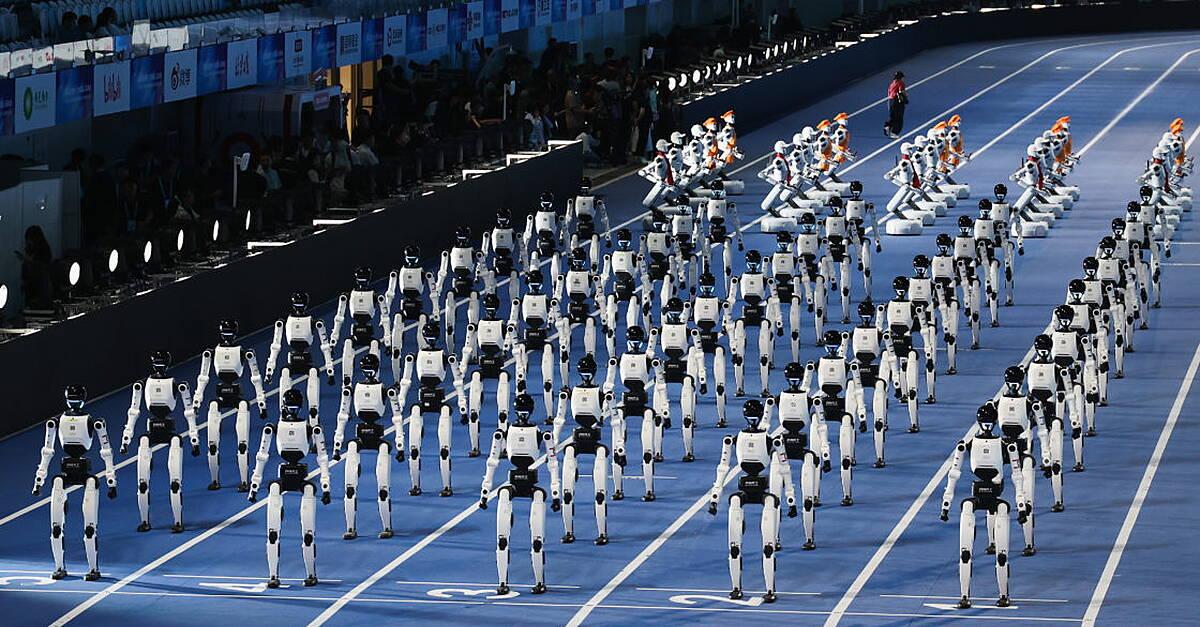
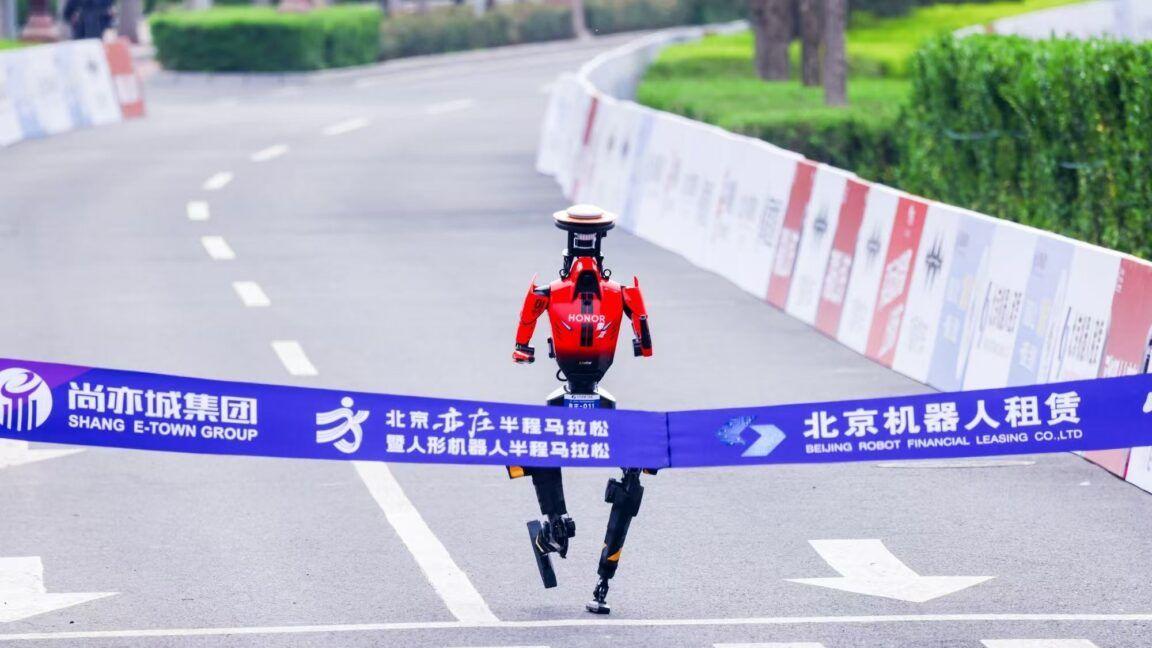
At the second annual World Humanoid Robot Games in Beijing, humanoid robots demonstrated unprecedented speed capabilities, with China's Tiangong Ultra completing the 100-meter sprint in 8.64 seconds—nearly a full second faster than Usain Bolt's 9.58-second human world record set in 2009
5
. Honor's Lightning came in at a close second with a time of 9.47 seconds, while another run by Tiangong Ultra clocked 9.39 seconds during qualifying rounds2
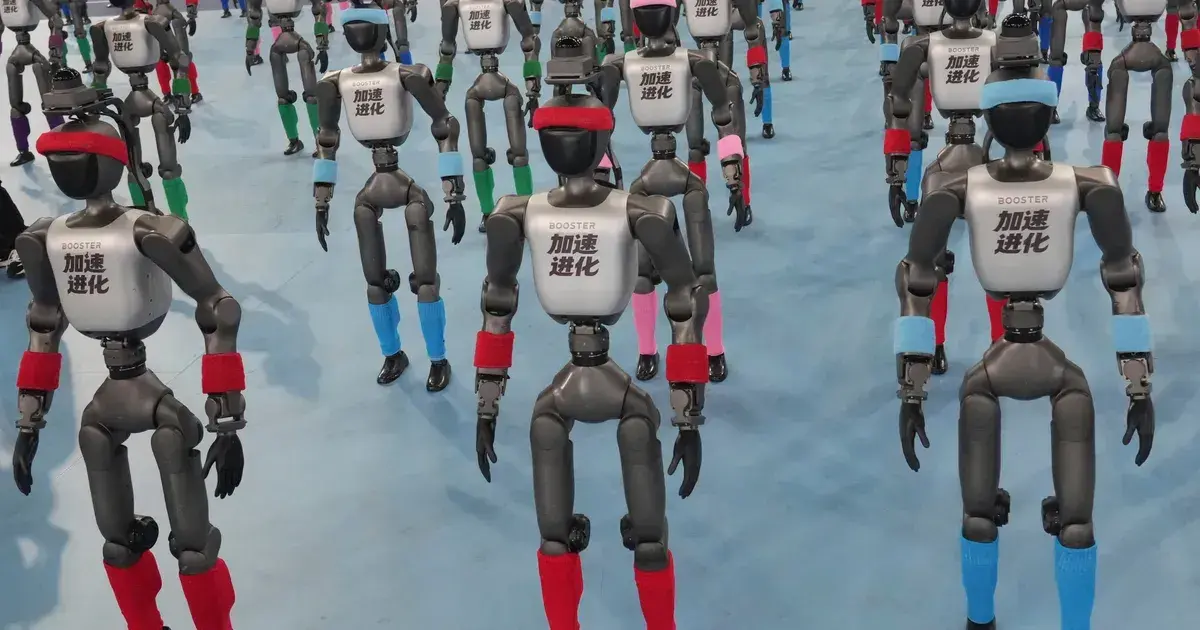
. The five-day competition, held from August 22 to 26 at Beijing's National Speed Skating Oval, brought together more than 2,056 robots from 666 teams across 16 countries, with the majority representing Chinese universities, research institutions, and robotics companies1
4
.
Source: Fortune
The games served as a defining marker for the robotics industry, showcasing how rapidly the technology has progressed. To put this in context, Tiangong Ultra won the same 100-meter race last year with a time of 21.50 seconds
1
. That means the robot cut its time by more than 12 seconds in just one year—a feat that took humans nearly a century to accomplish with a one-second improvement2
.How Humanoid Robots Achieve Superhuman Speed
While the speed achievements are remarkable, sport science experts emphasize that these humanoid robots don't run like humans. The robots translate energy into acceleration extremely efficiently, using electric motors and gearboxes that generate power faster than human muscles and tendons
3
. "An electric motor simply creates rotation. It doesn't need to pull and extend like muscles do," explained Park Hae-won, a professor at South Korea's KAIST who leads the school's humanoid lab3
.Tiangong Ultra's developer redesigned parts of the robot's torso and waist to cut weight and reduce the effort needed to move its body while running, according to Guo Yijie, a manager in its humanoid innovation department
3
. The robot also benefits from improved motors, enhanced range of movement, and advanced control software. These improvements enable an almost superhuman cadence of shorter, faster steps. While Bolt finished 100 meters in 41 steps, Tiangong appears to take more than 50 steps, but executes them far faster3
.Unlike human sprinters who experience neuromuscular fatigue and slow down in the final 20 meters, these robots maintain their highest speed through the final stage of the race
3
. However, this advantage comes with a significant drawback—the robots crashed into padded walls at the finish line, unable to decelerate gracefully2
.Real-World Challenges Reveal Robotics Limitations
While humanoid robots excel at track-and-field events and prescribed trajectories like backflips and sprints, they struggle significantly with high-dexterity tasks that humans perform effortlessly. "If I ask you which is harder—folding laundry or doing a backflip—most people will say folding laundry is way easier," says Karen Liu, a computer scientist at Stanford University. "But for humanoids, doing a task that we do in our daily lives is actually way harder than a backflip"
1
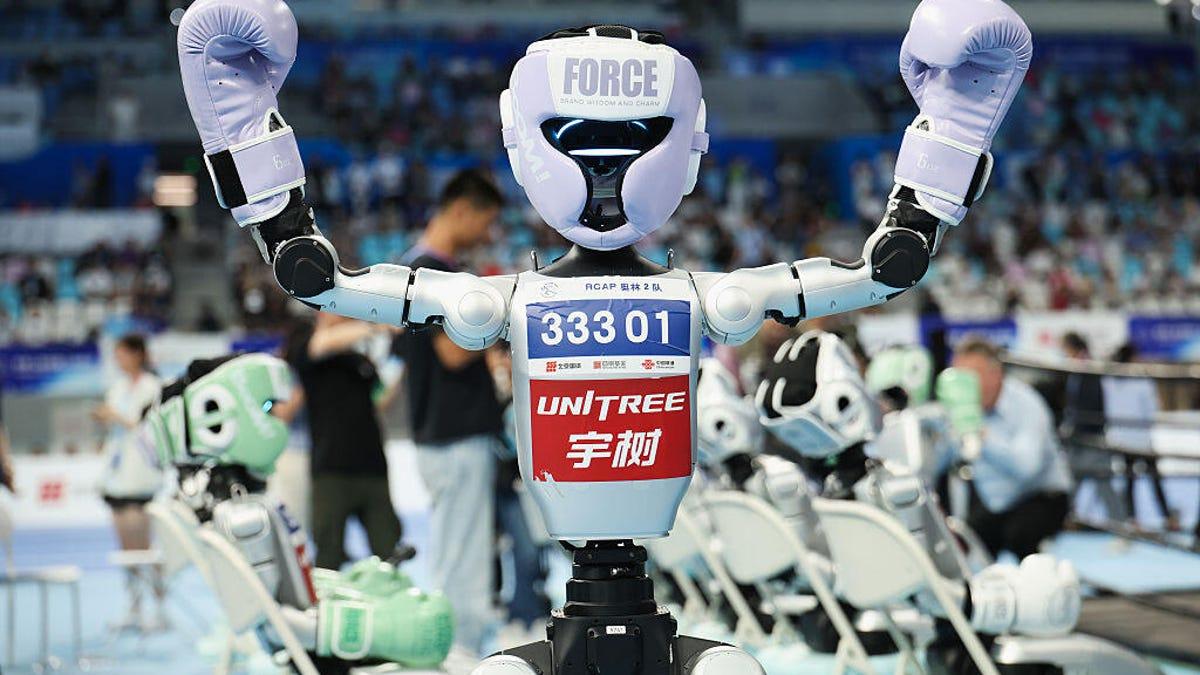
.This year's games expanded beyond athletics to include 51 disciplines, incorporating real-world challenges such as shelving books, making beds, and hammering nails into corkboards
1
5
. The scenario-based events also included simulated factories, restaurants, offices, and emergency settings. Robots that completed tasks autonomously were scored more highly than those remotely operated by humans1
.
Source: BreakingNews.ie
Creating robotic grippers that can mimic the strength and coordination of the human hand remains challenging, and using tools is particularly difficult because grippers struggle to create enough contact with a tool to apply strong force
1
. Indeed, robots at the games struggled to hammer nails efficiently, even when operated by team members wearing gloves that control the robots' movements1
.Related Stories
China's Technology Supply Chain Advantage
The games reveal why China is advancing so rapidly in robotics development. Jin Yongbin, Chief Technology Officer of MirrorMe Technology, whose humanoid Bolt competed at the Beijing games, explained: "In my view, China's supply chain is exceptionally complete. For the entire robot system, its motors, batteries, electric drives and transmission systems, are perfectly aligned with the existing automotive industry's supply chain. We are essentially transferring our established automotive supply chain to robotics"
4
.This technology supply chain enables diversification that seems unusual from a Western perspective—companies like Honor, primarily known for phones, and Xiaomi, known for consumer electronics, are now building competitive humanoid robots
4
. The ecosystem supports hundreds of teams building robots simultaneously, with events like the World Humanoid Robot Games encouraging engineers to compare notes and learn from each other. In 2024, an initiative was launched to facilitate data sharing between humanoid startups and companies4
."More importantly, we need to rely on events like this to continuously exchange ideas, evaluate the strengths and weaknesses of different technologies, and rapidly refine the robotics supply chain," Jin added
4
. This collaborative approach, combined with healthy competition, creates a unique development environment where engineers learn from and collaborate with engineers across company lines4
.What the Future Holds for Embodied AI
For developers, the games offered a public test bed for embodied AI, which combines AI software with machines that can perceive and act in the physical world
5
. He Wang, founder and chief technology officer of Galbot, said the competition would help teams improve their technology while showing what embodied AI systems could do autonomously. "It will provide a huge boost for industry development," he said5
.
Source: Seattle Times
Spectators noted visible improvements from the previous year. "Last year's robots looked a little stiff and uncoordinated," said 34-year-old Niu. "This year, they are much better. They are like healthy newborn babies growing up"
5
. Yang, 29, said she could imagine robots becoming as commonplace as smartphones, with applications in household chores and elderly care5
.However, experts emphasize that bipedal mobility improvements in decision-making, perception, and motor control are essential. Sports scientist Parunchaya Jamkrajang noted that robots capable of better turns and independent decisions—such as changing direction or decelerating to avoid obstacles—would be more impressive than simple speed gains
3
. As Aya Durbin, who directs development of the Atlas humanoid robot at Boston Dynamics, stated: "Humanoids won't become a part of our everyday lives if they're always 'toys'. They need to be used to solve actual problems and make the world a better place"1
.References
Summarized by

Navi
Related Stories
China's Humanoid Robots Claim 97% of Global Market as Embodied AI Shifts from Spectacle to Scale
19 Aug 2026•Technology

Beijing Hosts Inaugural World Humanoid Robot Games: A Showcase of AI and Robotics Progress
15 Aug 2025•Technology
China Prepares Humanoid Robots for Combat as PLA Pushes Technology from Labs to Battlefields
07 Sept 2026•Technology

Recent Highlights
1
Microsoft and Nvidia Launch Surface Laptop Ultra: A $2,599 AI-Ready PC With RTX Spark Chip
Technology

2
Trump Consulted Grok AI Before Ordering Venezuela Invasion and Capture of Nicolás Maduro
Policy and Regulation

3
Scientists Build AI Model That Reconstructs Images From Brain Scans in Record Time
Science and Research

Recent Highlights
Today's Top Stories





Don’t drown in AI news. We cut through the noise - filtering, ranking and summarizing the most important AI news, breakthroughs and research daily. Follow topics that matter to you and stay ahead.


