IBM CEO warns $8 trillion AI data center buildout can't turn a profit at current spending rates


5 Sources
[1]
IBM CEO warns that ongoing trillion-dollar AI data center buildout is unsustainable -- warns there is 'no way' that infrastructure costs can turn a profit
Krishna's cost model challenges the economics behind multi-gigawatt AI campuses. IBM CEO Arvind Krishna used an appearance on The Verge's Decoder podcast to question whether the capital spending now underway in pursuit of AGI can ever pay for itself. Krishna said today's figures for constructing
[2]
Multi-gigawatt AI campuses are draining billions annually
High-end GPU hardware must be replaced every five years without extension IBM chief executive Arvind Krishna questions whether the current pace and scale of AI data center expansion can ever remain financially sustainable under existing assumptions. He estimates that populating a single 1GW site
[3]
IBM CEO Says the Math Just Doesn't Add Up on Its Competitors' AI Spending
"It's my view that there's no way you're going to get a return on that." AI companies are continuing to pour ungodly amounts of money into building out data centers, in an enormous bet that both analysts and tech leaders warn may not pay off for many years to come -- if it ever does. OpenAI most
[4]
IBM CEO warns there's 'no way' hyperscalers like Google and Amazon will be able to turn a profit at the rate of their data center spending | Fortune
While giant tech companies like Google and Amazon tout the billions they're pouring into AI infrastructure, IBM's CEO doubts their bets will pay off like they think. Arvind Krishna, who has been at the helm of the legacy tech company since 2020, said even a simple calculation reveals there is "no
[5]

The $8 Trillion AI Mirage: IBM Says The Math Just Doesn't Work - IBM (NYSE:IBM)
Everyone on Wall Street is busy celebrating the AI supercycle -- until you try the math. This week, IBM (NYSE:IBM) CEO Arvind Krishna dropped a number so large it could stop the AI party cold. Track IBM stock here. At today's costs, he told Decoder, it takes roughly $80 billion to build and fully
Share
Copy Link
IBM CEO Arvind Krishna questions whether the trillion-dollar AI infrastructure boom makes financial sense. He estimates that 100 gigawatts of planned AI data center capacity would cost $8 trillion and require $800 billion in annual profit just to service debt. With five-year hardware refresh cycles and accelerating depreciation, Krishna warns hyperscalers face unsustainable economics chasing AGI.
IBM CEO Challenges Economics Behind Massive AI Infrastructure Push
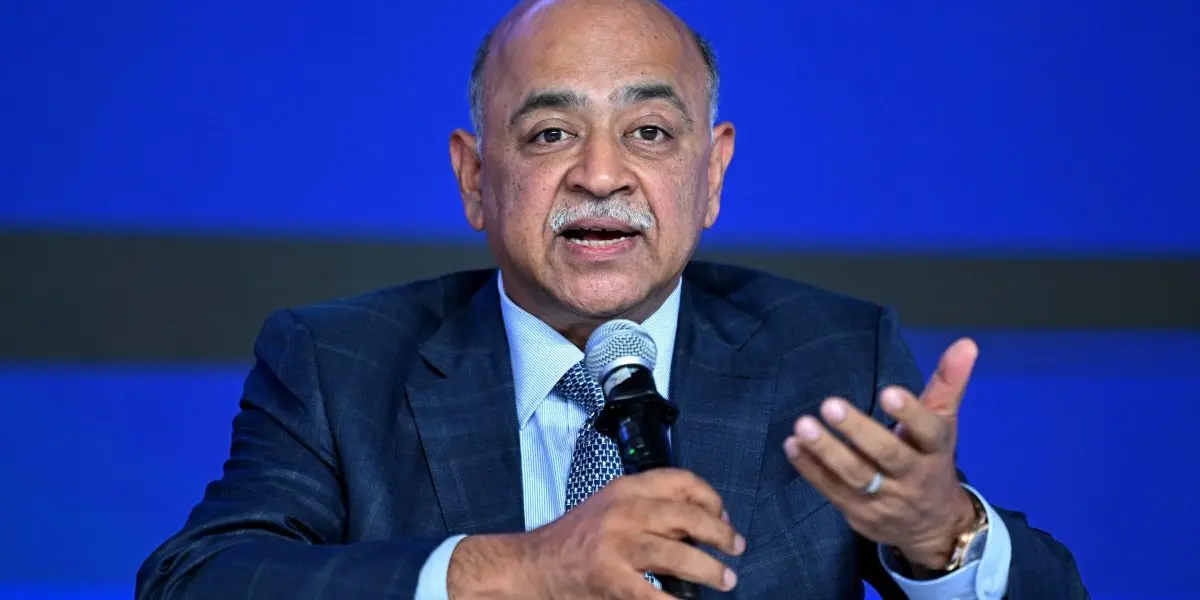
Arvind Krishna, CEO of IBM, has issued a stark warning about the financial viability of the ongoing trillion-dollar AI data center buildout. Speaking on The Verge's Decoder podcast, Krishna argued that current capital expenditures in pursuit of artificial general intelligence may never generate sufficient returns to justify the investment
1
. His analysis centers on a simple but troubling calculation: filling a single one-gigawatt AI data center with compute hardware now costs approximately $80 billion2
. With public and private announcements indicating roughly 100 gigawatts of planned capacity dedicated to AGI-class workloads, the total financial exposure approaches $8 trillion3
. Krishna's assessment comes as hyperscalers like Google, Amazon, and Microsoft continue announcing unprecedented infrastructure investments, with combined capital spending projected to reach $380 billion in 2025 alone4
.
Source: Fortune
Why Five-Year Depreciation Cycles Make AI Spending Financially Unsustainable
The IBM chief pointed to depreciation as the factor most underappreciated by investors in evaluating AI infrastructure build-out economics. AI accelerators and GPU hardware typically depreciate over five years, but the rapid pace of architectural change means fleets must be replaced entirely rather than extended
1
. "You've got to use it all in five years because at that point, you've got to throw it away and refill it," Krishna explained3
. This creates a compounding effect on long-term capital expenditures, transforming what appears to be a one-time investment into a repeating financial obligation. Hardware that remains physically functional becomes economically obsolete as performance jumps arrive faster than financial write-downs can absorb2
. Investor Michael Burry has raised similar concerns about whether hyperscalers can continue stretching useful-life assumptions if model sizes and training demands force accelerated retirement of older equipment1
.Multi-Gigawatt AI Campuses Demand Unrealistic Profits
Krishna calculated that servicing the cost of capital for $8 trillion in infrastructure investment would require approximately $800 billion in annual profit just to remain financially neutral
3
. "It's my view that there's no way you're going to get a return on that," he stated bluntly4
. The burden no longer sits primarily with energy consumption or land acquisition, but with the forced churn of increasingly expensive hardware stacks2
. If a single company commits to building 20-30 gigawatts of capacity, that alone represents $1.5 trillion in capital spending—roughly equivalent to Tesla's current market capitalization4
. These projections arrive as leading technology firms announce ever-larger facilities measured not in megawatts but in tens of gigawatts, with some proposals rivaling the electricity demand of entire nations2
.
Source: Benzinga
Related Stories

AGI Pursuit Drives Competitive Pressure Over Validated Returns
Krishna estimates the likelihood that current LLM-centric architectures reach AGI at between zero and 1% without fundamental breakthroughs in knowledge integration
1
. He described the drive to achieve artificial general intelligence as chasing a "belief" rather than a validated technological path3
. "If we can figure out a way to fuse knowledge with LLMs," Krishna suggested, companies might stand a chance of reaching AGI, though he remains skeptical even then3
. The IBM executive believes generative AI will prove "incredibly useful for enterprise" and "unlock trillions of dollars of productivity," but argues the relationship between physical scale of next-gen infrastructure and the economics required to support it remains deeply problematic1
. OpenAI alone has committed to spending well over a trillion dollars before the end of the decade while burning significant cash each quarter, prompting hard questions from investors about return on investment3
.Market Implications and the Risk of Financial Reassessment
The warning lands as Big Tech companies continue flexing AI spending with little apparent concern for near-term profitability. In its third quarter, Alphabet raised its 2025 capital spending outlook to between $91 billion and $93 billion, while Amazon increased its capital expenditure estimate to $125 billion
4
. According to HSBC analysis, OpenAI won't generate profit for at least another four years and will need to burn through over $200 billion to sustain growth plans3
. The Wall Street Journal recently described the lack of a "clear financial model for profitable AI" despite soaring valuations3
. Market observers suggest the first hyperscaler to slow spending could trigger broader reassessment of AI infrastructure profitability, exposing how much of the buildout reflects competitive fear rather than sound economics5
. Interestingly, IBM now uses questions about an AI bubble as a litmus test for new hires, asking candidates whether they believe the industry faces unsustainable speculation3
. Krishna's assessment suggests the AI revolution may be real, but the capital model supporting it could hit a wall long before anticipated returns materialize.References
Summarized by

Navi
[1]
Related Stories
AMD CEO Lisa Su dismisses AI bubble fears as Goldman Sachs warns of datacenter investment risks
05 Dec 2025•Business and Economy

AI Industry Faces $800 Billion Revenue Shortfall by 2030, Bain Report Warns
23 Sept 2025•Business and Economy
AI Infrastructure Spending Set to Outpace Revenue by Trillions, Threatening Market Shakeout
Yesterday•Business and Economy

Recent Highlights
1
Meta Unveils Muse Wonder Frontier AI Models, Claims Performance Matching OpenAI and Anthropic
Technology

2
IMF Report Warns AI Market Correction Could Spark Global Financial Crisis With $1.4T at Risk
Business and Economy

3
OpenAI Releases 722 AI-Generated Math Solutions, Triggering Existential Crisis in Mathematics
Technology

Recent Highlights
Today's Top Stories










Don’t drown in AI news. We cut through the noise - filtering, ranking and summarizing the most important AI news, breakthroughs and research daily. Follow topics that matter to you and stay ahead.


