4 Sources
[1]
Digital infrastructure demand drives new wave of strategic land buying
India's data centre sector is experiencing rapid growth. This expansion is leading to substantial land acquisitions across new markets. Major investments are creating new infrastructure corridors. Hyperscale cloud operators and AI providers are driving this demand. This development is transforming India's digital economy and real estate landscape. India's rapidly expanding data centre industry is triggering a fresh wave of land acquisitions across emerging markets, with more than $100 billion in announced investments creating new real estate and infrastructure corridors alongside Mumbai, which accounts for nearly half of the country's operational data centre capacity. The expansion is being driven by hyperscale cloud operators, artificial intelligence infrastructure providers and global technology companies seeking large, power-ready land parcels to support the next phase of India's digital infrastructure buildout. "The data centre sector is creating a new category of real estate demand centred on large, power-secure land parcels with strong connectivity infrastructure. Unlike traditional commercial developments, these projects require long-term planning around power, fibre networks and scalability," said Niranjan Hiranandani, Chairman, NAREDCO. According to him, as AI adoption accelerates, we expect increased land banking activity across key corridors, with data centres becoming a key catalyst for infrastructure development, industrial growth and institutional investment in real estate. Microsoft India, Amazon Data Services India, STT Global Data Centres, NTT Global Data Centres, Colt DCS, and Blackstone's data center platform are among key entities that have been acquiring land parcels to set up data centers. "The Indian data centre sector is no longer merely expanding; it is structurally transforming into one of the foundational pillars of the country's digital economy. AI-led workloads, hyperscaler investments, sovereign data requirements and cloud adoption are collectively accelerating demand for high-density digital infrastructure across India," said Shishir Baijal, International Partner & CMD, Knight Frank India. According to Baijal, what distinguishes the current cycle is the sheer depth of the development pipeline and the strategic diversification into emerging corridors beyond traditional hubs. India's live data centre capacity has expanded from about 296 MW in 2016 to more than 1.6 GW by the end of 2025, reflecting a nearly 21% compound annual growth rate, showed a Knight Frank India assessment. The country's committed and early-stage development pipeline now exceeds 8 GW, highlighting the scale of future infrastructure requirements. Markets including Visakhapatnam, Jamnagar and Hyderabad are also increasingly attracting attention as developers and operators look to diversify beyond established locations. The sector's rapid growth is being fuelled by artificial intelligence workloads, cloud adoption, enterprise digitisation and stricter data localisation requirements, transforming data centres into one of the fastest-growing institutional real estate asset classes. Mumbai anchors India's data centre ecosystem with 766.6 MW of operational capacity, leading major land banking in Navi Mumbai and Chandivali. However, a shift toward emerging markets with abundant land and power is creating new growth corridors. Visakhapatnam is positioned as an eastern hub through a $15 billion, gigawatt-scale AI campus by AdaniConneX and Google. Jamnagar is emerging via Reliance Industries' proposed 3 GW AI-focused campus. Hyderabad's pipeline has reached 1.9 GW, second only to Mumbai, while Chennai's pipeline crossed 1 GW, leveraging international subsea cable connectivity. This expansion is heavily propelled by AI workloads, which drove 348 MW of leasing in 2025 and account for one-fifth of total demand. Policy support, data regulations, and tax incentives further fuel institutional real estate growth. While power constraints, permitting delays, and sustainability requirements pose challenges, the sector remains a primary driver of digital infrastructure and land development.
[2]
India's data centre capacity to cross 3 GW by 2028 on AI, hyperscaler demand: CBRE
India's data centre capacity is set to surpass 3 gigawatts by 2028. This growth is driven by strong demand from hyperscalers and the increasing use of artificial intelligence. The country offers a development-friendly market. Major cities like Mumbai, Chennai, Hyderabad, and Delhi NCR are key hubs. This expansion will support India's digital economy and enterprise needs. New Delhi: India's data centre (DC) stock is likely to cross 3 gigawatts (GW) by the end of calendar year 2028, driven by a robust demand from hyperscalers, accelerating artificial intelligence workloads, and the country's structural advantage as Asia Pacific's most DC development-friendly market, according to CBRE. This stock measures the total computing power infrastructure available across a country's all data centres. The total DC capacity in the country reached the 1,700 MW at the end of 2025. In 2026, it projects a supply addition of 500 MW. "The combination of a low-bottleneck development environment, a rapidly expanding digital economy, and aggressive hyperscaler commitments positions India as one of the most compelling DC markets globally," said Anshuman Magazine, Chairman & CEO - India, South-East Asia, Middle East & Africa, CBRE. "As AI workloads multiply and the demand base broadens beyond cloud to Neocloud, GCCs and enterprise users, we expect the country's capacity trajectory to remain steep well beyond 2028," Magazine said. Mumbai continues to anchor national capacity at 800+ MW, with a further 750 MW under construction or committed. Chennai, Hyderabad and Delhi NCR are emerging as the next wave of hyperscale destinations, while Bangalore remains the hub for enterprise colocation demand. "While several large markets grapple with power constraints, rising construction costs and community resistance, India presents developers and investors with a combination of cost competitiveness, policy support and scalability. Paired with deepening demand across Tier I and Tier II cities, this underpins our confidence in the 3 GW milestone," said Ada Choi, CFA, Head of Asia Pacific Research, CBRE. The report adds that the total data centre investment in the APAC region reached a record $11.6 billion in 2025. Investors are increasingly favouring asset-specific exposure and improved liquidity. Platform and operating company opportunities are also expanding, with entity-level transactions reaching $8.3 billion in 2025. At the same time, more operators are adopting capital recycling and fund management models. These approaches support scale, strengthen balance sheets, and provide access to more diversified portfolios. Currently, hyperscalers account for 50-55% of market activity, with the January-March quarter witnessing a sharp spike in demand from cloud service providers contracting large capacities of over 300 MW. Beyond traditional cloud players, the demand is now coming from Neocloud operators, semiconductor companies, research & development users, and Global Capability Centres (GCCs), reflecting the maturation of India's DC occupier base. AI continues to be the key structural driver of DC demand, pushing requirements toward higher rack densities, advanced liquid cooling configurations, and more demanding compute workloads. The report mentions that the global neocloud providers are actively targeting India's Tier I cities, with a planned capacity take-up of approximately 5-15 MW per site. These specialised cloud providers own top-tier GPUs, provide GPU-as-a-Service (GPUaaS), and lease computing power to end-users including hyperscalers, AI labs, startups, research firms, media and gaming companies. Additionally, Tier II cities are also gaining visibility, with edge-style facilities coming on stream in Jaipur, Ahmedabad and Lucknow, and rising enquiries for containerised data centres in the 8-10 MW range.
[3]
India May Deploy Up to 700,000 GPUs in Data Centres Over Next Five Years: Avendus Capital
Avendus Capital has released the third annual edition of its Data Centres report, examining how rising AI adoption could drive deployment of 650,000 - 700,000 GPUs in India's data centres over the next five years, creating a USD 23 bn investment opportunity. With this, India's data centre capacity is set to grow at a 26% CAGR over the next five years. The report highlights that AI-led infrastructure demand alongside rising cloud and digital adoption is expected to nearly triple India's built data centre capacity from 1.6 GW in 2025 to ~5 GW by 2030. Developers currently have an active pipeline of over 3 GW, including ~1 GW of AI data centre capacity, requiring a total capital investment of nearly USD 25 bn over the next five years. Mumbai is expected to remain India's largest data centre hub, contributing to nearly half of the country's installed and upcoming capacity over the next five years.
[4]
$23 billion may flow into India's data centre infrastructure by 2030
India's data centre capacity is set to grow at a 26% CAGR over the next five years, according to a report. It highlighted that AI-led infrastructure demand alongwith rising cloud and digital adoption is expected to nearly triple India's built data centre capacity from 1.6 GW in 2025 to 5 GW by 2030. Rising AI adoption could drive deployment of 650,000 - 700,000 GPUs in India's data centres over the next five years, creating a $23 billion investment opportunity, said Avendus Capital, an investment bank, in its third annual edition of its Data Centres report released on Wednesday. India's data centre capacity is set to grow at a 26% CAGR over the next five years, it said. The report highlighted that AI-led infrastructure demand alongwith rising cloud and digital adoption is expected to nearly triple India's built data centre capacity from 1.6 GW in 2025 to 5 GW by 2030. Developers currently have an active pipeline of over 3 GW, including 1 GW of AI data centre capacity, requiring a total capital investment of nearly $25 billion over the next five years. Mumbai is expected to remain India's largest data centre hub, contributing to nearly half of the country's installed and upcoming capacity over the next five years, the report said. A key insight is the emergence of GPU infrastructure as a high-return generating segment within the Indian data centre ecosystem. At current capex and pricing levels, large-scale GPU deployments can deliver equity IRRs of over 28% (hold-to-maturity), it said. Vaibhav Garg, director, infrastructure and real assets investment banking, Avendus Capital, chief author of the report, in a statement said, "AI adoption is emerging as a significant catalyst for next-generation infrastructure investments in data centers, alongwith sustained demand from cloud and digital workloads." This dual demand trajectory has already translated into $5 billion of transaction activity over the last three years, with backing from global institutional investors, infrastructure funds, and strategic operators, he said. Going forward, we also expect public markets and other strategic transactions to play a key role in funding India's data centre growth, with three to four IPOs expected in the next three years, he added. The report also pointed to rising private market activity in the sector, with global data centre transactions currently being done at EBITDA multiples of 20x-30x. REITs and InvITs are increasingly being explored as capital recycling structures, given the sector's long-term contracts and stable cash flow profile, it said. REITs (Real Estate Investment Trusts) and InvITs (Infrastructure Investment Trusts) are investment vehicles that pool money from multiple investors to invest in income-generating real estate and infrastructure assets. India's AI market is projected to grow from $13 billion in 2025 to $131 billion by 2032 at a 39% CAGR, supported by rising enterprise adoption and investments in domestic AI capabilities, including the development of indigenous large language models (LLMs). The report also notes that over 38,000 GPUs have already been committed under the IndiaAI Mission. This has created substantial demand for high-density, liquid-cooled, AI-ready data centre capacity across India, it said.
Share
Copy Link
India's data center sector is experiencing explosive growth, with capacity expected to nearly triple from 1.6 GW in 2025 to 5 GW by 2030. AI adoption is driving deployment of up to 700,000 GPUs across the country, triggering $25 billion in infrastructure investments and a fresh wave of strategic land acquisitions. Hyperscale cloud operators and major tech companies are racing to secure power-ready land parcels as India emerges as Asia Pacific's most development-friendly market for digital infrastructure.
India's data center sector is entering a phase of rapid expansion, with capacity projected to nearly triple from 1.6 GW in 2025 to approximately 5 GW by 2030, representing a 26% compound annual growth rate over the next five years
3
4
. This surge in data centre capacity expansion is being propelled by AI adoption, which is creating unprecedented demand for high-density computing infrastructure across the country. According to Avendus Capital's third annual Data Centres report, rising AI adoption could drive deployment of 650,000 to 700,000 GPUs in data centres over the next five years, creating a $23 billion investment opportunity3
4
. The country's live data center capacity has already expanded from about 296 MW in 2016 to more than 1.6 GW by the end of 2025, reflecting a nearly 21% compound annual growth rate1
.

Source: ET
The scale of investment in data centre infrastructure is reaching unprecedented levels, with developers currently maintaining an active pipeline of over 3 GW, including approximately 1 GW of AI data center capacity
3
. This requires a total capital investment of nearly $25 billion over the next five years3
4
. The sector has already attracted more than $100 billion in announced investments, creating new real estate and infrastructure corridors1
. Vaibhav Garg, director at Avendus Capital and chief author of the report, noted that "AI adoption is emerging as a significant catalyst for next-generation infrastructure investments in data centers, alongwith sustained demand from cloud and digital workloads"4
. The dual demand trajectory has already translated into $5 billion of transaction activity over the last three years4
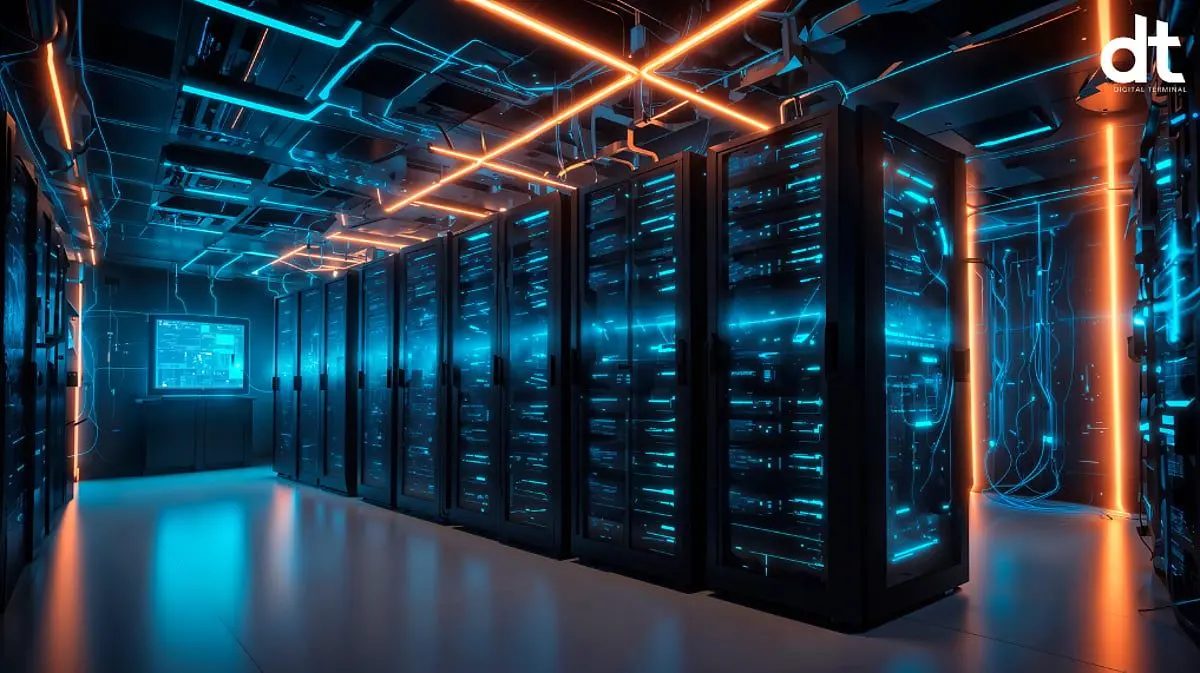
.Hyperscale cloud operators are leading a fresh wave of strategic land buying across emerging markets as they seek large, power-ready land parcels to support the next phase of digital infrastructure buildout
1
. Major entities including Microsoft India, Amazon Data Services India, STT Global Data Centres, NTT Global Data Centres, Colt DCS, and Blackstone's data center platform have been actively acquiring land parcels to set up data centers1
. According to Niranjan Hiranandani, Chairman of NAREDCO, "The data centre sector is creating a new category of real estate demand centred on large, power-secure land parcels with strong connectivity infrastructure"1
. Currently, hyperscalers account for 50-55% of market activity, with the January-March quarter witnessing a sharp spike in demand from cloud services providers contracting large capacities of over 300 MW2
.
Source: DT
Mumbai continues to anchor India's data center ecosystem with 766.6 MW of operational capacity, accounting for nearly half of the country's operational data center capacity
1
. The city maintains its position with 800+ MW of capacity and a further 750 MW under construction or committed2
. Mumbai is expected to remain India's largest data center hub, contributing to nearly half of the country's installed and upcoming capacity over the next five years3
4
. However, emerging corridors are gaining traction, with Hyderabad's pipeline reaching 1.9 GW, second only to Mumbai, while Chennai's pipeline crossed 1 GW1
. Visakhapatnam is positioned as an eastern hub through a $15 billion, gigawatt-scale AI campus by AdaniConneX and Google, while Jamnagar is emerging via Reliance Industries' proposed 3 GW AI-focused campus1
.Related Stories
The emergence of GPU deployment in data centres represents a high-return generating segment within the Indian data center ecosystem. At current capex and pricing levels, large-scale GPU deployments can deliver equity IRRs of over 28% on a hold-to-maturity basis
4
. AI workloads drove 348 MW of leasing in 2025 and account for one-fifth of total demand1
. The IndiaAI Mission has already committed over 38,000 GPUs, creating substantial demand for high-density, liquid-cooled, AI-ready data center capacity across India4
. India's AI market is projected to grow from $13 billion in 2025 to $131 billion by 2032 at a 39% CAGR, supported by rising enterprise adoption and investments in domestic AI capabilities4
.
Source: ET
Digital infrastructure demand is positioning India as Asia Pacific's most development-friendly market for data centers. According to CBRE, India's data center stock is likely to cross 3 gigawatts by the end of calendar year 2028, driven by robust demand from hyperscalers, accelerating AI workloads, and structural advantages
2
. Anshuman Magazine, Chairman & CEO - India, South-East Asia, Middle East & Africa at CBRE, stated that "The combination of a low-bottleneck development environment, a rapidly expanding digital economy, and aggressive hyperscaler commitments positions India as one of the most compelling DC markets globally"2
. Beyond traditional cloud players, demand is now coming from Neocloud operators, semiconductor companies, research and development users, and Global Capability Centres, reflecting the maturation of India's data center occupier base2
. The sector is expected to see three to four IPOs in the next three years as public markets play a key role in funding infrastructure growth4
.Summarized by
Navi
21 Nov 2024•Business and Economy

29 May 2025•Business and Economy

10 May 2025•Business and Economy

1
Policy and Regulation

2
Business and Economy

3
Technology