Intel expands Google Cloud partnership to deploy Gemini AI across workforce for chip design


4 Sources
[1]
Intel says it's going to lean on Google's Gemini to help automate and accelerate silicon development
Intel says it's going to lean on Google's Gemini to help automate and accelerate silicon development Intel Corp. said today it's expanding its long-running partnership with Google Cloud into the agentic artificial intelligence realm. By deploying the Gemini Enterprise platform across its global
[2]
Sundar Pichai Says 'Great' to see Intel Using Gemini Enterprise as Chipmaker Expands Google Cloud Partner
Google Cloud Deepens Intel AI Partnership Reacting to the announcement on X, Alphabet CEO Sundar Pichai wrote, "Great to see @Intel using Gemini Enterprise across its business, including to speed up the development of next-gen semiconductors!" Under the expanded agreement, Intel will deploy
[3]
Intel and Google deepen AI ties for chip design
Intel Corporation (INTC) and Google Cloud announced an expanded partnership on Thursday 16th, deploying Gemini Enterprise across Intel's workforce and pushing agentic AI tools into its chip design process, according to an Intel Newsroom statement. The announcement should have read as an
[4]
Intel expands Google Cloud partnership to deploy Gemini AI across workforce By Investing.com
Investing.com -- Intel and Google Cloud have expanded their multi-year strategic partnership to deploy Gemini Enterprise across Intel's global workforce and scale the chipmaker's semiconductor development on Google Cloud infrastructure, as the company accelerates its AI-driven operational
Share
Copy Link
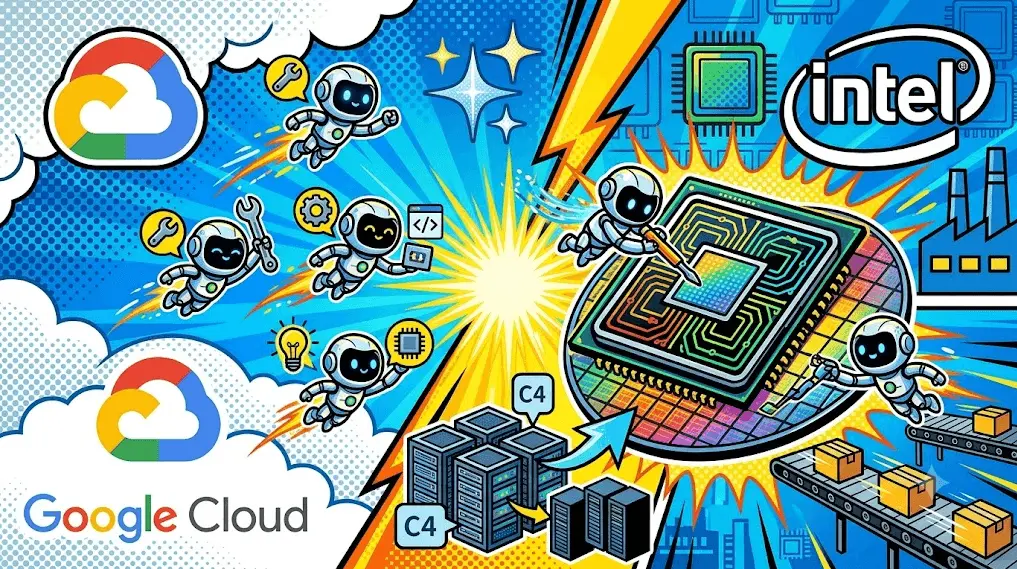
Intel is expanding its long-running partnership with Google Cloud by deploying Gemini Enterprise across its global workforce to accelerate chip design and automate workflows. The chipmaker will use AI agents for engineering, supply chain, and marketing operations while leveraging Google Cloud's C4 and N4 instances to run multiple high-performance computing simulations concurrently and dramatically speed up semiconductor development timelines.
Intel and Google Deepen Collaboration with Gemini Enterprise Deployment
Intel Corp. announced it will expand partnership with Google Cloud by deploying Gemini Enterprise across its global workforce, marking a significant shift from isolated AI pilot projects to enterprise-wide implementation
1
. The chipmaker aims to accelerate workflows across corporate, engineering, supply chain, and marketing operations through agentic AI capabilities. Intel Vice President and Chief Information Officer Cindy Stoddard described the initiative as an ambitious AI-powered transformation designed to help employees move with greater speed and agility while working more efficiently1
.
Source: SiliconANGLE
Alphabet CEO Sundar Pichai responded to the announcement on X, stating it was "great to see @Intel using Gemini Enterprise across its business, including to speed up the development of next-gen semiconductors"
2
. Google Cloud CEO Thomas Kurian emphasized that integrating custom, agentic AI workflows across core business functions and silicon design would help Intel achieve greater efficiency across its global operations2
.Agentic AI Tools Transform Chip Design and Engineering Workflows
The Intel Google partnership will enable the chipmaker to deploy Gemini AI across workforce operations with dedicated agentic coding assistance and engineering automation capabilities available organization-wide
1
. Intel plans to use Gemini's advanced reasoning skills to streamline development pipelines and automate complex, multistep workflows currently performed manually with customized line-of-business agents trained on Intel's unique business processes1
.The company will also make Gemini available to marketing and communications teams to generate hyper-targeted content for specific audiences. Early pilots have already demonstrated agents that can recommend relevant subject matter experts for any given topic and generate executive-ready messaging
1
. This approach to enterprise AI adoption represents a broader industry trend where large companies integrate generative AI into core business functions beyond experimental projects4
.Accelerate Silicon Development with Cloud Infrastructure
Intel's ambitions for AI in chip development extend to optimizing semiconductor development simulations and developer workloads using Gemini's capabilities
1
. To support this expanded workload, Intel will leverage Google Cloud C4 and N4 instances to augment its existing on-premises compute capabilities. Google launched these general-purpose VMs in April 2024, powered by fifth-generation Intel Xeon 6 processors and Titanium architecture for improved performance and efficiency2
.By automating much of this work and using high-performance computing resources, Intel should be able to run multiple complex simulations concurrently and dramatically speed up its chip design processes
1
. According to Stoddard, Google Cloud allows Intel to provide employees with a central hub to build and deploy AI agents through Gemini Enterprise and scale silicon development with elastic cloud infrastructure1
.Strategic Complexities and Market Response
The arrangement carries notable strategic implications. Google designs its own AI accelerators called Tensor Processing Units for use inside its data centers, meaning Intel's engineers are now building silicon partly on infrastructure controlled by a company that competes with Intel in custom AI silicon
3
. This dynamic highlights how companies are forced into complex relationships where they must share critical development environments with direct rivals to move fast enough to survive3
.Despite the announcement's significance, Intel shares closed down 5.84% on Thursday, sliding to $96.98
3
. However, the sell-off traced back to Taiwan Semiconductor Manufacturing reporting record second-quarter results the same day, posting a 67.7% gross margin and raising its 2026 capital spending target to as much as $64 billion3
. This underscores how Wall Street increasingly treats chipmakers as two separate stories: the AI partnerships they sign and the manufacturing execution that determines profitability3
.Related Stories

Building on Long-Standing Collaboration
The announcement builds on a longstanding partnership between Intel and Google that has included collaboration on AI chip interconnects and 5G networks
1
. In April, Google committed to adopting multiple future iterations of Intel Xeon central processing units that will be deployed on its public cloud platform to support AI and general-purpose computing workloads1
. As part of that arrangement, Google will also use Intel's infrastructure processing units or IPUs, which handle infrastructure management tasks so the CPUs have more capacity to focus on actual compute1
.
Source: Benzinga
Holger Mueller, an analyst with Constellation Research, noted that while it's a smart move for Intel to move more chip development to Google Cloud and lean on Gemini, some might see it as a reciprocal arrangement given that Intel's Xeon processors power Google Cloud's C4 and N4 compute instances
1
. Google Cloud Chief Product and Business Officer Karthik Narain insisted the partnership will transform what enterprise AI can achieve, stating that pairing Intel's engineering expertise with Google Cloud's agentic AI tools creates an autonomous foundation that will accelerate how they design, operate, and scale for the AI wave1
.What This Means for Digital Transformation
The expanded collaboration reflects how coding assistants and AI agents are becoming central to digital transformation strategies across the semiconductor industry. Intel's decision to deploy Gemini AI across workforce operations demonstrates confidence that generative AI can deliver measurable productivity gains when implemented at scale rather than confined to experimental use cases
4
. The move also signals that enterprise AI adoption is accelerating beyond simple automation into more complex agentic workflows that can handle multistep processes with minimal human intervention1
.References
Summarized by

Navi
[1]
[2]
[3]
Related Stories
Google and Intel expand multi-year partnership to advance AI infrastructure with Xeon CPUs
09 Apr 2026•Technology

Google Cloud bets big on AI agents with Gemini Enterprise platform and new chips
22 Apr 2026•Technology

Google orders over 3 million AI chips from Intel as TSMC capacity crunch forces industry shift
08 Jun 2026•Technology

Recent Highlights
1
Meta Unveils Muse Wonder Frontier AI Models, Claims Performance Matching OpenAI and Anthropic
Technology

2
IMF Report Warns AI Market Correction Could Spark Global Financial Crisis With $1.4T at Risk
Business and Economy

3
OpenAI Releases 722 AI-Generated Math Solutions, Triggering Existential Crisis in Mathematics
Technology

Recent Highlights
Today's Top Stories









Don’t drown in AI news. We cut through the noise - filtering, ranking and summarizing the most important AI news, breakthroughs and research daily. Follow topics that matter to you and stay ahead.


