Intel GPU D-Series Delivers 1.3 PFLOPS AI Inference With 480GB Memory in Air-Cooled Design


6 Sources
[1]
Intel's Crescent Island AI accelerator officially powers new GPU D-Series products -- chip delivers 1.3 peak PFLOPS of FP8 compute and 1.5 TB/s of memory bandwidth
Crescent Island gets official performance and bandwidth specs at OCP 2026. At OCP 2026 today, Intel has given Crescent Island a proper name: the Intel GPU D-Series. For the first time, the company also shared a theoretical peak performance target for the chip: 1.3 PFLOPS of FP8. It also disclosed
[2]
Intel GPU D-series AI inference chip specs revealed at OCP 2026
The chip, formerly code-named Crescent Island, delivers 1.3 petaflops of FP8 compute and 480GB of memory within a 350-watt power envelope Intel $INTC shared technical details Monday on its GPU D-series AI inference chip at the Open Compute Project Global Summit, giving the product formerly
[3]
Intel GPU D270 Targets 300B-Parameter Models With 480GB of LPDDR5X
Intel has officially announced the GPU D270, previously associated with the Crescent Island development name. The data-center accelerator is designed for agentic AI inference and large-memory workloads, with a maximum of 480GB of LPDDR5X memory per card. Intel's Xe3P architecture provides 32 Xe
[4]
Intel Crescent Island Squeezes 1.3 PFLOPs Of FP8 Into Just 350W As D270 Targets The Competition With Value-Oriented LPDDR5X Up To 480 GB
Intel is announcing its D-Series GPUs, formerly Crescent Island, as the next AI data center lineup based on the Xe3P architecture. Intel D-Series "Crescent Island" GPUs Pack 1.3 PFLOPs of FP8 at 350W, Rivaling Existing Pro Cards From NVIDIA & AMD The Intel Crescent Island GPU is based on the
[5]

Intel unveils GPU D-series for AI inference at OCP summit By Investing.com
SANTA CLARA, Calif. - Intel Corporation (NASDAQ:INTC) announced technical details of its GPU D-series, formerly code-named Crescent Island, and introduced new Xeon-based rack designs at the Open Compute Project Global Summit on Monday. The GPU D-series is built on Intel's Xe3P architecture and
[6]

Intel Corporation Shares New Technical Details On Intel GPU D-Series And Introduces New Intel Xeon-Based Rack Designs
Intel corporation shared new technical details on the Intel GPU D-series, formerly code-named Crescent Island, introduced new Intel Xeon-based rack designs and highlighted open software and ecosystem innovations. At OCP, Intel showcased new Xeon-based rack designs developed with ecosystem partners
Share
Copy Link
Intel officially launched its GPU D-Series AI inference accelerator, formerly code-named Crescent Island, at the Open Compute Project Global Summit. The chip delivers 1.3 PFLOPS of FP8 compute and up to 480GB of LPDDR5X memory within a 350W power envelope, targeting large language models and agentic AI workloads in standard data center infrastructure.

Intel GPU D-Series Launches With Xe3P Architecture for AI Inference
Intel officially unveiled its GPU D-Series AI inference accelerator at the Open Compute Project Global Summit, giving the chip formerly code-named Crescent Island its commercial name and disclosing detailed specifications for the first time
1
2
. The Intel GPU D-Series is built on the company's new Xe3P architecture, delivering 1.3 PFLOPS of FP8 compute alongside 1.5 TB/s of memory bandwidth and up to 480GB of LPDDR5X memory, all within a 350W TDP1
2
. The chip uses a standard PCIe form factor with air-cooled design, allowing deployment in existing data center environments without specialized cooling infrastructure2
.Targeting Large Language Models and Trillion Parameter Workloads
The GPU D-Series is designed specifically for large language models, long-context inference, and concurrent inference services
1
2
. According to Intel, a single card can support models with up to 300 billion parameters, while an eight-GPU system can handle models exceeding one trillion parameters2
3
. The first product in the lineup, the Intel GPU D270, features 32 Xe cores and 256 matrix engines optimized for agentic AI and large-memory workloads3
. "Inference is becoming the defining AI workload, and enterprises need infrastructure that delivers the right performance at the right cost," said Anil Nanduri, vice president of AI Products and GTM at Intel's Data Center Group2
.LPDDR5X Memory Strategy Balances Capacity and Cost
Intel's choice of LPDDR5X memory for the GPU D-Series represents a strategic departure from competitors like Nvidia and AMD, who rely on high-bandwidth memory (HBM) for their data-center accelerators
4
. While LPDDR5X generally offers lower bandwidth than HBM, it provides high capacity with lower cost and power consumption3
. The 480GB capacity significantly exceeds AMD's Instinct MI450X at 432 GB of HBM4 and Nvidia's Vera Rubin at 288 GB of HBM44
. This memory configuration positions the GPU D-Series for inference workloads where model residency and capacity are as important as peak arithmetic throughput3
. The 480GB capacity could reduce the need to partition large models across multiple accelerators, simplifying deployment and reducing communication overhead3
.Performance Positioning Against Nvidia and AMD Alternatives
The GPU D-Series targets a different performance and infrastructure profile than Nvidia's highest-end hardware
2
. Each of the 72 Rubin GPUs in Nvidia's Vera Rubin NVL72 rack-scale system delivers 17.5 PFLOPS of FP8 throughput, but requires liquid cooling and draws substantially more power1
2
. Among PCIe AI accelerator options, the Intel GPU D270 compares favorably: AMD Radeon AI PRO R9700 reaches 766 TFLOPs of FP8 at 300W, while Nvidia RTX PRO 5500 Blackwell delivers 846 TFLOPs of FP8 at 600W4
. The AMD Instinct MI350P reaches 2.3 PFLOPS but with FP8 micro-scaling4
. Intel's bundling of LPDDR5X at 160 GB for reference designs and up to 480 GB for partner models positions it as a value-optimized product4
.Related Stories


Xe3P Architecture and Software Ecosystem Foundation
The Xe3P architecture powering Crescent Island is the first chip built on Intel's massively parallel computing architecture, lacking most graphics-specific functional units that would characterize a traditional GPU
1
. Each Xe3P core packs 8 Vector Engines with FP8+FP4 precision and 8 XMX engines with 16-deep systolic arrays4
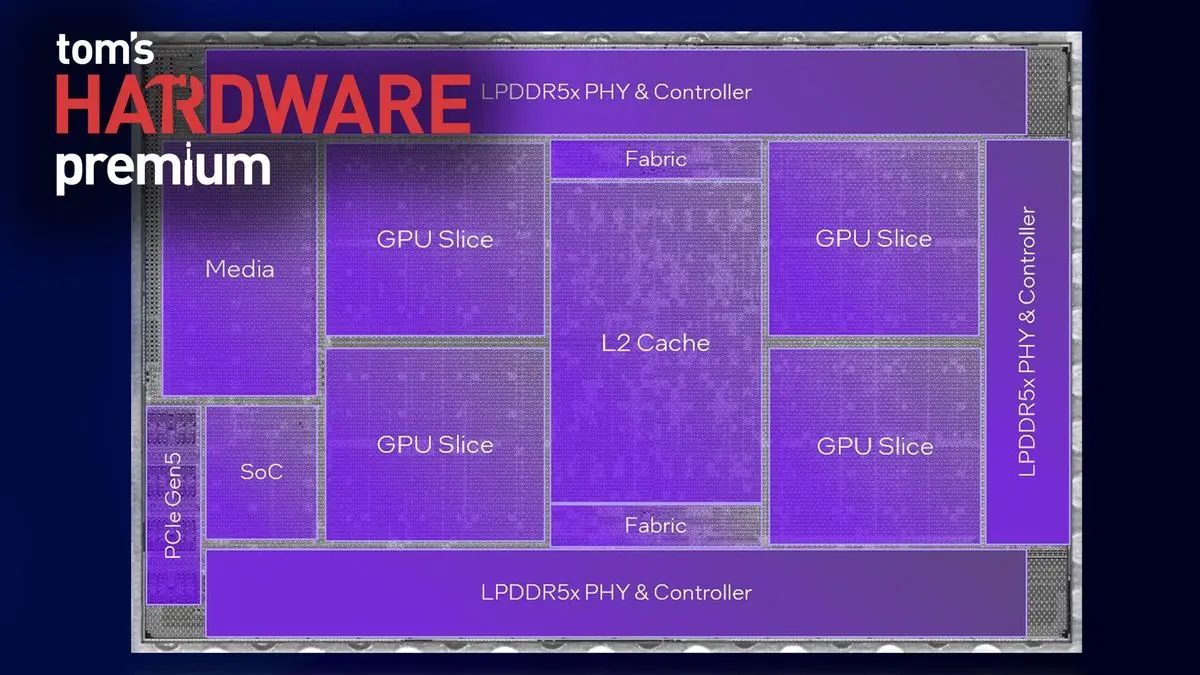
. The GPU D270 comprises four compute slices with 8 cores each, totaling 32 Xe3P cores, 256 Vector Engines, and 256 XMX units4
. Intel is highlighting the "common Xe software foundation" it has built for AI across its Xe Cores in integrated GPUs and discrete GPU products1
. The company announced Day 0 support for Meta's Muse Glimmer model and native upstream integration with AI frameworks including vLLM, SGLang, llm-d, and Nvidia Dynamo4
5
.Market Implications and Deployment Timeline
Customer sampling of GPU D-Series products is currently underway, though Intel did not announce a broad launch date or pricing
2
3
. Intel is working with a broad ecosystem of OEMs, ODMs, neoclouds, independent software vendors, appliance providers, and AI-native companies for commercialization1
5
. The company is also contributing to the Open Adapter Card workgroup to define a standardized sub-rack accelerator card form factor for improved interoperability5
. This represents Intel's latest attempt to gain traction in AI hardware infrastructure after the failure of the Data Center GPU Max family (Ponte Vecchio) and its mothballed follow-ons1
. In a market hungry for inference compute cycles, a product with proven architectural design targeted specifically at tokens-as-a-service providers in an accessible thermal and electrical envelope might provide Intel the toehold it needs as AI models advance and agentic workflows assume greater importance1
.References
Summarized by

Navi
Related Stories
Intel Crescent Island AI Accelerator Packs 480GB Memory, 32 Xe3P Cores for Inference Workloads
25 Aug 2026•Technology
Intel Unveils Crescent Island: A New AI-Focused GPU for Data Centers
14 Oct 2025•Technology
Intel Crescent Island targets AI inference with cheaper memory, air-cooling to challenge Nvidia
01 Jun 2026•Technology

Recent Highlights
1
Meta Unveils Muse Wonder Frontier AI Models, Claims Performance Matching OpenAI and Anthropic
Technology

2
IMF Report Warns AI Market Correction Could Spark Global Financial Crisis With $1.4T at Risk
Business and Economy

3
OpenAI Releases 722 AI-Generated Math Solutions, Triggering Existential Crisis in Mathematics
Technology

Recent Highlights
Today's Top Stories









Don’t drown in AI news. We cut through the noise - filtering, ranking and summarizing the most important AI news, breakthroughs and research daily. Follow topics that matter to you and stay ahead.


