Jeff Bezos backs CuspAI's $400M raise as AI materials science startup hits $2.6B valuation


2 Sources
[1]
CuspAI: Bezos backs $2.6bn materials-AI startup
CuspAI, which uses AI to design new materials, is reportedly raising $400M led by Bezos's family office, days after he launched his own physical-AI lab. The bet: the next AI gold rush is in atoms, not text. Jeff Bezos appears to have settled on his AI thesis, and it is not chatbots. It is the
[2]
Scientific research start-up CuspAI to raise $400m with Jeff Bezos among backers - FT
UK start-up CuspAI is set to raise $400m in a funding round that includes Amazon's Jeff Bezos, according to the Financial Times. When Turing Prize laurate Yann LeCun joined Nobel Laureate and Turing Prize winner Professor Geoffrey Hinton on CuspAI's Advisory Board last year, the young materials
Share
Copy Link
CuspAI, a Cambridge-based startup using generative AI for materials science, is raising $400M led by Bezos Expeditions at a $2.6B valuation. The scientific research start-up has quadrupled its value in nine months, with backers including Kleiner Perkins and advisors Geoffrey Hinton and Yann LeCun. The move signals Bezos's conviction that the next AI frontier lies in physical materials, not chatbots.
Jeff Bezos Bets Big on AI Materials Science
CuspAI, a two-year-old Cambridge startup pioneering AI-driven materials design, is in advanced talks to raise approximately $400M at a $2.6B valuation, according to the Financial Times
1
2
. The CuspAI funding round is led by Bezos Expeditions, Jeff Bezos's family office, alongside Silicon Valley venture firm Kleiner Perkins. Term sheets have been signed, though the deal has not yet closed2
. If finalized, this would represent a remarkable 5x valuation jump in just nine months, up from $520M in September1
.A Search Engine for the Material World

Source: Silicon Republic
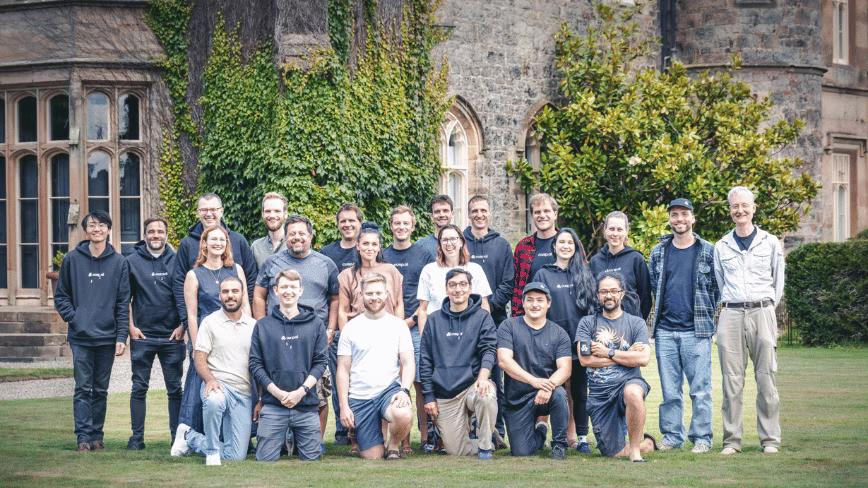
Founded in 2024 by Max Welling, a machine-learning pioneer and distinguished scientist at Microsoft Research, and Chad Edwards, a chemist who helped build quantum-computing firm Quantinuum, CuspAI applies generative AI for materials science to accelerate materials discovery
1
. The scientific research start-up describes itself as a "search engine for the material world"—users describe desired properties like strength, conductivity, or heat tolerance, and the system proposes chemical compositions up to 10 times faster than conventional methods1
.What sets CuspAI apart is its synthesis-aware AI models, which ensure the materials they propose can actually be manufactured rather than existing only in simulation
1
. This practical approach has already attracted major clients: Meta is using the platform for carbon capture, Hyundai for clean energy applications, and Kemira to strip PFAS "forever chemicals" from water1
.Star-Studded Advisory Board Signals Credibility
CuspAI's advisory board reads like a who's who of AI luminaries. Geoffrey Hinton, a Nobel Laureate and Turing Prize winner, joined forces with fellow Turing Prize laureate Yann LeCun on the board, cementing the startup's reputation as a "soonicorn"
2
. The company's angel backers include OpenAI co-founder Durk Kingma, Google VP of Research Zoubin Ghahramani, Dropbox co-founder Arash Ferdowsi, and Hugging Face founder Thomas Wolf2
.Nvidia CEO Jensen Huang gave CuspAI a notable shout-out as one of the UK startups to watch during his meeting with UK Prime Minister Keir Starmer last year
2
. The company's Series A funding round of over $200M was co-led by New Enterprise Associates (NEA) and Temasek, with participation from NVentures (Nvidia's venture capital arm), Samsung Ventures, and Hyundai Motor Group2
.Related Stories

The Physical-AI Thesis Takes Shape
The timing of this investment reveals Jeff Bezos's strategic direction. Just six days before news of the CuspAI deal broke, Bezos unveiled Prometheus, a roughly $10B physical-AI lab designed to do for engineering what large language models did for text—marking his first chief-executive role since leaving Amazon
1
2
. CuspAI fits precisely into this worldview, sitting at the intersection where generative AI meets the physical world1
.While Bezos Expeditions has made smaller bets across Anthropic, Perplexity, and Figure AI, AI materials science appears to be where he's placing his largest conviction
1
. Two nine-figure moves into physical-AI within a week send a clear signal about where one of tech's sharpest operators believes the next decade of value creation lies1
.A Crowded But Promising Frontier
CuspAI operates in an increasingly competitive landscape. XtalPi is valued at approximately $2.5B, while Periodic Labs—founded by ex-OpenAI and DeepMind staff—raised a $200M seed round at a $1B valuation
1
. European rivals Altrove and Dunia Innovations are also pursuing materials discovery breakthroughs1
.The roughly 65-person lab faces real challenges ahead. The valuation represents a steep mark-up, and AI-designed materials remain an early commercial bet rather than a proven business model
1
. CuspAI specializes in using molecular simulation to accelerate breakthrough materials for industrial applications across semiconductors, energy, and climate2
. The company's ability to deliver on this promise will determine whether it can justify its soaring valuation and lead the charge in transforming how humanity discovers and manufactures new materials.References
Summarized by

Navi
[1]
Related Stories
Bezos backs CuspAI's $450M raise as startup launches AI Materials Foundry with Nvidia and Meta
20 Jul 2026•Startups
CuspAI Secures $100M for Revolutionary AI-Powered Materials Discovery Platform
11 Sept 2025•Technology

Jeff Bezos backs five AI startups in June as family office leads 2026 investment surge
02 Jul 2026•Startups

Recent Highlights



Recent Highlights
Today's Top Stories









Don’t drown in AI news. We cut through the noise - filtering, ranking and summarizing the most important AI news, breakthroughs and research daily. Follow topics that matter to you and stay ahead.


