6 Sources
[1]
Bezos backs CuspAI as startup teams up with Nvidia to hunt for chipmaking materials
Jeff Bezos has invested in CuspAI, a British startup which on Monday unveiled a partnership with Nvidia and a number of other industry leaders as it hunts for breakthroughs in semiconductors, clean energy and advanced manufacturing. The $450 million fundraise, which values CuspAI at $2.6 billion, was led by Kleiner Perkins and NEA, with significant participation from Jeff Bezos' Bezos Expeditions. Additional new investors include Glade Brook Capital Partners, Lux Capital, AMD Ventures, and Britain's Sovereign AI Venture Fund. CuspAI uses artificial intelligence to simulate the performance of novel materials, narrowing the huge number of possibilities for laboratory testing. "Most big leaps in technology come down to a material, and the next set, from cheaper carbon capture to semiconductors and cleaner water, is stuck waiting on materials nobody has discovered yet," Josh Coyne, partner at Kleiner Perkins, said in a statement. "CuspAI built a search engine that changes that."
[2]
CuspAI signs up Nvidia and Meta for AI materials push
Cambridge startup CuspAI has signed up Nvidia, Meta, Samsung and dozens more to a coalition that uses AI to invent new materials. It confirmed a $450m raise and backing from the UK government on the same day. A two-year-old British AI lab wants to build the search engine for materials that do not exist yet. On Monday it gathered an unusual crowd to help. Cambridge-based CuspAI launched the AI Materials Foundry, a coalition of more than 45 companies and research labs, Reuters reported. The founding partners include Nvidia, Meta, Samsung, Hyundai Motor Group, Applied Materials, Tokyo Electron and Lam Research. The idea is to pool their data, labs and computing power to design new materials faster. The launch came with money to match. CuspAI confirmed a $450m (€385m) Series B led by Kleiner Perkins and NEA, with backing from Jeff Bezos's investment fund. The round values the company at $2.6bn. TNW first reported in June that the raise was in the works, then led by Bezos's family office and not yet closed. The materials bottleneck CuspAI's pitch is that progress is stuck on chemistry. "The world needs materials that don't yet exist," co-founders Chad Edwards and Max Welling wrote. Without them, they argue, the next 50 years of industrial progress hit a wall. Its platform, MIRA, runs the full discovery cycle. It generates candidate materials, simulates them, plans how to make them, then coordinates lab tests to check they work. The aim is to compress work that normally takes years. One target is close to the chip industry's heart. CuspAI wants to cut, or remove, the rare metals that chipmakers depend on, such as iridium and ruthenium. It is chasing gains in clean energy, batteries and even cleaner water too. A British sovereignty play The deal doubles as a win for the UK's tech ambitions. CuspAI is the fourth company backed by the government's Sovereign AI Venture Fund, the Guardian reported, a scheme that invests in early-stage British firms to help them scale. The fund only backs companies with a UK head office and British founders. It typically puts in between £1m and £10m, though the government did not disclose its stake here. "CuspAI is putting the power of AI to work to help us tackle some of the biggest challenges facing the UK and the world," said Liz Kendall, the science and technology secretary. For a government keen to keep home-grown AI at home, a $2.6bn Cambridge company is a useful poster child. Star power CuspAI has stacked its bench. It has hired John Giannandrea, a former Apple and Google executive, to help set up its US operations. Abhi Talwalkar, an AMD board member and chair of Lam Research, joins its advisory board. Its list of advisers already included the AI pioneers Yann LeCun and Geoffrey Hinton. The company is opening a Singapore office and adding staff in Cambridge, Amsterdam, Berlin, Tokyo and the US. The backers frame the work as a shift in how science gets done. "CuspAI built a search engine" for undiscovered materials, said Josh Coyne of Kleiner Perkins. He argued its edge is designing materials that can actually be built, not just ones a model can dream up. The bet sits alongside a wider push to point AI at hard scientific discovery, from drugs to chemistry. The Foundry now has to prove the models can find materials that survive contact with a real lab. Its 45-plus partners, and its investors, are betting they will. Some of them, like Nvidia, have joined similar coalitions before.
[3]
Jeff Bezos and UK government invest in £2bn British startup CuspAI
Company aims to develop AI software that cuts research times and use of rare metals in chipmakers' supply chains Amazon's founder, Jeff Bezos, and the UK government have invested in a £2bn British artificial intelligence startup that is aiming to become the "search engine for rare materials" that accelerates the next wave of technological breakthroughs. The Cambridge-based CuspAI has raised $450m (£330m) in funding from investors including Bezos and the government's sovereign AI fund, valuing the two-year old business at $2.6bn. The company has launched the AI Materials Foundry, a coalition of more than 48 tech companies, industrial firms and research facilities, with the aim of building software underpinned by artificial intelligence to discover and develop new materials for chipmakers and other industries. CuspAI hopes to significantly cut research times and reduce or eliminate the use of rare metals - including iridium and ruthenium - in chipmakers' supply chains. The coalition, which includes the chipmaker Nvidia, the Facebook and Instagram owner, Meta Platforms, and the carmaker Hyundai, aims to use frontier AI, the most advanced, general-purpose artificial intelligence models, to discover new materials that could make energy networks and batteries more efficient and advance the power of semiconductors that underpin the AI revolution. "If we don't make progress fast, the next 50 years of industrial progress will be constrained by a single challenge: the world needs materials that don't yet exist," said the CuspAI co-founders Dr Chad Edwards and Prof Max Welling. "That's what we're on a mission to solve - combining frontier agentic AI with deep domain expertise, exclusive data access and close customer partnerships. The world simply can't make the progress it needs to with known materials, that much is clear." The company said the round of series B funding will enable it to expand internationally, opening a new office in Singapore and increasing staff numbers in Cambridge, Amsterdam, Berlin, Tokyo and the US. Josh Coyne, a partner at Kleiner Perkins, the venture capital firm that co-led the latest round of funding, said: "Most big leaps in technology come down to a material, and the next set, from cheaper carbon capture to semiconductors and cleaner water, is stuck waiting on materials nobody has discovered yet. CuspAI built a search engine that changes that." The latest fundraise followed a $100m series A investment last year. CuspAI is the fourth company to receive funding from the government's fund targeting investment in early-stage British AI firms to help them scale up to compete on the world stage. The government did not disclose the size of the investment. Criteria for receiving funding from the sovereign AI fund, which makes a typical equity investment in a startup of between £1m and £10m, include having a main office in the UK and the company founders being British. Liz Kendall, the science and technology secretary, said: "CuspAI is putting the power of AI to work to help us tackle some of the biggest challenges facing the UK and the world today, such as energy and climate change. By backing British companies such as this we are paving the way for breakthroughs that are set to grow our economy, protect the natural world and improve everyone's lives." CuspAI has brought on board John Giannandrea, a former Apple and Google executive, who is helping set up its US operations. The company is also working with Abhi Talwalkar, a board member at chip maker AMD and chair of Lam Research.
[4]
CuspAI raises $450 million Series B for AI materials discovery
Venture firms Kleiner Perkins and NEA led the round, with participation from Jeff Bezos's Bezos Expeditions, Glade Brook Capital Partners, Lux Capital, AMD $AMD Ventures, Britain's Sovereign AI Venture Fund, and others, the company said. Existing investors including Temasek and Prosus also participated. The AI Materials Foundry brings together more than 45 organizations -- including Nvidia $NVDA, Meta $META, Samsung, Hyundai Motor Group, and Lam Research $LRCX -- to pool computing resources, laboratory access, and scientific expertise on CuspAI's platform, the company said. Chad Edwards, CuspAI's co-founder and chief executive officer, said much of the new funding will support lab operations in Cambridge, Singapore, and the San Francisco Bay Area, according to Bloomberg.
[5]
Cambridge's CuspAI launches AI Materials Foundry, confirms $450m raise
CuspAI says materials discovery is the 'single challenge' holding back industrial progress - and it's built a foundry of global partners to help solve it. Cambridge-based start-up CuspAI has launched its 'AI Materials Foundry', a global network of data, labs, compute and scientific expertise designed to speed up the discovery of new materials. More than 45 founding partners have signed on, including Nvidia, Meta, Samsung, Hyundai Motor Group, Henkel, Applied Materials, Tokyo Electron and Lam Research, spanning the US, Asia-Pacific and Europe. "If we don't make progress fast, the next 50 years of industrial progress will be constrained by a single challenge: the world needs materials that don't yet exist," said co-founders Dr Chad Edwards and Prof Max Welling in a blog post announcing the initiative. "That's what we're on a mission to solve - combining frontier agentic AI with deep domain expertise, exclusive data access and close customer partnerships." The launch comes alongside a $450m Series B funding round, led by Kleiner Perkins and NEA with significant participation from Jeff Bezos's Bezos Expeditions - as previously flagged here at SiliconRepublic.com when the deal was in the works. The round values CuspAI at $2.6bn, up from $520m last September, and follows a Series A of more than $100m less than a year ago. New investors include Glade Brook Capital Partners, Lux Capital, AMD Ventures, Tru Arrow Partners, StepStone, Britain's Sovereign AI Venture Fund, the Netherlands' Invest-NL and John Doerr, while existing backers Temasek, Basis Set Ventures, Giant Ventures, Touring Capital, Prosus, Phoenix Court and Northzone also returned. Founded in 2024 by Edwards and Welling, CuspAI applies generative AI and molecular simulation to materials discovery. Kleiner Perkins partner Josh Coyne, who co-led the round, said what sets the pair apart is that "they design for materials that can actually be built, not just ones a model can dream up", adding that he believes CuspAI's technology "can define the AI-driven materials revolution". CuspAI is also growing its global footprint, with a new Singapore office joining hubs in Cambridge, Amsterdam, Berlin, Tokyo and the US. John Giannandrea, formerly of Apple and Google, is helping build out its US operations, while Abhi Talwalkar, an AMD board member and chairman of Lam Research, joins the advisory board. "The opportunity in front of us has never been more urgent, or more exciting," Edwards and Welling said. "New materials can unlock performance, sustainability and new solutions to existing intractable problems."
[6]
Jeff Bezos Backs UK startup Racing To Fix Chip Materials
The chip industry has a materials problem. Building faster, denser semiconductors takes rare minerals and enormous amounts of energy, and supply has not kept pace with AI driven demand. That gap has become one of the defining stories of the AI boom this year, showing up in everything from earnings calls to stock swings. That crunch has already rattled markets once this year. Now a small Cambridge startup says artificial intelligence itself might be the fix, and some very well known names just wrote it a very large check to find out if that bet pays off. Wall Street is watching the chip material crunch Severe shortages of semiconductors, especially memory chips, hit share prices across the tech sector hard last week. DRAM and NAND prices have surged for months as hyperscale cloud providers lock up production capacity years in advance, leaving less for consumer electronics and automakers. Micron Technology has become the clearest example of what that scarcity does to a stock. Shares went parabolic earlier this year, rising nearly 40% in five sessions as the memory shortage worsened, and the company has since raised its capital spending plans by billions of dollars to keep up with orders. Not everyone is convinced the AI trade can keep running at this pace. Michael Burry, the investor famous for calling the 2008 housing crash, has built a basket of bearish bets that includes Nvidia and other chip-adjacent names, arguing valuations have gotten ahead of themselves. CuspAI's $450 million bet on new materials CuspAI, a two-year-old British startup, has raised $450 million in Series B financing, giving it a $2.6 billion valuation. That is up from just $520 million last September, a nearly five-fold jump in under a year, according to the company. Alongside the raise, CuspAI launched the AI Materials Foundry on Monday, July 20, 2026. The coalition brings together more than 48 technology and industrial partners, including Nvidia, Meta Platforms, Samsung and Hyundai Motor Group, to pool computing power, laboratory access and scientific expertise for materials research spanning the United States, Asia Pacific and Europe. Bezos doubles down on physical AI This is not Bezos's only large bet on AI. He is also co-CEO of Prometheus, the physical AI startup that raised $12 billion at a $41 billion valuation in June. Bezos has been vocal about how such AI tools could reshape manufacturing and even labor markets. Bezos has reportedly been exploring a fund of up to $100 billion to buy manufacturers outright and rebuild them around AI. Chipmaking is one of the sectors named as a target for that broader strategy. Google DeepMind has said it will soon start its own work on AI driven material discovery, and investors have already backed several teams led by former OpenAI and DeepMind researchers chasing the same idea. The field is getting crowded fast. What this means for the AI trade CuspAI is a small piece of a much bigger story about whether AI can actually solve the physical bottlenecks slowing down its own growth. Chips need new materials, memory is scarce, and energy costs keep climbing. No single funding round changes that overnight. If CuspAI's approach works even partially, it could ease some of the scarcity that has been driving swings in chip stocks all year and give chipmakers more room to plan around AI demand instead of chasing it. If it does not, it becomes one more example of AI hype racing ahead of lab results. Either way, the roster of names now involved, from Nvidia to Bezos to Kleiner Perkins, suggests the biggest players in tech are not waiting around to find out. They are placing their bets now, while the shortage is still headline news. Benzinga Disclaimer: This article is from an unpaid external contributor. It does not represent Benzinga's reporting and has not been edited for content or accuracy. Market News and Data brought to you by Benzinga APIs To add Benzinga News as your preferred source on Google, click here.
Share
Copy Link
Cambridge-based CuspAI has raised $450 million in Series B funding at a $2.6 billion valuation, with backing from Jeff Bezos and the UK government. The startup launched the AI Materials Foundry, partnering with Nvidia, Meta, Samsung, and over 45 organizations to use AI for discovering new materials for semiconductors, clean energy, and advanced manufacturing.
CuspAI, a Cambridge-based startup, has closed a $450 million Series B funding round that values the two-year-old company at $2.6 billion
1
. The round was led by Kleiner Perkins and NEA, with significant participation from Jeff Bezos through Bezos Expeditions2
. Additional investors include Glade Brook Capital Partners, Lux Capital, AMD Ventures, and Britain's Sovereign AI Venture Fund, with existing backers Temasek and Prosus also participating4
. This marks a dramatic jump from the company's $520 million valuation in September, following a Series A of more than $100 million less than a year ago [5](https://www.siliconrepublic.com/start-ups/cambridges-cuspai-l aunches-ai-materials-foundry-confirms-450m-raise).
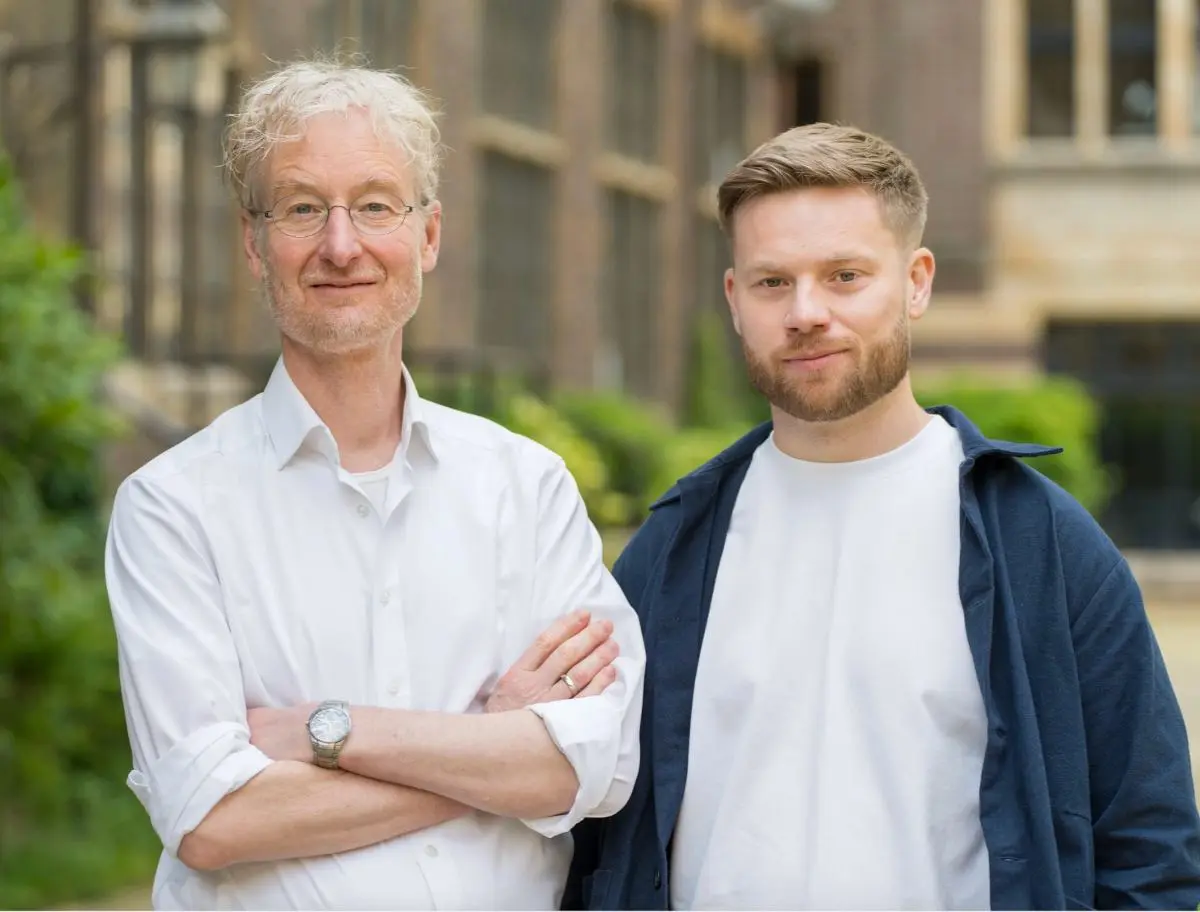
Source: Silicon Republic
Coinciding with the funding announcement, CuspAI launched the AI Materials Foundry, a coalition bringing together more than 45 companies and research labs
2
. Founding partners include Nvidia, Meta, Samsung, Hyundai Motor Group, Applied Materials, Tokyo Electron, and Lam Research3
. The initiative pools computing resources, laboratory access, and scientific expertise to accelerate the discovery of new materials using AI4
. This AI materials push addresses what co-founders Dr. Chad Edwards and Prof Max Welling describe as the "single challenge" constraining the next 50 years of industrial progress: the world needs materials that don't yet exist [5](https://www.siliconrepublic.com/start-ups/cambridges-cuspai-l aunches-ai-materials-foundry-confirms-450m-raise).CuspAI's platform, MIRA, uses AI to simulate the performance of novel materials, running the full discovery cycle from generation to laboratory testing
2
. The AI-driven software narrows the huge number of material possibilities for laboratory testing, compressing work that normally takes years1
. Josh Coyne, partner at Kleiner Perkins, explained that CuspAI built a search engine that changes how materials discovery happens, noting that "most big leaps in technology come down to a material"3
. What distinguishes this AI-driven materials discovery startup is its focus on designing materials that can actually be built, not just ones a model can dream up [5](https://www.siliconrepublic.com/start-ups/cambridges-cuspai-l aunches-ai-materials-foundry-confirms-450m-raise).The startup aims to cut or eliminate the use of rare metals in chipmakers' supply chains, specifically targeting iridium and ruthenium
2
. Beyond semiconductors, CuspAI is pursuing breakthroughs in clean energy, batteries, carbon capture, and water purification1
. The company combines frontier AI to accelerate material discovery with deep domain expertise, exclusive data access, and close customer partnerships3
. This approach using generative AI and molecular simulation represents a shift in how science gets done, pointing AI at hard scientific discovery challenges2
.Related Stories
CuspAI is the fourth company backed by the UK government's Sovereign AI Venture Fund, which invests between £1 million and £10 million in early-stage British firms
2
. The fund only backs companies with a UK head office and British founders3
. Science and technology secretary Liz Kendall stated that CuspAI is putting the power of AI to work to tackle some of the biggest challenges facing the UK and the world2
. For a government keen to keep home-grown AI at home, a $2.6 billion Cambridge company serves as a useful demonstration of British AI capabilities on the global stage.Much of the new funding will support lab operations in Cambridge, Singapore, and the San Francisco Bay Area, with CuspAI opening offices across multiple continents
4
. The company is adding staff in Cambridge, Amsterdam, Berlin, Tokyo, and the US3
. John Giannandrea, a former Apple and Google executive, is helping establish US operations, while Abhi Talwalkar, an AMD board member and chair of Lam Research, joins the advisory board2
. The company's existing advisers include AI pioneers Yann LeCun and Geoffrey Hinton2
. The Foundry now must prove its models can find materials that survive contact with real laboratories, with its 45-plus partners betting they will deliver on the promise of AI-driven materials revolution.Summarized by
Navi
[2]
[5]
17 Jun 2026•Startups

11 Sept 2025•Technology

02 Oct 2025•Science and Research

1
Policy and Regulation

2
Policy and Regulation

3
Policy and Regulation