Jensen Huang says software engineers prefer building AI agents over writing Python code


2 Sources
[1]
Jensen Huang says his engineers would rather build agents than write code
The Nvidia chief frames the shift as a promotion for his staff, and as more evidence that AI is creating jobs rather than cutting them. Nvidia's software engineers are writing less code than ever, and according to their chief executive, that is exactly how they like it. Jensen Huang said this
[2]
Nvidia CEO Jensen Huang Says Software Engineers Would Rather Build AI Agents Than Write Python Code - NVI
Nvidia Engineers Shift To AI Agent Development On Wednesday, in an interview published by Nvidia, Huang said the rise of "agentic systems" is creating a new category of technical skills. "These agentic systems are new skills and now we have a lot of software engineers building agents," Huang
Share
Copy Link
Nvidia CEO Jensen Huang reveals his software engineers now prefer building AI agents to writing Python code, framing the shift in software engineering as a promotion rather than a threat. He argues AI is creating jobs, not eliminating them, as engineers focus on designing agentic systems, benchmarks, and guardrails instead of mundane coding tasks.
Nvidia CEO Frames Shift in Software Engineering as Promotion
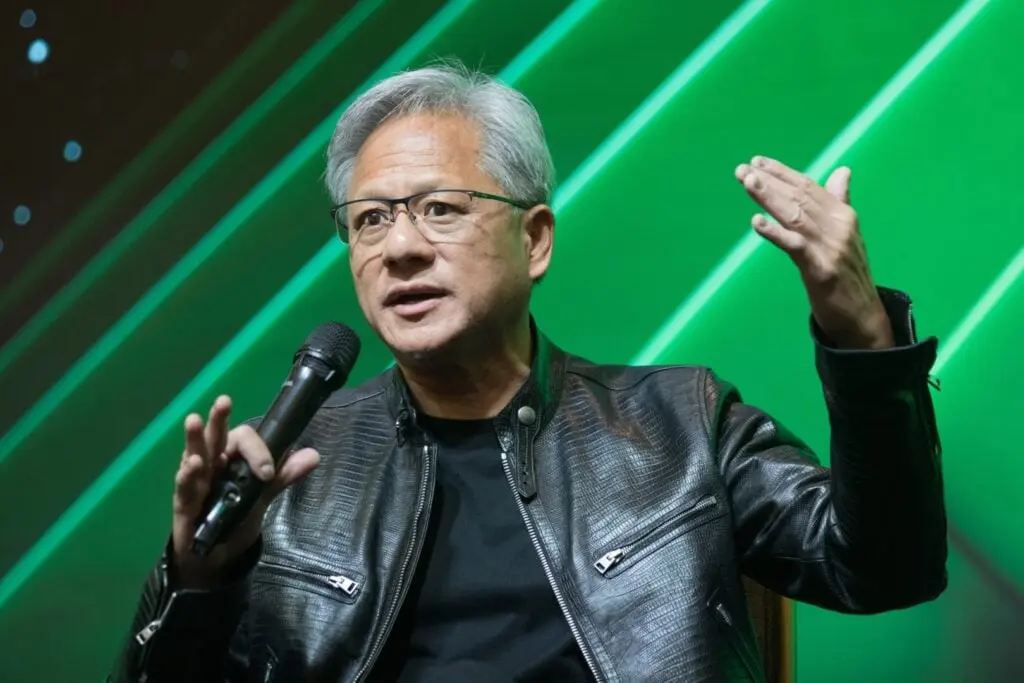
Jensen Huang, the CEO of Nvidia, revealed this week that his software engineers are writing less code than ever before—and they couldn't be happier about it
1
. In an interview published by the company on Wednesday, Huang said that engineers would rather build AI agents than write Python code, a transformation he describes as a promotion rather than a job threat2
. "These agentic systems are new skills, and now we have a lot of software engineers building agents," Huang explained. "If you ask me, every one of my software engineers prefers to be building agents than to be writing Python code"1
.
Source: Benzinga
From Mundane Coding to Creative Agent Design
The distinction Huang draws centers on the nature of engineering work itself. The typing part of the job—the mundane work of turning an idea into syntax—is now something an AI agent can handle
1
. "You're taking all the mundane work, and you're trying to get this agent to do it," Huang said. "That requires imagination, that requires creativity, a lot of technology"2
. Instead of churning out lines of code, Nvidia engineers now spend their days designing agentic systems, writing benchmarks, and developing guardrails that keep those systems in check1
. An AI agent breaks a large goal into smaller steps, allowing software to plan and act rather than simply respond to a single prompt1
.AI is Creating Jobs, Not Cutting Them
Where Huang parts company with several tech leaders is on employment impact. He rejected warnings that AI will hollow out white-collar work, insisting instead that AI is creating jobs across the industry
1
. "The amount of work that we have to do to bring AI into the world is really quite incredible," he said. "So it's creating a whole bunch of jobs. And, my software engineers love this"1
. This optimism contrasts sharply with warnings from Anthropic CEO Dario Amodei and Amazon boss Andy Jassy, both of whom have cautioned that AI could eliminate entry-level and administrative positions1
. Huang has consistently maintained that "AI creates jobs" and represents "the United States's best opportunity to re-industrialize ourselves"1
.Related Stories
Nvidia's Strategic Push into the Agent Economy
Huang, who cofounded Nvidia in 1993, has become one of the loudest advocates for deploying AI assistants inside companies
1
. He has repeatedly floated a future in which Nvidia deploys agents across every division to lift productivity, an ambition that aligns neatly with selling the chips and platforms that power them1
. Nvidia has spent the past year positioning itself as the infrastructure beneath the agent economy, and a workforce that builds agents is also a workforce that consumes ever more compute1
. The company recently cited stronger-than-expected AI infrastructure demand and raised its long-term growth outlook2
. Microsoft's AI business has already surpassed $37 billion in annual recurring revenue, while AWS has expanded partnerships to include access to OpenAI models2
. For now, the pitch lands as much with investors as with staff—a company whose own engineers reach for agents by default serves as a persuasive advertisement for the hardware Nvidia sells1
.References
Summarized by

Navi
Related Stories
Nvidia CEO Jensen Huang Pushes for Maximum AI Automation While Promising Job Security
25 Nov 2025•Business and Economy

Jensen Huang Warns AI Leaders Against Fearmongering as Nvidia Pushes Optimistic Vision
16 Mar 2026•Technology

Nvidia CEO Jensen Huang Unveils "Agentic AI" Vision at CES 2025, Predicting Multi-Trillion Dollar Industry Shift
07 Jan 2025•Technology

Recent Highlights
1
Microsoft and Nvidia Launch Surface Laptop Ultra: A $2,599 AI-Ready PC With RTX Spark Chip
Technology

2
OpenAI Releases 722 AI-Generated Math Papers on GitHub, Igniting Fury Among Mathematicians
Science and Research

3
Trump Consulted Grok AI Before Ordering Venezuela Invasion and Capture of Nicolás Maduro
Policy and Regulation

Recent Highlights
Today's Top Stories











Don’t drown in AI news. We cut through the noise - filtering, ranking and summarizing the most important AI news, breakthroughs and research daily. Follow topics that matter to you and stay ahead.


