Local Voice Assistant on Mini PC Outperforms Alexa With Complete Privacy and Offline Control


2 Sources
[1]
My smart home finally answers me without the internet, and the model doing it runs on a mini PC
Jasmine is Software and PC Hardware Author at XDA with years of tech reporting experience ranging from AI chatbots right down to gaming hardware, she's covered just about everything. Whether it's breaking news about the latest AMD NPUs or creating video tutorials on social media platforms, Jasmine
[2]
I built a voice assistant is faster than Alexa and completely private
Nick Lewis is an editor at How-To Geek. He has been using computers for 20 years --- tinkering with everything from the UI to the Windows registry to device firmware. Before How-To Geek, he used Python and C++ as a freelance programmer. In college, Nick made extensive use of Fortran while pursuing
Share
Copy Link
Tech enthusiasts are building offline voice assistant systems using open-source AI models that run entirely on mini PCs, delivering faster response times than commercial alternatives like Alexa and Google Assistant. These self-hosted systems eliminate cloud dependency, ensure complete data privacy, and operate with lower latency while requiring only modest hardware like the GEEKOM A5 or a consumer GPU.
Local Voice Assistant Outpaces Cloud-Based Competitors
A growing movement among tech enthusiasts demonstrates that local voice assistant systems built with open-source AI models can outperform commercial alternatives like Amazon Alexa and Google Assistant while running entirely on consumer hardware. These self-hosted systems eliminate the multi-second latency inherent in cloud-based processing, delivering responses faster than human speech on modest hardware configurations.
1
2
Unlike mainstream smart home assistants that compress and transmit voice recordings to corporate servers for processing, these offline voice assistant implementations handle the entire AI pipeline locally. When internet connectivity drops, commercial systems become completely non-functional, but local voice assistant setups continue operating without interruption. The performance advantage stems from eliminating network round-trips entirely, with speech-to-text models like NVIDIA's Parakeet processing audio faster than real-time on a consumer GPU.
2
Open-Source AI Models Power Privacy-Focused AI Systems
Building a functional local voice assistant requires combining several open-source AI models into a cohesive pipeline. The foundation starts with speech-to-text conversion using OpenAI's Whisper model, which runs locally on CPU or integrated graphics and translates raw audio waveforms into text with exceptional accuracy without contacting external APIs.
1
For intent recognition, Home Assistant Assist parses natural language commands directly through Home Assistant's native intent engine, mapping phrases like "turn on the office lights and set the thermostat to 72°F" to specific device actions. Text-to-speech functionality comes from Piper, an ultra-fast neural engine optimized for modest hardware, generating realistic synthesized voices locally.
1
More sophisticated implementations incorporate wake word detection through openWakeWord or microWakeWord, followed by decision trees that route commands appropriately. Natural language processing utilizes llama3.2:3b to map conversational speech to explicit commands, while Qwen 3 handles general queries requiring contextual understanding. Kokoro provides high-quality text-to-speech output for the system's responses.
2
Mini PC Hardware Makes Self-Hosted System Viable
The hardware requirements for runs on a mini PC configurations are surprisingly modest. The GEEKOM A5 2027 edition, featuring a Ryzen 5 7430U processor with Zen 3 cores, handles local processing effectively without discrete GPUs for basic implementations. The processor's AVX2 instruction support accelerates matrix multiplication operations required by Whisper and Piper models.
1
Energy efficiency proves critical for always-listening systems, with the mini PC maintaining 15 to 25 watt idle power consumption, ensuring 24/7 operation without significant electricity costs. The system supports up to 64GB DDR4 RAM, providing headroom for lightweight local large language models like Llama 3 8B via Ollama, enabling genuinely conversational interactions beyond basic command-response patterns.
1
For more demanding implementations, a single consumer GPU like the RTX 5060 Ti proves sufficient to run the entire stack, including wake word detection, speech-to-text via Parakeet, natural language understanding through llama models, and text-to-speech generation.
2
Related Stories
Data Privacy Guarantees Through Local Processing
Privacy-focused AI implementations eliminate dependence on corporate privacy policies that change without notice. Commercial assistants raise concerns about data retention, conversation training, and wake word misfires, with users unable to verify actual practices beyond reading complex legal documents. Local processing ensures nothing leaves the server, with users maintaining complete control over data retention policies.
2
The Wyoming protocol bridge, part of Home Assistant's Wyoming integration, decouples audio-capture hardware from processing, allowing distributed ESP32-based M5Stack Atom Echo satellites running ESP Home Voice Assistant firmware to capture audio in multiple rooms and stream it over Wi-Fi to the central processing unit. This architecture maintains data privacy while enabling whole-home coverage.
1
Users can configure systems to retain misfires for model fine-tuning through LORA training, then disable retention entirely once accuracy improves. This level of control remains impossible with commercial systems, which also increasingly inject shopping suggestions and ad-driven responses into interactions.
1
2
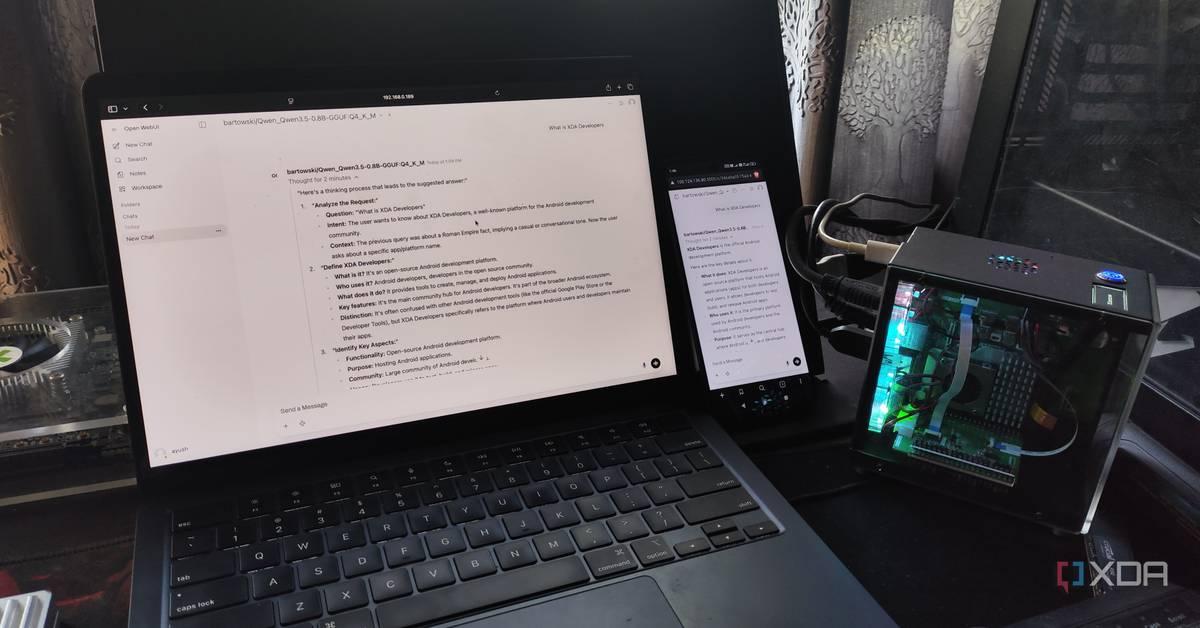
Orchestration occurs through Home Assistant's Assist pipeline via the Wyoming protocol or custom scripts, with simple Raspberry Pi or ESP32-based microphone and speaker satellites deployed throughout the home. The result is a lightning-fast, completely private smart home system where users maintain absolute control over their voice data and system behavior.
2
References
Summarized by

Navi
[1]
Related Stories
Users Are Ditching Claude and ChatGPT for Local AI Models That Run on Personal Computers
04 Sept 2026•Technology

Users turn to local AI as cloud computing capacity hits unexpected limits
29 Jun 2026•Technology
Developers ditch cloud AI for local LLM setups running on low-power hardware
30 May 2026•Technology

Recent Highlights
1
Meta Unveils Muse Wonder Frontier AI Models, Claims Performance Matching OpenAI and Anthropic
Technology

2
IMF Report Warns AI Market Correction Could Spark Global Financial Crisis With $1.4T at Risk
Business and Economy

3
OpenAI Releases 722 AI-Generated Math Solutions, Triggering Existential Crisis in Mathematics
Technology

Recent Highlights
Today's Top Stories












Don’t drown in AI news. We cut through the noise - filtering, ranking and summarizing the most important AI news, breakthroughs and research daily. Follow topics that matter to you and stay ahead.


