4 Sources
4 Sources
[1]
Esther and Anne Wojcicki back new healthcare accelerator, fund | TechCrunch
A new residency-venture program helps to tackle one of the most pressing issues in the U.S. -- healthcare. Mary Minno, an investor and former product manager at Google, announced on Wednesday the launch of an early-stage startup accelerator program called Treehub and an early-stage venture firm called AI Health Fund, aimed at backing startups working at the intersection of healthcare and AI. The AI Health Fund is the venture arm of the Treehub residency, where founders apply to incubate their ideas. The residency program lasts six months -- the first 12 weeks are dedicated to helping founders find product-market fit, and the last 12 weeks are focused on company direction, Minno said. "It could be raising a large round, it could be joining a traditional accelerator, or perhaps deploying across a hospital system." She got the idea for launching a residency and a program late last year when she was six weeks postpartum with her second child, and when a family member was diagnosed with acute leukemia, going from "being very healthy to very sick virtually overnight," she said. She didn't like how hard it was to find a specialist for this family member, how long they had to wait before they could be treated after being diagnosed, and how policy and outdated technology often slowed down the treatment process. "It's only when people went outside of that system and broke the rules that things could happen," she said. "I realized that we need more startups here because they're going to challenge the status quo." So she turned to her longtime friend Esther Wojcicki (an educator and mother of the late former YouTube CEO Susan Wojcicki and 23andMe founder Anne Wojcicki). Esther was once Minno's high school journalism teacher, and the two have remained close ever since. The two spoke about how to increase innovation in the health sector and about how academics -- often the ones with lots of research -- struggle to get startup ideas off the ground. The problem is that they don't really know how to tell a good story, at least not in the way venture investors like to hear, and they also don't know how to commercialize their research well, Minno said. She and Esther wanted to build a program that would team operators with academic-focused founders, "similar to the way a venture would in order to teach them the art of building a business." In addition to launching the Treehub residency, for which founders must apply, Minno and Esther decided to team up with members of the biomedical data science department at Stanford to launch the AI Health Fund, writing early checks (ranging from $50,000 to $150,000) to companies coming from academic circles. The fund intends to raise $10 million and made its first close last year at $1.5 million, Minno said. They raised $500,000 from family and friends, then received a $1 million check from billionaire VC Tim Draper. Anne Wojcicki has joined as an operating partner, while Esther serves as founding adviser. The Stanford team includes Roxana Daneshjou, an assistant professor of biomedical data science and dermatology at Stanford Medicine; Minno's husband, Derek, who is president of the VC firm Point Capital; and Alexander Ioannidis, an assistant professor of biomedical data science and genetics at Stanford. The AI Health Fund is hoping to back at least 60 companies in this first iteration of the program. The fund was set up as a separate vehicle because Minno also wanted to back founders who might not go through the program or who might be second- or third-time founders without a need for the Treehub program but who still have a good idea. With that said, the AI Fund has already backed 12 companies from the Treehub program, including the women's hormone tracker Clair Health (which also went through a16z speedrun), and researcher Dennis Walls new company focused on pediatric autism. Minno said the residency is still in its experimental phase as the team works out the best way to navigate the accelerator-fund approach. She said the residency program's true value prop is that it hopes to work with founders at the earliest stage, before there is even a company. "In more than half the cases, we introduce the founders to the lawyers that helped them incorporate, so we almost play a co-founder-like role," she said. "The difference between us and the other accelerators out there is we're really helping them strategize and to get along well; when there's a problem, we help them with problem-solving skills," Esther said. Minno said the Treehub residency program wants to build to support founders' needs, such as arranging meetings they might need or whatever else is needed to help them scale their businesses. "We don't have demo day because these companies mature at different rates," she said. The goal, overall, is to see how the first iteration of the residency program goes, to "understand which aspects of it can be scaled and which aspects need to stay small," Minno continued. "It's really important to us that we make every company we work with successful," she continued. "Our vision is to 10x it, so we're starting with something very small and then our plan is, after we run this cycle a few times, hopefully do this across the country."
[2]
Esther and Anne Wojcicki join new healthcare accelerator, fund | TechCrunch
A new residency-venture program helps to tackle one of the most pressing issues in the U.S. -- healthcare. Mary Minno, an investor and former product manager at Google, announced on Wednesday the launch of an early-stage startup accelerator program, Treehub, and an early-stage venture firm, AI Health Fund, aimed at backing startups working at the intersection of healthcare and AI. The AI Health Fund is the venture arm of the Treehub residency, where founders apply to incubate their ideas. The residency program lasts six months -- the first 12 weeks are dedicated to helping founders find product-market fit, and the last 12 weeks are focused on company direction, Minno said. "It could be raising a large round, it could be joining a traditional accelerator, or perhaps deploying across a hospital system." She got the idea for launching a residency and a program late last year when she was six weeks postpartum with her second child, and when a family member was diagnosed with acute leukemia, going from "being very healthy to very sick virtually overnight," she said. She didn't like how hard it was to find a specialist for this family member, how long they had to wait before they could be treated after being diagnosed, and how policy and outdated technology often slowed down the treatment process. "It's only when people went outside of that system and broke the rules that things could happen," she said. "I realized that we need more startups here because they're going to challenge the status quo." So she turned to her long-time friend Esther Wojcicki (an educator and mother of the late former YouTube CEO Susan Wojcicki and 23andMe founder Anne Wojcicki). Esther was once Minno's high school journalism teacher, and the two have remained close ever since. The two spoke about how to increase innovation in the health sector and about how academics -- often the ones with lots of research -- struggle to get startup ideas off the ground. The problem is that they don't really know how to tell a good story, at least not in the way venture investors like to hear, and they also don't know how to commercialize their research well, Minno said. She and Wojcicki wanted to build a program that would team operators with academic-focused founders, "similar to the way Adventure Studio would in order to teach them the art of building a business." In addition to launching the Treehub residency, for which founders must apply, Minno and Esther decided to team up with members of the biomedical data science department at Stanford to launch the AI Health Fund, writing early checks (ranging from $50,000 to $150,000) to companies coming from academic circles. The fund intends to raise $10 million, and made its first close last year at $1.5 million, Minno said. They raised $500,000 from family and friends, then received a $1 million check from billionaire VC Tim Draper. Anne Wojcicki has joined as an operating partner, while Esther serves as founding advisor. The Stanford team includes Roxana Daneshjou, an assistant professor of biomedical data science and dermatology at Stanford Medicine; Minno's husband, Derek, who is president of the VC firm Point Capital, and Alexander Ioannidis, an assistant professor of biomedical data science and genetics at Stanford. The AI Health Fund is hoping to back at least 60 companies in this first iteration of the program. The fund was set up as a separate vehicle because Minno also wanted to back founders who might not go through the program or who might be second-or third-time founders without a need for the Treehub program, but who still have a good idea. With that said, the AI Fund has already backed 12 companies from the Treehub program, including the women's hormone tracker Clair Health (which also went through a16z speedrun), and researcher Dennis Walls new company focused on pediatric autism. Minno said the residency is still in its experimental phase as the team works out the best way to approach the accelerator-fund approach. She said the residency program's true value prop is that it hopes to work with founders at the earliest stage, before there is even a company. "In more than half the cases, we introduce the founders to the lawyers that helped them incorporate, so we almost play a co-founder-like role," she said. "The difference between us and the other accelerators out there is we're really helping them strategize and to get along well; when there's a problem, we help them with problem-solving skills," Esther Wojcicki said. Minno said the Treehub residency program wants to build to support founders' needs, such as arranging meetings they might need or whatever else is needed to help them scale their businesses. "We don't have demo day because these companies mature at different rates," she said. The goal, overall, is to see how the first iteration of the residency program goes, to "understand which aspects of it can be scaled and which aspects need to stay small," Minno continued "It's really important to us that we make every company we work with successful," she continued. "Our vision is to 10x it, so we're starting with something very small and then our plan is, after we run this cycle a few times, hopefully do this across the country."
[3]
Treehub launches with Tim Draper and Anne Wojcicki to back the next wave of AI health founders - SiliconANGLE
Treehub launches with Tim Draper and Anne Wojcicki to back the next wave of AI health founders Treehub, a new Stanford University-adjacent residency program backed by the AI Health Fund, launched today, with billionaire investor Tim Draper and 23andMe Holding Co. founder Anne Wojcicki among the high-profile names attached to an effort to scout early-stage artificial intelligence and healthcare founders emerging from academic labs. Based in Los Altos, California, just off Stanford University's campus, Treehub is being pitched as a boutique residency built to bridge the gap between academic breakthrough and fundable company, a stage where scientist-founders have historically struggled to secure capital or operational support. The AI Health Fund, Treehub's venture arm, writes the first check into every company that comes through the program and, in many cases, commits capital before a company has been formally incorporated. Treehub combines elements of a venture studio, an incubator and a traditional venture fund. Founders in the program are offered access to proprietary medical data, curated programming with payers, buyers and investors and mentorship from operators who have built and exited healthcare and technology startups. The program targets three investment domains: precision outcomes, including genomic risk stratification and consumer-driven care; care efficiency, including ambient intelligence and automated logistics; and frontier science, including robotic surgery and digital twin simulations. "The next great healthcare company probably isn't being built in a garage," said Mary Minno, founding partner at Treehub and a former product management executive at Google LLC. "It's being built in a lab by a scientist who has never had a venture partner willing to back them at the earliest stage. Treehub bridges that gap." The involvement of Wojcicki is notable given the colorful history of 23andMe, the consumer genomics company she co-founded in 2006. 23andMe filed for Chapter 11 bankruptcy in March 2025 after a sustained decline in its stock and a major 2023 data breach that exposed information on roughly 7 million customers. Wojcicki ultimately reacquired the company through her nonprofit TTAM Research Institute later that year. She joins Treehub as an operating partner. Draper, founder of Draper Associates and an early investor in Tesla Inc., Skype and Coinbase Global Inc., is named as a backer of the program, though the size of his commitment was not disclosed. The rest of Treehub's leadership spans academia and finance. Dr. Roxana Daneshjou, an assistant professor of biomedical data science and dermatology at Stanford Medicine and an adviser to OpenEvidence Inc. and Pear VC, joins Treehub alongside Dr. Alexander Ioannidis, a Stanford assistant professor and founder of Galatea Bio Inc. They are joined by Derek Minno, president of Point Capital and Esther Wojcicki, educator and mother of Anne Wojcicki, who is joining Treehub as a founding adviser. "I've seen what happens when brilliant scientists get the right support at the right moment," said Anne Wojcicki. "Treehub is building the infrastructure to make that repeatable and at the scale and speed the healthcare industry actually needs."
[4]
Legendary Educator Esther Wojcicki and Former Student Launch $10M A.I. Health Fund
The veteran educator and the mother of the famous "Wojcicki sisters" teams up with a former student to invest in early-stage A.I. health care startups. What do actor James Franco, former NBA player Jeremy Lin and writer Lisa Brennan-Jobs have in common? They were all students of Esther Wojcicki. Beyond raising future Silicon Valley leaders like Anne and Susan Wojcicki, the educator spent decades pioneering a media program at Palo Alto High School. Watching her students thrive has been "the best gift ever," Wojcicki told Observer. Now, she's going into business with one of them. Sign Up For Our Daily Newsletter Sign Up Thank you for signing up! By clicking submit, you agree to our <a href="http://observermedia.com/terms">terms of service</a> and acknowledge we may use your information to send you emails, product samples, and promotions on this website and other properties. You can opt out anytime. See all of our newsletters Wojcicki is partnering with Mary Minno, a former Google senior product manager and one of her former 10th-grade students, to launch an A.I.-focused health care fund alongside a residency program called Treehub. The venture, which quietly launched in October and was unveiled today (April 22), aims to support founders emerging from academia as they turn ideas into companies. "The premise is very simple: invest in people before others are willing to invest in them," Minno told Observer. Some companies need help communicating complex scientific ideas, while others require guidance in navigating co-founder dynamics or building partnerships. "There's no one-size-fits-all approach to this." The AI Health Fund has already invested in a dozen companies and expects to back around 60 as it deploys roughly $10 million over the next 18 months. Based in Los Altos, Treehub offers more than capital, providing mentorship, data and programming designed to help founders avoid common startup pitfalls, including internal conflict. "We have to help them get along and not hold grudges, not be vindictive," said Wojcicki. Wojcicki's track record in Silicon Valley extends beyond her classroom. She is the mother of Janet Wojcicki, a pediatrics professor at the University of California, San Francisco; Anne, the co-founder of 23andMe; and Susan, the former CEO of YouTube who died in 2024 from lung cancer. She also founded a widely influential high school journalism program that has since expanded nationwide. Her work is guided by principles she calls TRICK -- trust, respect, independence, collaboration and kindness -- which she plans to apply at Treehub. "As people get older, they become more constrained," said Wojcicki. "Kids don't have that, and so they can actually take a look at the system and say, 'Wow, why aren't they doing that?" Minno, who stayed in touch with Wojcicki over the years as she worked at Google and Facebook, approached her with a plan to rethink health care after a loved one experienced a medical crisis. "I showed up to Esther's house four months post-partum, holding my son, and I was like, 'You have to help me fix health care,'" said Minno. "What we need to do is develop a new system by which we programmatically facilitate and accelerate the adoption and distribution and success of companies that can make it better." They recruited Roxana Daneshjou, an assistant professor of biomedical data science and dermatology at Stanford Medicine; Alexander Ioannidis, an assistant professor of biomedical data science and genetics at Stanford, and Minno's father, Derek, president of Point Capital, to help lead the effort. Anne Wojcicki will serve as Treehub's operating partner. "We see family as a feature, not a bug," said Minno. The AI Health Fund focuses on three areas: precision outcomes, care efficiency and frontier science. It is particularly interested in academic founders with deep domain expertise, such as Stanford professor Dennis Wall, whose work on digital interventions for pediatric autism is among its early investments. Looking ahead, Minno and Wojcicki plan to expand beyond health care into areas like climate. "We won't need to worry about health if we don't have a planet," Wojcicki said. They also hope to scale Treehub beyond its current base, where roughly 75 percent of founders come from Stanford and UC Berkeley, to universities nationwide. "We want to take this model and prove it works here, and then have it work everywhere," said Minno. "There's no time to wait and solve these issues."
Share
Share
Copy Link
Former Google product manager Mary Minno has launched Treehub, a six-month residency program, alongside the AI Health Fund, targeting $10 million to invest in startups at the intersection of healthcare and AI. Backed by Tim Draper, Anne Wojcicki, and Esther Wojcicki, the venture aims to bridge the gap between academic research and fundable companies, with early checks ranging from $50,000 to $150,000.
Mary Minno, an investor and former product manager at Google, has unveiled Treehub, an early-stage startup accelerator, and the AI Health Fund, a venture firm focused on startups working at the intersection of healthcare and AI
1
. The initiative, announced Wednesday, represents a new approach to supporting academic founders who struggle to commercialize breakthrough research despite possessing deep domain expertise.
Source: SiliconANGLE
The AI Health Fund intends to raise $10 million and has already secured its first close at $1.5 million, including $500,000 from family and friends and a $1 million check from billionaire VC Tim Draper
2
. The fund writes early checks ranging from $50,000 to $150,000 to companies emerging from academic circles and aims to back at least 60 companies in its first iteration1
.
Source: TechCrunch
The residency program lasts six months, with the first 12 weeks dedicated to helping founders find product-market fit and the last 12 weeks focused on company direction, which could include raising a large round, joining a traditional accelerator, or deploying across a hospital system
1
. Based in Los Altos, California, just off Stanford University's campus, Treehub works with founders at the earliest stage, often before a company exists. "In more than half the cases, we introduce the founders to the lawyers that helped them incorporate, so we almost play a co-founder-like role," Minno explained2
.The program offers mentorship, access to proprietary medical data, and curated programming with payers, buyers, and investors
3
. Unlike traditional accelerators, Treehub doesn't host a demo day because "these companies mature at different rates," Minno noted1
.Anne Wojcicki, 23andMe founder, has joined as an operating partner, while her mother, Esther Wojcicki, serves as founding adviser
1
. Esther, a legendary educator who taught Minno journalism in high school at Palo Alto High School, remained close with her former student over the years4
. The Stanford University team includes Roxana Daneshjou, an assistant professor of biomedical data science and dermatology at Stanford Medicine, and Alexander Ioannidis, an assistant professor of biomedical data science and genetics at Stanford2
.
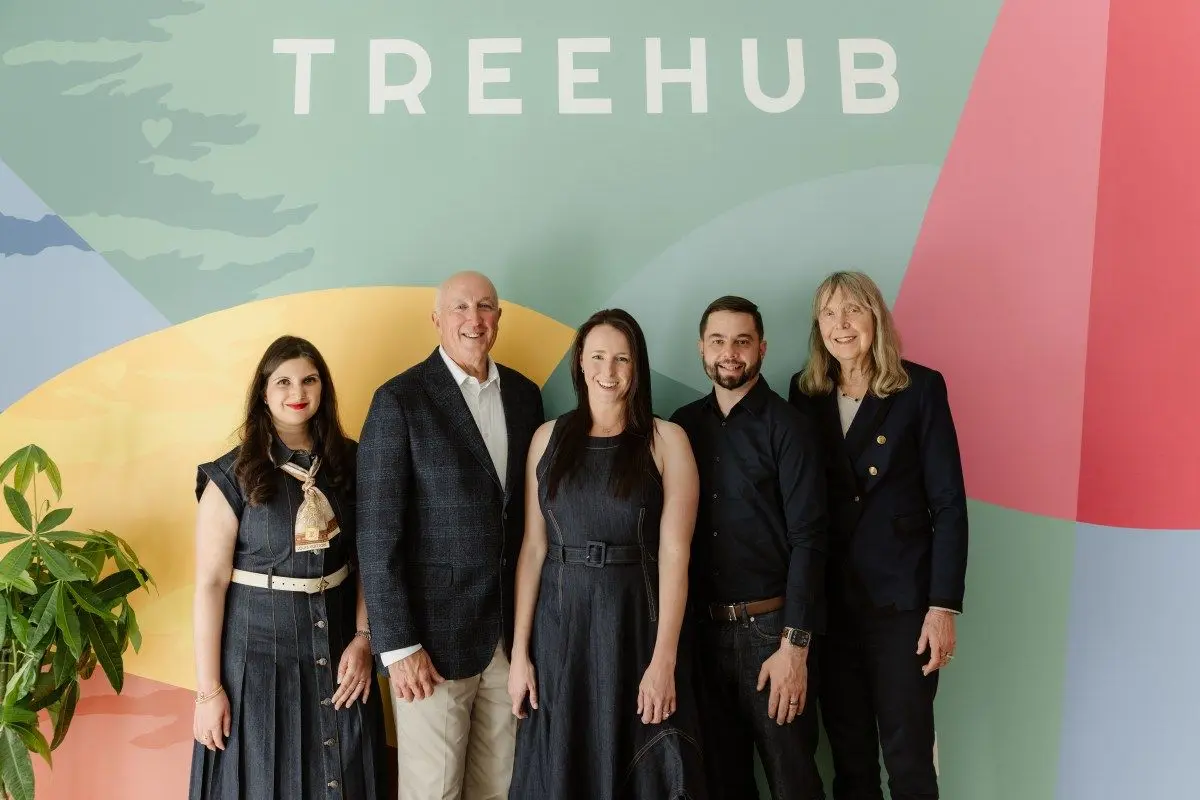
Source: TechCrunch
Minno's inspiration came late last year when she was six weeks postpartum with her second child and a family member was diagnosed with acute leukemia. The difficulty finding a specialist, long wait times, and how outdated technology slowed treatment revealed systemic failures. "I realized that we need more startups here because they're going to challenge the status quo," she said
1
.Related Stories
The program targets three investment domains: precision outcomes, including genomic risk stratification and consumer-driven care; care efficiency, including ambient intelligence and automated logistics; and frontier science, including robotic surgery and digital twin simulations
3
. The AI Health Fund has already backed 12 companies from the Treehub program, including women's hormone tracker Clair Health, which also went through a16z speedrun, and researcher Dennis Wall's new company focused on pediatric autism1
."The next great healthcare company probably isn't being built in a garage," Minno said. "It's being built in a lab by a scientist who has never had a venture partner willing to back them at the earliest stage"
3
. The AI Health Fund expects to deploy roughly $10 million over the next 18 months . Looking ahead, the team plans to expand beyond healthcare into areas like climate and scale the model beyond its current base, where roughly 75 percent of founders come from Stanford and UC Berkeley, to universities nationwide .Summarized by
Navi
[3]
1
Policy and Regulation

2
Technology

3
Business and Economy