Meta cuts Manus off from internal systems as China forces reversal of $2 billion AI acquisition


4 Sources
[1]
After spat with Chinese gov't, Meta cuts AI Manus off from its internal systems and is 'sunsetting' platform, report claims -- Beijing-ordered breakup of $2 billion AI deal begins
Manus staff lost access to Meta's data systems earlier this month. Meta has finished separating its operations from Manus, the Chinese-founded agentic AI startup it acquired for roughly $2 billion in December, Bloomberg reported, citing people familiar with the matter. Manus employees have
[2]
Manus original investors plan to buy back AI firm from Meta for $2 billion, The Information reports
June 18 (Reuters) - The early Chinese backers of AI startup Manus are planning to buy the company back from Meta (META.O), opens new tab at the $2 billion price that the Facebook parent paid, The Information reported on Thursday, citing two people with direct knowledge of the matter. The move is
[3]
Meta cuts Manus off from data systems, begins unwinding deal
Meta has cut Manus off from its internal systems and told staff to sunset the platform. The $2 billion acquisition is being dismantled after Beijing ordered it unwound in April, and Manus's founders are trying to raise $1 billion for a buyback. Meta has erected a data firewall between itself and
[4]
Meta's Biggest AI Bet Stalled: China Blocks Manus Deal, Forces Strategy Shift
Meta's plans for AI startup Manus have hit a major obstacle after China reportedly blocked the deal. The move has forced changes inside the partnership and raised fresh questions about the future of global AI investments. Meta's effort to strengthen its position in artificial intelligence has
Share
Copy Link
Meta has severed operational ties with Manus, the Chinese-founded AI startup it acquired for $2 billion, following Beijing's unprecedented order to unwind the completed deal. Manus employees lost access to Meta's data systems in early June, while the startup's founders scramble to raise $1 billion for a buyback that could reshape cross-border AI investments.
Meta Cuts Off Manus Following Beijing's Unprecedented Intervention
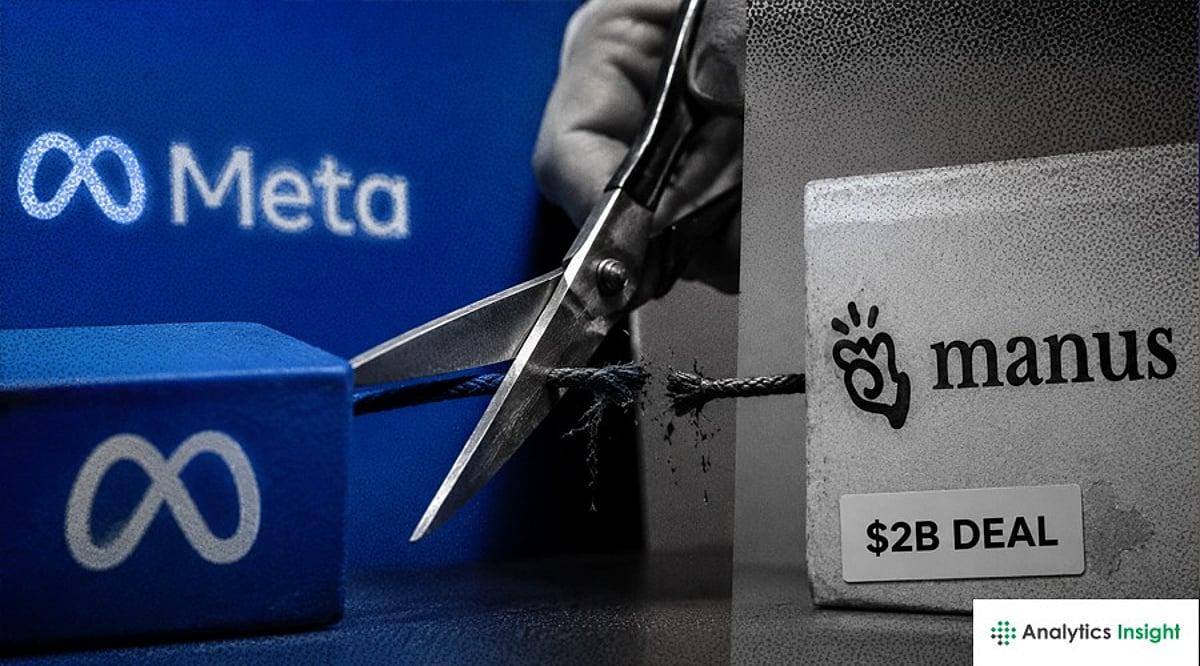
Meta has completed the operational separation from Manus, the agentic AI startup it acquired for roughly $2 billion in December 2025, marking the first concrete step in complying with a Chinese government order to reverse the completed AI acquisition
1
. Since early June, Manus staff have been locked out of Meta's internal data systems, and Meta employees are now barred from using Manus tools for internal work3
. An internal memo viewed by Bloomberg indicates Meta is "sunsetting" the platform, with existing Manus projects being migrated onto Meta's own systems1
.
Source: Analytics Insight
China Regulatory Intervention Marks Historic First
China's National Development and Reform Commission (NDRC) ordered the Meta Manus deal unwound in April 2026 under its foreign investment security review mechanism, the country's equivalent of CFIUS in the United States
1
. This Beijing-ordered reversal represents the first time Chinese authorities have forcibly reversed a completed cross-border AI acquisition, even though Manus had relocated its headquarters and core team from Beijing to Singapore in mid-20251
. The NDRC concluded the transaction violated foreign investment security concerns and technology export rules3
. The regulatory probe escalated dramatically in March when authorities barred co-founders Xiao Hong and Ji Yichao from leaving mainland China and summoned them to Beijing for questioning3
.Founders Scramble to Buy Back AI Firm
Manus's three founders—Xiao Hong, Ji Yichao, and Zhang Tao—are now attempting to raise approximately $1 billion from outside investors to fund a buyback at a valuation matching the $2 billion Meta paid
1
. The early Chinese backers of the agentic AI startup are planning to buy back the company from Meta at the original acquisition price, according to reports citing people with direct knowledge of the matter2
. If the buyback proceeds, the next step would involve establishing Manus as a Chinese joint venture with those backers, potentially ahead of a Hong Kong IPO3
. Early backers including Tencent, ZhenFund, and HSG have already received their proceeds from the original sale, complicating efforts at unwinding the deal1
.Related Stories

What Meta Has Already Learned Cannot Be Unlearned
The technical challenge of truly reversing this AI acquisition extends beyond simple financial transactions. Manus's value resides in its model weights and engineering expertise, both of which have been flowing into Meta for the past six months
1
. No regulatory order or data firewall can recall what Meta's engineers have already absorbed from working with the autonomous AI agent technology. Meta has not yet clarified how it will demonstrate to the NDRC that Manus's technology has been removed from its systems1
. Despite the operational split, some Manus features including connections to Meta's Ads Manager and Instagram remain active, raising questions about how complete the separation currently is3
.
Source: Reuters
Geopolitical Implications for AI Strategy
The intervention sends a clear signal that incorporating in Singapore does not place Chinese AI founders beyond Beijing's regulatory reach
3
. Manus drew comparisons to DeepSeek in Chinese state media as a symbol of domestic AI capability, making its sale to a U.S. hyperscaler a test case Beijing evidently decided it couldn't allow1
. China has since formalized tougher outbound-investment rules that give regulators expanded authority for blocking cross-border AI transactions involving technology, talent, or intellectual property with Chinese origins3
. The situation demonstrates how advanced AI systems have become matters of national interest, with governments increasingly involved as companies race to secure talent, technology, and computing power4
. The entire arc from Manus's viral demo in March 2025—which garnered over one million views in 20 hours—to $2 billion exit to regulatory demolition took less than a year3
.References
Summarized by

Navi
[2]
[3]
[4]
Related Stories
China Blocks Meta's $2 Billion Manus Acquisition, AI Startup to Resume Independent Operations
11 Aug 2026•Policy and Regulation

Manus founders seek $1 billion to reverse Meta acquisition after Chinese regulatory block
21 May 2026•Business and Economy
Manus Resumes Independent Operations After China Blocks Meta's $2 Billion Acquisition Deal
01 Sept 2026•Business and Economy
Recent Highlights



Recent Highlights
Today's Top Stories



Don’t drown in AI news. We cut through the noise - filtering, ranking and summarizing the most important AI news, breakthroughs and research daily. Follow topics that matter to you and stay ahead.


