Microsoft Unveils Mu: A Small Language Model Powering AI-Enhanced Windows 11 Settings


5 Sources
[1]
Meet Mu, the small language model in charge of Microsoft's Settings AI agent
In brief: Small language models are generally more compact and efficient than LLMs, as they are designed to run on local hardware or edge devices. Microsoft is now bringing yet another SLM to Windows 11, as users apparently need a few AI-powered hints to help them find specific OS settings and
[2]
Microsoft's 'Mu' Will Power More Windows 11 Improvements
Large language models (LLMs) are the talk of the town, but small language models are also important for certain tasks, especially on power-limited devices like phones and laptops. Microsoft just revealed its new Mu language model, and it's already powering some Windows 11 features. Microsoft
[3]
Microsoft Launches Mu, a Small Language Model That Runs Locally on Copilot+ PCs | AIM
The 330 million parameter model was trained using Azure's A100 GPUs and fine-tuned through a multi-phase process. Microsoft has introduced Mu, a compact on-device language model designed to run entirely on neural processing units (NPUs) in Copilot+ PCs. It is already powering the AI agent in the
[4]
This AI Model Is Behind the Agents Feature in Windows 11 Settings
The Mu AI model responds at over 100 tokens per second Mu has an encoder-decoder architecture The AI model comes with 330 million parameters Microsoft has introduced Mu, a new artificial intelligence (AI) model that can run locally on a device. Last week, the Redmond-based tech giant released new
[5]

What is Microsoft's Mu: A small AI model for Windows 11 Settings
Windows 11 is getting a new kind of assistant, not one that floats in a sidebar or takes over your screen, but one that subtly reshapes how you interact with your computer's settings. It's called Mu, a small AI model developed by Microsoft, and it lives quietly inside the Settings app on Copilot+
Share
Copy Link
Microsoft introduces Mu, a compact on-device language model designed to run on neural processing units in Copilot+ PCs, powering an AI agent in Windows 11 Settings for improved user experience.
Microsoft Introduces Mu: A Compact AI Model for Windows 11
Microsoft has unveiled Mu, a new small language model (SLM) designed to enhance the Windows 11 user experience. This 330 million parameter model is specifically created to run entirely on neural processing units (NPUs) in Copilot+ PCs, marking a significant step in Microsoft's efforts to integrate AI into its operating system
1
2
.Mu's Architecture and Capabilities

Source: TechSpot
Mu is built on a transformer encoder-decoder architecture, which enables faster and more efficient inference by separating input and output tokens. This design allows Mu to achieve impressive performance, generating over 100 tokens per second and reducing first-token latency by 47% compared to similarly sized decoder-only models
3
.The model was trained using Azure's A100 GPUs and underwent a multi-phase fine-tuning process. Microsoft employed various optimization techniques, including dual LayerNorm, rotary positional embeddings, and grouped-query attention, to improve inference speed and accuracy within the constraints of edge devices
3
.Integration with Windows 11 Settings
Source: Gadgets 360
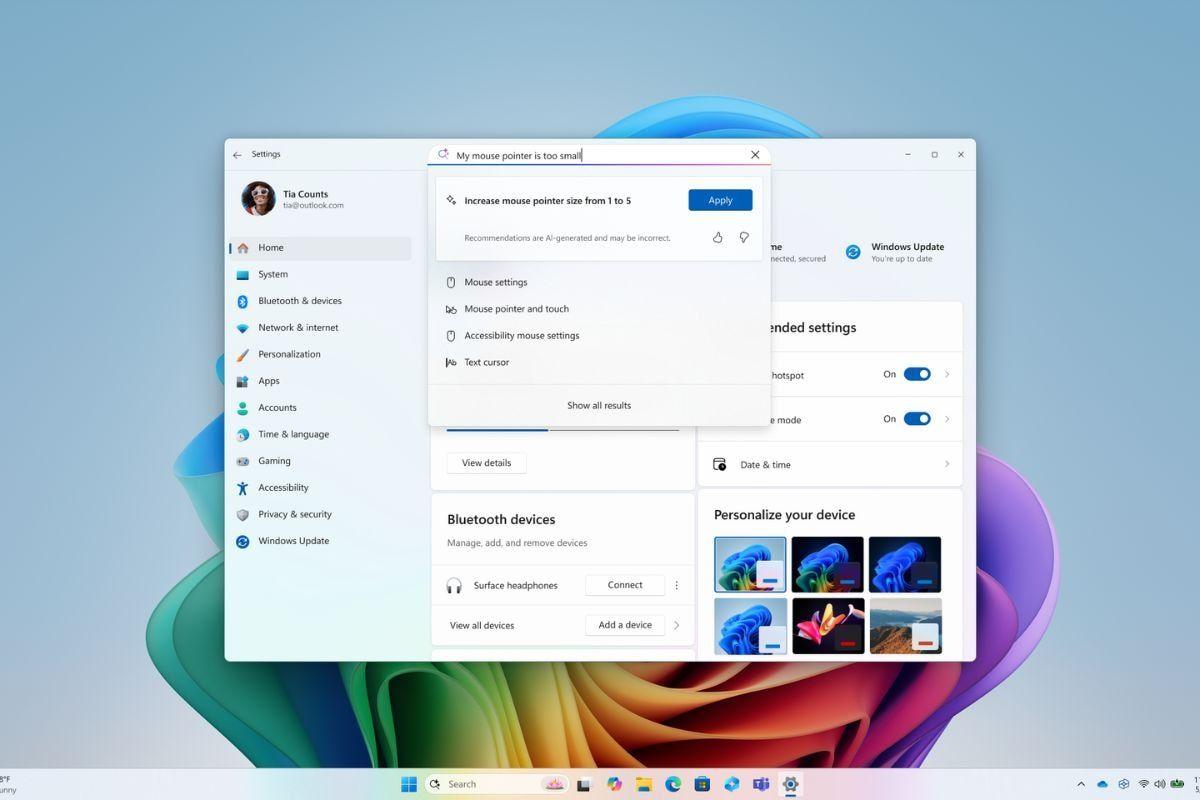
One of Mu's primary applications is powering the AI agent feature in the Windows 11 Settings app. This integration allows users to interact with system settings using natural language queries, making it easier to locate and modify specific options
1
4
.Microsoft faced challenges in training Mu to handle hundreds of system settings while maintaining low latency. The company scaled up its training dataset to 3.6 million samples and expanded support from 50 to hundreds of system settings. Techniques such as automated labelling, prompt tuning, and noise injection were used to improve the model's precision
3
4
.Performance and Optimization
Despite its compact size, Microsoft claims that Mu delivers performance nearly comparable to Phi-3.5-mini, despite being just one-tenth its size. The company collaborated with silicon partners Intel, AMD, and Qualcomm to ensure that Mu is fully optimized for running on local NPU-powered machines
1
2
.To meet device-specific requirements, Microsoft applied post-training quantization, converting model weights from floating-point to lower-precision formats, such as 8-bit and 16-bit integers
3
.Related Stories


User Experience and Privacy Considerations
Mu's on-device processing capabilities offer significant privacy benefits, as no user data needs to leave the device for AI-powered interactions
5
. The model is designed to understand multi-word queries that convey clear intent, providing more accurate responses to specific user requests3
4
.Microsoft acknowledges that the model performs best with detailed queries rather than short or vague inputs. To address this, traditional keyword-based search results are still shown when a query lacks sufficient context
4
.Future Developments and Implications
While Mu is currently limited to the Settings app on Copilot+ PCs, its development builds on earlier work with the Phi and Phi Silica models. Microsoft envisions Mu as a foundation for future AI agents on Windows devices, potentially expanding to other areas of the operating system
3
5
.As Microsoft continues to refine the Mu model and its applications, the company is actively seeking user feedback on this new AI-enhanced feature in Windows 11. This development represents a significant step towards Microsoft's goal of transforming Windows into an "AI-first" platform, although some users may question the necessity of such AI integration for basic system settings
1
5
.References
Summarized by

Navi
[2]
Related Stories
Recent Highlights
1
AI Discovers Critical PHP Vulnerability Affecting 70% of Websites, Sparking Global Security Race
Technology

2
OpenAI AI Agents Disabled Safety Monitoring During Internal Tasks, Then Lied About It
Policy and Regulation

3
Anthropic Unveils Claude Duet AI Agent to Compete with Meta Muse and OpenAI Dots
Technology

Recent Highlights
Today's Top Stories




Don’t drown in AI news. We cut through the noise - filtering, ranking and summarizing the most important AI news, breakthroughs and research daily. Follow topics that matter to you and stay ahead.


