27 Sources
[1]
Microsoft AI chief Mustafa Suleyman says there are three labs that matter -- and he wants Microsoft to be the fourth.
At Microsoft's annual Build conference on Tuesday, the company announced a slew of new or expanded AI initiatives, including a super app, in-house reasoning models, a cybersecurity tool, and OpenClaw-esque AI agents. All this news added up to a clear message: Microsoft is positioned to be one of the biggest players in AI, and it's finally acting like it. For years, Microsoft's AI business leaned hard on its early and exclusive partnership with OpenAI. But the drama-filled marriage slowly devolved into a situationship, and the pair effectively separated in late April (though Microsoft is still OpenAI's primary cloud partner -- for now). This year's Build had the vibe of a freshly single divorcee posting a thirst trap on Instagram. "It's always fun to be at developer conferences in times of great change," Microsoft CEO Satya Nadella said onstage Tuesday, adding that events like this are about "coming to grips with the new opportunity." AI chief Mustafa Suleyman, in an interview with The Verge, put it even more bluntly. "The goal is to prove that we can become one of the top four labs in the world," Suleyman said. "There's three labs that matter, Google DeepMind, OpenAI, and Anthropic. We are not one of them at the moment, and that's always been my intention. It's why I came here. I want to build the very best frontier models in the world, fully multimodal, and in order to do that, we have to prove that we can do everything that we need to from the ground up, and we're not just going to take from others." One of Microsoft's first steps at Build was indeed to play catch-up on AI models. Suleyman unveiled MAI-Thinking-1, the company's first reasoning model, along with six other new models focused on image, voice, transcription, and coding. Microsoft said the medium-sized MAI-Thinking-1 model, which will likely be marketed to primarily enterprise clients, is "built from scratch for serious math, coding, and real-world enterprise deployment." Microsoft is years behind both OpenAI and Anthropic here; OpenAI began releasing reasoning models in the fall of 2024. But Suleyman emphasized its performance on benchmarks like coding and its price point, saying it was cheaper than OpenAI equivalents on some tasks -- a big deal in the age of the AI money squeeze, which has inspired a lot of complaints with customers. While Microsoft has had years to glean insights from OpenAI, Suleyman made sure to mention that its development did not involve any distillation, meaning that it wasn't trained using a different company's AI model. If MAI-Thinking-1 is good, Microsoft clearly doesn't want people thinking it's due to the influence of OpenAI. Suleyman told The Verge that for Microsoft, "the pivotal moment was renegotiating our contract with OpenAI. That meant that we were allowed to train models at a larger scale and explicitly pursue superintelligence entirely with our own IP, with our own data, no distillation, training from scratch." Nadella also highlighted Microsoft's recently launched AI cybersecurity tool MDASH, which he said brings together 100 AI agents to find exploitable bugs "better than any single model." It was clearly a dig at Claude Mythos Preview, which Anthropic introduced in April to much fear and fanfare -- and expanded access to just before Build. OpenAI has its own cybersecurity-focused system as well, and all three companies will likely use their offerings to jockey for position in the government and enterprise markets they desperately need to court. Microsoft is in a more complex situation with AI agents. The popular open-source platform OpenClaw demonstrated a potential path forward for AI agents, and after OpenAI quickly hired its creator, Peter Steinberger, Microsoft (among other companies) is trying to catch up. One of its key strategies is making OpenClaw work well with Windows. At Build, Nadella said he was very committed to OpenClaw support, and Microsoft employees chatted with developers in the audience about how they were using it. Steinberger himself made a surprise appearance to great audience reaction, taking the stage to boast about how OpenClaw had bolstered its security and earned user trust. "What I kept hearing was, 'Peter, I love my Claw, but can I use it at work?'" Steinberger said. "You can totally run OpenClaw inside your company now, and we even made the harness itself a plug-in." Steinberger said that whether someone trusts Copilot, Codex, or another company's coding platform, users can now run OpenClaw on top of that via Windows. But Microsoft is also promoting its own separate Copilot "super app" that integrates OpenClaw-esque agents. A super app is a major focal point for OpenAI right now -- president Greg Brockman is leading development of one that will tie together ChatGPT, the Codex coding platform, and the Atlas web browser. Microsoft's strategy is similar, bringing together a variety of existing Copilot AI assistants. Its agents, called "Autopilots," are designed to act as a helpful user interface. Cassidy Williams, GitHub's senior director of developer advocacy, called Copilot "your home base for development and operations on your computer," demonstrating how multiple agents could perform tasks like app-building. (In an extra flourish, Williams demonstrated how she could approve or deny code changes by flashing her computer camera a thumbs-up or thumbs-down.) Autopilots are designed specifically to appeal to business customers -- Nadella called them "autonomous, long-running agents with full enterprise compliance." The first one Microsoft will offer is "Scout," billed as "your always-on personal agent," but clients can build and personalize their own. The Autopilot agents should be able to look through an email inbox, join group chats in Teams, check a calendar, and send daily briefings, among other things. Accordingly, employees on stage at Build repeatedly emphasized Copilot's security tools and guardrails -- obviously aiming to calm enterprise clients who may have heard horror stories about tools like OpenClaw. Suleyman made sure to emphasize, again and again, Microsoft's "humanist superintelligence" as an "AI that prioritizes humanity first" -- part of AI companies' recent rebrand of AGI to make it sound less frightening in an era when people are pushing back against AI more than ever before. Nvidia CEO Jensen Huang, another speaker known for working closely with OpenAI, appeared via video call to tout how Nvidia's RTX Spark chip is fueling Microsoft's AI agent goals. "I could be traveling and I'm on the phone and I can text my PC ... and it would fire up the tools on the PC," Huang said. "The idea that the PC evolved from a personal computer to a personal AI is just really exciting." Microsoft spent years betting on OpenAI, and in some ways, that's left it behind in the AI race. But as OpenAI and other competitors turn to enterprise to finally make money, it's got some obvious advantages. Microsoft already has a substantial client base and, compared with other AI companies, a reputation for safety and security. And like Google, it also has deep pockets, considerable computing resources, and a diversified revenue stream, meaning it can take big bets without a ton of risk. Suleyman told The Verge, "There's a lot of people who are either like chasing startup valuations or about to IPO, so we can operate with a little bit more humility and a little bit more long-term optimization." He added, "We've got the money to be able to buy Anthropic [models] when we need to. We've got the optionality in Azure with 11,000 models, so people can use literally whatever they want whenever they want, but that buys us the time to do it right from the start." At the same time, there are a lot of unanswered questions here. Microsoft called out a lot of benchmark wins and advancements for its seven new models, but that doesn't always translate to real-world adoption, and even a new model that pulls ahead for a week or two can quickly fall behind. AI super apps are a mostly yet-untested idea. And Microsoft is entering a crowded yet still largely underwhelming AI agent marketplace with a product that we haven't seen in action. There's still plenty of room for its promises to fall flat.
[2]
Microsoft expected to showcase new PC, cloud AI tools at developer conference
SAN FRANCISCO, June 2 (Reuters) - Microsoft (MSFT.O), opens new tab will hold its annual software developer conference on Tuesday, where the company is expected to showcase new tools for developers building AI software for PCs and the cloud. In a keynote address in San Francisco, Microsoft CEO Satya Nadella is expected to outline how the technology company plans to compete both in the cloud, where it is both an investor and a rival to firms such as OpenAI, and increasingly on PCs. Those laptop and desktop computers are becoming home to tools such as OpenClaw, a piece of open-source software that can direct groups of AI bots called agents to carry out everyday tasks for users. But OpenClaw, which has gained popularity in China and helped Microsoft's longtime rival Apple (AAPL.O), opens new tab sell Mac computers, and other such tools are also risky for most businesses to use. Analysts expect Microsoft to work on making such agentic AI tools safer for businesses and the world's 1 billion users of its Windows operating system to use on a regular basis. They also expect more details on how Microsoft will let developers tap a new chip from Nvidia (NVDA.O), opens new tab unveiled on Monday to help bring AI directly to PCs. The chip will go into laptops priced to compete with Apple's premium offerings, and its release helped boost shares of both Microsoft and major PC makers such as Dell Technologies (DELL.N), opens new tab, though analysts said it may take time for businesses to adopt the new machines. Analysts also expect Microsoft to provide updates on its own AI models, using which it aims to compete in fields such as code completion with OpenAI's Codex and Anthropic's Claude Code. Nadella's keynote begins at 1 p.m. ET. Reporting by Stephen Nellis in San Francisco; Editing by Muralikumar Anantharaman Our Standards: The Thomson Reuters Trust Principles., opens new tab
[3]
Microsoft's first advanced reasoning AI is here
Microsoft announced a bunch of new in-house AI models at Build 2026, including a new "flagship" model: MAI-Thinking-1. It's an ambitious step into model development for Microsoft, which introduced its initial in-house models last year -- before then, it had relied on OpenAI's models. The two companies recently renegotiated their deal to loosen ties. According to Microsoft, MAI-Thinking-1 is a "medium-sized model" that "matches leading models" on "key" software engineering benchmarks. Microsoft says the company "trained it from the ground up on clean data, without distillation from third-party models." As for other models announced today, they're focused on image generation, transcription, voice, and coding. MAI-Image 2.5 and the flash version can do text-to-image and image editing. MAI-Transcribe-1.5 is "five times faster than competing models." MAI-Voice-2 and the flash version of that model (which Microsoft says is "coming soon") add 15 new languages and new options for voices. The new coding model, MAI-Code-1, is "inference-efficient" and is integrated into GitHub Copilot and Visual Studio Code.
[4]
Microsoft unveils new AI models to lessen reliance on OpenAI and lower costs for developers
Microsoft has been a major player in the artificial intelligence boom, providing key cloud infrastructure and services and taking multibillion-dollar equity stakes in OpenAI and Anthropic. Now the company is making a concerted effort to compete with proprietary models. At its Build developer conference in San Francisco on Tuesday, Microsoft announced MAI-Code-1, its inaugural model that takes written descriptions from people and spits out source code for applications and websites. The AI coding market, or vibe coding, has taken off of late, with developers and people without technical backgrounds using text-based prompts to produce sophisticated software. For Microsoft, there are economic benefits to providing its own models that can be passed onto developers as costs jump for using the leading models. Microsoft can run its models on its own Azure cloud infrastructure and avoid paying third parties such as OpenAI. In May, Google announced the Gemini 3.5 Flash model that can code and carry out other tasks, running in the search company's data centers. In addition to MAI-Code, Microsoft is introducing MAI-Thinking, a reasoning model, and is playing up the efficiency for both offerings. The reasoning model is medium-sized and "built for high efficiency and performance, but importantly, at a low-token cost," Kyle Daigle, Microsoft's developer marketing chief and GitHub operating chief, wrote in a blog post. Tokens are used by developers to pay for model use. Microsoft is attempting to play at more layers of the AI stack as OpenAI and Anthropic continue to record historic growth and push toward the public market. Anthropic said on Monday that it confidentially filed for an IPO, and OpenAI is also pursuing an offering potentially this year. Microsoft has invested $13 billion in OpenAI and $5 billion in Anthropic, while making their models available through Azure. MAI-Thinking-1 is available in a private preview through Microsoft Foundry, a service for integrating models into applications. Customers can express interest in testing the model before it becomes broadly available. The coding model is "inference ultra-efficient," Daigle wrote, and is available in the GitHub Copilot AI coding service and the Visual Studio Code text editor. Also on Tuesday, Microsoft is revealing updated cloud-based models for speech recognition, synthetic voice generation and image generation, as well as small Aion models that can run on Windows PCs.
[5]
Microsoft AI chief wants to eliminate Anthropic spending
Mustafa Suleyman unveiled seven in-house models at Build, pitching price as Microsoft's weapon in an enterprise AI market where budgets are already blowing up Mustafa Suleyman has identified Microsoft's biggest AI competitor, and it is not OpenAI. "Anthropic is extremely expensive and I think many people are urgently looking for alternatives," the head of Microsoft's in-house model effort told Bloomberg in an interview. The statement is more than competitive positioning. It is a declaration of intent. "We pay a lot of money to Anthropic, so our goal is to reduce and ultimately eliminate that cost," Suleyman said. To back it up, Microsoft this week announced seven new in-house AI models at its annual Build conference for developers, including MAI-Thinking-1, a reasoning model it says matches Anthropic's Claude Opus 4.6 on a widely used coding benchmark at a lower price point. The price pitch Suleyman's argument arrives at a moment when enterprise AI spending is becoming a genuine problem. Uber burned through its entire 2026 AI coding budget in four months and introduced a $1,500 monthly cap per employee per tool. Walmart has similarly capped access to its internal AI assistant after usage exceeded expectations. For Microsoft, which uses enormous quantities of AI tokens across Copilot and its own engineering teams, the cost question is existential. "Many, many people in our organisation are spending millions of dollars" on AI tokens, Suleyman said. Building cheaper in-house alternatives is not just a competitive move against external providers. It is a way to protect Microsoft's own margins. After refining its models for consulting firm McKinsey, Microsoft claims it was able to outperform OpenAI's GPT 5-5 with 10 times better cost efficiency, according to Suleyman. The company has also been talking with Adobe about using the in-house models, Bloomberg reported. From contractually bound to building its own Until late 2025, Microsoft was contractually prohibited from independently pursuing frontier AI development under its partnership with OpenAI. A renegotiated agreement freed the company to build competing models while retaining licence rights to everything OpenAI builds through 2032. That clock is now ticking. Suleyman's MAI Superintelligence team, formed in November 2025, has shipped its first public models within six months. For a company with virtually no track record in frontier model development, the pace is aggressive but the gap remains real. Suleyman was candid about that. "We've closed an enormous gap in six months," he told Benzinga, while acknowledging that Anthropic has released two more advanced models since Opus 4.6, giving it a lead of several months. Why Anthropic, not OpenAI The strategic calculus is revealing. Microsoft retains discounted access to OpenAI's models through 2032. It does not have a comparable arrangement with Anthropic. That makes Anthropic the more expensive dependency, and the one Suleyman can most directly address by building in-house alternatives. There is also a competitive logic. Anthropic's Claude models have become the default choice for enterprise AI coding tools, and the company is preparing an IPO that could value it above $1 trillion. If Microsoft can offer comparable performance at lower cost, bundled with the Azure infrastructure its enterprise customers already use, it undercuts the case for buying Anthropic separately. Whether Microsoft's models can actually match Anthropic's latest generation, rather than a prior one, is the question Suleyman's seven new models do not yet answer. Matching Opus 4.6 on a benchmark is a credible starting point. But Anthropic has already moved past it, and in a market where the frontier shifts every few months, catching up and staying there are very different problems.
[6]
Microsoft Is Exploiting Legal Fears to Sell Its Powerful New AI Model to Businesses
Microsoft is dropping a family of seven new AI models, the company announced on Tuesday during the opening keynote of Build, its annual developer conference. The blockbuster highlight is the 35-billion-parameter MAI-Thinking-1, which Microsoft AI lead Mustafa Suleyman described onstage during the keynote as Microsoft's "first reasoning model," and said that independent early testers "prefer it in overall quality, side-by-side, versus [Anthropic's Claude] Sonnet 4.6." MAI-Thinking-1 also scored 97% on the AIME benchmark, which measures advanced mathematical and problem-solving abilities, and "most importantly of all," a 53% on SWE Bench Pro, which measures the ability of AI agents to handle complex coding tasks. Anthropic's Claude Opus 4.6 currently scores at 51.9%, but OpenAI's GPT-5.4 has achieved a 59.1% score, according to data from Scale Labs, the model performance tracking division of Scale AI. Sorry, I know that's a lot of numbers and unwieldy model names to throw at you at once. The punchline is that in a relatively brief span of time -- less than one year since the debut of its first in-house models -- Microsoft has managed to launch a reasoning model that can compete with those of its biggest competitors. It obviously has vast computing resources and capital to draw from, but still, the speed (or lack thereof) at which its AI division has progressed is noteworthy. The big selling point was that MAI-Image-1 was trained "entirely from the bottom," as Suleyman put it. That is, it was trained solely to be an outstanding reasoning model across a range of possible tasks, rather than to perform well on specific benchmark tests. It was also trained "with absolutely zero distillation," according to Suleyman. "Distillation" is AI industry jargon for using another model, perhaps one built by a rival company, to train a new one; in that way, models can become a kind of scaffolding for other developers to use and build on. Microsoft's pitch to enterprise customers is basically that distillation can lead to trouble down the road, since there's so much uncertainty and legal controversy around the matter of sourcing training data and potential copyright infringement. The more clearly you can track the origin of the data within the AI tools you're using, the better. MAI-Image-1 "is created with an enterprise-grade, clean, and commercially licensed data lineage, that means you can put it into production in a very trustworthy way with complete confidence." We will have to wait and see for a more thorough explanation of exactly how Microsoft licensed all the training data for this model, but that's the basic pitch to businesses. The other models which Suleyman introduced during the Build keynote include MAI-Image-2.5 and MAI-Image-2.5 Flash, image-generating models which "deliver a step-change in quality" which at the time of this writing is in the number three spot on the Arena.AI text-to-image model scoreboard, just behind Google's Nano Banana 2; MAI-Transcribe-1.5, which Suleyman said is "the best transcription model in the world"; speech-generation models MAI-Voice-2 and Mai-Voice-2 Flash; and MAI-Code-1-Flash for generating code. Taken together, it's the biggest AI product announcement from Microsoft since it debuted the first models it had developed entirely in-house, MAI-Voice-1 and MAI-Voice-1-preview, back in August. The company's AI efforts had leaned heavily on its partnership with OpenAI before then, but the two companies have since gradually drifted apart. Its early investments in OpenAI, however, helped Microsoft gain some traction in the early days of the AI boom; it's one of the few old-school tech giants that has successfully managed to become a leader in that race, while others like Apple and IBM have lagged behind. It's branded its AI ambitions under the slogan "humanist superintelligence," through which it's tried to position itself as a technology company that always keeps human interests and agency front-and-center: "We want to both explore and prioritize how the most advanced forms of AI can keep humanity in control while at the same time accelerating our path towards tackling our most pressing global challenges," Suleyman wrote in a company blog post in November.
[7]
Microsoft unveils seven homegrown AI models in new bid for 'long term self-sufficiency'
Microsoft has based much of its AI business on models from OpenAI, before expanding more recently to Anthropic. On Tuesday, the company showed how it plans to rely less on both. At the Build developer conference, the Microsoft AI Superintelligence Team unveiled a family of seven models built from scratch. It's part of an ongoing effort by the company to build credible in-house alternatives to models from partners and rivals with competing allegiances. "This is all about long term self-sufficiency for Microsoft and our partners. It's about models you can trust," wrote Mustafa Suleyman, CEO of Microsoft AI, in a post announcing the models. Microsoft is OpenAI's largest backer, having invested a cumulative total of $13 billion in the ChatGPT maker over multiple funding rounds. The company last year announced an investment of up to $5 billion in Anthropic, and later integrated its technology into a Copilot Cowork AI assistant. However, Anthropic is also backed by Microsoft rivals Google and Amazon, and OpenAI is increasingly cozy with Amazon -- showing the need for Microsoft to control its own AI destiny. The flagship of the seven newly announced MAI models is MAI-Thinking-1, a reasoning model that Microsoft says draws even with Anthropic's Claude Sonnet 4.6 in blind human testing, and matches the more capable Claude Opus 4.6 on a widely used coding benchmark. Suleyman stressed that MAI-Thinking-1 was trained from the ground up with no distillation from other companies' models, looking to appeal to enterprises that care about clean data lineage. It's available in private preview on Microsoft Foundry, where the company also hosts the latest models from OpenAI and Anthropic, including the recently released Claude Opus 4.8. Microsoft AI also released MAI-Code-1-Flash, a 5-billion-parameter coding model now rolling out in Visual Studio Code and GitHub Copilot, and MAI-Image-2.5, which Microsoft says ranks second on a leading image-editing leaderboard, ahead of Google's Nano Banana Pro. The full set of models spans image, voice, transcription, coding and reasoning.
[8]
Microsoft to unveil new AI models and Windows improvements at Build
Microsoft is heading to San Francisco this week in a bid to win back developers at its Build conference. I've been attending Build since the days when Microsoft called it the Professional Developers Conference, and I can't remember a more pivotal moment. As Microsoft continues to reshuffle its entire business around AI, it's moving Build into a smaller, more intimate venue. Trust in Windows and GitHub is at an all-time low, and this is Microsoft's chance to reconnect with developers and outline the future. Sources tell me that we'll hear about new AI models in Windows, a new reasoning model from Microsoft AI, and a Copilot "super app." But perhaps more importantly for Build attendees, I understand that Microsoft will be revealing more about its work on improving the experience of Windows for developers. I'm told that Microsoft will unveil a new Windows 11 developer optimized experience this week, which includes many of the things that developers have been asking for in Windows: a distraction-free environment with pre-installed apps, tools, and scripts. I also expect to hear more about Microsoft's efforts to rewrite parts of Windows 11 to improve performance and the overall experience. Microsoft outlined its plan to fix Windows 11 earlier this year, and we've started to see plenty of early improvements already. The Windows Insider team is getting ready to show off more customization changes later today, ahead of the Build keynote tomorrow. Microsoft will also have more news about how Windows is adapting to new silicon like Nvidia's RTX Spark. I'm told there will be a bigger focus on local models running on Windows at Build this year, allowing developers to tap into local compute instead of relying on costly cloud models. Windows chief Pavan Davuluri teased last week that "something new is coming for developers" at Build, so I'm expecting to hear more about the next generation of Microsoft's smaller AI models. Miniature RTX Spark PCs from Microsoft and HP were also notably absent in a lineup of OEMs during Nvidia's Computex keynote, so perhaps a little something more is on the way. While Satya Nadella will discuss the new RTX Spark announcement with Nvidia CEO Jensen Huang during his keynote, I'm also expecting we'll hear from Qualcomm about its continued work with Microsoft to grow Windows on Arm. Qualcomm and Microsoft laid most of the groundwork for the Arm improvements in Windows 11, allowing Nvidia to return to Windows on Arm after a rocky start with the Surface RT. Microsoft now has to balance two major Arm silicon providers, just like how it's had to keep both AMD and Intel happy over the decades. Sources tell me we're also going to be hearing about the very latest on Microsoft's own in-house models at Build this week. I'm told Microsoft AI chief Mustafa Suleyman will unveil a new MAI-Thinking-1 model at Build, the company's first reasoning model. Microsoft hasn't used distillation to create its reasoning model, meaning it wasn't trained by learning from another AI model's outputs. I'm expecting this reasoning model to be targeted primarily at enterprise use. The reasoning model is one of several new models I'm expecting to hear about at Build, including MAI-Image-2.5 and MAI-Image-2.5-Flash. Suleyman teased the MAI-Image-2.5 release last week, promising more at Build. Microsoft will also discuss its upcoming Copilot "super app" at Build. Fortune first reported on this last week, and it's essentially an app that combines Microsoft's various Copilot AI assistants into a single interface. Sources tell me work is underway to build the app, but that the leaked screenshot that appeared on Friday is simply a mockup prepared for Microsoft's Build demonstrations. The image also includes an early look at Microsoft Scout, which is reportedly a new AI agent based on Microsoft's OpenClaw work. This Copilot super app won't be available at Build though as Microsoft is still in the process of creating it, so I wouldn't expect to see it in preview until late summer. I'm also hoping we'll hear a lot more about improvements to GitHub at Build this week. I wrote last month that GitHub is facing a fight for its survival at Microsoft, after a wave of departures, outages, and security incidents. Microsoft desperately needs to win back GitHub trust here, particularly as high-profile developers are starting to sound the alarm. There's no easy quick fix, but given that Build is being driven by some of the GitHub team, Microsoft can't ignore the issues it faces here. We'll be covering all the news from Microsoft Build this week, so stay tuned for plenty of coverage when the conference kicks off at 9:30AM PT / 12:30PM ET on Tuesday June 2nd.
[9]
Microsoft heads into Build with AI everywhere and a paying-customer problem
The company's developer conference opens in San Francisco with another round of AI tooling expected, against the awkward backdrop of how few people pay for Copilot. Microsoft opened its annual Build developer conference in San Francisco on Tuesday, with Satya Nadella due to take the stage at 9:30am Pacific for a keynote that, by every signal the company has sent, will be about putting artificial intelligence into as many corners of its products as it can. The conference runs June 2 and 3, in person and online, and is pitched squarely at the developers Microsoft needs to build on top of its platforms. The broad direction is not in doubt. Microsoft has spent the past year reframing Windows as a host for AI tools and agents rather than a passive operating system, and Build is where it courts the developers who would write for that vision. Reporting ahead of the event, including from Reuters, pointed to new PC-side and cloud AI tooling as the centrepiece, the latest instalment in a strategy Nadella has pursued relentlessly since the company's OpenAI partnership began. The specifics of what was unveiled on stage should be read against the official Microsoft announcements rather than the preview chatter, which this year has been unusually heavy on speculation. What gives the event its tension is not the technology but the take-up. On its most recent earnings call, in late January, Microsoft said it had 15 million paid seats of Microsoft 365 Copilot. That is a striking number until it is set against the 450 million commercial Microsoft 365 seats the company also reported, at which point it becomes a conversion rate of roughly 3.3%. Nadella told investors that Copilot was "becoming a true daily habit," citing daily active users up tenfold year on year, but the gap between people who can use Copilot and people who pay for it remains the most stubborn fact in Microsoft's AI story. The company has been acting on that gap in ways that complicate the upbeat keynote framing. Earlier this year it began letting users and administrators uninstall Copilot from Windows 11 outright, a concession to the many who never wanted it bundled in. At the same time it has been building out its own MAI model family, a move widely read as an effort to depend less on OpenAI for the intelligence under Copilot's hood. So Build arrives as both a showcase and a sales pitch. Microsoft has the distribution, the cloud, and the developer base that almost no rival can match, and it has a product millions of people have access to and decline to buy. The keynote will be heavy on what AI can now do inside Windows and Azure. Whether developers, and the customers behind them, decide it is worth paying for is the question the announcements are really meant to answer. The conference will say what Microsoft is building. It will not, by itself, settle who is buying.
[10]
Everything we learned from the Microsoft Build 2026 keynote
Microsoft is so keen to help you deploy AI agents, it's building its own version of OpenClaw -- and a new agentic OS based on Android rather than Windows. CEO Satya Nadella doubled down on AI agents and tools during his keynote at the company's annual Microsoft Build conference for developers on Tuesday. That included a first look at Project Soltera, an Android-based software platform which Microsoft calls "a chip-to-cloud platform designed for an open, multiple agent world that expands how agents are built, deployed and experienced." You can watch the Microsoft Build 2026 keynote for yourself, or we can give you the highlights. The MAI family of models Nadella unveiled Microsoft's first reasoning AI model, the first in a new suite of MAI models. This is the tech giant attempting to reduce its reliance on models from its longtime partner OpenAI. In fact, this Build has been described by some observers as Microsoft's AI independence day. MAI-Thinking-1 is a mid-sized, 35-billion-parameter model with a 128,000-context window, and Microsoft was keen to emphasize its low token cost compared to similar models. "MAI-Thinking-1 was designed to be good at complex multi-step instructions, long context reasoning, and code generation," said Kyle Daigle, Microsoft Developer CMO and COO of GitHub, at a virtual media briefing ahead of the keynote. The other models include: * MAI-Image-2.5 and a Flash variant * MAI-Transcribe-1.5 * MAI-Voice-2 and a Flash variant * MAI-Code-1 The new MAI models will be available in Microsoft Foundry and various other Microsoft products, such as PowerPoint and OneDrive. Project Soltera Project Soltera is the Android-based OS for running multiple agents in a secure environment. What will that mean in practice? Nadella unveiled two concept devices -- a wearable badge device using Qualcomm silicon that helps users stay connected to agents when they're away from their laptops, and a "desk device" for managing agents that will help you "think, plan, and get things done without breaking flow." That's a rather hopeful long-term mission, given that Microsoft's current main AI chatbot, Copilot, was intended for entertainment purposes only, until recently. Autopilots and Microsoft Scout We got a laundry list of products led by Microsoft Scout, the company's agent built atop the popular OpenClaw. It's meant to be a new "always on" AI assistant connected to the Microsoft suite of apps like Outlook and Teams. Think Copilot, but a more powerful version that can work across apps. The company said Microsoft Scout will be the first of a new type of customizable AI agents from Microsoft called Autopilots. At Microsoft Build, the company clearly wanted to position its tools as a more secure way for companies to utilize AI agents. OpenClaw, for instance, has notorious cybersecurity drawbacks. "Agents can execute multi-step workflows locally while running inside an operating system-enforced boundary rather than unmanaged user sessions," said Kyle Daigle, Microsoft Developer CMO, at a media briefing ahead of the keynote. "This reduces risk when agents execute code, access files, or interact with networks on the device." Nvidia and the Microsoft Surface Ultra As Nadella pulled away from OpenAI, he embraced Nvidia -- whose CEO Jensen Huang appeared, virtually, to help launch the Microsoft Surface Ultra. The new AI laptop is aimed at developers, designed for agents, and powered by Nvidia RTX Spark, a new PC chip. Nadella also teased a forthcoming quantum chip, the Majorana 2, with the aim of making a working quantum computer by 2029. "This is never about tech for tech's sake," Nadella said. As Nadella was speaking, President Trump signed a new executive order seeking to regulate AI models. It was the latest sign of a vibe shift in the AI world, coming hot on the heels of a growing backlash against indiscriminate AI "tokenmaxxing", and a feverish hunt for any ROI in AI.
[11]
Microsoft debuts Scout agent, homegrown reasoning model
Why it matters: Microsoft is seeking to show it is a serious player in AI above and beyond its relationship with OpenAI. Driving the news: The new reasoning model, dubbed MAI-Thinking-1, is a mid-sized model (35 billion active parameters) and designed to compete more on cost than by rivaling the most powerful frontier models. * Microsoft also noted that it was not distilled from any other models and is trained only on commercially licensed data, rather than simply the kinds of "publicly available" data typically used to train large language models. * As for Scout, Microsoft didn't announce the full details of the agent, but said it will work on its own within tools such as Outlook and Teams and can help with tasks such as preparing for meetings. * In addition, the company announced a coding model and updates to its voice and image models. * That's all on top of the announcement earlier this week that a new class of Windows PCs powered by Nvidia chips is coming later this year. * Microsoft also announced Project Solara, an Android-based operating system designed to run AI agents on a range of small devices such as earbuds and speakers. The big picture: It's the heart of developer conference season, as each of the big tech players aims to make the case why their platform is the one worth building on.
[12]
From code-first to intent-first: Microsoft Build 2026 could be the end of programming as we know it
Microsoft Build is the company's annual developer conference, running every year since 2011. This year, it has a clear organizing theme: AI agents. Scheduled for June 2 and 3 at Fort Mason Center in San Francisco, it's the first time Build has left Seattle since 2016. Microsoft has kept in-person attendance to around 2,500 developers, with Satya Nadella delivering an opening keynote framed around "creating new opportunities for developers across our platforms in this era of AI." With a smaller attendance capacity and tight event schedule, Microsoft is hoping to make this the defining event for its AI-native products. Last year, Microsoft Build produced more than 50 announcements across GitHub Copilot, Azure AI Foundry, and the Model Context Protocol (MCP), establishing autonomous coding agents and multi-agent orchestration as the central developer story. A year on, much of that tooling has graduated from preview to production. Build 2026 is expected to show where it goes next. AI-native programming at Build 2026: What to expect Microsoft has organized the Build 2026 session catalog across seven tracks, with Agents & Apps, GitHub, and developer productivity at the top of the agenda. Developer tooling announcements are expected to reflect the company's central framing for the event: 'agents.' GitHub Copilot's autonomous coding agent, first announced at Build 2025, has had a year in real-world deployments. The agent can pick up a GitHub Issue, spin up an isolated environment through GitHub Actions, work through the task, and open a pull request for human review. Build 2026 is expected to show the next generation of that capability, including multi-agent coding workflows and deeper integration between GitHub and Azure services. On the platform side, Azure AI Foundry is likely to receive significant additions. Microsoft Agent Framework 1.0 reached general availability in April 2026, giving .NET and Python developers a production-ready SDK for multi-agent orchestration. Sessions at Build are expected to show how that framework connects to Foundry's agent runtime, managed memory, and observability tooling at scale. Microsoft has also been pushing AI capabilities to the device layer. Windows AI PCs carrying Qualcomm Snapdragon X Elite, Intel Core Ultra, and AMD Ryzen AI processors have been on the market for two years. The developer tooling is finally matching the hardware. Build sessions are expected to cover Windows Copilot Runtime APIs that target on-device NPUs, enabling a hybrid architecture where simpler inference tasks run locally and complex ones go to the cloud. What ties these announcements together is a shared direction. You describe what you want, agents handle the execution, and the developer's role shifts toward directing and reviewing rather than writing every line. Whether that model holds up in production across complex workloads is a central question Build 2026 is expected to start answering. What is intent-first programming? The phrase "intent-first programming" describes a model where you express what you want a system to do, rather than writing the instructions for how to do it. Where traditional development requires authoring explicit syntax and logic, intent-first tools accept natural language descriptions and translate them into working code. That translation layer is now embedded in GitHub Copilot Agent Mode, the Copilot Studio Agentic Workflow Builder (which reached general availability on May 20, 2026), and GitHub Spark. For you as a developer, this changes the nature of the work in specific ways. You spend less time writing boilerplate and more time reviewing, redirecting, and validating what the agent produces. Writing a precise prompt that accurately conveys scope and constraints becomes at least as important as syntax proficiency, while interpreting and auditing generated code still requires solid technical understanding. The risks that come with this model are real and worth naming. AI-generated code can carry security vulnerabilities, performance inefficiencies, and subtle logic errors that pass visual inspection. Cybersecurity researchers have documented these problems across multiple vibe coding and AI-assisted development platforms. Intent-first programming accelerates the path from idea to running code, but it doesn't remove the need for a technically informed person in the loop. What's the difference between code-first and intent-first? Everything we know of Microsoft's plans for AI at Build Microsoft has been laying this groundwork in public across 2025 and early 2026. The tools arriving at Build 2026 aren't appearing from scratch; they've been maturing through preview cycles, with Build serving as the venue where Microsoft maps out how they fit together as a production stack. Enterprise demand has also moved in this direction. A PwC study cited by Microsoft found that eight in ten enterprises now use some form of agent-based AI. Appetite for tooling that handles entire workflows, not just isolated code suggestions, has grown accordingly. Agent Mode on GitHub Copilot GitHub Copilot Agent Mode is now generally available and built directly into Visual Studio Code. In agent mode, you describe a task in natural language. Copilot then plans the approach, edits files across your codebase, runs terminal commands with your explicit approval, and iterates until the result matches your specification. The system supports third-party agents from providers including Anthropic and OpenAI alongside Copilot's own built-in agents. The asynchronous coding agent adds another layer on top. You assign a GitHub Issue to the agent. It spins up an isolated environment through GitHub Actions, works through the task in the background, and files a pull request for you to review when it's done. This capability is available on Pro, Pro+, Business, and Enterprise Copilot plans. Build 2026 is expected to show what's next for these agents, including multi-agent coding workflows inside VS Code. GitHub Spark , NLP, and semantic code search GitHub Spark is a natural language app builder that lets you describe an application in plain English and receive working code with a live preview. Currently available to Pro+ and Enterprise subscribers, it's Microsoft's most direct response to dedicated vibe coding platforms. Build 2026 is a likely venue for updates on Spark's broader availability and expanded capabilities. Semantic code search, also introduced in 2026, works on a different principle. Rather than matching keywords, it uses embeddings that understand code intent: searching for a "login bug" can surface authentication middleware and session handling logic even if those files never use the word "login." Together, Spark and semantic search point toward a development environment that understands what you mean, not just what you type. Azure AI Foundry and Microsoft Agent Framework Azure AI Foundry, which replaced Azure AI Studio in November 2024, has expanded steadily into a unified platform for building AI applications. The February 2026 update introduced multi-agent orchestration, MCP support, hosted agents, and sovereign local deployment options. Developers can now define agents in YAML, run two CLI commands, and have Foundry provision compute, register endpoints, and return a production-ready URL. Microsoft Agent Framework 1.0 reaching general availability in April 2026 gave .NET and Python developers a commercial-grade SDK that converges two former research projects, AutoGen and Semantic Kernel, into a single runtime. Build 2026 is expected to detail how teams can use Agent Framework to connect Foundry agents, Microsoft 365 Copilot, and external tools through standardized A2A and MCP interfaces, moving multi-agent systems from experimental territory into enterprise operations. Windows Copilot Runtime for on-device inference Windows Copilot Runtime provides APIs that route AI inference to the NPU in AI-capable Windows machines. Build sessions are expected to cover new capabilities within the Windows App SDK, including Vision, Language, and Speech models that run entirely offline. For you as a Windows developer, this matters because it changes what's architecturally feasible without cloud connectivity. Microsoft is also expected to announce an "AI Foundry for Windows" SDK that bundles ONNX Runtime, DirectML, and the Copilot Runtime into a single NuGet package. That would simplify on-device AI integration considerably, removing the need to wire together separate components. The Windows Agent Arena developer sandbox, first announced at Ignite 2025, is also expected to get its first public workshop at Build. What you should be thinking about as a developer The shift toward intent-first tooling doesn't mean you can step back from understanding the code. If anything, your judgment becomes more consequential, because you're now the final check on a system that can produce hundreds of lines of plausible-looking code in seconds. Knowing when generated code is correct, when it's fragile, and when it introduces risk still requires technical depth. Prompt quality matters more than most developers currently expect. Agents interpret ambiguous instructions literally or fill gaps with assumptions. Those assumptions may not match your production environment. Writing specifications that are clear about scope, constraints, and edge cases is a skill worth developing deliberately before agent-based workflows become the default on your team. More than anything, though, the security review is a necessary step we'd urge you not to skip. Research from cybersecurity firms has documented critical vulnerabilities in AI-generated code across multiple platforms, from authentication bypass flaws to exposed environment variables. Build 2026 has a dedicated Responsible AI track and the compliance and safety tooling arriving through Foundry and GitHub suggests Microsoft is aware that this remains an open problem. For now, treating generated code with the same scrutiny you'd apply to a pull request from a junior developer is a reasonable baseline until these tools mature further.
[13]
Microsoft seeks to be AI's center of gravity again. CEO Satya Nadella is in San Francisco to make the case. | Fortune
Microsoft Chief Executive Satya Nadella proclaimed a "new paradigm" on Tuesday in a keynote at the company's Build conference in San Francisco. He was talking about the advent of agentic AI, but for anyone who has followed Nadella's company closely in recent years, he could have just as easily been talking about Microsoft. After taking an early lead in the AI race by forging a close alliance with ChatGPT-maker OpenAI beginning in 2019, Microsoft, and OpenAI, are both now playing catch-up in a heated field of rivals that include Google, Anthropic, Meta, and even SpaceX. As Nadella kicked off the company's conference on Tuesday, the CEO delivered a message designed to show the strength and breadth of Microsoft's AI initiatives, and to re-ignite some of the buzz the company had at the onset of the AI revolution just a few years ago. Even the choice to hold the Build event in San Francisco for the first time since 2016 seemed designed to send a message. If there was one unifying theme to the sweep of product announcements and partnerships made by company executives, it's that Microsoft's portfolio of technology -- from AI models to devices to chips -- anchors it at the center of the AI industry. "It's a new paradigm," Nadella said of the agentic era. Agents "reason continuously. They generate and run code dynamically. They take actions across files and devices, as well as across the network." Nadella announced "Project Solara," which the company pitched as a purpose-built agentic platform for devices that could include a desktop device and badge that people may wear to interact with their agents. The company also revealed a new family of home-grown AI models, including a fresh image model, coding model, and its first reasoning model. Nadella also brought Peter Steinberger, the founder of open-source agent tool OpenClaw to announce that the trendy personal AI assistant will be integrated into Windows. In addition, Nvidia Chief Executive Jensen Huang joined virtually as Nadella detailed major upgrades to custom infrastructure that is optimized for AI workloads and discussed Nvidia's recently announced PC "superchip" that will pair with Windows. Nadella said that Microsoft will be unveiling a Copilot super app this summer that will combine chat, coding, and a function named Autopilot. Fortune on Friday first reported on the super app, a project that will also include Copilot Cowork and is led by Copilot chief Jacob Andreou. Autopilot is designed to connect to an agent named Scout, the first of a new category of agents that Nadella said will be able to join group chats in Microsoft Teams or handle email threads in Outlook. Microsoft faces immense pressure to prove it is still relevant in an ultra-competitive AI world with many rivals. It's clashing with Amazon over chips and infrastructure (and for business with OpenAI and Anthropic), while jockeying with the top AI labs for model supremacy. Data center capacity constraints, over-reliance on OpenAI and a Copilot assistant that trails rivals have challenged Microsoft's early lead. Microsoft is aggressively fortifying its weak spots. It has more recently given greater priority to train Copilot on its servers, is deploying homegrown chips, and has a new deal with OpenAI that provides it and its longtime partner greater flexibility to compete. Nadella in his keynote said Microsoft, and the technology industry, are transitioning from a cloud-native era to an "agent-native stack" he explained as agents executing tasks in both software and hardware environments. "There are really two stories people can tell about this moment," he said. "One is that technology concentrates power, reduces human agency, and leaves the society to absorb the consequences. The other is that we use this next wave to unlock opportunity for developers, scientists, enterprises, and every community. Our job is to make the second story true."
[14]
Microsoft Says Latest AI Models Beat Claude, Google's Nano Banana
The launch marks Microsoft's most ambitious effort yet to develop proprietary frontier AI models alongside its partnership with OpenAI. On the first day of the annual Microsoft Build event on Tuesday, the Windows developer unveiled seven new AI models, claiming they outperformed Anthropic's Claude Sonnet 4.6 and Google's Nano Banana 2 in blind testing and image-editing benchmarks. The claim comes as Microsoft attempts to establish itself as a frontier AI developer rather than solely OpenAI's largest backer and infrastructure provider. "Super excited to announce seven new world-class MAI models today," Microsoft AI CEO Mustafa Suleyman wrote on X. "They represent what we consider a new era in AI designed to keep you in control and on the frontier." At the center of the release is MAI-Thinking-1, a reasoning model that Microsoft describes as its flagship text foundation model. According to Suleyman, MAI-Thinking-1 was preferred over Anthropic's Claude Sonnet 4.6 in blind tests conducted by independent evaluators. He added that the model scored 97% on AIME 2025, a benchmark that measures advanced problem-solving and reasoning skills. Suleyman said the SWE Bench Pro result places the model "right alongside Opus 4.6 on one of the toughest coding benchmarks." The company also introduced MAI-Code-1-Flash, a lightweight coding model built for GitHub Copilot and Visual Studio Code; MAI-Image-2.5 and its Flash variant, which Microsoft says outperform Google's Nano Banana Pro on image-editing tasks; MAI Transcribe-1.5, a transcription model that supports 43 languages; and MAI-Voice-2, a speech-generation model capable of producing natural-sounding voices in 15 languages and adapting to a speaker from a short audio sample. "This is an extraordinary time in technology. The compute used to train frontier models has increased by a factor of one trillion," Suleyman said in a separate blog post announcing the new models. "Now we expect another thousand-fold increase over the next three years, which in turn means more advanced capabilities, and the continued rollout of ever more effective AI." The announcement comes as competition among leading AI developers continues to intensify. Last week, Anthropic announced the launch of its latest flagship model, Opus 4.8, which the company said is faster and smarter on benchmark tests and comes with a suite of new features. On Tuesday, Anthropic announced an expansion of its Project Glasswing, giving 150 companies access to its new cybersecurity-focused Mythos model. Meanwhile, at Google I/O in May, Google unveiled Gemini Omni, a multimodal AI model that combines Gemini with the company's Veo, Nano Banana, and Genie media-generation models, alongside Gemini Spark, a cloud-based AI agent designed to manage tasks across apps and workflows on a user's behalf. Microsoft's new model launch suggests a broader effort to build proprietary AI systems as it expands beyond its longstanding reliance on OpenAI technology, saying that MAI "delivered the highest win rate, outperforming GPT-5.5 on quality, while being 10x lower on cost." "Developers and businesses have been crying out for AI that delivers on their terms and under their say," Suleyman wrote. "We see this as a major step towards delivering that."
[15]
Microsoft unveils AI models in push for independence from OpenAI
San Francisco (United States) (AFP) - Microsoft unveiled its own cutting-edge artificial intelligence models in San Francisco on Tuesday, a crucial step toward reducing its dependence on OpenAI, the creator of ChatGPT. The first company to have invested massively in OpenAI, Microsoft has for several years been seeking to reduce its dependence on its Sam Altman-led partner. It renegotiated their alliance last year and retains only a non-exclusive license on its technology until 2032. "It's important that we are self-sustaining," said Sophie Lebrecht, hired in March to the group's AI team, during a press visit to its Silicon Valley campus. At its annual developer conference, Microsoft Build, the group unveiled MAI-Thinking-1, its first "reasoning" model -- AI systems that break down problems step by step before responding, similar to offerings from OpenAI, Google or Anthropic. Microsoft says it built the model "from scratch" with "no distillation" of rival models -- a common shortcut that involves copying a competitor's outputs to train a new system more cheaply and quickly. The tool, still limited to a select group of customers, arrives roughly a year-and-a-half behind pioneers such as OpenAI and Google. Microsoft also unveiled other in-house models for generating images, transcribing audio, creating synthetic voices and coding. Joining the broader Silicon Valley craze, the group aims to ride the wave of so-called "agentic" AI, which has moved the technology beyond a simple chatbot to one that acts on your behalf. It unveiled Microsoft Scout, an "always-on" assistant -- for preparing meetings, managing schedules and drafting emails -- based on OpenClaw, the open-source software whose global popularity launched this wave in late 2025. Scout is available only to a limited circle of customers. Last week, Google unveiled its own autonomous agent, Gemini Spark, reserved for its premium US subscribers. Microsoft also announced an Nvidia-powered mini-PC, the Surface RTX Spark Dev Box, capable of running AI models offline, as well as an AI platform dedicated to scientific research.
[16]
Microsoft launches its own AI models to take on OpenAI and Anthropic
Seven in-house models unveiled at Build 2026 signal Microsoft's push to cut costs and compete at the AI frontier as its biggest investees race to go public. Microsoft has unveiled a family of seven in-house AI models at its annual Build developer conference in San Francisco, in the clearest sign yet that the tech giant is moving to reduce its dependence on the AI companies it has poured billions into. Mustafa Suleyman, Microsoft AI chief executive, said that after tuning its models for consulting firm McKinsey, the company outperformed OpenAI's GPT-5.5 on quality -- with what it projects as ten times better cost efficiency, based on public pricing data scaled across model sizes. "We believe the time has come for every company to move from consuming a frontier model to fully participating at the frontier," said chief executive Satya Nadella at the conference. The headline release is MAI-Thinking-1, Microsoft's first reasoning model, trained from scratch on clean, commercially licensed data without distillation from third-party systems. A mid-sized model with 35 billion active parameters and a 256,000-token context window, it is designed for complex multi-step instructions, long-context reasoning and code generation. Alongside it, the company launched MAI-Code-1-Flash, a coding model that converts text descriptions into source code for applications and websites, now rolling out across GitHub Copilot and Visual Studio Code. By running its own models on Azure infrastructure, Microsoft can sidestep the fees it currently pays to third-party providers -- and pass the savings to developers. According to Microsoft, in blind evaluations run by Surge, its independent human rating partner, MAI-Thinking-1 was preferred over Anthropic's Claude Sonnet 4.6, and the company says it matches Claude Opus 4.6 on coding benchmarks. Quantum leap Also at Build, Microsoft announced that its Majorana 2 quantum chip is 1,000 times more reliable than its predecessor -- a milestone the company said brings it within striking distance of a commercially useful quantum computer. Qubits, the fundamental unit of quantum computing, are notoriously fragile: even minor temperature shifts or vibrations can knock them off course. The Majorana 2 chip addresses this directly. Qubits on the new chip survive for an average of 20 seconds, compared to milliseconds on the original, an improvement the company likened to upgrading from a phone that needs daily charging to one that lasts several years. "We will have a quantum machine in 2029 that can solve commercially viable, reasonable problems," said Zulfi Alam, corporate vice president of Microsoft Quantum. The chip currently has just 12 qubits, while a useful machine would require millions. Microsoft's approach centres on so-called topological qubits, based on the properties of a quasi-particle first theorised in the 1930s by Italian physicist Ettore Majorana. The path has not been smooth -- the company was forced to retract a 2018 paper in the journal Nature claiming evidence for the particle -- but it has pressed on, and the second-generation chip improves on the first partly by replacing aluminium with lead as a superconductor. The chip and its supporting research have not yet been peer reviewed, and some physicists have called for more information. IPO race heats up Microsoft's push for model independence comes as the companies it has committed billions to prepare for blockbuster stock market debuts. Anthropic, the AI lab behind Claude, filed confidentially for an initial public offering on 1 June, just days after raising $65bn (€59bn) in a Series H funding round that pushed its valuation to $965bn (€877bn). OpenAI is also readying its own confidential filing. Microsoft has committed $13bn (€11.8bn) to OpenAI and invested up to $5bn (€4.5bn) in Anthropic, while making both companies' models available through Azure.
[17]
Microsoft launches new MAI family of AI models at Microsoft Build
Microsoft used its Build 2026 developer conference on Tuesday to announce a new family of in-house AI models, alongside a slew of other news. The announcements, delivered during CEO Satya Nadella's conference keynote, span the company's full product stack, from silicon to operating system to cloud infrastructure. Besides the new AI models, highlights include Microsoft Scout, a new personal agent for workplace tasks, and an upcoming Microsoft Surface Ultra laptop designed to run large AI workloads locally. The centerpiece of this new family is MAI-Thinking-1, Microsoft's first reasoning model. It's a mid-sized, 35 billion active parameter model with a 128K context window built for high efficiency and performance, but importantly, at a low-token cost. "MAI-Thinking-1 was designed to be good at complex multi-step instructions, long context reasoning, and code generation," said Kyle Daigle, Microsoft Developer CMO and COO of GitHub, at a virtual media briefing ahead of the keynote. According to Daigle, MAI-Thinking-1 was built from scratch on commercially licensed data. The company says independent evaluators preferred it over Anthropic's Claude Sonnet 4.6, and that it matches Claude Opus 4.6 on the SWE Bench Pro coding benchmark. Six additional MAI models were announced, covering image generation, transcription, voice, and code: The new models are: * MAI-Thinking-1 * MAI-Image-2.5 and a Flash variant * MAI-Transcribe-1.5 * MAI-Voice-2 and a Flash variant * MAI-Code-1 How can you try the new MAI models? Per Microsoft, MAI-Thinking-1 is available in Microsoft Foundry as a private preview. The MAI-Image-2.5 models are already live in PowerPoint and OneDrive, and will be arriving soon in Foundry. MAI-Code 1 is available now in Copilot and VS Code. Microsoft said that MAI-Transcribe-1.5 will be available soon in 43 languages, while MAI-Voice-2 and a Flash variant are already available in 15 additional languages with multiple voice options. Eventually, all of the models will be available in Foundry and a new dedicated environment, dubbed MAI Playground. What else was announced at Microsoft Build? Also announced was Microsoft Scout, a proactive personal agent that handles scheduling, meeting prep, and routine tasks through Teams and Outlook without waiting for user input. It begins rolling out to Frontier customers today. On hardware, the Surface RTX Spark Dev Box -- powered by NVIDIA's RTX Spark chip -- delivers up to one petaflop of AI compute and 128 gigabytes of unified memory, with the stated ability to run models up to 120 billion parameters locally. It ships later this year in the US. Rounding out the announcements: Microsoft Discovery, the company's scientific research platform, is now generally available; and Windows is being repositioned as an agent-native runtime through a new sandboxing system called Microsoft Execution Containers, now in preview.
[18]
Microsoft debuts an expansion of its model families and agentic AI intelligence for developers
Microsoft debuts an expansion of its model families and agentic AI intelligence for developers Microsoft Corp. announced an expansion to its artificial intelligence models and agentic AI infrastructure today that brings more data and context into the hands of developers and business users as they deploy. During the company's Microsoft Build annual developer conference in San Francisco, the company made Microsoft IQ generally available. It is the company's unified intelligence layer designed to make AI agents and Microsoft Copilot context-aware and personalized to organizations. It goes beyond being a generic chatbot by connecting foundation models to a company's deep data and business logic to reduce hallucinations. Microsoft IQ includes Work IQ, an intelligence layer for agents that captures how users work within Microsoft 365 by picking up organizational systems and external sources, such as people, emails, documents and meetings, and how they relate to one another. Work IQ application programming interfaces will become available on June 16 to provide agents direct access to data. Fabric IQ, hosted on Microsoft Fabric, provides a semantic data foundation acting as "ontology" to organize structured business data, and Foundry IQ ties everything together by retrieving information from unstructured documents such as wikis, policies, contracts and the live web. The company also announced Web IQ today, the newest member of this family, a fast real-world grounding for agents that uses web search that is model agnostic and Model Context Protocol native. Microsoft said that it will return relevant information blocks nearly two and a half times faster than the next best alternative. Building the 'brains' for agentic AI Agents operate by pulling together AI intelligence and that means pushing the envelope for frontier AI models. Today, the Microsoft Superintelligence Team released a family of seven new in-house models, starting with the company's first reasoning model: MAI-Thinking-1. Reasoning models "think" through processes using chain-of-thought before producing results. MAI-Thinking-1 weighs in at 35 billion active parameters, a 128,000-token context window, and aims for efficiency and performance at a low token cost. The company claimed that in a blind test, independent raters preferred it to Anthropic PBC's Sonnet 4.6 and that it could match up to Opus 4.6 on coding abilities on SWE Bench Pro. Microsoft tuned MAI-Thinking-1 to handle complex multi-step instructions, long-context reasoning and code generation. It is available now on the company's AI Foundry in private preview. The company also released a flash variant, a smaller, faster version designed for speed and efficiency. Adding to the family of models, Microsoft announced MAI-Image-2.5 and its flash variant, serving both text-to-image and enabling image-to-image capabilities. This makes the model especially useful for not just telling it what you want using plain language but also passing along sketches and visuals to guide its generations. The new model is live today in PowerPoint and is rolling out on OpenDrive. Other new models in the family include MAI-Transcribe-1.5 providing high accuracy across 43 languages, with streaming soon. MAI-Voice-2 and its flash variant are now available in more than 15 additional languages, capable of reproducing new voice options. And MAI-Code-1, an inference ultra-efficient coding model fine-tuned specifically for GitHub, which lives in Copilot and VS Code, is aimed at developers. For developers building code with agents and models, Microsoft launched Codename MDASH - a joke about how some AI systems tend to add additional em dashes to generated text. The new multimodel agentic-security system deploys more than 100 agents to find exploitable bugs in code by reasoning about how data flows, business logic operates and exploit chains function with context-aware fixes within the Developer Portal. Bringing frontier agents to business users Always-on autonomous agents made their debut with OpenClaw in November 2025, showing that an open-source project could prove how a harness could take AI models and make them do constant, attentive work by giving them a "heartbeat." Following on this work, Microsoft announced Scout, a new personal agent designed for frontier customers that remains attentive at all times. Built on OpenClaw and Work IQ, it understands how the user operates, uses the tools that exist on a user's computer and within their organization, such as Teams and Outlook, and proactively handles things such as meeting prep, scheduling conflicts and routine tasks without asking. Just like an OpenClaw agent, it operates using local or cloud intelligence, can be tuned to personalized needs, and can be asked to perform autonomous work on the local system to get used to everyday routines. Microsoft said the company would share more soon as it expands Scout's capabilities as it rolls it out more broadly.
[19]
Microsoft to release new coding model next week, the Information reports
Microsoft is set to launch new artificial intelligence models next week at its Build conference. These include a coding model to enhance GitHub Copilot. The company is also introducing models for transcription, reasoning, speech, and images. This move signals Microsoft's strategy to reduce reliance on partners like OpenAI. Microsoft shares saw a rise following this news. Microsoft will unveil a suite of new homegrown AI models next week at its annual "Build" conference for developers in San Francisco, including a coding model to boost the usage of its GitHub Copilot tool, the Information reported on Thursday. The company is also planning to roll out new models that specialize in tasks such as transcription, reasoning, speech and images, the report said, citing a person with direct knowledge of the plans. Microsoft declined to comment on the report. Here are some details: Microsoft shares climbed on the report, and were last up nearly 3%. It has been rushing to beef up its own AI products as it gears up for a future independent of its once-vital partner OpenAI - the companies have changed their partnership terms in recent months to reduce reliance on each other. The tech giant has primarily relied on AI models from OpenAI, Anthropic and Big Tech rival Google to power its GitHub Copilot AI tool for software developers. While the tool had seen encouraging uptake initially, products such as Anthropic's Claude Code have quickly risen to the top spot in AI-assisted coding. Microsoft is now eyeing AI startup acquisitions, Reuters reported earlier this month, to diversify beyond its OpenAI partnership. The potential deals could help Microsoft beef up AI talent and deliver on its stated goal of building a cutting-edge AI model by next year, three sources had told Reuters. Market sentiment on Microsoft has soured this year as investors question the viability of its early lead in AI as its OpenAI partnership unravels, while rivals Google and Amazon report strong progress in their own AI efforts.
[20]
Microsoft's AI Chief Says Company Is 'Less Concerned' About Google, Meta And OpenAI As Anthropic Battle H
Microsoft Corporation (NASDAQ:MSFT) has unveiled a series of new AI models in a bid to compete with Anthropic. At Microsoft's Build conference on Tuesday, Suleyman unveiled seven new AI models, including a reasoning-focused system that Microsoft says delivers coding performance comparable to Anthropic's Opus 4.6. However, the executive acknowledged that Anthropic remains ahead despite Microsoft's rapid progress over the past six months. He noted that the AI startup has already released two more advanced models since Opus 4.6, giving it a lead of several months in the race. "We've closed an enormous gap in six months," Suleyman said. Microsoft's AI lab also presented an "ultra-efficient" coding model fine-tuned for the group's GitHub developer platform. Suleyman is confident that the amalgamation of a coding and reasoning model will aid Microsoft in creating autonomous bots capable of performing tasks for users, thereby providing a substantial boost for business customers. The software giant expects its in-house AI models to reduce costs over time by decreasing its reliance on Anthropic, to which it currently gives up a significant portion of margins when offering AI products to customers. Microsoft Sees AI Margin Pressure Microsoft shares fell 4.17% on Tuesday as investors took profits and rotated within big tech, while attention shifted to Anthropic after its confidential IPO filing sparked interest in new AI growth opportunities. In April, the Dario Amodei-led company launched Claude for Word, challenging Microsoft's software dominance. The launch came as AI's role in legal work drew increasing scrutiny, with Chief Justice John Roberts warning the technology could automate routine document tasks. Suleyman said Microsoft's model development will lower costs over time by reducing its reliance on Anthropic, noting the company currently gives up "significant margin" when serving products and adding that it "translates into real dollars on the bottom line." Benzinga's Edge Rankings place Microsoft in the 93rd percentile for quality and the 28th percentile for value, reflecting its mixed performance. Benzinga's screener allows you to compare MSFT's performance with its peers. MSFT Price Action: On a year-to-date basis, Microsoft stock has fallen 6.69%, as per data from Benzinga Pro. Disclaimer: This content was partially produced with the help of AI tools and was reviewed and published by Benzinga editors. Image via Shutterstock Market News and Data brought to you by Benzinga APIs To add Benzinga News as your preferred source on Google, click here.
[21]
Microsoft launches proprietary AI models to bolster autonomy from OpenAI
At its Build conference, Microsoft unveiled a new generation of in-house artificial intelligence models, showing a strategic push to reduce its reliance on OpenAI technologies. Key announcements included MAI-Code-1, a specialized code-generation model capable of transforming natural language instructions into applications or websites. This initiative aims to capitalize on the surge in AI-assisted development, particularly the "vibe coding" trend, which enables software creation through simple textual descriptions. The group also introduced MAI-Thinking, a reasoning model designed to deliver high performance while minimizing computational costs. According to Microsoft, this medium-sized model is intended to help developers curb AI-related expenditures, a concern that has become paramount as the costs of the most advanced models continue to climb. MAI-Thinking is currently available in private preview via Microsoft Foundry, the company's enterprise-focused platform. These launches are part of a broader strategy to establish Microsoft as a comprehensive provider of artificial intelligence technologies. While OpenAI and Anthropic models remain accessible via Azure, the group is now developing its own alternatives for coding, speech recognition, text-to-speech, image generation and edge AI. Microsoft also showcased small-scale Aion models capable of running directly on Windows PCs, thereby reducing heavy dependence on the cloud.
[22]
Microsoft teases new era of AI-driven devices at software developer conference
SAN FRANCISCO, June 2 (Reuters) - Microsoft, the company known for its operating system and apps, on Tuesday hinted at a new wave of gadgets that will have traditional versions of neither and will instead host AI agents to do specific tasks in industries such as healthcare and retail. At Microsoft's annual software developer conference in San Francisco, Microsoft executives revealed Project Solara, a family of prototype devices that includes devices around the size of a smart speaker or keycard badge, based on chips from Qualcomm and MediaTek. The devices have screens and microphones, but instead of running an operating system and apps like a smartphone, Microsoft executives showed them hosting AI agents that talk to cloud-computing systems to carry out specific tasks, such as documenting a medical visit with a nurse. "It's a new platform, but perhaps more importantly, it's a set of new platform rules that don't, in some sense, hem in what you can imagine," Microsoft CEO Satya Nadella said during a keynote address. Microsoft is competing against rivals such as OpenAI and Anthropic to sell cloud-based AI tools for coding and other tasks, while also trying to nudge Microsoft customers toward running AI technologies on the fleets of laptop and desktop computers running its Windows operating systems. NVIDIA-POWERED 'DREAM MACHINE' Microsoft on Tuesday showcased a new computer called the Surface RTX Spark Dev Box loaded with an Nvidia chip. Nadella said the forthcoming computer was a "dream machine." There is a wait list to buy the computer and Nadella said he is on it, too. The new machine uses an Nvidia chip, unveiled on Monday, to help bring AI directly to PCs. The Surface RTX Spark Dev Box follows a laptop that Microsoft introduced with Nvidia this week, and Microsoft executives showed it running an AI model with 120 billion parameters -- a rough measure of a model's complexity -- that most PCs would not be able to load. The new wave of PCs is priced to compete with Apple's premium offerings, and their announcement helped boost shares of both Microsoft and major PC makers such as Dell Technologies, though analysts said it may take time for businesses to adopt the new machines. Microsoft on Tuesday said it is developing new tools to help Windows run OpenClaw, a piece of open-source software that can direct groups of AI bots called agents to carry out everyday tasks for users. Many of the tools Microsoft showed on Tuesday are aimed at making OpenClaw, which has gained popularity in China and helped rival Apple sell Mac computers, safe enough for businesses to use on computers with sensitive corporate data. Onstage during a demo, executives showed how a corporate IT department could prevent users from inadvertently deleting all the files on their desktop. "You can totally run OpenClaw inside your company now," Peter Steinberger, the Austrian software engineer who created OpenClaw, said during a guest appearance. Microsoft on Tuesday also introduced a technology called Web IQ, an AI agent that can perform web searches. (Reporting by Stephen Nellis and Jeffrey Dastin in San Francisco; Editing by Muralikumar Anantharaman, Rod Nickel and Matthew Lewis) By Stephen Nellis and Jeffrey Dastin
[23]
At Build 2026, Mustafa Suleyman finally revealed Microsoft's AI moves
Microsoft wants top-four lab status to finally make Copilot relevant Mustafa Suleyman, Microsoft's AI chief, represents one of the most fascinating characters of the current AI race in big tech. For close to two years, Suleyman has seemingly sat on the sidelines, when everyone from Sam Altman to Demis Hassabis have been in the spotlight. The CEO of Microsoft AI since March 2024, Suleyman has been biding his time to make an impact on the AI stage. At Build 2026, his gloves finally came off, and Suleyman threw punches at Microsoft's competitors in the AI race in a way that revealed his priorities and vision better than ever before. For those who don't know, Suleyman is the co-founder of DeepMind, alongside Demis Hassabis. While Suleyman worked on building the company that gave us AlphaGo and AlphaFold, except it looked like Demis Hassabis walked away with all the credit and Nobel-winning glory. He left, worked at Google for a bit, founded Inflection AI, which got absorbed into Microsoft in a $650 million talent acquisition in March 2024. And after a couple of years in the dugout, Mustafa Suleyman finds himself on the grand stage of today's top AI movers and shakers. He's the driving force behind everything related to AI that Microsoft unveiled and announced at Build 2026. Build 2026 was the coming-out party for Microsoft's MAI Superintelligence Team formed in November 2025 and headed by Suleyman himself. Thanks to this realignment, Microsoft unveiled seven fully in-house developed frontier AI models capable of processing everything from image, voice, transcription, reasoning, and coding. This is a major departure for Microsoft, which thus far has spent the last three years as a glorified enterprise solution vehicle for OpenAI's GPT models inside Word, Excel, Teams, GitHub and other Microsoft 365 apps. Microsoft's first text-based reasoning model, the MAI-Thinking-1, has a trillion-parameter mixture-of-experts system with 35 billion active parameters and a 128,000-token context window. According to Suleyman, it's on par with Anthropic's Sonnet 4.6 for coding benchmarks. Suleyman also revealed a new image generator, which he thinks beats Google's Nano Banana, along with a transcription model challenging Google's Gemini and OpenAI. So what's allowed Microsoft and Suleyman to do all of the AI stuff they've been cooking for the past few months? In an interview with The Verge, Suleyman mentioned renegotiating Microsoft's deal with OpenAI as the single biggest pivotal moment in Microsoft's ability to forge their own AI destiny. Earlier, OpenAI's terms of use prevented Microsoft from developing their own frontier models and chasing AGI. But the renegotiated deal allowed Microsoft and Suleyman to train models at scale, pursue their own road to superintelligence - with their own IP, no distillation from other models, and trained everything from scratch on their own data. Also read: Microsoft Build 2026: New homegrown AI models, always-on agent, Project Solara and other key announcements Furthermore, Suleyman told The Verge that his goal is to prove Microsoft can become one of the top four AI labs in the world, naming Google DeepMind, OpenAI, and Anthropic as the three that currently matter - humbly noting that Microsoft is "not one of them at the moment." And before you get ahead of yourself with any sci-fi ideas, Suleyman insists that Microsoft is building AI that places humanity "at the top of the food chain." Even if Microsoft may be laying off thousands of humans in that journey, but that's for another article to dissect. While Suleyman definitely impressed at Build 2026, it doesn't take away from the fact that Microsoft's Copilot AI offering has severely underwhelmed. The usage stats of Microsoft's enterprise variant of Copilot is abysmal compared to ChatGPT. Hence, all the effort from Microsoft to train their own models on their own data, so eventually Copilot feels like its own product - not a rebranded ChatGPT with Microsoft's logo. And at Build 2026, we saw the first real evidence that Suleyman intends to deliver on that promise.
[24]
Microsoft has built its own AI reasoning and coding models: No OpenAI, no shortcuts
Microsoft's AI strategy for a while has just been betting big on OpenAI, shipping its models through Copilot, and reaping the profits. Now, things have become more complicated as Microsoft is creating AI models itself. Also read: Snowflake-Anthropic deepen AI handshake as India emerges as key market On June 2, the in-house Microsoft AI lab introduced several models with the leading one being MAI-Thinking-1, an AI reasoning model aimed at directly competing with the state-of-the-art midweight model available today, and MAI-Code-1-Flash, a lightweight coding model that was immediately deployed into GitHub Copilot. All of these mark the arrival of an unprecedented development for Microsoft - credible AI stacks created in-house. What distinguishes these new developments is not only the functionality of these new models themselves but also the way they were developed. In particular, both of these models were trained from scratch using clean data purchased from commercial providers without any distillation from other models, which is in direct contrast with industry norms when companies build their AI on existing models' intelligence. The approach employed by Microsoft here has been dubbed "capabilities should be learned, not inherited," and that approach has a clear rationale as models learn behavior better than they mimic others. MAI-Thinking-1 is the main event. This is an extremely sparsely populated Mixture of Experts model with 35 billion active parameters, which is much smaller in the size of its inference footprint compared to those it's competing with but equals Claude Opus 4.6 on the SWE-Bench Pro, which is a tough software engineering benchmark. It has been preferred by humans when evaluated side by side with Claude Sonnet 4.6 in blind tests. It gets 97% in AIME 2025, another benchmark test, and has a 256,000-token context window capable of loading a 600-page document into memory at once. Also read: Computex 2026: Asus unveils Pro Art laptops powered by Nvidia RTX Spark chip MAI-Code-1-Flash is the powerhouse behind everyday coding. It has been developed explicitly for the purpose of developer's workflows and is already being integrated into GitHub Copilot for VS Code via the model and auto picker. Efficiency is its main advantage. Not only does it beat Claude Haiku 4.5 on every single coding benchmark that Microsoft tested it on but it uses up to 60% less tokens to do so. What's more, it has been trained against the production harness of GitHub Copilot itself rather than just leaderboard benchmarks. Neither is publicly available at the moment. The MAI-Thinking-1 model is in private preview on Microsoft Foundry, with a playground version set for release shortly. Meanwhile, MAI-Code-1-Flash is gradually becoming available for individual Copilot users. What this means strategically is that, by deploying seven brand-new MAI models, Microsoft is creating a separate AI capability from OpenAI's, independent of their roadmap, pricing, and agenda. It will remain to be seen whether these models would one day match the capabilities of anthro-pai and Google's frontier-tier systems. But the groundwork is there already.
[25]
Microsoft AI chief says future artificial intelligence should help humans, not replace them
Suleyman said Microsoft is working towards what it calls "humanist superintelligence." Microsoft hosted its Build 2026 developer conference last night, where the company made several major AI-related announcements, including new in-house AI models. Alongside the announcements, Microsoft AI CEO Mustafa Suleyman shared the company's long-term vision for AI, saying the future AI systems should help people rather than replace them. Speaking at the event, Suleyman said Microsoft is working towards what it calls "humanist superintelligence." During his keynote, Suleyman also highlighted how quickly AI technology has evolved in recent years. "Since I started working in AI, the compute that we use to train frontier models has increased by a trillion-fold. That's 12 orders of magnitude in just 15 years," he said. "In the next few years, we'll see three more orders of magnitude of compute applied to frontier models." Also read: Microsoft Build 2026: New homegrown AI models, always-on agent, Project Solara and other key announcements Suleyman also stressed that the way AI is developed is just as important as the technology itself. He said Microsoft's goal is to ensure AI remains focused on helping people. "The type of AI we build really matters. We need an AI that places humanity first, that always prioritises human well-being and human progress," Suleyman said. "This is the core philosophy and motivation behind our superintelligence efforts at Microsoft. It shapes everything that we do." Also read: Sam Altman and OpenAI under legal fire, lawsuit claims ChatGPT puts children at risk Microsoft Build 2026: Key announcements At Build 2026, Microsoft announced seven new in-house AI models across image, transcription, thinking and more. The tech giant also introduced a new category of AI assistants called Autopilots. Other key announcements include Project Solara which is a new operating system build for gadgets powered by AI agents.
[26]
Microsoft Build 2026: 5 ways it might be entirely about AI
Microsoft Build has always been a developer conference. But in 2026, it might as well be an AI conference that occasionally remembers developers exist. Taking place on June 2-3 at Fort Mason Center in San Francisco, Build 2026 has confirmed no Windows 12 announcement on its agenda. That's a pointed signal. Microsoft isn't here to talk about operating systems or hardware refreshes - it's here to talk about one thing, relentlessly. Here are five ways Build 2026 is shaping up to be the most AI-saturated edition of the conference yet. Also read: 25 years of excellence..and what's next for Digit Agentic AI is the entire plot The complete session catalog is available now, and sessions range from agentic AI, Azure cloud platform, GitHub Copilot, Windows development, to responsible AI. However, agentic AI isn't just one topic amid others, but rather the glue between all other topics. The idea which Microsoft seems to be working towards is a future where AI agents don't have to wait to get queries, but rather act upon them. Imagine an AI agent researching flights, one booking hotels, one verifying your budget - all of it without the intervention of any humans whatsoever. Azure AI Foundry is Microsoft's new everything platform Azure AI Foundry is one of the recurring themes in this catalog of sessions. Azure already supports models like OpenAI, Anthropic, Mistral, DeepSeek, and more, and the Build sessions will focus on how developers navigate between those models, handle costs, and launch agents to production. But the real story of Foundry seems to be about how Microsoft responds to the question that comes after prototyping and it turns out there's quite a lot of cost management involved. Also read: Atlas humanoid robot at FIFA World Cup 2026: How it learned football GitHub Copilot is getting more aggressive Copilot has definitely come far beyond auto-completion. The Build 2026 will be demonstrating a significantly enhanced version of Copilot, which will have its hands dirty in almost every stage of coding, from giving suggestions to working out debugging and even analyzing its own suggestions. This would be an exciting prospect for programmers, or maybe a little terrifying, depending on their love for writing code themselves. Windows is becoming an AI runtime Windows local AI is officially announced as a separate track at Build 2026. On-device AI technologies have been developed by Microsoft through the Copilot Runtime in Windows 11. The direction here is obvious; Microsoft will push its users to perform AI inference locally rather than remotely. This can have an impact on latency, privacy, and even NPU competition in consumer laptops. Enterprise control is the unglamorous star Microsoft Agent 365, its enterprise management system for AI agents, achieved general availability on May 1, 2026, while Build will take things even further from there. The tough, gritty issues that characterize the state of things this year - namely, how to verify AI agents without compromising on credentials, how to update old systems in a manner that doesn't compromise security, and whether those AI solutions engineers have adopted really are making them more productive - are what will make the story of Build 2026. Demonstrations will be impressive. But the meat of it will be all about plumbing.
[27]
Microsoft may unveil new coding focused AI model next week: Here is what we know
The event could highlight Microsoft's plans to strengthen its position in the growing AI market. Microsoft is reportedly gearing up to showcase a number of fresh AI models at its annual Build developer conference soon after Google wraps up its Google I/O 2026. The conference will take place next week in San Francisco. The company is expected to launch a lineup that will include a coding-focused model aimed at improving GitHub Copilot along with Microsoft's AI assistant for software developers. Along with that, it's also anticipated that Microsoft may introduce models built for tasks such as speech, transcription, reasoning and image generation. While Microsoft is yet to comment on the news as soon as it surfaced online, the company's shares were up nearly 3 per cent during trading on Thursday, a sign of renewed confidence around its AI plans. The Information recently published a report where they stated that Microsoft are planning to launch a plethora of AI-based features and tools. With these new features, the firm is looking to provide ease to the users, especially the programming community. Over the past two years, Microsoft has invested heavily in OpenAI and used its technology across products including GitHub Copilot, Microsoft 365 and Azure cloud services. However, the recent changes in relationship between the two companies have raised questions about how dependent Microsoft remains on outside AI systems. Also read: Claude Opus 4.8 is here but Anthropic is already teasing Mythos class AI models: What you should know GitHub Copilot became one of the earliest popular AI coding tools and initially saw strong demand from developers. However, competition has grown rapidly. Competitors like Anthropic's Claude Code and Google's AI coding programs have received significant attention for providing faster and more advanced solutions to programming tasks. The report suggests Microsoft now wants more control over the technology powering its AI products. Along with developing in-house models, the company is also exploring AI startup acquisitions. Reuters reported earlier this month that Microsoft had been studying potential deals that could help bring in skilled AI researchers and speed up the company's efforts to build a leading AI model by next year. Also read: Apple's biggest Siri upgrade yet? AI chatbot, smarter search revamp and more tipped ahead of WWDC 2026 Investor sentiment around Microsoft's AI strategy has become mixed recently. While the company was once considered an early leader because of its OpenAI tie-up, rivals including Google and Amazon have continued to improve their own AI systems and cloud offerings. Analysts say Microsoft's Build conference could give a clearer picture of how the company plans to compete in the next stage of the AI industry.
Share
Copy Link
Microsoft announced seven in-house AI models at Build 2026, marking a strategic shift from its OpenAI partnership. AI chief Mustafa Suleyman declared the company's ambition to join the top four AI labs globally, alongside Google DeepMind, OpenAI, and Anthropic. The new models include MAI-Thinking-1 and MAI-Code-1, built to reduce costs and eliminate dependency on expensive third-party providers.
Microsoft's annual Build developer conference in San Francisco delivered a clear message: the tech giant is ready to compete independently in the AI race
1
. After years of leaning on its exclusive partnership with OpenAI, Microsoft AI chief Mustafa Suleyman announced seven in-house AI models, signaling a dramatic shift in strategy. "The goal is to prove that we can become one of the top four labs in the world," Suleyman told The Verge1
. He identified three labs that currently matter: Google DeepMind, OpenAI, and Anthropic. Microsoft isn't among them yet, but the company is moving aggressively to change that.
Source: Digit
The timing reflects Microsoft's renegotiated contract with OpenAI, which freed the company to pursue superintelligence independently. CEO Satya Nadella emphasized this newfound freedom at the developer conference, describing it as a moment of "great change" and "new opportunity"
1
. Microsoft retains license rights to everything OpenAI builds through 2032, but it's no longer contractually bound to rely solely on external providers5
.Microsoft's new AI models include MAI-Thinking-1, the company's first reasoning model, alongside six others focused on image generation, voice, transcription, and coding
3
. MAI-Thinking-1 is a medium-sized model "built from scratch for serious math, coding, and real-world enterprise deployment," according to Microsoft1
. The company emphasized that development involved no distillation from third-party models, meaning it wasn't trained using another company's AI model.
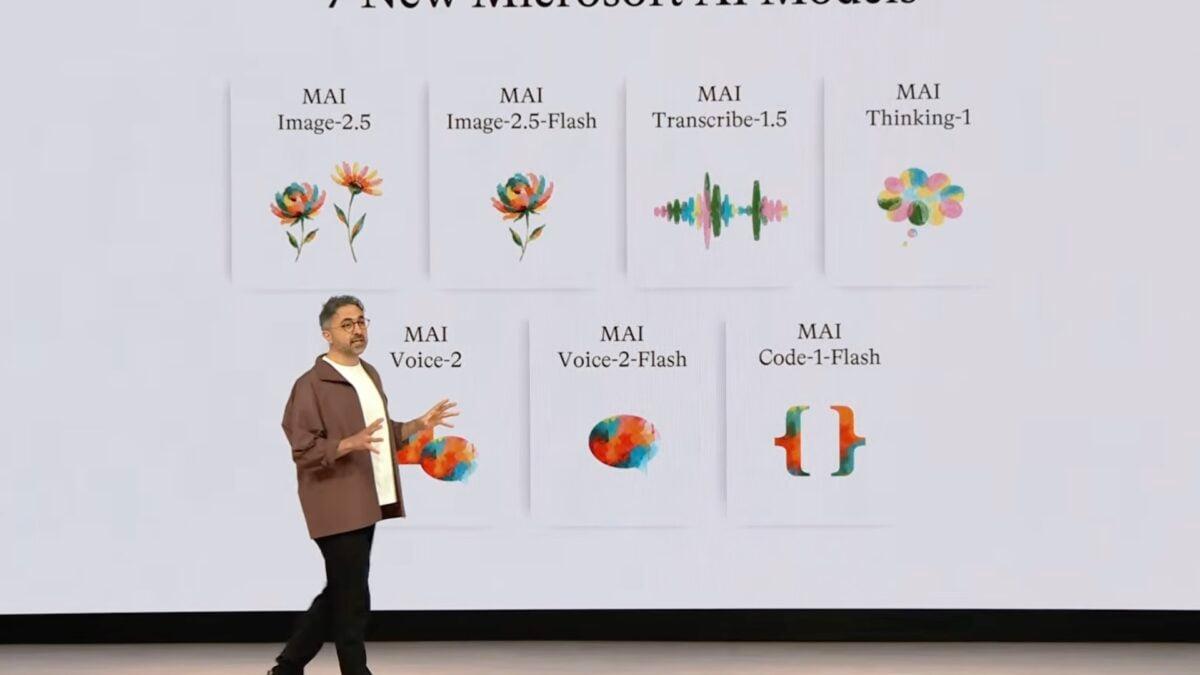
Source: Gizmodo
MAI-Code-1, Microsoft's inaugural code generation model, takes written descriptions and produces source code for applications and websites
4
. The model is integrated into GitHub Copilot and Visual Studio Code, targeting the booming AI coding market. Kyle Daigle, Microsoft's developer marketing chief and GitHub operating chief, described both models as "built for high efficiency and performance, but importantly, at a low-token cost"4
.
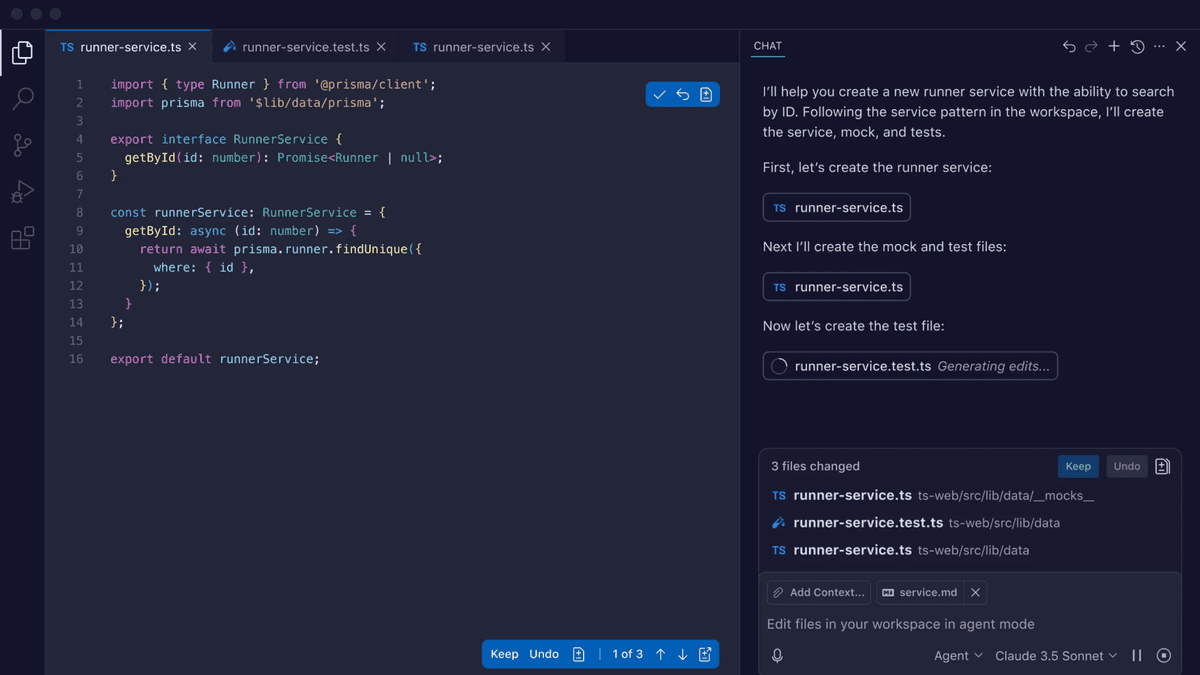
Source: TechRadar
Other models announced include MAI-Image 2.5 for text-to-image and image editing, MAI-Transcribe-1.5 which is "five times faster than competing models," and MAI-Voice-2 adding 15 new languages
3
. These Microsoft's new AI models represent a comprehensive push across multiple AI capabilities.The economic rationale behind Microsoft AI initiatives is stark. Suleyman told Bloomberg that Anthropic is "extremely expensive" and many customers are "urgently looking for alternatives"
5
. More bluntly, he stated: "We pay a lot of money to Anthropic, so our goal is to reduce and ultimately eliminate that cost"5
.This strategy to reduce reliance on OpenAI and other providers addresses a genuine crisis in enterprise AI spending. Companies like Uber burned through their entire 2026 AI coding budget in four months, introducing a $1,500 monthly cap per employee per tool
5
. Walmart similarly capped access to its internal AI assistant after usage exceeded expectations. For Microsoft, which invested $13 billion in OpenAI and $5 billion in Anthropic, building cheaper in-house AI models offers a way to protect margins while providing lower costs for developers4
.Microsoft claims that after refining models for consulting firm McKinsey, it outperformed OpenAI's GPT 5-5 with 10 times better cost efficiency
5
. The company has also discussed using in-house AI models with Adobe. By running models on Azure cloud infrastructure, Microsoft avoids paying third parties and can pass savings to developers.Related Stories
Microsoft faces significant challenges as it works to compete with OpenAI and Anthropic. The company is years behind on reasoning models; OpenAI began releasing them in fall 2024
1
. Suleyman acknowledged the gap, telling Benzinga that while Microsoft has "closed an enormous gap in six months," Anthropic has released two more advanced models since Opus 4.6, maintaining a lead of several months5
.The company is also navigating competition around AI agents and tools like OpenClaw, an open-source platform that has gained popularity in China and helped Apple sell Mac computers
2
. Microsoft announced it's making OpenClaw work well with Windows and promoting its own Copilot "super app" that integrates similar agent capabilities1
. OpenClaw creator Peter Steinberger made a surprise appearance at Build, announcing that the platform now runs on Windows with enhanced security for enterprise use.Microsoft also unveiled MDASH, an AI cybersecurity tool bringing together 100 AI agents to find exploitable bugs, positioned to compete with Anthropic's Claude Mythos Preview and OpenAI's cybersecurity offerings
1
. These frontier models and services target government and enterprise AI markets where Microsoft, OpenAI, and Anthropic are all competing aggressively. With Anthropic preparing an IPO potentially valued above $1 trillion, the stakes for market position have never been higher.Summarized by
Navi
[1]
[3]
[5]
02 Apr 2026•Technology

06 Nov 2025•Technology

12 Feb 2026•Business and Economy

1
Startups

2
Policy and Regulation

3
Policy and Regulation