Microsoft wants your spare PCs to team up on AI models too big for one machine


2 Sources
[1]
Microsoft's RDMA over USB4 will make running local AI models on multiple Windows 11 machines a lot easier
If you're into running local LLMs, there's always the problem that you need more hardware. While you can simply kit out your machine with bigger and beefier hardware, there's only so much you can do, especially in the current market. Add XDA on Google Add as Preferred Source Follow on Google
[2]
Microsoft Unveils RDMA Over USB4 For Windows 11, Combining Multiple PCs To Run Massive AI Models With Up To 4X Lower Latency
Microsoft has announced a new Windows 11 feature that could significantly expand the capabilities of local AI computing by allowing multiple PCs to combine their memory and GPU processing resources through ordinary USB4 connections. Called RDMA over USB4, the technology makes it possible to run
Share
Copy Link
Microsoft has announced remote direct memory access, or RDMA, over USB4 for Windows 11, a feature that lets several ordinary computers pool their memory and graphics power over USB4, the standard port on modern machines, to run AI models too large for any single machine
2
1
. If it works as described, developers could run large AI models locally on a cluster of consumer machines instead of buying dedicated AI servers2
.
Source: XDA-Developers
RDMA is a networking method datacenters use to let one computer read another computer's memory directly, skipping much of the back-and-forth ordinary networking requires. On Windows it currently means dedicated Ethernet or InfiniBand adapters, which consumer machines typically lack
1
. Microsoft combined the two, the report says, because those ports are already on almost every modern computer1
. Microsoft's blog frames the feature as a way to cut communication latency and combine machines to run large AI models without special adapters1
. In Microsoft's own measurements between two PCs, round-trip latency for small messages dropped to roughly 28 to 50 microseconds, millionths of a second2
1
. That is about four times lower than Ethernet over the same link2
1
.Three mini PCs, one 235-billion-parameter model
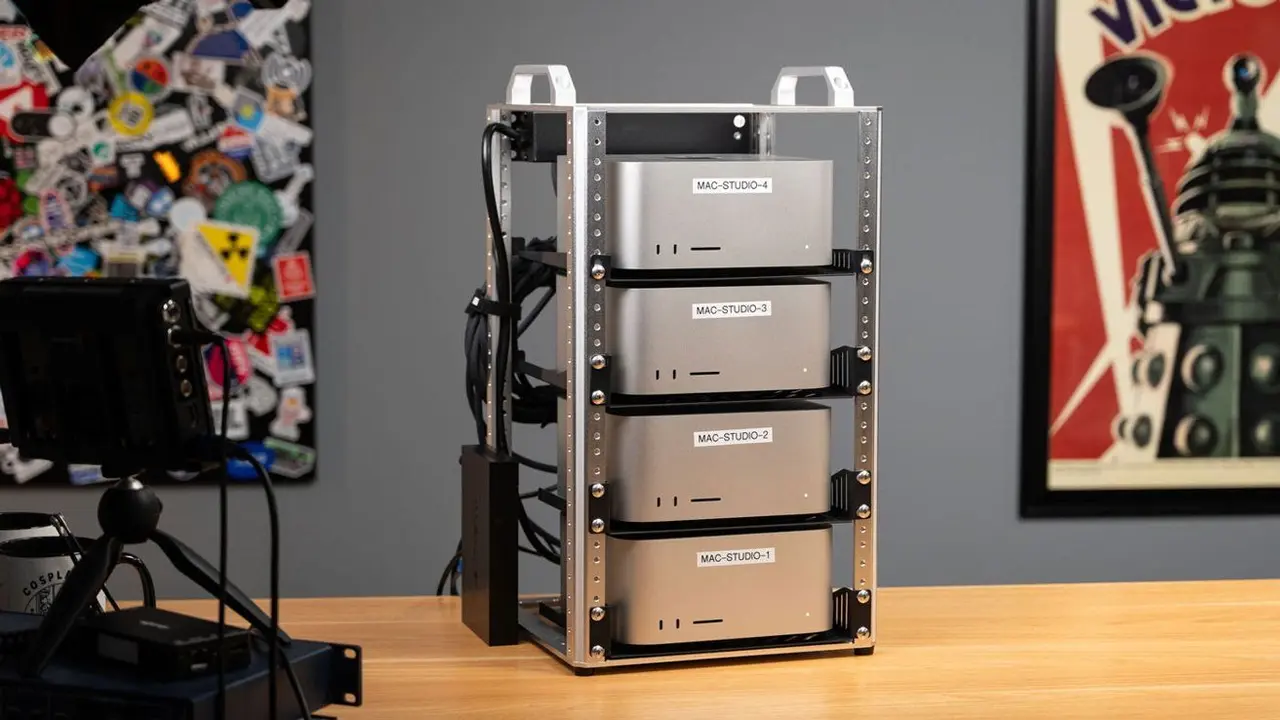
The headline demonstration pairs Microsoft with Advanced Micro Devices. Three mini PCs, each running a Ryzen AI Max+ 395 processor with Radeon 8060S graphics and 128 gigabytes of unified memory, were connected in a full mesh over 40 Gbps USB4
2
1
. Together they ran the 235-billion-parameter Qwen3 model at about 18.5 tokens per second, using 4-bit quantization2
1
. That model cannot fit in any one of those machines' 128 gigabytes of memory, which is the whole point of the demonstration2
.
Source: Wccftech
On its own setup, AMD reported faster results: about 22 tokens per second while generating text and 118 while processing the prompt
2
1
. All of these figures come from the companies' own measurements2
1
.Per one report, Intel has run its own demonstration as well
2
. Three, then four, computers built on Core Ultra Series 3 processors, each with 64 gigabytes of memory and Thunderbolt 4, were used2
. Running the 120-billion-parameter GPT-OSS-120B model, they managed about 49 tokens per second on three machines and 54 on four2
. That model cannot fit in a single 64-gigabyte system either2
.Getting it working is not simple
The hardware bar is low. Each machine needs one USB4 port for every other machine in the group, one cable per pair, plus enough combined memory and graphics power
1
. The setup is fussier. The machines must be wired in a full mesh where each connects to every other, and the links should run at 40 Gbps or faster2
1
. Each application must also explicitly support distributed execution through the NetworkDirect interface2
1
. Daisy-chaining the machines instead substantially degrades performance2
1
.It is disabled by default, and demands Registry edits and test signing before anything runs
2
1
. Test signing means temporarily disabling Secure Boot, and Microsoft recommends using dedicated development machines rather than a daily driver2
1
. Connections that fail do not retry on their own, so applications have to handle that themselves2
1
. Microsoft has also released an open-source NetworkDirect provider, along with a modified version of llama.cpp2
1
.The feature sits in an experimental Windows Insider build, and Microsoft has announced no release date
2
1
. The company has published the tools for developers who want to try it, and has not said when anyone else will get to2
1
.Related Stories
References
Summarized by

Navi
[1]
Related Stories
Microsoft tests AI features on Nvidia GPUs as Copilot+ exclusivity begins to fade
11 Jun 2026•Technology
Windows 11 Tests User Control Over Unified Memory Split for AI Workloads and Gaming
24 Aug 2026•Technology

NVIDIA and Microsoft Collaborate to Accelerate AI Development on Windows PCs
20 May 2025•Technology
Recent Highlights



Recent Highlights
Today's Top Stories










Don’t drown in AI news. We cut through the noise - filtering, ranking and summarizing the most important AI news, breakthroughs and research daily. Follow topics that matter to you and stay ahead.


