MIT's Bionic Knee Breakthrough: Integrating Prosthetics with Human Physiology


4 Sources
[1]
A bionic knee integrated into tissue can restore natural movement
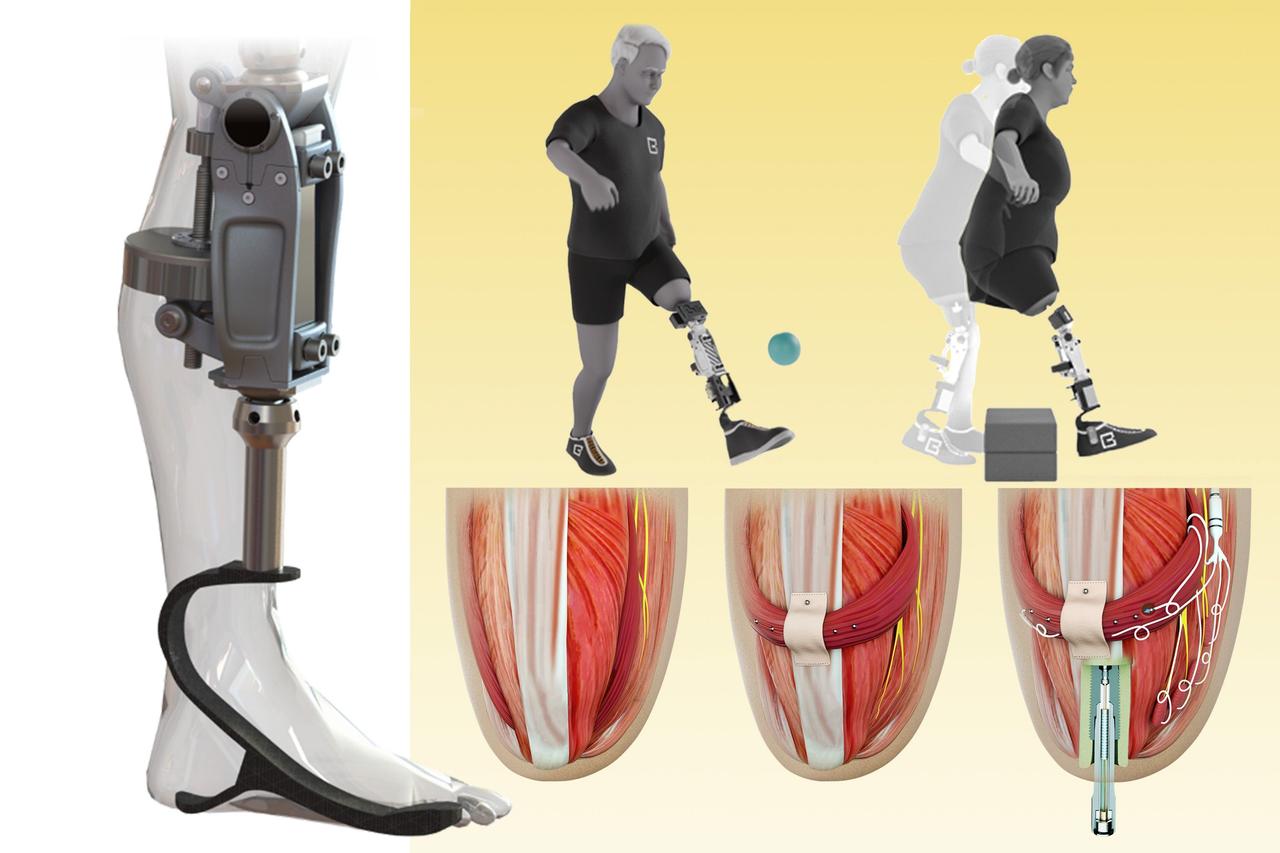
Caption: A subject with the osseointegrated mechanoneural prosthesis overcomes an obstacle placed in their walking path by volitionally flexing and extending their phantom knee joint. Control signals from their residual knee muscles are used to produce movement of the powered prosthetic knee that
[2]
New bionic knee connects directly with muscles and bone to feel more like the user's body
A study participant with the bone-integrated prosthesis dodges obstacles in their path (Image credit: MIT) A newly developed bionic knee could help people with above-the-knee amputations walk and climb with greater ease than they could with a traditional prosthesis. The new prosthesis, described
[3]
MIT's integrated bionic knee enables natural movement in amputees
The new bionic knee is directly integrated with the user's muscle and bone tissue (bottom row right), allowing for faster and more fluid motion than with a traditional prosthesis Researchers at the Massachusetts Institute of Technology (MIT) have developed a method to restore astoundingly natural
[4]
Bionic Knee Allows Better Movement For Amputees
By Dennis Thompson HealthDay ReporterFRIDAY, July 11, 2025 (HealthDay News) -- "Better. Stronger. Faster." Those words were written for TV's bionic "Six Million Dollar Man," but they could soon apply to everyday folks with above-the-knee amputations, a new study says. A new bionic knee allows
Share
Copy Link
MIT researchers have developed a revolutionary bionic knee that integrates directly with muscle and bone tissue, offering improved mobility and a greater sense of embodiment for above-knee amputees.
Revolutionary Bionic Knee Design
Researchers at the Massachusetts Institute of Technology (MIT) have developed a groundbreaking bionic knee that promises to significantly improve the lives of above-knee amputees. This innovative prosthesis, described in a recent study published in the journal Science, integrates directly with the user's muscle and bone tissue, offering superior mobility and a greater sense of embodiment compared to traditional prosthetic limbs
1
2
3
.
Source: MIT
Advanced Integration Techniques
The new bionic knee employs two key technologies:
-
Agonist-Antagonist Myoneuronal Interface (AMI): This surgical approach reconnects pairs of muscles that work in opposition, such as the hamstring and quadriceps, allowing them to communicate within the residual limb. This restoration of the natural muscle dynamics provides crucial sensory feedback, enabling more intuitive control of the prosthesis
1
3
. -
Enhanced Osseointegrated Prostheses for the Rehabilitation of Amputees (e-OPRA): This bone-integrated system involves implanting a titanium rod into the residual femur bone. The implant contains 16 wires that collect information from electrodes placed on the AMI muscles, facilitating more accurate signal transduction
1
2
.
Improved Functionality and Control
The combination of AMI and e-OPRA, termed the osseointegrated mechanoneural prosthesis (OMP), offers several advantages over traditional socket-based prostheses:
- Better stability and load-bearing capacity
- Enhanced mechanical control
- Reduced risk of skin infections associated with socket prostheses
- Improved sensory feedback for more natural movement
1
2
3
4
Clinical Study Results

Source: New Atlas
A small clinical study compared the performance of two subjects with the OMP system against those with only AMI surgery and those with neither AMI nor e-OPRA. The results were promising:
- OMP users demonstrated superior performance in tasks such as walking, bending the knee to specific angles, climbing stairs, and navigating obstacles
1
2
3
. - Participants reported a greater sense of ownership and agency over the prosthetic limb, indicating improved integration with their body image
2
3
.
Related Stories

Future Prospects and Challenges
While the results are encouraging, the bionic knee is not yet commercially available. Professor Hugh Herr, a senior author of the study and co-director of the K. Lisa Yang Center for Bionics at MIT, estimates that it may take about five years for the system to receive FDA approval through larger clinical trials
2
3
4
.Broader Impact on Prosthetic Technology
This development is part of a broader trend in creating more natural and intuitive prosthetic limbs. Recent innovations in the field include:
- An intricate unpowered prosthetic foot designed to replicate the bone structure of a real foot
- A prosthetic hand capable of gripping objects with appropriate pressure
3
As research in this area continues to advance, the line between artificial limbs and natural body parts may become increasingly blurred, offering hope for improved quality of life for amputees worldwide.
References
Summarized by

Navi
[2]
[4]
Related Stories
Revolutionary Algorithm Transforms Robotic Prosthetics to Restore Natural Movement and Prevent Secondary Health Issues
20 Nov 2025•Health

AI Co-Pilot for Bionic Hands Transforms How Amputees Control Prosthetics with Intuitive Grasping
09 Dec 2025•Health
Revolutionary AI-Powered Material Allows Amputees to Adjust Prosthetic Fit via Smartphone
27 Mar 2025•Health

Recent Highlights
1
Microsoft and Nvidia Launch Surface Laptop Ultra: A $2,599 AI-Ready PC With RTX Spark Chip
Technology

2
Trump Consulted Grok AI Before Ordering Venezuela Invasion and Capture of Nicolás Maduro
Policy and Regulation

3
Scientists Build AI Model That Reconstructs Images From Brain Scans in Record Time
Science and Research

Recent Highlights
Today's Top Stories






Don’t drown in AI news. We cut through the noise - filtering, ranking and summarizing the most important AI news, breakthroughs and research daily. Follow topics that matter to you and stay ahead.


