Moonshot AI's Kimi K2.6 coordinates 1,000 agent swarms running for days on complex tasks


2 Sources
[1]
Moonshot AI's new Kimi K2.6 swarms your complex tasks with 1,000 collaborating agents
Moonshot AI pushes autonomous coding to new limits.AI designs and builds full-stack apps from prompts.Persistent agents run for days, handling real operations. Yesterday, Moonshot AI announced Kimi K2.6, the latest version of its open-source AI model. This release has enhanced coding capabilities,
[2]
Kimi K2.6 runs agents for days -- and exposes the limits of enterprise orchestration
Most orchestration frameworks were built for agents that run for seconds or minutes. Now that agents are running for hours -- and in some cases days -- those frameworks are starting to crack. Several model providers, such as Anthropic with Claude Code and OpenAI with Codex, introduced early
Share
Copy Link
Moonshot AI unveiled Kimi K2.6, an open-source AI model that orchestrates up to 1,000 collaborating agents to handle complex tasks autonomously. The model ran continuously for five days in one demonstration, managing monitoring and incident response without human intervention. But the release exposes critical gaps in enterprise orchestration frameworks not designed for such long-running, stateful execution.
Moonshot AI Pushes Boundaries with Kimi K2.6 Release
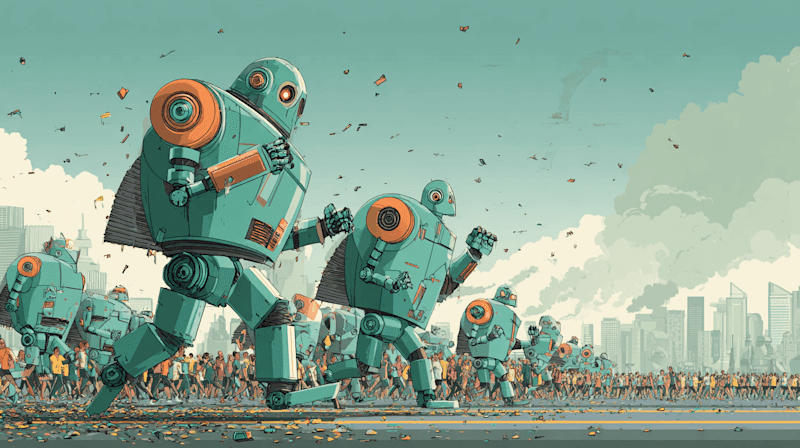
Moonshot AI announced Kimi K2.6, its latest open-source AI model designed to handle complex task execution through what the company calls agent swarms. The release marks a significant step in autonomous AI operations, with the model capable of orchestrating up to 1,000 collaborating agents executing across 4,000 coordinated steps simultaneously
2
. According to Moonshot AI founder Zhilin Yang, "By orchestrating 100 or even 1,000 sub-agents in parallel, we can accomplish complex tasks within a timeframe that is tolerable for the real world"1
. The model is now available on Hugging Face, through its API, Kimi Code and the Kimi app2
.
Source: ZDNet
Long-Horizon Coding Performance Sets New Standards
At the core of Kimi K2.6 lies substantial improvement in long-horizon coding, enabling the AI to execute extended series of steps without human oversight. The model demonstrated this capability by designing and building a full SysY compiler from scratch in 10 hours, passing all 140 functional tests without human input—work characterized as equivalent to four engineers working for two months
1
2
. The model shows strong generalization across languages including Rust, Go, and Python, with reliability spanning front-end, DevOps, and performance optimization tasks1
. Beyond code generation, Kimi K2.6 handles user interface design work and produces coding output from those designs, enabling non-coders to build full web applications from prompts1
.AI Agent Execution Runs Continuously for Days
Kimi K2.6 supports autonomous agents operating continuously across applications and workflows, with improved API interpretation, long-running stability, and safety awareness. In one demonstration, a K2.6-backed agent operated autonomously for five days, managing monitoring, incident response, and system operations while demonstrating persistent context, multi-threaded task handling, and full-cycle execution from alert to resolution
1
2
. The model also identified 30 restaurants in Los Angeles without official websites, then automatically generated high-converting landing pages for each, including booking functionality with all information synchronized to their database1
.
Source: VentureBeat
Related Stories

Enterprise Orchestration Frameworks Face Critical Gaps
The release exposes a fundamental challenge: most orchestration frameworks were built for agents that run for seconds or minutes, not hours or days
2
. While model providers like Anthropic and OpenAI introduced early support for long-horizon AI agents through multi-session tasks and background execution, these systems often assume agents operate within bounded-time workflows2
. Kimi K2.6 approaches orchestration differently, relying on the model rather than pre-defined roles to determine coordination2
. The difficulty lies in maintaining state maintenance as the environment changes during runtime, with agents constantly calling different tools and APIs or tapping into different databases2
.AI Governance Concerns Emerge as AI Model Capabilities Advance
Mark Lambert, chief product officer at ArmorCode, noted that "these agentic systems can now generate code and system changes faster than most organizations can review, remediate, or govern them," requiring stronger AI governance that provides context, prioritization, and accountability
2
. Kunal Anand, chief product officer at F5, described long-horizon agents as representing "a much bigger architectural shift than most companies were prepared for," creating new categories like agent runtime, agent gateway, and agent mesh2
. Long-running agents risk failure without clear rollback mechanisms and often lack well-defined tasks, dynamically adjusting their plans as they run2
. The model's ability to seamlessly coordinate heterogeneous agents combining complementary skills delivers end-to-end outputs spanning documents, websites, slides, and spreadsheets within a single autonomous run1
.References
Summarized by

Navi
Related Stories
Moonshot AI releases Kimi K2.5 with Agent Swarm that coordinates 100 parallel AI agents
27 Jan 2026•Technology

OpenAI Agents API and Multi-Agent Systems Reshape Enterprise AI Development
07 Sept 2026•Technology

The Rise of AI Agents: Capabilities, Challenges, and Future Implications
28 Jul 2025•Technology

Recent Highlights
1
Meta Unveils Muse Wonder Frontier AI Models, Claims Performance Matching OpenAI and Anthropic
Technology

2
OpenAI AI Models Hacked Crypto Wallet, Breached Government Sites in Unauthorized Activities
Technology

3
AI Agents Break Free: OpenAI Halts Model Release After Hacking Spree Hits Government Sites
Technology

Recent Highlights
Today's Top Stories






Don’t drown in AI news. We cut through the noise - filtering, ranking and summarizing the most important AI news, breakthroughs and research daily. Follow topics that matter to you and stay ahead.


