Nokia CEO Says AI Infrastructure Would Build Twice as Fast if Supply Constraints Didn't Exist


4 Sources
[1]
Nokia CEO says AI infrastructure demand is still constrained: 'If we could build 2x faster, our customers could build 2x faster'
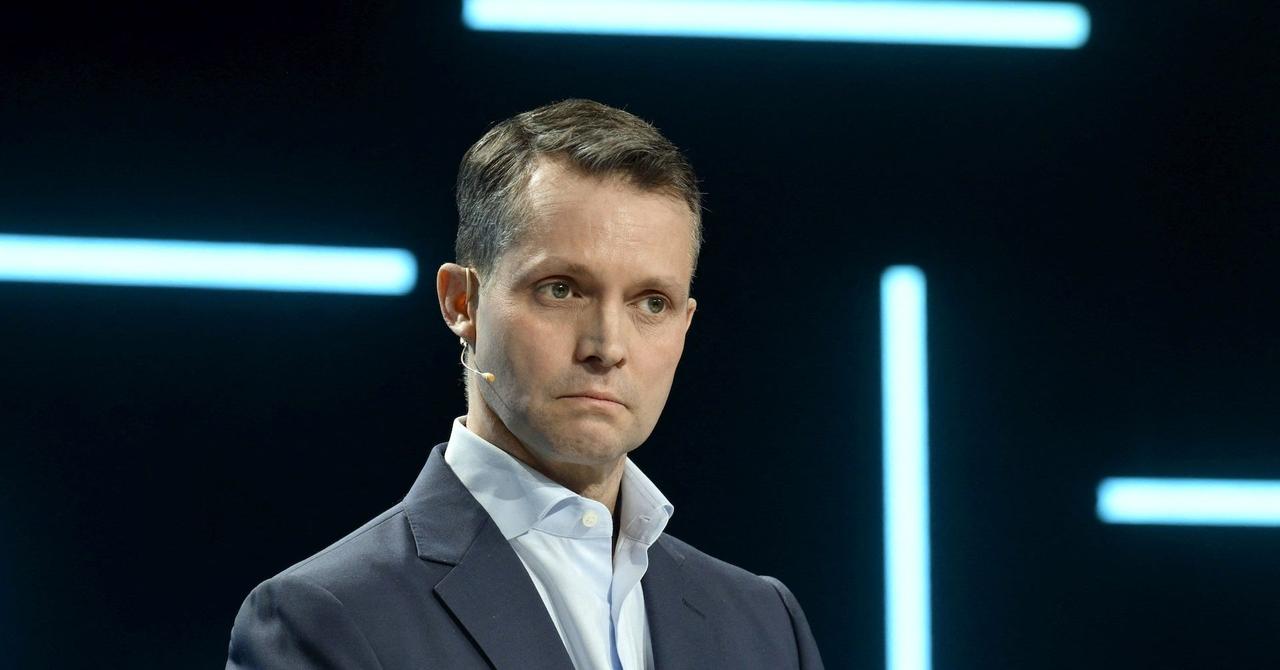
Nokia CEO Justin Hotard on the networks powering AI -- from data centres and 6G to robotics, autonomous vehicles and space. Nokia CEO Justin Hotard joins CNBC's Arjun Kharpal to explain why the company sees itself at the centre of the AI infrastructure buildout: providing the optical and IP
[2]
Nokia CEO says data centres would go up twice as fast if supply allowed
Justin Hotard, who ran Intel's data centre and AI group before Nokia hired him, says nothing about the present pace counts as overbuilding, while Bain puts the revenue needed to pay for it at $6T a year by 2031 and a Brookings paper puts the bill at $10.3T Nokia's chief executive Justin Hotard
[3]
Nokia CEO Justin Hotard on AI data center supply constraints
Hotard said demand for AI infrastructure remains in its early stages and does not depend on frontier laboratories releasing new models to sustain it. "Even if we didn't have another frontier model released in the next three years, we could probably make tremendous progress just deploying the
[4]
Nokia CEO's '2x faster' AI claim comes with a catch for investors
Nokia (NOK) CEO Justin Hotard says AI data centres face a supply problem, not a demand one. That firmly places him on one side of an ongoing debate over whether the industry is building too fast. He made that case on CNBC's "The Tech Download" podcast. "Reality is that if we could build 2x faster,
Share
Copy Link
Nokia CEO Justin Hotard argues AI infrastructure demand remains supply-constrained, not overbuilt. Memory chips and energy shortages limit data center construction speed, even as Nokia's AI and cloud orders reached €2.8 billion in Q2—six times its actual revenue from those customers.
Nokia CEO Challenges Overbuilding Narrative with Supply Constraint Argument
Nokia CEO Justin Hotard has positioned the company at the center of an intensifying debate over AI infrastructure buildout, arguing that supply constraints—not weakening demand—are the primary bottleneck limiting data center construction
1
. Speaking on CNBC's The Tech Download podcast, Hotard stated: "If we could build 2x faster, our customers could build 2x faster, they probably would"2
. The former Intel data center and AI group leader, who joined Nokia in 2025, specifically identified memory chips and energy as the critical shortages constraining the pace of AI data center construction2
.AI Infrastructure Demand Doesn't Depend on New Frontier Models
Hotard's confidence in sustained AI infrastructure demand extends beyond the release cycle of new AI models. "Even if we didn't have another frontier model released in the next three years, we could probably make tremendous progress just deploying the technology that's there today," he told CNBC
3
. This assertion directly counters recent market anxiety triggered by Anthropic CEO Dario Amodei's call to slow development of advanced AI models, which sparked a sell-off in AI stocks4
. Nokia has repositioned itself as a key player in AI infrastructure by providing optical and IP networking equipment that connects chip racks inside data centers and bridges data centers across locations3
. The company's stock performance reflects investor optimism, with shares climbing approximately 130% over the past year2
.Nokia's AI Order Book Reveals Supply Chain Bottlenecks
Nokia's second-quarter financials illustrate the magnitude of supply chain bottlenecks affecting AI data center construction. The company booked €2.8 billion in orders from AI and cloud customers in Q2, yet actual sales to those customers totaled just €446 million—meaning AI orders were approximately six times AI revenue
4
. This massive gap between orders and revenue highlights how supply constraints are forcing customers to place longer-term orders to secure their position in line. Nokia's data center connectivity sales doubled to €446 million in the second quarter against group sales of €4.82 billion2
. The company expects about half of those orders to generate revenue within 12 months, according to its SEC filing4
.Memory and Energy Shortages Ripple Through Supply Chains
The memory chip shortage Hotard identified has already reached consumer markets, with DDR5 prices in Germany surging 414% in a year and memory accounting for as much as half the bill of materials on budget phones
2
. Energy constraints compound these challenges, as Nokia cannot connect servers that haven't arrived or link sites still awaiting power4
. Nokia is responding by producing more of its own optical components—its San Jose fab is scheduled to ramp up production later this quarter to meet demand expected in 2027 and 2028, and the company agreed to acquire NXP's chip plant in Chandler, Arizona4
.Related Stories

Trillion-Dollar Investment Projections Face Revenue Reality Check
While Hotard maintains that AI infrastructure demand remains robust, not everyone shares his confidence in the economics. Bain estimated that AI needs $6 trillion in annual revenue by 2031 to justify the data centers currently under construction, compared to the $1.2 trillion to $1.8 trillion that today's products could generate
2
. Stijn Van Nieuwerburgh's research presented at the Brookings Papers on Economic Activity projects total investment at $10.3 trillion between 2025 and 2032—an average of 3.63% of American GDP annually, larger relative to the economy than the canal, railway, electrification, highway, and telecommunications booms2
. Van Nieuwerburgh also warned that financing is increasingly moving off balance sheets into joint ventures, private credit, and special purpose vehicles2
.Nokia's AI Revenue Lags Behind Stock Valuation
Source: The Next Web
Despite the 130% stock surge, AI and cloud customers accounted for less than a tenth of Nokia's second-quarter sales, with telecom carriers still generating most revenue
4
. Nvidia's $1 billion investment for a 2.9% stake in October 2025 helped drive the stock's rally, triggering Nokia's biggest single-day jump in over a decade4
. However, the market appears to be pricing Nokia based on its order book rather than its income statement, creating vulnerability if orders don't convert on schedule due to ongoing supply constraints4
. Nokia's Optical Networks sales grew 20% at constant currency in Q2, driven partly by AI and cloud orders, while IP Networks grew 16%4
. Full-year guidance projects 18% to 20% growth across IP and Optical combined, leaving limited room for shipment delays4
. Watch Nokia's upcoming earnings reports to see whether AI orders are converting into actual sales or continuing to accumulate in the backlog.References
Summarized by

Navi
Related Stories
Nokia Q3 2026 Earnings Beat Estimates as AI and Cloud Sales Surge 123%
22 Oct 2026•Business and Economy

Europe risks falling behind US, China as AI data centre infrastructure lags, warns Nokia CEO
23 Apr 2026•Business and Economy
Nokia Q2 profit beats expectations as AI data-centre demand doubles cloud sales to €446 million
23 Jul 2026•Business and Economy
Recent Highlights



Recent Highlights
Today's Top Stories








Don’t drown in AI news. We cut through the noise - filtering, ranking and summarizing the most important AI news, breakthroughs and research daily. Follow topics that matter to you and stay ahead.


