Nokia launches AI Networking Innovation Lab to shape next-generation data center infrastructure


2 Sources
[1]
Nokia launches AI networking innovation lab to accelerate AI native data center infrastructure
AI is rapidly moving beyond chatbots and copilots into a far larger transformation centered on infrastructure. As enterprises, hyperscalers and governments race to scale AI capabilities, the focus is shifting towards the foundational systems required to support massive AI workloads. In this
[2]
Nokia Targets AI Infrastructure Market With New Innovation Lab - Nokia (NYSE:NOK)
The new facility is aimed at accelerating co-innovation with AI and cloud partners and advancing next-generation networking solutions for AI infrastructure. The lab will act as a collaboration hub focused on developing advanced AI networking technologies, architectures, and ecosystems with
Share
Copy Link
Nokia has opened an AI Networking Innovation Lab in Sunnyvale, California, positioning itself at the intersection of AI infrastructure and networking. The facility will serve as a co-innovation hub with partners including AMD, Lenovo, Supermicro, Keysight Technologies, and WEKA to develop AI-native networking solutions for large-scale AI training and real-time inference workloads.
Nokia Bets on AI Networking as Infrastructure Bottleneck
Nokia has launched an AI Networking Innovation Lab in Sunnyvale, California, marking a strategic shift toward becoming a foundational player in the AI infrastructure market
1
. The facility positions the telecommunications giant at the intersection of AI, cloud infrastructure, and next-generation data centers, reflecting an industry-wide recognition that networking intelligence will be as critical as compute power in scaling AI capabilities[1](https://economictimes.indiatimes.com/ai/ai-insights/nokia-l aunches-ai-networking-innovation-lab-to-accelerate-ai-native-data-center-infrastructure/articleshow/131245421.cms).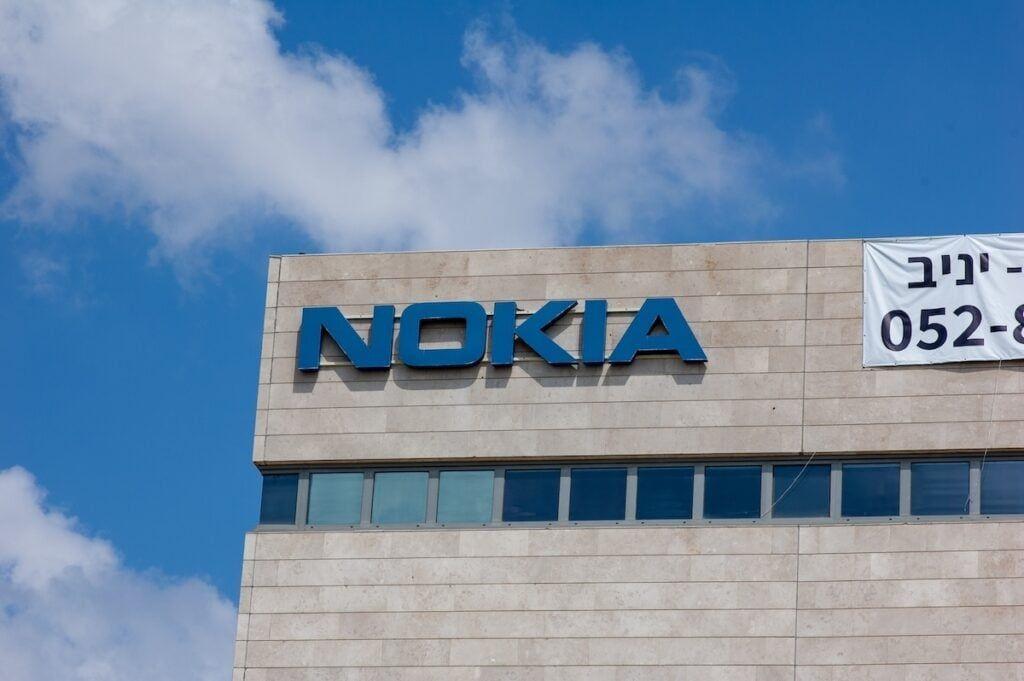
Source: Benzinga
The Innovation Lab will operate as both a testing ground and collaboration hub where partners can design, validate, and optimize AI-native networking architectures under real-world conditions
1
. Early technology collaborators include AMD, Lenovo, Supermicro, Keysight Technologies, WEKA, Everpure, and Nscale, among others2
.Why AI Native Data Center Infrastructure Matters
Large-scale AI training and real-time inference demand extremely high-bandwidth, ultra-low latency, congestion control, and seamless synchronization—requirements that traditional cloud-era data center infrastructure was not built to handle
1
. As enterprises, hyperscalers, and governments race to scale AI workloads, networking is emerging as one of the industry's most critical bottlenecks1
.
Source: ET
Unlike traditional enterprise systems, AI environments require highly optimized data movement across GPUs, storage systems, and distributed compute clusters. Even small networking inefficiencies can reduce GPU utilization, slow training cycles, and significantly increase operational costs
1
. The lab brings together AI networking protocols, switching silicon and hardware platforms, plus new architectural concepts, with joint validation across a partner ecosystem2
.Strategic Positioning in Open AI Ecosystems
Nokia's strategy reflects a broader industry push toward open and interoperable AI ecosystems. The company emphasizes standards-driven architectures and multi-vendor compatibility, positioning itself against excessive dependence on closed AI infrastructure stacks
1
. This approach matters for enterprises seeking flexibility in building AI-native networking architectures without vendor lock-in.Historically known for telecommunications infrastructure, Nokia is reframing its identity as a critical enabler of AI-era connectivity
1
. Its focus on validated AI networking designs, deployment testing, and ecosystem collaboration signals a long-term ambition to control part of the foundational infrastructure powering the next generation of AI1
.Related Stories

What This Means for the AI Infrastructure Market
As global AI adoption accelerates, companies controlling the infrastructure layer may ultimately hold the greatest strategic advantage. Nokia's move suggests that the future of AI will not be defined solely by models or chips, but by the networks capable of connecting them at scale
1
. The lab aims to help shape future data center networking by advancing AI networking technologies, architectures, and ecosystems with multiple partners2
.For organizations building AI capabilities, watch how validated networking solutions from this collaboration affect deployment timelines and operational efficiency. The emphasis on low-latency, high-bandwidth solutions could become a differentiator as AI models continue to scale and distributed inference becomes standard practice.
References
Summarized by

Navi
[1]
Related Stories
Nokia Restructures Around AI Networks with $1 Billion Nvidia Partnership
20 Nov 2025•Business and Economy
Nokia Partners with CoreWeave to Power Hyperscale AI Cloud Infrastructure
16 Sept 2024

Nokia CEO Says AI Infrastructure Would Build Twice as Fast if Supply Constraints Didn't Exist
06 Oct 2026•Business and Economy

Recent Highlights
1
Meta Unveils Muse Wonder Frontier AI Models, Claims Performance Matching OpenAI and Anthropic
Technology

2
IMF Report Warns AI Market Correction Could Spark Global Financial Crisis With $1.4T at Risk
Business and Economy

3
OpenAI Releases 722 AI-Generated Math Solutions, Triggering Existential Crisis in Mathematics
Technology

Recent Highlights
Today's Top Stories








Don’t drown in AI news. We cut through the noise - filtering, ranking and summarizing the most important AI news, breakthroughs and research daily. Follow topics that matter to you and stay ahead.


