Nomagic deploys AI brain in warehouse robots, halves human intervention in live operations


2 Sources
[1]
Nomagic puts an AI brain into live warehouse robots
Nomagic, a Warsaw-based warehouse robotics firm, says it has put a vision-language-action model into live customer operations and roughly halved the rate at which its robots stall for human help. Its new AI lab, run by a former Google DeepMind researcher, is betting on mastery before the industry's
[2]
Nomagic AI lab led by former Google DeepMind researcher claims success with 'AI brain' for robots | Fortune
"Embodied AI" and "physical intelligence" are all the rage with Silicon Valley investors these days. The idea is that AI's next frontier will be systems that don't just use software but can take action in the real world through robotic devices, from self-driving cars to humanoid robots. Many
Share
Copy Link
Warsaw-based Nomagic has deployed a vision-language-action model into live warehouse operations with paying customers, cutting robot-caused human interventions by roughly half. The company's new AI lab, led by former Google DeepMind researcher Markus Wulfmeier, is pursuing task-specific mastery before generality—a stark contrast to the industry's race toward general-purpose robot brains.
Nomagic Puts AI Brain Into Live Warehouse Robotics Operations
Nomagic, a Warsaw-based warehouse robotics firm, has deployed a vision-language-action model into live customer operations, achieving what most robot labs are still demonstrating in controlled settings
1
. The company reports that its VLA model has roughly halved the rate at which its robots stall and require human intervention, marking a significant step forward in autonomous warehouse operations2
. The firm maintains European headquarters in Warsaw and a U.S. base in Sandy Springs, Georgia.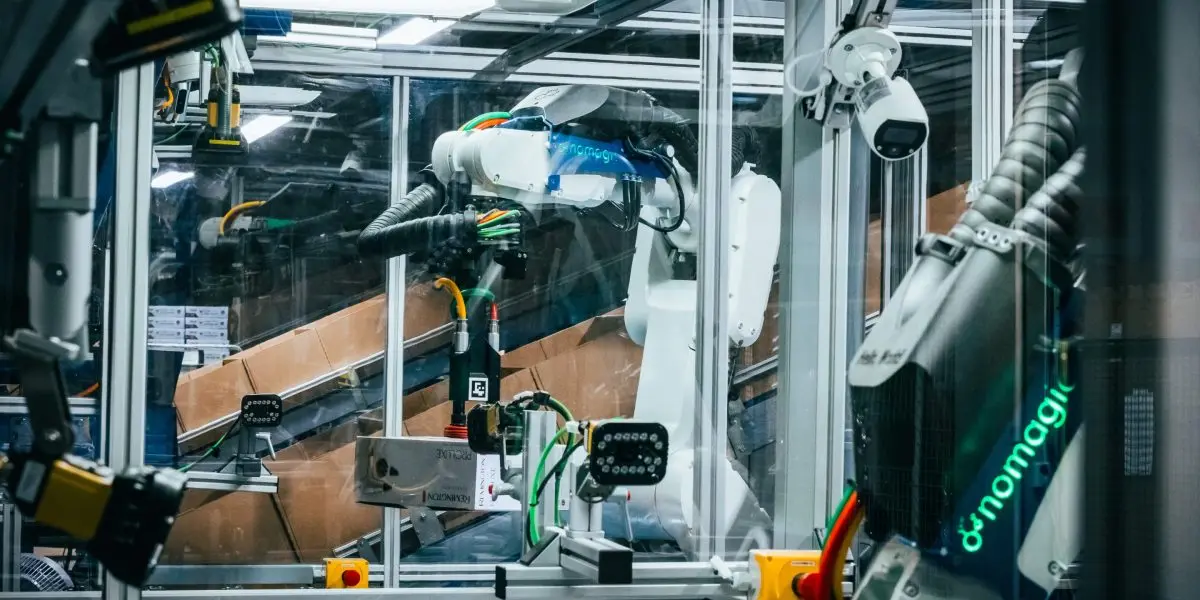
Source: Fortune
Earlier this year, Nomagic established an AI research lab and hired Markus Wulfmeier, a former Google DeepMind researcher and core member of the Gemini Robotics team, as chief scientist
1
. A vision-language-action model combines the ability to see objects, read plain-language instructions, and then act—capabilities that many labs are pursuing for embodied AI applications.Mastery Before Generality: A Different Approach to AI-Driven Robotics
Nomagic's strategy diverges sharply from the prevailing industry approach. While most companies race to build general-purpose robot brains that can drop into any machine, Nomagic runs the logic backwards
1
. The company aims for models that nail one task out of the box, then builds towards a general system. "Most of our community is racing to build the most general robot brain," Wulfmeier told Fortune. "We're betting that the harder part is actual mastery and that it has to be earned in real deployments first"1
.This reasoning rests on the long tail problem that has slowed self-driving cars. Training in simulation or by remote control gets a model to roughly 80 per cent accuracy, but in warehouse robotics, that threshold is insufficient
1
. If a robot needs a human once an hour, the economics collapse. The company acknowledges that general-purpose AI models perform significantly below human-level accuracy on each task right out of the box2
.Wrapping VLA Models in Safety Harnesses for Live Production Environment
Nomagic admits its VLA model is not perfect. "Our VLAs aren't at 99.9% success on their own yet," the company stated, adding that no rival's deployed VLAs are either
1
. To bridge this gap, the company wraps the model in older "classical" software that catches errors and enforces safety. "The bar in the physical world is high: 99.9% isn't a marketing number, it's the cost of being allowed in the building," said co-founder and chief executive Kacper Nowicki. "So we built a harness that clears it from day one, while the AI inside keeps getting better"1
.The company's edge comes from data generated by its deployed fleet, which makes millions of successful picks each month. Two million picks come from fashion platform Zalando alone
1
. Nomagic trains its VLAs on this live stream of operational data, not on simulations, allowing the AI brain to learn from real-world edge cases.Related Stories
First Deployment Shows Tangible Results at Brack.Alltron
The first VLA deployment runs at Brack.Alltron, Switzerland's second-largest e-commerce platform
1
. Founder Roland Brack confirmed the shift was real: "Today, we are seeing robots that truly understand their environment. This intelligence allows us to run autonomous shifts through nights and Sundays"1
. By targeting the most common edge cases where robots get stuck and call for human assistance, Nomagic has achieved measurable improvements in live customer operations2
.The deploy-first stance marks a real contrast with labs chasing general-purpose humanoids and raises the stakes in the race to automate Europe's warehouses. Co-founder Tristan d'Orgeval emphasized this approach: "We didn't build a lab and then go hunting for a problem. The order matters. It's what separates a demo from a business"
1
. As the company continues to reduce robot stalls and improve operational efficiency, the industry will be watching whether mastery-first proves more viable than the generality-first approach dominating Silicon Valley's embodied AI investments.References
Summarized by

Navi
[1]
Related Stories
AI2 Unveils MolmoAct: Open-Source AI Model Revolutionizes Robot Spatial Reasoning
13 Aug 2025•Technology

Alibaba unveils AI models for robots as China shifts focus to physical AI and autonomous systems
16 Jun 2026•Technology

Skild AI Unveils Groundbreaking 'Skild Brain' Model for Multi-Purpose Robots
30 Jul 2025•Technology
Recent Highlights
1
Meta Unveils Muse Wonder Frontier AI Models, Claims Performance Matching OpenAI and Anthropic
Technology

2
IMF Report Warns AI Market Correction Could Spark Global Financial Crisis With $1.4T at Risk
Business and Economy

3
OpenAI Releases 722 AI-Generated Math Solutions, Triggering Existential Crisis in Mathematics
Technology

Recent Highlights
Today's Top Stories








Don’t drown in AI news. We cut through the noise - filtering, ranking and summarizing the most important AI news, breakthroughs and research daily. Follow topics that matter to you and stay ahead.


