Jensen Huang Projects Nvidia Chip Sales to Double in 2027 Amid Surging Global AI Demand


6 Sources
[1]
Jensen Huang says Nvidia will sell twice as many chips next year
* Nvidia CEO Jensen Huang said on Thursday that his company will double the number of chips it sells next year. * "I expect Nvidia to sell twice as many chips as this next year as we do this year," Huang told the media before a summit with the U.K.'s King Charles III in Scotland. * In addition to
[2]
Nvidia's Huang expects to sell twice as many chips next year
His company's formal guidance is 70% revenue growth, with doubling named only as what supply would allow, and Europe's gigafactories need 100,000 chips each from the same order book Jensen Huang told reporters at King Charles III's AI summit in Scotland that he expects to sell twice as many chips
[3]
Jensen Huang forecasts Nvidia chip sales to double in 2027
The Nvidia CEO made the projection at a summit convened by King Charles III in Scotland, citing AI demand across industries and economies Nvidia $NVDA CEO Jensen Huang forecast on Thursday that the company will sell twice as many chips next year as it does this year, pointing to AI investment
[4]
Nvidia CEO Jensen Huang Expects Chip Sales To Double Next Year as He Downplays AI Slowdown Calls: 'When a
Nvidia Corporation (NASDAQ:NVDA) CEO Jensen Huang expects the company to double its chip sales in the coming year. "I expect Nvidia to sell twice as many chips as this next year as we do this year," Huang said at a summit with King Charles III in Scotland on Thursday, CNBC reported. He attributed
[5]

Huang just doubled his chip forecast and blocked a regulator
Chief executives get two microphones. One is bolted to an earnings call, where every number carries legal weight and a team of lawyers reads it first. The other is a hallway, a stage, or a scrum of reporters, where the same person can say almost anything. Nvidia (NVDA) has used both for three
[6]

Jensen Huang expects Nvidia chip sales to double next year
Jensen Huang, Nvidia's chief executive, expects the company to sell twice as many chips next year as this year, fueled by the global acceleration in investment in artificial intelligence. The forecast comes as Nvidia is targeting 70% growth for its fiscal year ending in January 2028, which would
Share
Copy Link
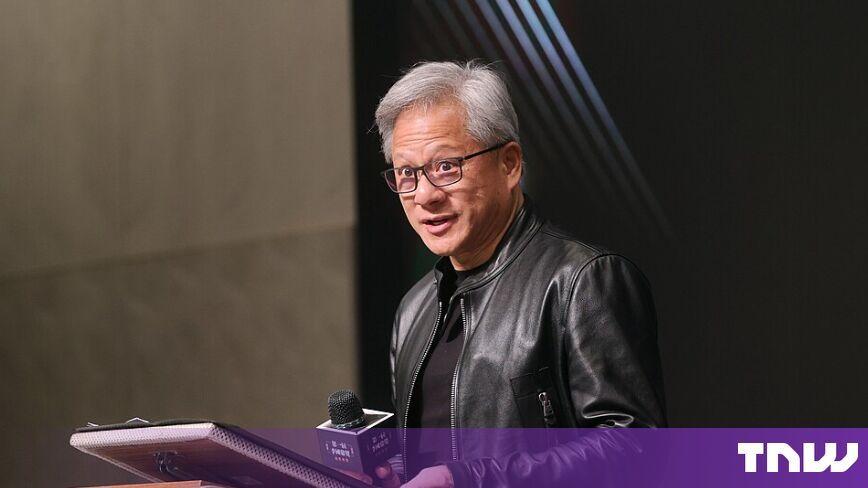
Nvidia CEO Jensen Huang announced at King Charles III's AI summit in Scotland that the company expects to sell twice as many chips next year. The bold projection exceeds Nvidia's formal 70% revenue growth guidance and signals continued AI adoption across industries despite supply constraints and margin pressures.
Nvidia CEO Doubles Down on Chip Sales Forecast
Jensen Huang told reporters at an AI summit convened by King Charles III in Scotland that Nvidia expects to sell twice as many chips next year compared to this year
1
. The projection significantly exceeds Nvidia's formal guidance issued last month, which called for 70% revenue growth in the fiscal year ending January 2028, or roughly $673 billion3
. "The reason for that is because AI has so much contribution to the benefits of different industries, different economies, and you can see that in almost every single country that we're in, people want to invest in AI," Huang explained1
.
Source: The Next Web
The gap between unit volume doubling and 70% revenue growth reveals important margin dynamics. If chip units double while revenue grows 70%, average revenue per chip would fall by roughly 15%
5
. Finance chief Colette Kress previously indicated that gross margin will decline to 71% to 72% in the fourth quarter of fiscal 2027, partly due to memory prices5
. The margin trough arrives before the projected unit doubling materializes.Supply Constraints Meet Growing Global Demand for AI
Nvidia does not disclose total chip sales volumes, but the company's portfolio extends well beyond its flagship data center GPUs like Blackwell and Rubin
1
. The chipmaker produces central processors, switch chips, optical networking chips, laptop processors, chips for robotics and automotive applications, and the processor powering Nintendo's Switch 2 gaming console3
. Huang previously disclosed that Nvidia shipped 6 million Blackwell GPUs in four quarters1
.Kress noted during the company's Q2 earnings call that Nvidia remains supply constrained, stating that revenue could double if sufficient supply existed
2
. Nvidia posted $96.2 billion in revenue for the quarter ending July 26, more than double the same period last year, and guided to $108 billion for the current quarter2
. The company achieved a 75% gross margin in the second quarter5
.AI Infrastructure Spending and Europe's Position in the Queue
Huang anticipates AI infrastructure spending will reach $3 trillion to $4 trillion by 2030
4
. Europe's plans for up to seven AI gigafactories complicate the supply picture. The European Commission has budgeted approximately EUR 30 billion total, with roughly EUR 1 billion of public funding committed2
. Each gigafactory requires around 100,000 chips, four times what a standard AI factory holds2
.Construction on the first gigafactory starts in 2027, with sites expected to become operational from 2028
2
. Seventy-seven proposals came in from 16 member states across 60 sites2
. Huang's projected doubling occurs before any European gigafactory switches on, raising questions about order book priorities. Nvidia takes about EUR 1 billion in data center revenue in a day2
.Related Stories
AI Safety Takes Center Stage at Scotland Summit
Huang joined representatives from Google DeepMind, OpenAI, and Anthropic at the Scotland summit to address AI safety, a subject gaining urgency following warnings that the most advanced AI systems have grown beyond human control
3
. King Charles III pressed executives, stating "we need sufficient means of control before it is all too late"5
."When a product is not safe, we should hold it back and keep engineering it," Huang said
1
. He argued that AI should not be regulated like social media because it functions as underlying technology rather than a consumer product2
. Huang's position assigns safety responsibility to individual companies rather than coordinated industry pauses. The Scotland appearance came days after President Donald Trump phoned into the All-In Summit in Los Angeles, dismissing AI safety concerns as "a hoax" and telling Huang "I'm with you all the way"3
.Market Response and Competitive Landscape
Nvidia shares rose as much as 2.8% in Thursday trading in New York and are up about 17% this year
2
. The company carries a market value above $5 trillion5
.
Source: Benzinga
Huang recently described Nvidia as the "World's First and Only Growth Value Stock," positioning its expanding AI platform and broad customer base to capture the next phase of global AI infrastructure spending
4
.Competition intensifies as Huawei unveiled over 10 new AI chipsets, challenging Nvidia, AMD, and Intel in the global AI infrastructure market
4
. Huang emphasized that rental prices for Nvidia's older H100 GPUs continue climbing, reinforcing his view that "NVIDIA compute is fungible, durable and highly rentable"4
. The divergence between Huang's public projections and formal guidance creates a pattern investors must navigate as AI adoption across industries accelerates while margin pressures build.References
Summarized by

Navi
[2]
[4]
[5]
Related Stories
Nvidia Bets Big: $99B in Equity Investments Drive 70% Revenue Growth Forecast Amid Debate
07 Sept 2026•Business and Economy

AMD's Data Center Revenue Doubles to $6.7 Billion as AI Chips Drive Growth, Gaming Sales Drop 31%
05 Aug 2026•Business and Economy

Nvidia's Q2 Sales Expected to Double, but Investor Expectations Remain High
26 Aug 2024

Recent Highlights



Recent Highlights
Today's Top Stories






Don’t drown in AI news. We cut through the noise - filtering, ranking and summarizing the most important AI news, breakthroughs and research daily. Follow topics that matter to you and stay ahead.


