Nvidia DSX POD Slashes AI Factory Deployment From 6 Months to Just 14 Days With Vera Rubin Racks


10 Sources
[1]
Nvidia's grand plan for speeding up datacenter deployments: AI trailer parks
Tens of thousands of Nvidia GPUs sit idle in Meta's Prometheus supercluster, just waiting for a failure 14 hours ago Datacenters are taking too long to bring online to fill the demand of the AI boom. So starting in 2027, Nvidia and its partners will offer its Vera Rubin rack systems fully
[2]
Nvidia announces plug and play Vera Rubin racks that can be shipped on a truck
* Nvidia's new DSX Pod AI Factory packages seven Vera Rubin AI racks in a shipping container designed to be transported by truck. * All the cabling and liquid cooling for the Pod are assembled at the factory. * Nvidia did not disclose a price; analysts estimate a single Vera Rubin rack can cost
[3]
Nvidia's AI factory to slash deployment time from 6 months to just 14 days
Liquid-cooled AI PODs claim to save 54 million liters of water daily * Nvidia's DSX POD aims to cut AI infrastructure deployment to 14 days * Factory-built containers move major AI data center assembly away from deployment sites * Vera Rubin systems form the computing foundation of Nvidia's DSX
[4]
NVIDIA Introduces DSX POD AI Factories to Accelerate Europe's Infrastructure Deployment
Factory-Built With a Global Ecosystem Including Bull, Dell Technologies, HPE, Lenovo, Schneider Electric and Vertiv, the New Reference Design Speeds Infrastructure Deployment From Months to Weeks, Accelerating Time to First Production Tokens * NVIDIA introduces DSX POD, a reference design for
[5]

Nvidia is unveiling a container AI factory as neocloud stocks slide
Nvidia says its DSX POD cuts AI data center deployment time from six months to as little as 14 days, with deliveries set for early 2027 Nvidia $NVDA introduced a reference design on Wednesday for AI factories built inside modular containers, a product the company said cuts deployment time at a
[6]
Nvidia's DSX POD containerized AI data centers can deploy in 14 days
Partners including Dell, HPE and Foxconn will build the Vera Rubin units, with deliveries expected to start in early 2027 Nvidia $NVDA on Wednesday introduced DSX POD, a reference design for Vera Rubin AI data centers that partners build inside modular containers, cutting deployment time at a
[7]

Nvidia CEO's new plan could dramatically reshape the AI race
Jensen Huang no longer talks about AI like a software story. Speaking in Berlin on October 21, the Nvidia chief told the crowd that AI has become a manufacturing industry, and he pitched the company's hardware as the machinery behind it. The timing is interesting. Nvidia held up better than most
[8]
Vertiv, Nvidia target 10-week cut in AI power, cooling setup
Vertiv (VRT) says a new approach developed with Nvidia could cut the time required to design and deploy power and cooling infrastructure for an AI data center from about 120 days to 48 days. The company supplied the electrical and cooling equipment that keeps high-density data centers running.
[9]

NVIDIA DSX Pod: AI Data Centers Ready in 14 Days
NVIDIA has unveiled its DSX Pod AI Factory, a container-sized system with seven Vera Rubin racks, factory-installed cabling and liquid cooling. It targets AI data center deployment in 14 days, with initial deliveries planned for early 2027. NVIDIA announced its DSX Pod AI Factory on Wednesday,
[10]

NVIDIA Introduces DSX POD Reference Design For Complete Vera Rubin AI Factories
NVIDIA introduced DSX POD, a reference design for complete NVIDIA Vera Rubin AI factories built by partners inside modular containers, integrated and validated before delivery. The units arrive ready to connect out of the box to a prepared site?s power, cooling, networking and other supporting
Share
Copy Link
Nvidia unveiled DSX POD, a container-based AI factory that cuts datacenter deployment time from six months to 14 days. Each modular unit packs seven Vera Rubin racks with 504 GPUs, factory-tested and ready to connect. Partners including HPE, Dell, and Schneider Electric will deliver the plug and play systems starting early 2027.
Nvidia Unveils Container-Based AI Factory to Accelerate Infrastructure Deployment
Nvidia introduced DSX POD at GTC Berlin this week, a reference design for modular datacenter containers that promises to revolutionize how quickly companies can bring AI infrastructure online
1
4
. The container-based AI factory reduces deployment time at a prepared site from six months to as little as 14 days, addressing critical supply chain challenges that have slowed the AI boom2
. Each DSX POD weighs approximately 28,000 kilograms and arrives with computing, networking, electrical distribution, and liquid cooling already integrated and validated at the factory3
. The modular design moves complex integration tasks away from construction sites into manufacturing facilities, where equipment undergoes assembly and testing before shipment.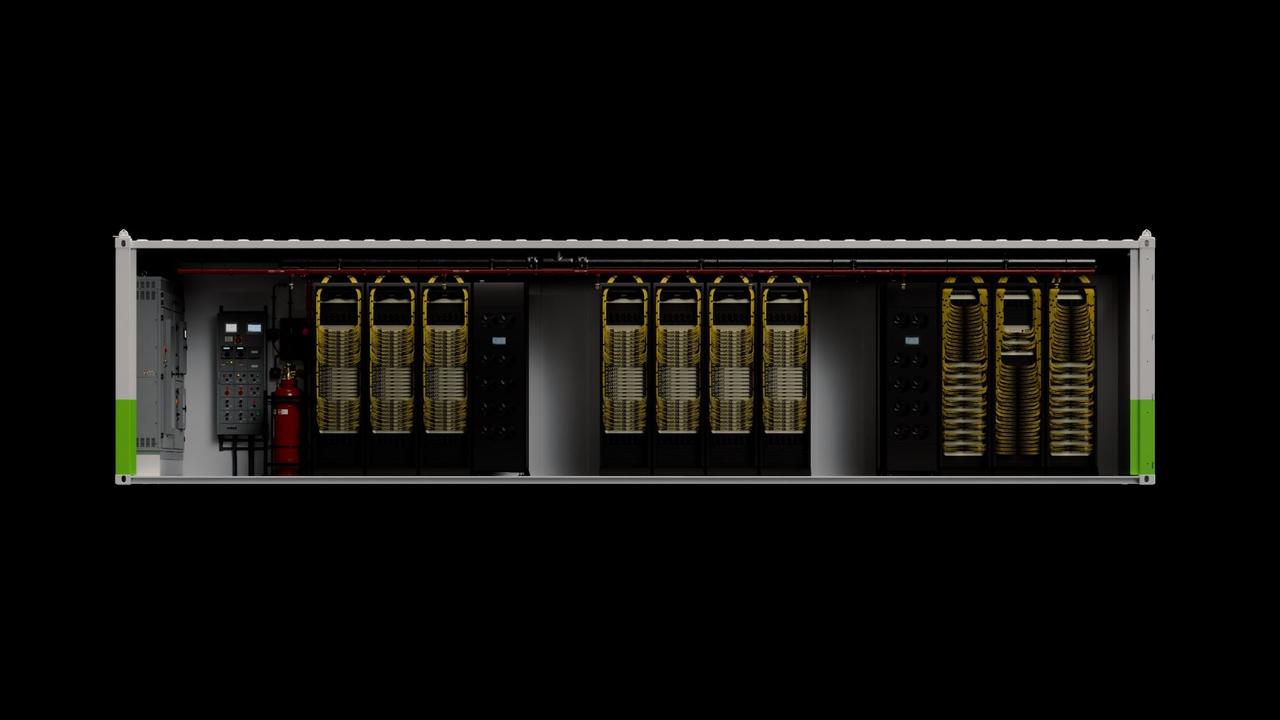
Source: NVIDIA
Vera Rubin NVL72 Racks Power the Plug and Play System
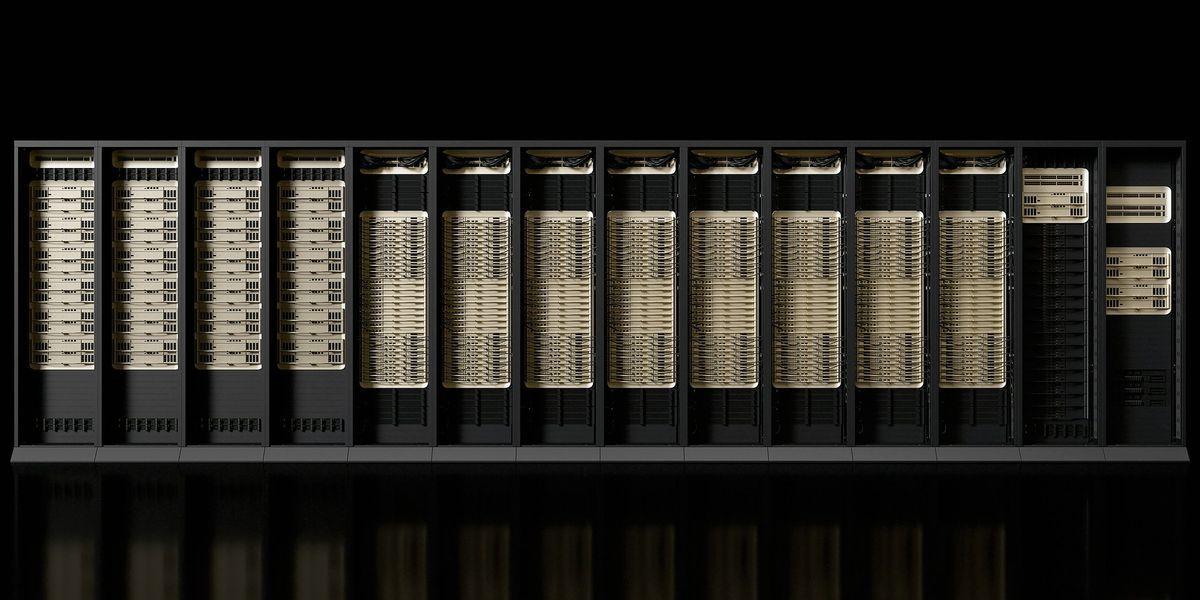
Inside each 28 metric ton container sit seven Vera Rubin NVL72 racks packing 504 GPUs and 252 Vera CPUs, connected through approximately 17 kilometers of Spectrum-X cabling
1
3
. While Nvidia did not disclose pricing, analysts estimate a single Vera Rubin rack can cost more than $7 million2
5
. The plug and play Vera Rubin racks arrive with all cabling and liquid cooling assembled at the factory, designed to be transported by truck on normal roads2
. "The only thing that has to happen when it gets to the site is it's placed in its location, connected to the rest of the other containers, and validated through final burning and testing," explained Nvidia VP of hyperscale computing Ian Buck2
. Nvidia validates every fitting, cable, and component before the pod leaves the factory, catching potential issues before customers hook everything up1
.Rapid Deployment of AI Infrastructure Targets Revenue Generation
Jensen Huang emphasized that faster AI data center deployment directly impacts revenue potential. "An AI factory creates value when it starts producing tokens -- not when construction is complete," the Nvidia CEO stated
4
5
. Huang told the Berlin audience that slow datacenter start-ups can eat up revenue worth billions5
. The 14-day deployment timeline allows operators to start training models and running production workloads earlier, potentially bringing forward opportunities to generate revenue3
. Factory-tested containers reduce exposure to component delays and costly, error-prone onsite work, creating a shorter path to model training and production inference4
. However, the rapid deployment estimate depends on site readiness, meaning power availability, cooling capacity, networking and other supporting systems must already be prepared3
.Related Stories
Global Manufacturing Partners to Deliver Modular AI Factories
Nvidia is working with a global ecosystem including HPE, Dell Technologies, Lenovo, Foxconn, Schneider Electric, and Vertiv to manufacture and deliver DSX POD systems worldwide
2
3
. The modular design is entirely customizable, allowing customers to choose preferred partners for different components1
. Additional partners include Anduril, Armada, Bull, Crusoe, DayOne, Delta, Eaton, GIGABYTE, Pegatron, Quanta Cloud Technology, and Wistron4
. Deliveries are expected to begin in early 20272
4
. The announcement comes as neocloud stocks experienced volatility, with CoreWeave stock closing 10% lower and Nebius stock losing 7% during the conference5
. Nvidia owns close to 10% of CoreWeave, which carries more than $40 billion in debt, though Huang pushed back on financial concerns5
.Energy Efficiency Claims Target Water and Power Consumption
Nvidia unveiled new DSX specifications for waterless datacenters alongside the DSX POD announcement, using closed-loop liquid cooling and dry coolers rather than water-thirsty cooling towers
1
. The company claims a deployment operating at 2GW could save 54 million liters of water daily compared with conventional systems relying on cooling towers3
. Nvidia's DSX MaxLPS technology can reportedly deliver equivalent token output using 30% less power through dynamic allocation within an AI facility's available electricity budget3
. Another component, DSX Flex, adjusts datacenter power consumption in response to electricity prices, grid conditions and utility requirements3
. These efficiency gains still require independent verification under real-world operating conditions, and extreme temperatures may require additional mechanical cooling that could reduce water savings3
. The effort builds on work announced at the AI Infra Summit earlier this year, when Nvidia outlined plans to squeeze more performance from less power while allowing datacenters to adjust workloads based on changing grid conditions1
.References
Summarized by

Navi
Related Stories
Nvidia DSX Platform Drives 40% Energy Efficiency Gains as Power Becomes AI Infrastructure's Biggest Constraint
16 Sept 2026•Technology
NVIDIA DSX Enables European AI Factories to Slash Water Use and Cut Power Consumption by 30%
21 Oct 2026•Technology

Nvidia Unveils Omniverse DSX Blueprint for Gigawatt-Scale AI Data Centers
29 Oct 2025•Technology
Recent Highlights



Recent Highlights
Today's Top Stories









Don’t drown in AI news. We cut through the noise - filtering, ranking and summarizing the most important AI news, breakthroughs and research daily. Follow topics that matter to you and stay ahead.


